
QUESTIONNAIRES & INTERVIEWS

SPECIFICATION: Self-report techniques. Questionnaires, interviews, structured and unstructured.
QUESTIONNAIRES AND INTERVIEWS ARE MEASURING TOOLS, NOT A SPECIFIC RESEARCH METHOD
A persistent source of confusion in research methods is the assumption that a questionnaire or an interview is a research method in its own right. It is not. Both are instruments for collecting data. The method is determined by what the researcher does with that data. If the researcher simply gathers responses from a group, it is a survey. If they compare groups or conditions, it is an experiment or a quasi-experiment. If they examine a relationship between variables, it is a correlation. If they build a detailed account of one person or a small group, it is a case study. The same questionnaire or interview can therefore be used across entirely different research designs.
The exception is the survey. In a survey, the questionnaire or interview is central because the purpose is simply to gather responses from a sample or population. There is no manipulation of an independent variable, no comparison between conditions, and no attempt to test a relationship between variables. Once those elements are introduced, the study is no longer a survey, even if it still uses a questionnaire or interview. For example, the Eating Attitudes Test can be used in several different ways. If it is given to all secondary school-aged female students in South East London to establish how many report disordered eating attitudes, this is a questionnaire survey. The aim is to collect responses from a defined population. If the same Eating Attitudes Test is given to patients before and after treatment, the questionnaire is not functioning as a survey tool but as a measure of the dependent variable. The researcher is assessing whether scores change across two conditions, pre-treatment and post-treatment. This is a repeated measures design.
If the test is used to compare people with anorexia and people with bulimia, the questionnaire is being used to compare naturally occurring groups. This is a quasi-experimental design. If EAT scores are examined alongside another measured variable, such as duration of illness, and the researcher is testing whether there is an association between them, the questionnaire provides one variable within a correlational study. If the EAT is used within a detailed investigation of a single patient or a small clinical group, it forms part of a case study. In this context, the questionnaire is one source of data among others, such as interviews, observations, or clinical records, contributing to a broader account rather than standing alone. The same principle applies to interviews. They are simply another way of collecting data. What matters is not the interview itself, but how the data from it is used within the design. The key point remains constant. Questionnaires and interviews do not define the method. Their role depends entirely on how the data they produce is used.
WHAT TO CHOOSE: INTERVIEWS VERSUS QUESTIONNAIRE SURVEYS
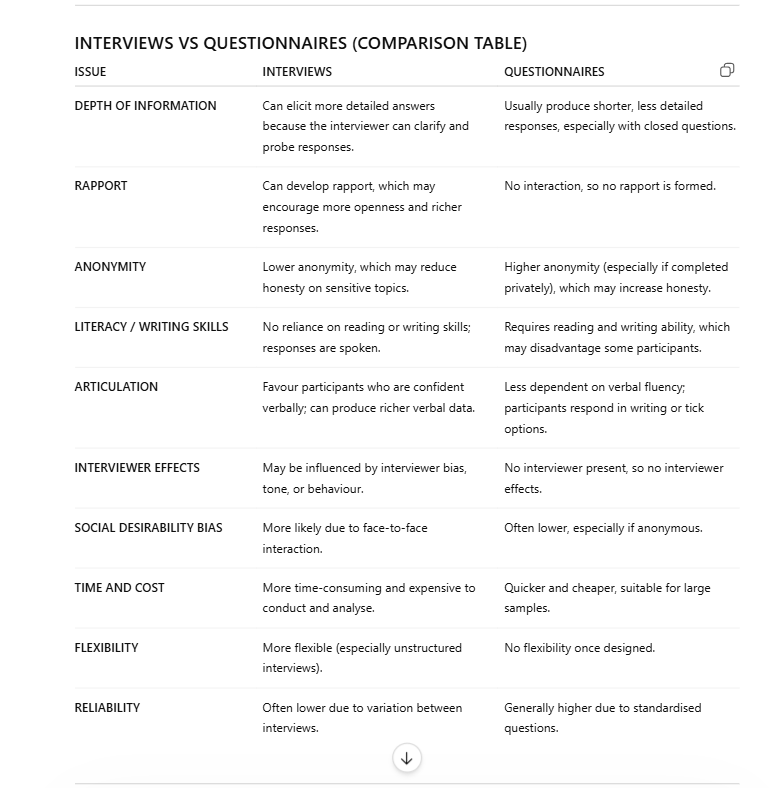
INTERVIEWS IN PSYCHOLOGICAL RESEARCH
“Conducting interviews is a complex, labour-intensive and uncertain business, fraught with tricky issues that psychologists are often ill-equipped to address (Bannister et al., 1995).” Despite these difficulties, the interview is a common way of conducting research; it may form the basis of a case study or be used to measure the dependent variable. It can also be used to collect data similar to questionnaire surveys. “
An interview is a qualitative method in which data are generated through direct verbal interaction between the researcher and the participant. Its purpose is to access subjective accounts such as beliefs, experiences, meanings, and interpretations, rather than to produce fixed, pre-coded responses. For this reason, interviews are not genuinely compatible with closed questions. Closed responses restrict participants to predetermined options, removing the possibility of elaboration, clarification, or reinterpretation. Once responses are reduced to fixed categories, the method is no longer functioning as an interview in any meaningful sense, but as a verbally administered questionnaire. The defining feature of an interview is flexibility. The researcher can probe, follow up, and adjust the direction of questioning in response to what the participant says. This allows for the generation of richer, more nuanced data that reflects how individuals understand and articulate their own experiences, rather than forcing those experiences into predefined response formats
STRUCTURED INTERVIEWS IN PSYCHOLOGICAL RESEARCH
KEY FEATURES STRUCTURED INTERVIEWS
A structured interview is a research method in which the interviewer asks a fixed set of predetermined (pre-fixed) questions in the same order to every participant, and the participant provides spoken responses. The key feature is that the questions are standardised and identical for all participants, with no deviation in wording, order, or content. This ensures the procedure is controlled and consistent across the sample. The purpose of this structure is to ensure high reliability, so that any differences in responses are due to differences between participants, not differences in how the interview was conducted. Because the questions are fixed, responses can often be coded or converted into numerical data, allowing for comparison and analysis. Structured interviews are used when researchers want consistent data collection across participants under identical conditions, often to enable statistical comparison of results.
Pre-set questions: All questions are decided before the interview begins.
Fixed order: Every participant is asked the same questions in the same sequence.
Closed-ended format: Responses are limited (e.g. yes/no, multiple choice, rating scales).
Standardisation: Ensures consistency across all interviews.
Quantitative data: Answers can be converted into numerical data for statistical analysis.
ADVANTAGES OF STRUCTURED INTERVIEWS
They produce high reliability because all participants receive the same questions in the same order.
They allow for direct comparison between participants due to standardisation.
They can reduce ambiguity in data collection by clearly defining and fixing questions.
They are suitable for studies where results need to be coded or quantified.
DISADVANTAGES OF STRUCTURED INTERVIEWS
They have low flexibility, as the interviewer cannot deviate from the set questions or explore responses further.
They may reduce the depth of information because responses are constrained by fixed questions.
They can still be affected by interviewer bias, depending on delivery.
They are more time-consuming and therefore costly than questionnaires because they require direct administration.
USES OF STRUCTURED INTERVIEWS
Structured interviews are used where the researcher needs direct, controlled access to a participant’s responses and cannot rely on independent completion of a questionnaire.
They are used in diagnosing mental illness, where symptoms must be assessed systematically, clarified, and checked in real time to ensure accuracy and consistency.
They are used with participants who cannot complete questionnaires independently, such as young children, individuals with low literacy, cognitive impairment, or language difficulties. The interviewer ensures the questions are understood and completed properly.
They are used in sensitive or high-risk topics where responses may be avoided, misunderstood, or minimised on a questionnaire. The interviewer can probe, clarify, and ensure the question is answered as intended.
They are used where misinterpretation would invalidate the data, for example, when questions are complex or require explanation. The interviewer standardises delivery and prevents variation in understanding.
They are used in cross-cultural research, where language, meaning, and context may need to be controlled to ensure that all participants are responding to the same construct.
They are used in controlled research settings where the researcher must ensure that all participants receive identical instructions and respond under the same conditions.
They are used where completion rates matter, as the presence of an interviewer reduces missing data and increases compliance compared to self administered questionnaires.
The defining feature is control. Structured interviews are used when the researcher cannot risk variation in interpretation, completion, or response quality.
UNSTRUCTURED INTERVIEWS
An unstructured interview is a research method where there are no pre-set questions and no planned questioning schedule. The interviewer may have a general theme or topic, but does not prepare specific questions in advance. The participant is encouraged to speak freely, and the interviewer listens and responds naturally, following the participant's lead. Any questions that arise are spontaneous and unplanned, meaning each interview develops in a completely different direction depending on the participant’s responses. The aim is to gather detailed, in-depth accounts of a person’s experiences and meanings in their own words, without restricting them to fixed questions or categories.
ADVANTAGES OF UNSTRUCTURED INTERVIEWS
They produce high validity, because participants are free to express their thoughts and experiences in depth and without restriction.
They are highly flexible, allowing the interview to develop naturally based on what the participant says.
They are useful for gaining insight into complex or sensitive topics, where structured questioning may limit expression.
They generate rich qualitative data, providing a detailed understanding of individual experiences.
They avoid forcing responses into pre-defined questions or categories, allowing the participant’s perspective to shape the data..
DISADVANTAGES OF UNSTRUCTURED INTERVIEWS
They have very low reliability, because no two interviews follow the same questions or structure.
They are difficult to replicate, since the process is not standardised.
They are time-consuming and costly, due to lengthy interviews and complex qualitative analysis.
They can be affected by interviewer bias, since the interviewer has full control over how the conversation develops.
Because unstructured interviews lack a fixed structure, participants may sometimes struggle to speak in a focused way or fail to provide information relevant to the research aim. This means the collected data may be less useful or less directly relevant, as some responses may be vague, unfocused, or not meaningfully address the topic.
USES OF UNSTRUCTURED INTERVIEWS
Unstructured interviews are used in:
Exploratory research where little is known about a topic
Studies aiming to develop new ideas or theories
Research into complex experiences (e.g. identity, emotions, trauma)
Sensitive topics where participants need full freedom to respond
Qualitative studies focused on meaning rather than measurement
SEMI-STRUCTURED INTERVIEW IN PSYCHOLOGICAL RESEARCH
A semi-structured interview is a research method in which the interviewer uses a set of predetermined questions (often based on key themes) while also having the freedom to ask follow-up questions depending on the participant’s responses. This means the interview has a basic structure but is not rigid, allowing the conversation to develop more flexibly. It is often seen as a middle approach between structured and unstructured interviews, combining standardisation with openness. The prepared questions ensure that core topics are covered across all participants, while the flexibility allows the interviewer to explore interesting or unexpected answers in more depth. This balance means semi-structured interviews can reduce some of the limitations of both structured and unstructured methods: they maintain enough structure to allow comparison across participants, while still allowing depth, clarification, and exploration of meaning.
ADVANTAGES OF SEMI-STRUCTURED INTERVIEW
Semi-structured interviews can produce rich, detailed qualitative data because the interviewer can follow up on responses and explore them in depth.
They maintain a degree of reliability, since all participants are asked a core set of standardised questions.
They also improve validity, because participants are not restricted to fixed answers and can explain their experiences in their own words.
The ability to ask probing questions allows the researcher to clarify meaning, reduce misunderstandings, and gain deeper insight.
They can help balance structure and flexibility, making them suitable for complex topics that require both comparison and depth.
DISADVANTAGES OF SEMI-STRUCTURED INTERVIEW
They are still less reliable than structured interviews, because follow-up questions can vary between participants.
They can be time-consuming and costly, due to longer interviews and more complex qualitative analysis.
They may still be affected by interviewer bias, since the interviewer decides which responses to explore further.
They are also more difficult to replicate exactly, because not all interviews follow the same conversational path.
SEMI- STRUCTURED INTERVIEW EXAMPLES
Semi-structured interviews use a set of pre-planned questions, but allow flexibility in how questions are asked, followed up, or explored. They are used where consistency is needed, but depth and clarification are also important.
In clinical psychology, semi-structured interviews are used during assessment, where clinicians follow a standard set of topics but probe further depending on the patient’s responses. This allows symptoms to be explored in detail rather than reduced to fixed categories.
In developmental psychology, researchers may interview children using a guiding set of questions, but adapt wording, ask follow-up questions, or clarify meaning depending on the child’s understanding.
In social psychology, semi-structured interviews are used to explore attitudes or experiences in more depth than a questionnaire allows, while still maintaining some consistency across participants.
In qualitative research, semi-structured interviews are widely used to investigate personal experiences, beliefs, or interpretations, where the researcher needs both direction and flexibility
CLINICAL INTERVIEW IN PSYCHOLOGICAL RESEARCH
Clinical interviews are structured or semi-structured interviews used in clinical practice to assess and diagnose mental disorders, such as depression, schizophrenia, anxiety disorders, and eating disorders. In modern psychology and psychiatry, they are often tightly structured or based on standardised diagnostic schedules, meaning clinicians follow a set framework of questions linked to diagnostic criteria (e.g. DSM or ICD systems). This ensures that symptoms are assessed consistently across patients. However, within this structure, clinicians may still ask clarifying or follow-up questions to ensure an accurate understanding of symptoms and their severity. The goal is not free conversation, but systematic assessment of diagnostic criteria. Earlier approaches (e.g. Freud’s psychoanalysis or Piaget’s clinical method) were more informal and flexible, but modern clinical interviews used for diagnosis are much more standardised and reliability-focused.
QUESTIONNAIRES IN PSYCHOLOGICAL RESEARCH
Questionnaires are a common method of data collection in psychological research. They consist of a set of written questions designed to gather information from participants in a structured and systematic way. Because the same questions are presented to all participants, questionnaires allow researchers to collect data efficiently from large numbers of people. A questionnaire survey is a research method in which participants complete a questionnaire as the sole source of data. The aim is to gather responses from a sample or population in order to identify patterns, attitudes, behaviours, or experiences.
Questionnaires are not limited to numerical data. Many use closed questions with fixed response options, which produce quantitative data that can be easily compared and analysed. However, questionnaires can also include open-ended questions, where participants respond in their own words. These generate qualitative data, providing more detailed and nuanced insights into how individuals think, feel, and interpret their experiences. Questionnaires can be administered in different ways. They may be completed on paper, distributed in person or through printed media, or delivered electronically via email or online platforms. They can also be completed in the presence of a researcher or independently.
The defining feature of questionnaire surveys is not the format of the data, but the use of a questionnaire as the primary method for collecting responses from a group.
STRUCTURED QUESTIONNAIRES
A structured questionnaire is a set of pre-written questions presented in a fixed order, with standardised wording and predetermined response options. All participants receive the same questions in the same format, and their responses are typically limited to closed-ended options such as yes/no, multiple-choice, or rating scales. This standardisation ensures that the data collected are consistent and directly comparable across participants. Structured questionnaires are commonly used where the aim is to collect quantifiable data from large samples and identify patterns or trends.
ADVANTAGES OF STRUCTURED QUESTIONNAIRES
Structured questionnaires produce data that are easy to quantify, analyse, and compare across individuals. Because all participants respond to the same questions in the same way, the method is reliable and can be replicated.
They are efficient. Large amounts of data can be collected quickly and at relatively low cost, particularly when distributed online or to groups.
They reduce researcher bias. The fixed wording and format limit the researcher's influence on participants’ responses.
They allow for anonymity, which can increase honesty, particularly when dealing with sensitive topics.
They are practical for large-scale research, where consistency and standardisation are essential.
DISADVANTAGES OF STRUCTURED QUESTIONNAIRES
Structured questionnaires lack depth. Fixed response options limit what participants can say and may fail to capture the complexity of their thoughts or experiences.
They assume that all participants interpret questions in the same way, which may not be the case. Misunderstandings cannot be clarified.
They can produce superficial data. Responses may reflect the available options rather than the participant’s true views.
They are inflexible. The researcher cannot probe, follow up, or explore unexpected responses.
They are vulnerable to response biases, such as social desirability or acquiescence, where participants may select answers that appear acceptable rather than accurate
STRUCTURED QUESTIONNAIRE EXAMPLES
Social Readjustment Rating Scale – A fixed list of life events with standardised stress scores. The same questions are asked in the same order, allowing comparison across individuals.
Daily Hassles Scale – Participants respond to a predetermined set of everyday stressors, typically using fixed response options.
Eating Attitudes Test – A structured screening tool for disordered eating, using standardised questions and response categories.
UK Census – A large-scale, structured data collection using identical questions for all participants. When conducted face-to-face, it follows a fully structured interview format.
These examples all rely on preset questions, fixed wording, and standardised responses, ensuring consistency and allowing quantitative comparison
WELL-KNOWN STRUCTURED QUESTIONNAIRES IN PSYCHOLOGY
Generalised Anxiety Disorder scale (GAD-7)
Beck Anxiety Inventory (BAI)
Eating Attitudes Test (EAT)
Body Shape Questionnaire (BSQ)
Social Readjustment Rating Scale (SRRS)
Daily Hassles Scale
Hare’s Psychopathy Checklist (PCL-R)
Minnesota Multiphasic Personality Inventory (MMPI)
Beck Depression Inventory (BDI)
Patient Health Questionnaire (PHQ-9)
Hospital Anxiety and Depression Scale (HADS)
Yale-Brown Obsessive Compulsive Scale (Y-BOCS)
Fear Survey Schedule (FSS)
Social Phobia Inventory (SPIN)
Alcohol Use Disorders Identification Test (AUDIT)
Drug Abuse Screening Test (DAST)
UNSTRUCTURED INTERVIEWS
Unstructured interviews use open-ended questions and do not follow a fixed schedule. The researcher begins with a broad topic and allows the participant to direct the discussion. Responses are not restricted, so the generated data are qualitative rather than numerical.
This approach is associated with a phenomenological perspective, focusing on how individuals experience and interpret events from their own point of view. It is idiographic in nature, aiming to understand the particular rather than produce general laws. As a result, unstructured interviews are often used in exploratory or new areas of research where little is known, and the aim is to generate insight rather than test hypotheses.
They are commonly used in case studies, clinical contexts, and research into complex or sensitive experiences such as trauma, identity, mental illness, or life transitions, where structured methods would restrict what can be said.
ADVANTAGES OF UNSTRUCTURED INTERVIEWS
They produce rich, detailed qualitative data that capture meaning, context, and personal experience.
They allow participants to express themselves freely, increasing validity.
They are useful in new or under-researched areas because they allow unexpected themes to emerge.
They align with idiographic and phenomenological approaches, focusing on individual experience.
DISADVANTAGES OF UNSTRUCTURED INTERVIEWS
They lack standardisation, so reliability is low, and replication is difficult.
They are vulnerable to interviewer bias, as the researcher influences the direction and tone of the interview.
They are time-consuming to conduct and analyse.
They produce data that are difficult to compare across participants and cannot be easily quantified.
They have limited generalisability due to small samples and unique responses.
SEMI-STRUCTURED INTERVIEWS AS AO3
Semi-structured interviews combine open-ended questions with a planned structure. The researcher has a set of key questions and can probe, clarify, and follow up as needed. This improves comparability across participants while still allowing qualitative depth. They offer higher validity than structured interviews because responses are not restricted, but greater reliability than unstructured interviews because there is some consistency in questioning. However, they still rely on the researcher’s judgement, so interviewer bias remains a concern, and the data can still be complex and time-consuming to analyse.
SURVEYS IN PSYCHOLOGICAL RESEARCH
A survey is a research method that systematically gathers data from many people. Surveys are carried out on carefully selected, representative samples so that findings can be generalised to the wider population. The defining feature of a survey is that it collects responses, not tests relationships between variables or compares conditions. Surveys allow researchers to ask participants about attitudes, behaviours, experiences, or intentions in a standardised way. Questionnaires can be administered in several ways. They may be distributed as printed forms, for example, handed out in person, placed in drop boxes, or embedded in newspapers where participants complete them manually. They may be sent electronically by email or hosted online. They can also be completed in the presence of the researcher, for example in a classroom or controlled setting
ADVANTAGES OF QUESTIONNAIRE-SURVEYS
Questionnaire surveys can be quick, cheap, and easy to analyse if they are online, anonymous, and require no researcher intervention. Other types of questionnaire surveys are more problematic, e.g., those that need personal data or require qualitative analysis.
Lots of people can be tested quickly
Data can often be analysed easily
Some participants might find it easier to express their feelings on paper, e.g., they are not articulate or embarrassed to talk about personal life events.
Questionnaire surveys can gather vast amounts of data, allowing more reliable generalisation to the overall population.
DISADVANTAGES OF QUESTIONNAIRES-SURVEYS
If the wording of the questions is unclear, then this will affect internal validity, e.g., the answers will be invalid. This may occur because the researcher has used jargon or did not anticipate literacy issues with some participants.
Leading questions may also influence responses given, for example, it is clear what is being encouraged with the following question: “ Do you think spending money on education is a good thing?
Researcher effects: If the researcher administers the questionnaire, participants may be affected by the researcher's appearance, e.g., investigator effects such as gender, ethnicity, religion, class, occupation, accent, etc. Even body language, such as nods and smiles, can influence responses or create demand characteristics and social desirability bias.
Researcher bias: Researcher bias may arise when analysing qualitative data.
Low response rate: less than 30% of people respond to questionnaire surveys. Lots of questionnaires will not be returned!
Questionnaire surveys are not empirical; they do not show cause and effect. They are great for preliminary research or for situations where experiments would be unethical or impossible.
People may tell fibs. Even in anonymous questionnaires,, this may be an issue. Again, lie questions may be included, e.g., in Eysenck’s Personality Questionnaire (EPQ).
DESIGNING QUESTIONNAIRE & SURVEYS
One of the biggest problems with designing questionnaire surveys is the wording of the questions. Firstly, there is the issue of ‘open’ or ‘closed’ questions. Open questions and closed questions collect quantitative data (see data handling and analysis if you are unfamiliar with these concepts).
Below is an example of a closed question using quantitative data.
Q. Why did you start vaping? Please circle any reason below that caused you to start smoking:
PEER-PRESSURE STRESS COPIED-SOMEONE-YOU-ADMIRED BOREDOM TO-LOSE-WEIGHTTO-LOOK-COOL OTHER
An open-ended question is a question that cannot be answered with a "yes" or "no" response or with a static response. Open-ended questions are phrased as statements that require a longer personalised response.
FOR EXAMPLE:
Q) Why did you start vaping?
A)________________________________________________________________________________________________________
Leading questions are phrased to subtly direct the participant towards a particular answer. Unlike neutral questions, they imply what the “expected” or “acceptable” response might be
EXAMPLES OF LEADING QUESTIONS
‘Don’t you agree that school uniforms improve behaviour?’
‘You support stricter laws on crime, don’t you?’
‘Isn’t it better for children to be raised in a stable home?’
‘Do you agree that this effective method should be used more widely?’
‘Wouldn’t you say the new policy has been a success?’
‘You found the task straightforward, didn’t you?’
‘Do you think responsible people should recycle more?’
‘Isn’t it important that people exercise regularly?
Rather extreme examples, admittedly, real surveys carried out by experienced pollsters would be far more subtle, but you get the idea! t is always a good idea to test your questionnaire in a pilot study first to ensure it doesn’t take hours to complete and that participants understand the questions. Feedback like this may suggest follow-up questions for the real study.
OTHER DESIGN ISSUES IN QUESTIONNAIRE SURVEYS
OPEN OR CLOSED QUESTIONS, e.g., quantitative or qualitative data?: See above for examples.
QUESTION ORDER: For example, questions about demographic data (such as age, address, etc) come 1st and sensitive questions later.
AVOID UNNECESSARY JARGON: Don’t assume your respondents know the multi-store memory model. Use plain English.
AVOID LEADING QUESTIONS: For example, “Was the suspect’s dress green or blue?” See Loftus and eyewitness testimony for more on this and the cognitive interview.
AVOID EMOTIVE QUESTIONS: For example, “ Do you think killing defenceless animals in abattoirs is bad?”
AVOID DOUBLE BARRELL QUESTIONS: For example, “Do you think life is stressful, or was it more stressful five years ago?”
AVOID VALUE JUDGEMENTS: For example, “What is your occupation?” or “How many children do you have?”
AVOID VAGUENESS OR AMBIGUITY: For example, How much do you smoke?: NEVER RARELY SOMETIMES OFTEN. These terms are subjective and need to be replaced with -
How much do you smoke?
0 1-5 6-1011-20 20+
CONDUCT A PILOT STUDY TO ASCERTAIN THE READABILITY OF YOUR QUESTIONNAIRE.