OBSERVATIONS AS A RESEARCH METHOD
Types of observation, specifically the environment in which the observation takes place.: naturalistic observation vs controlled observation
Ways of viewing an observation: disclosed observation vs undisclosed observation
Ways of designing an observation, e.g., the method used to record behaviour: structured observation vs unstructured observation
Ways of participating in an observation: participant observation vs non-participant observation
Observational design techniques: behavioural categories, event sampling, and time sampling
Observations are a vital tool in the psychologist's arsenal and, if done properly, can provide oodles of ecologically valid and detailed information about all manner of behaviours. However, they also have many pitfalls and raise a whole host of methodological and ethical issues. Observations can be subdivided in many ways, each with its own distinct advantages and disadvantages. Please do not get confused over experiments that use observations as a method of assessing participants (e.g., the DV). For example, Bandura’s Bobo Dolls and Piliavin’s work on bystander apathy on the New York subway. These are not observations; they are experiments first and foremost. We all know what questionnaires are and have all filled out lots of them over the years. Basically, a questionnaire is a list of written questions that can gather a lot of relevant information relatively quickly and cheaply.
But when it comes to determining observations from correlations and experiments that use observations, things get trickier. It can be confusing to determine the type of research method used if observations are in the mix. This is because observations are not just used in surveys; they are also used in experiments and correlations. For example, Piliavin’s work on bystander apathy on the New York subway was designed to measure apathy, and raters had to observe how many participants helped a distressed passenger If tally had only been carried out on one set of participants, e.g., it was the only measure taken from participants, then it would indeed be considered an observation. But the results from one train were compared with another train, which had a different IV. Therefore, this study is not an observation; it is an experiment that used observations to gather its data. The criterion for choosing observation over other methods is that, in true observation, participants are doing only one thing, e.g., ALL participants are being watched on one subway train, with no other measures or conditions. This point also applies to interviews and questionnaires.
NATURALISTIC OBSERVATIONS
Natural experiments are easy to explain. People or animals are observed in their natural environment, without any sort of intervention or manipulation of variables and both with and without their knowledge. The researcher observes behaviour in its natural environment as many of the ethologists studying animal behaviour record their information.
EXAMPLES INCLUDE OF NATURALISTIC OBSERVATIONS
Seyfarth & Cheney’s research on the warning calls of the vervet monkey
Sylva’s study of play in young children.
Much of the work carried out by Konrad Lorenz
Ainsworth’s study of attachments in Ugandan women would be a human example of naturalistic observation.
Being sane in insane places by Rosenhan
ADVANTAGES OF NATURALISTIC OBSERVATIONS
Ecological validity: Clearly, this provides data of very high ecological validity, as it has not been tainted by observer intervention, with the observed not usually knowing that their behaviour is being observed.
Reliability: There is a bias issue. For example, if a researcher is examining aggressive acts in a football game and assumes that boys will be more aggressive, the results may be inadvertently interpreted in this way.
Reduced demand characteristics: For the same reason, there should be no demand characteristics. If you’re unaware that you’re being observed, you won’t try to please the researcher.
Ethics is a major problem in many observational studies, especially in naturalistic studies. Not knowing you’re being watched creates issues with privacy, and participants not consenting to take part
Detailed: The information collected tends to be more detailed and provides a fuller picture of behaviour than the sort of information that can be collected in a laboratory. Think of the criticisms of behaviour in the strange situation
DISADVANTAGES OF NATURALISTIC OBSERVATIONS
However, control of the environment is not possible, and confounding variables make it impossible to replicate the observation or control its effects, so the researcher cannot be certain what factors are creating the behaviour being observed
Sometimes this is the only possible way of doing research, especially if people are unwilling or unable to complete questionnaires or interviews
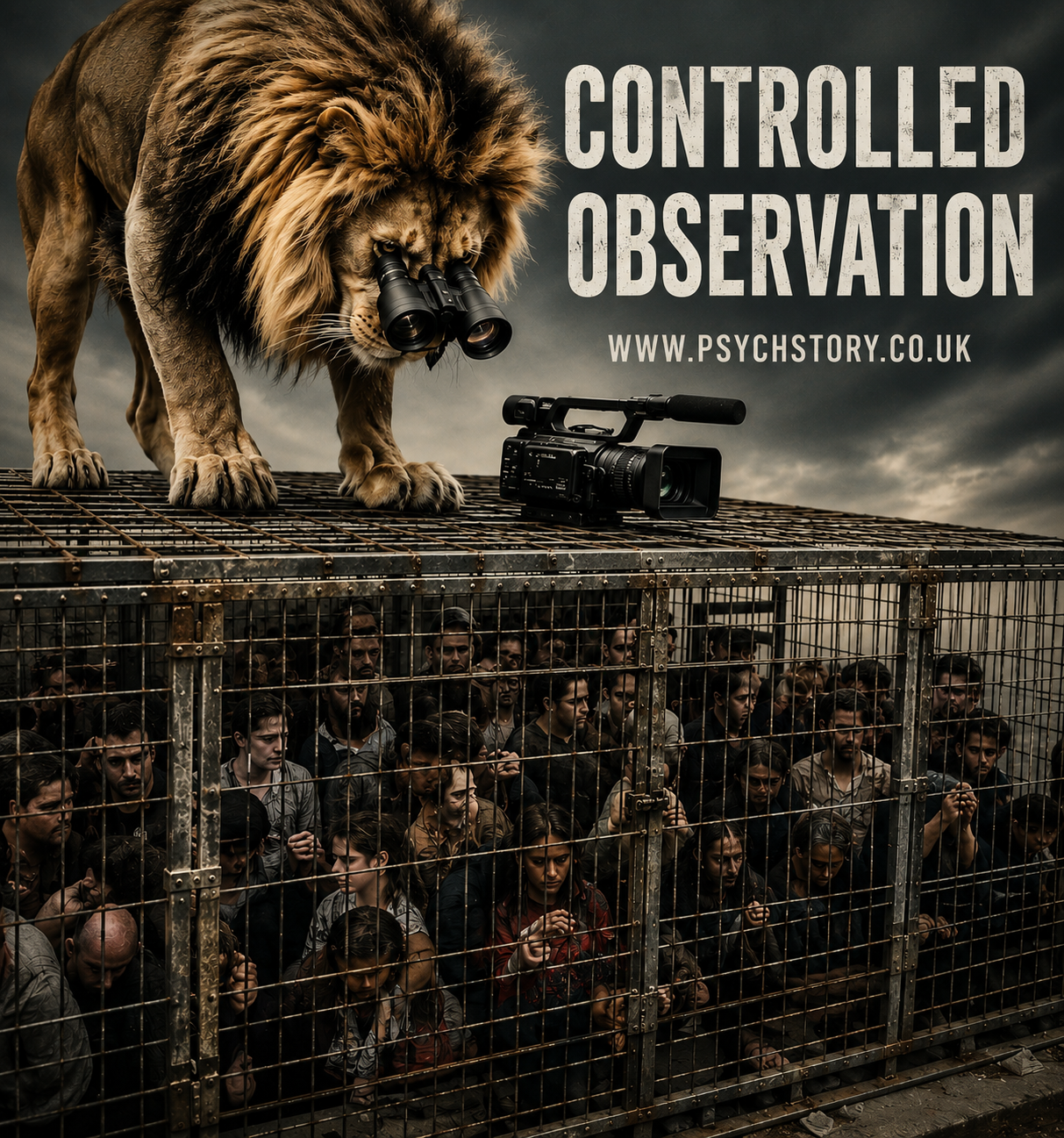
CONTROLLED OBSERVATIONS IN PSYCHOLOGY
Controlled observations are conducted under standardised conditions, typically in a laboratory, where extraneous variables such as noise, timing, temperature, and distractions are carefully regulated. This control reduces interference and allows the researcher to isolate the behaviour of interest. One-way mirrors or observation rooms are often used, and participants are usually aware they are being observed.
EVALUATION OF CONTROLLED OBSERVATIONS: A key strength is reliability. The high level of control allows procedures to be standardised and replicated by other researchers. This includes consistent conditions, potential variable manipulation, and tight control of extraneous influences. However, this comes at the cost of ecological validity. Behaviour observed in artificial settings may not reflect real-world behaviour, limiting generalisability.
STRUCTURED OBSERVATIONS IN PSYCHOLOGY
Structured observations refer to how behaviour is recorded, not where the observation takes place. The researcher uses pre-determined categories and observation schedules to systematically record behaviour. This often involves coding schemes, where specific behaviours are counted or categorised. Ainsworth’s Strange Situation is a classic example in which the behaviour of caregivers and strangers is deliberately organised to observe infant attachment responses.
EVALUATION OF STRUCTURED OBSERVATIONS: Structured observations increase control over confounding variables and make it easier to identify patterns and potential cause-and-effect relationships. They also produce quantitative data, which is easier to analyse statistically. However, ecological validity is often reduced because behaviours are triggered by artificial or staged situations. Participants may also alter their behaviour due to awareness of observation, introducing demand characteristics.
UNSTRUCTURED OBSERVATIONS IN PSYCHOLOGY
Unstructured observations involve recording behaviour in as much detail as possible without predefined categories. The researcher documents all relevant behaviour, often in narrative form. This approach is particularly useful for studying behaviours that are rare or poorly understood, and it is commonly used in naturalistic settings..
APPLICATION SCENARIOS
The playground study is a naturalistic observation because behaviour is observed in a real-world setting without manipulation. If no coding system is used, it is also unstructured, as behaviour is recorded descriptively.
The classroom seating study is a structured observation. The researcher manipulates the environment by changing seating arrangements and systematically observes participation, indicating both control and planned observation.
The social media tracking study is structured. Behaviour is recorded using predefined metrics through an app, even though participants behave in their usual environment. The method of recording is systematic.
The family home camera study is naturalistic because it takes place in a real environment. If behaviour is later coded into categories, it becomes structured. Awareness of cameras may still influence behaviour.
The cafeteria study is structured. The researcher manipulates the environment by introducing new food options and records behaviour systematically before and after the change.
The toddler toy study is controlled and structured. The environment is arranged by the researcher, and behaviour is observed within predefined conditions, often with systematic recording of choices and duration
EVALUATION OF UNSTRUCTURED OBSERVATIONS: A major strength is the depth and richness of data. Detailed descriptions allow for a more comprehensive understanding of behaviour, increasing internal validity by capturing authentic behavioural patterns. However, the lack of standardisation introduces subjectivity. Observer bias is more likely, as researchers decide what is important without fixed criteria. This reduces reliability and makes replication more difficult
ACTIVITIES FOR STRUCTURED AND UNSTRUCTURED OBSERVATIONS
Look at the following scenarios and consider the characteristics of each observation method and the specific context of each study to determine whether they are structured or naturalistic observations.
Scenario: Researchers want to understand how children interact with each other in a playground setting. They go to a local park and observe children playing, taking notes on how often they engage in cooperative versus competitive play.
Question: Is this a structured or naturalistic observation? Explain your choice, considering factors like the level of control over variables and the potential influence of the observer's presence.
:Scenario: A study is conducted to see how different seating arrangements in a classroom affect student participation. The researcher changes the seating arrangement every week and observes student engagement and participation in class discussions.
Question: Is this a structured or naturalistic observation? Justify your answer, considering the manipulation of variables and the potential for observer effects.
Scenario: Researchers are interested in how teenagers use social media daily. They ask a group of teenagers to use their social media as they usually would, but with an app that tracks their usage patterns.
Question: Is this a structured or naturalistic observation? Provide reasons for your choice, considering the extent of the researcher's intervention and its impact on participants' behaviour.
Scenario: With the family's consent, researchers set up cameras in various rooms of a family’s house to understand how siblings interact at home. The researchers then observe and analyse the footage to study the siblings' behaviour.
Question: Is this a structured or naturalistic observation? Explain your decision, considering ethical considerations, control over the research environment, and the potential awareness of being observed by family members.
Scenario: A school wants to see how introducing new healthy food options in the cafeteria affects students' food choices. Researchers record the types of food students select before and after the introduction of these new options.
Question: Is this a structured or naturalistic observation? Justify your response, considering the level of manipulation of cafeteria offerings and potential influences on students' choices.
Scenario: To study toy preferences, toddlers are brought into a room with various types of toys, and researchers observe which toys the children choose to play with and for how long.
Question: Is this a structured or naturalistic observation? Support your answer by considering the level of control over the toy selection environment and the potential impact of observer presence on toddlers' choices.
UNDISCLOSED OR COVERT OBSERVATION
Also known as disclosed v undisclosed observation
Covert (hidden) observation involves observing subjects without their knowledge. In this method, the observer remains hidden or disguises their intent to avoid influencing the behaviour of those being observed. This approach can provide more authentic data since subjects behave naturally, unaware they are being studied.
However, it raises ethical concerns about privacy and consent; on the other hand, it is where subjects are aware they are being observed. This method is more ethically transparent as it respects the subjects' right to know they are part of a study. However, it can lead to changes in behaviour (known as the Hawthorne effect), as subjects might alter their actions because they know they are being watched.
Overt observations, where participants are aware that they are being observed, can still be vulnerable to threats to internal validity. These threats can affect the accuracy and reliability of the collected data. Here are some threats to validity in overt observations: Participants may modify their behaviour to align with what they believe the observer expects or desires. They may try to conform to social norms or the perceived goals of the study, leading to behaviour that does not accurately reflect their natural tendencies.: Participants might present themselves in a more favourable or socially desirable light during overt observations. This bias occurs when individuals alter their behaviour to appear more virtuous, cooperative, or polite rather than behaving authentically. An observer's presence can influence participants' behaviour, especially when overt. Participants may feel self-conscious, become nervous, or change their behaviour because they know they are being watched. This can result in the Hawthorne effect, in which participants behave differently due to awareness of being observed.: Reactivity refers to participants' awareness of being observed, prompting them to change their behaviour, whether by conforming to perceived expectations or rebelling. Reactivity can lead to altered behaviour patterns that do not represent participants' usual actions.: Even in overt observations, observer bias can occur if the observer's expectations, beliefs, or interpretations influence their data collection and analysis. This bias can skew the results if the observer unintentionally records or interprets data in a way that aligns with their preconceived notions.: In overt observations, participants may self-select to participate in the study based on their comfort level with being observed. This self-selection can lead to a biased sample that does not accurately represent the entire population of interest.: The presence of an observer can sometimes influence participants through non-verbal cues, such as facial expressions, body language, or subtle feedback. These cues can inadvertently signal certain behaviours to the participants.
:The Hawthorne effect is a specific type of reactivity. It refers to the phenomenon where individuals change their behaviour or improve their performance because they are aware of being studied or observed. This effect was originally identified in a series of studies at the Western Electric Hawthorne Works in Chicago, where workers' productivity improved when they knew they were being observed, regardless of whether their working conditions were changed. Several specific tactics and tools can be employed for covert observations, specifically tailored to avoid detection by the subjects being observed. These methods are designed to ensure the observer remains unnoticed, allowing the collection of unaltered, natural behaviour data. Here are some techniques: unaltered techniques.
TECHNIQUES FOR COVERT OBSERVATIONS
Hiding: The observer positions themselves in a concealed location to observe the subjects without being seen. This could be behind a one-way mirror, in a hidden room, or camouflaged in the environment. Hiding is particularly useful in controlled environments or natural settings where subjects can be observed without knowledge.
Hidden Cameras and Microphones: Cameras and microphones are placed out of sight or disguised as everyday objects. This is often used in natural settings where direct observation by a researcher might alter the subjects' behaviour.
Participant Observation: The researcher becomes part of the group being studied, observing from within without revealing their true purpose. This method is often used in ethnographic studies.
Unobtrusive Measures: Observing behaviours or outcomes without the participants' knowledge. Examples include analysing discarded trash to study consumption habits or using existing records and data to study patterns without direct interaction.
Online Observation: Observing behaviours in online environments, such as social media, forums, or other digital platforms, where the observer's presence is unknown to the participants.
Surveillance Techniques: Utilising surveillance tools like GPS tracking, website cookies, and other data-gathering technologies that monitor without the subjects' awareness
Disguise: The observer uses a disguise to blend into the environment. This could involve wearing clothing that matches the studied population, using props, or altering one's appearance to avoid recognition. Disguises are especially useful in public settings or situations where the observer needs to move among the subjects. Sunglasses: While more subtle than other methods, sunglasses can conceal the observer's gaze, making it less obvious where they look. This can be helpful in situations where direct eye contact might alert subjects to being observed.
Reflective Surfaces: Using mirrors or other reflective surfaces to observe subjects indirectly. This method allows the observer to watch subjects without directly facing them, reducing the likelihood of being noticed.
Long-Distance Observation Tools: Binoculars or long-range cameras can be used to observe subjects from a distance. This method is beneficial in outdoor or large settings where the observer can maintain a physical distance.
Inconspicuous Note-Taking: Small, discreet devices or methods for recording observations, like a hidden voice recorder or shorthand notes on a smartphone, can be essential for minimising visibility while still capturing data.
Each method minimises the observer's presence and avoids influencing the subjects' behaviour. However, while these techniques can be effective for gathering unaltered observational data, they must be used with careful consideration of ethical guidelines, particularly around privacy and informed consent.
EVALUATING COVERT OBSERVATIONS: An advantage of covert observation is that investigator effects are minimised. Since the investigator is concealed, it is less likely that their behaviour will influence the participants' performance. As a result, there is less chance of demand characteristics occurring. This means the participants’ behaviour will be more natural and representative of their everyday behaviour. The ethical issues associated with the covert observation method are intrinsic to its design. Participants are unaware they are participating in research and can’t give fully informed consent or withdraw from the study. However, observing human behaviour in public places such as shopping centres, parks, and restaurants is perfectly legal.
DISCLOSED OR OVERT OBSERVATION
Participants know they are being observed. This reduces ethical issues of consent and privacy, but reduces validity due to increased demand characteristics. An overt observation is where the observations are not hidden, and the participants know they are being observed, for example, filming publicly (overt non‐participant) or joining a gym and informing the other members that you are doing an observation (overt participant). This method is more ethically transparent as it respects the subjects' right to know they are part of a study. However, it can lead to changes in behaviour (known as the Hawthorne effect), as subjects might alter their actions because they know they are being watched.
EVALUATING OVERT OBSERVATIONS: A strength of the overt method is that it is more ethical than the covert method, as the participants know their behaviour is being observed. it is possible to inform them in advance of the aims and thus obtain informed consent. This awareness of participation also allows participants to exercise their right to withdraw themselves or their data from the investigation before, during or after the observation is conducted. As a result, the reputation of psychological research as being ethical is protected. A drawback of using an overt style of observation is the possibility of investigator effects. A bias can occur when the investigator's actions influence participants' behaviour in unintended ways (e.g., through body language or facial expressions). As a result, participants may change their behaviour in response to demand characteristics and act according to their perception of the research aims. Therefore, authentic and natural behaviour is not being observed, thus reducing the internal validity of the observation because it is overt.
ACTIVITIES ON DISCLOSED OR OVERT OBSERVATION
Here are some scenarios involving animals and babies where students need to decide whether covert or overt observation would be more suitable:
In each scenario, students should weigh the benefits and drawbacks of both observation methods and consider factors such as the potential influence of the observer’s presence on subjects' behaviour, the naturalness of the environment, ethical considerations, and the study's goals. The choice between covert and overt observation often hinges on balancing the need for authentic behaviour against ethical concerns and the practicalities of the research setting.
Scenario: Researchers want to study the social interactions of a group of chimpanzees in a zoo enclosure.
Question: Should this be a covert or overt observation, and why? Consider aspects like the primates' natural behaviour and the potential impact of the observer's presence.
:Scenario: A study aims to understand how children aged 5-7 interact in a playground setting, with a focus on forming friendships.
Question: Would you recommend a covert or overt approach, and what factors influence this decision? Consider an observer's impact on children's behaviour and ethical considerations.
:Scenario: A company wants to assess how different office layouts affect employee productivity and interaction.
Question: Should the observation be covert or overt, and why did you choose? Consider the Hawthorne effect and the ethical implications of monitoring employees without their knowledge.
:Scenario: Sociologists are interested in studying social behaviours and interactions in city centre nightlife environments.
Question: Why is a covert or overt observation method more suitable? Consider the environment's dynamics and the influence of an observer's presence on social behaviour.
Scenario: Researchers are interested in studying smartphone usage in restaurants, particularly among families. They want to understand how smartphone use affects family interactions during meals.
Question: Would you recommend covert or overt observation, and what factors inform your decision? Consider the impact of observer presence on restaurant behaviour and the potential for demand characteristics.
PARTICIPANT OBSERVATION
Here, the researchers get involved with the participants they are observing. It can be either covert (a group member quietly observing others without their knowledge) or overt (a group member using a camera to record the behaviour of other members with their full knowledge). Festinger (1956) joined a cult to observe how they would react when their predicted end-of-the-world deadline came and went. The cult leader reassured his flock that their prayers had saved the planet! This is an example of undisclosed participant observation. Researchers may occasionally join in but make others aware of their role as psychologists.
On occasions, researchers have been able to infiltrate groups and remain members for a period, allowing for detailed, longitudinal information to be gathered, for example, about the behaviour and motivations of street gangs and religious cults. It isn't easy to see how such groups could be studied in any other way.
EVALUATING PARTICIPANT OBSERVATIONS: A strength of using participant observation in psychological research is that the researcher can obtain in-depth data because the observer is near the participants. There are ethical issues with this type of deceitful observation, and the researcher may unwittingly interfere with the group dynamics and behaviour.
NON-PARTICIPANT OBSERVATION
The more likely scenario is that participants are observed from a distance rather than that the researchers infiltrate the group.
ETHICS OF OBSERVATIONS
Observations raise several unique ethical issues. These vary depending on the nature of the observation taking place, but here are a few:
Consent: participants are often unaware of being observed, so they cannot consent to participate in your research.
Debrief: Often, there is no opportunity for a debrief. For example, in Piliavin’s observation of bystander apathy on the New York subway, participants were unaware. They would have left the train before researchers had a chance to debrief.
Deception: Participants' unawareness of observation is itself a form of deception. Researchers may also cause additional deception by using stooges. Again, Piliavin used research team members to pretend to be blind or drunk.
DESIGNING OBSERVATIONS FOR OBSERVATIONS
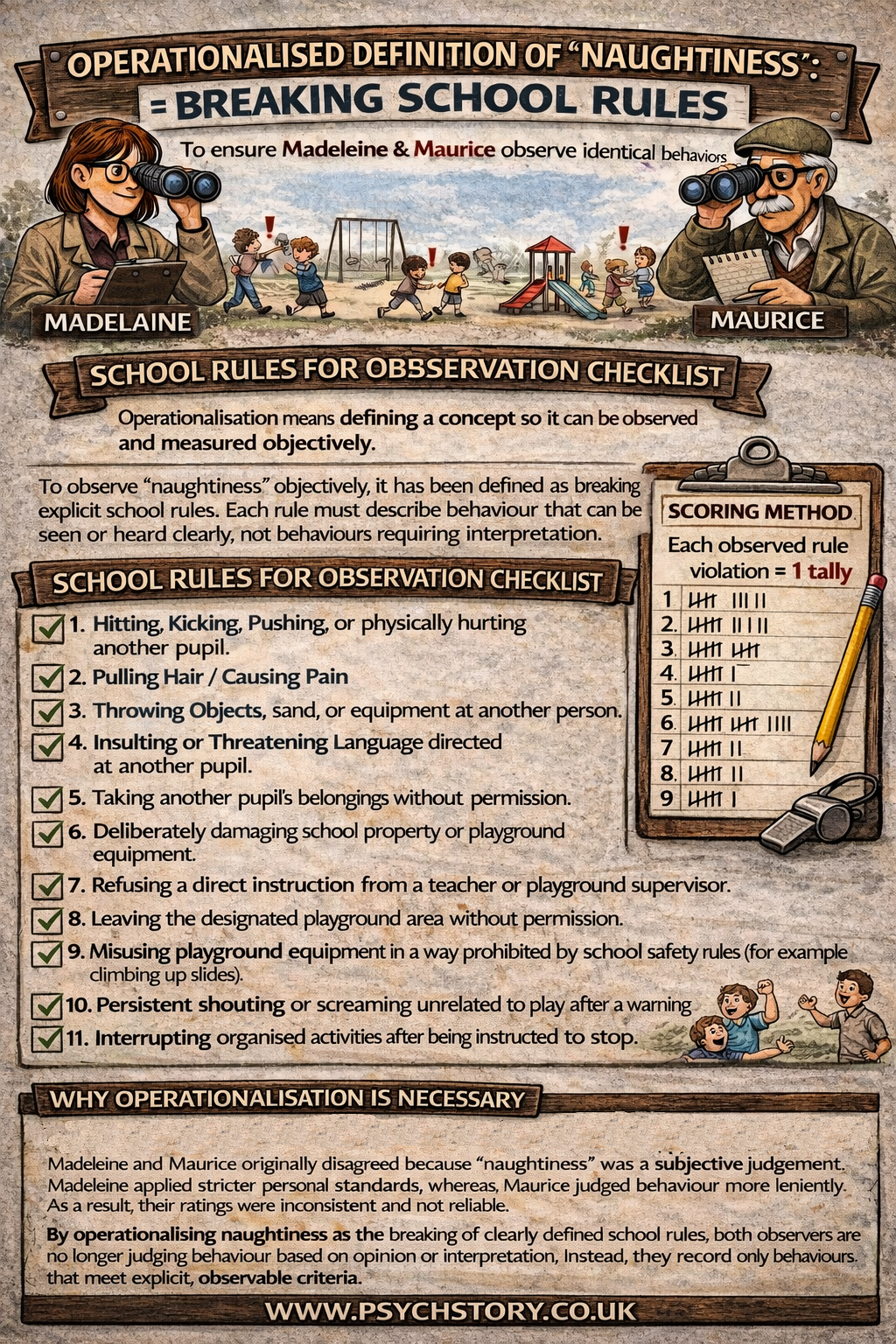
Observational research may appear deceptively simple. At first glance, it seems as though the researcher merely watches behaviour and records what happens. In reality, designing an observation involves a large number of methodological decisions, practical problems, and ethical considerations long before any observation actually begins. Researchers must first decide exactly what behaviour they are interested in studying and, crucially, how that behaviour will be defined. Human behaviour is often messy, complex, subjective, and open to interpretation. Terms such as “aggression,” “attachment,” “anxiety,” “dominance,” or “attention seeking” may sound straightforward in everyday language, but in scientific research, they must be carefully operationalised into specific observable actions. For example, if a researcher claims to be studying aggression in children, what actually counts as aggression? Is shouting aggressive? Is pushing aggressive? What about sarcasm, staring, grabbing toys, or excluding another child socially? Different observers may interpret the same behaviour differently unless the categories are clearly defined beforehand.
Researchers must also decide where the observation will take place. Behaviour observed in a controlled laboratory may differ dramatically from behaviour observed in a natural environment such as a classroom, playground, hospital, shopping centre, or family home. Human beings often behave differently depending on whether they know they are being watched, who is present, and how artificial the environment feels. Another important issue concerns visibility and practicality. Some behaviours occur very rapidly or simultaneously, making them difficult to observe accurately in real time. A nursery classroom, for example, may contain dozens of interactions happening at once. Researchers, therefore, need to think carefully about how observations will be organised and recorded so that important behaviours are not missed.
Observers themselves can also create problems. Human judgment is subjective, and different observers may interpret the same behaviour differently. A behaviour viewed by one observer as playful may be interpreted by another as hostile or aggressive. Researchers must therefore consider how to improve consistency between observers and reduce observer bias. Ethical issues are particularly important in observational research because participants are often observed in real-world settings. Researchers must consider questions of consent, privacy, confidentiality, protection from harm, and deception. For example, should participants always know they are being observed? If participants know they are being watched, their behaviour may become artificial. However, secretly observing people raises serious ethical concerns, particularly in private settings such as homes, hospitals, schools, or online environments.
Researchers must also think carefully about vulnerable groups. Observing children, psychiatric patients, elderly individuals, or people in distress raises additional ethical responsibilities because these participants may not be able to give fully informed consent or may be particularly vulnerable to harm or invasion of privacy. Designing an observation, therefore, involves far more than simply “watching behaviour.” Researchers must make careful decisions about what behaviours will be studied, how they will be defined, where observations will occur, how behaviour will be recorded, how observer bias will be controlled, and how ethical guidelines will be maintained throughout the research process
HOW TO MEASURE OBSERVATIONS
BEHAVIOURAL CHECKLISTS
EVENT SMALING
TIME SAMPLING
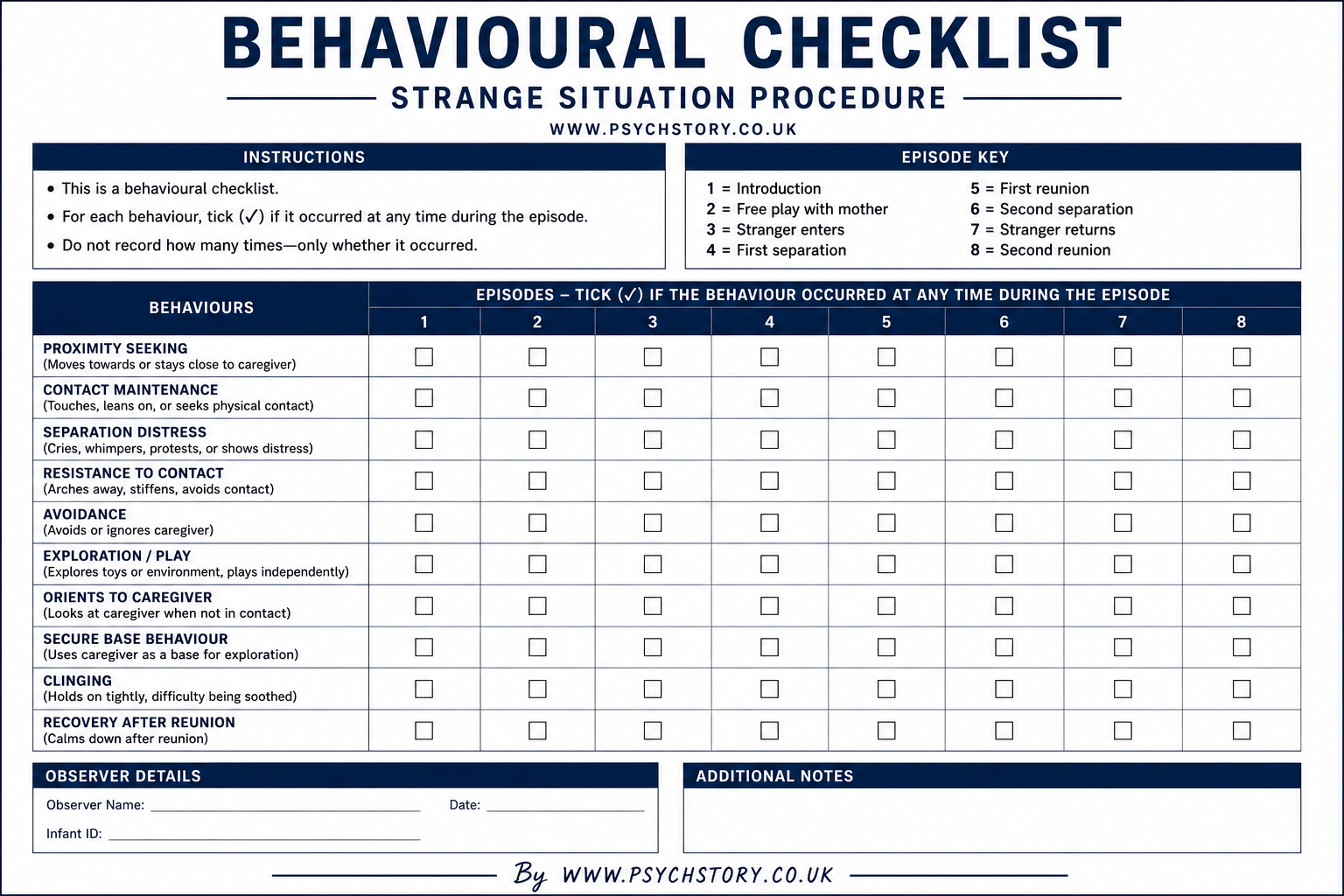
BEHAVIOURAL CHECKLISTS AND CODING SCHEMES
In observational research, psychologists often need a structured way of recording behaviour. Human behaviour is fast-moving, complex, and often difficult to record objectively in real time. Researchers, therefore, frequently use coding schemes, also known as behavioural checklists, to organise observations into clear behavioural categories. A behavioural checklist consists of a list of predefined behaviours that the observer looks for during the observation. Whenever one of the target behaviours occurs, the observer records it, usually by ticking a box, adding a tally, or writing a behavioural code. For example, a researcher observing attachment behaviour in infants may create categories such as:
• proximity seeking
• avoidance
• separation distress
• clinging
• resistance to comfort
• eye contact
• smiling
• crying
Whenever one of these behaviours occurs, the observer records it using the checklist.
The purpose of behavioural checklists is to make observations more objective, systematic, and easier to analyse scientifically. Instead of writing vague descriptions such as “the child seemed upset,” the researcher records specific observable actions that can be counted and compared across participants. Behavioural categories should ideally be mutually exclusive, meaning that each behaviour should fit into only one category at a time. The categories should not overlap. For example, if a participant shouts loudly and pushes another child, the observer should be able to classify the behaviour clearly within the coding system. However, this is often difficult in real observational research because human behaviour is messy and behaviours frequently overlap. A child may simultaneously display anxiety, aggression, avoidance, and attention-seeking behaviour, making it difficult for observers to decide which category is the “correct” one. If categories are unclear or overlapping, different observers may code the same behaviour differently, reducing inter-observer reliability. Researchers must therefore spend considerable time carefully operationalising behavioural categories before the observation begins. Some observations are continuous, meaning the observer attempts to record everything that happens in detail throughout the observation period. Researchers may use written notes, audio recordings, or video recordings to capture behaviour as completely as possible.
However, continuous observation can become extremely difficult in busy or fast-moving environments where many behaviours occur simultaneously. Researchers may therefore use sampling techniques to make the observation more manageable. Two common sampling methods are event sampling and time sampling. Event sampling involves recording a behaviour every time it occurs. Time sampling involves recording behaviour only at predetermined time intervals. Behavioural checklists and coding schemes have several advantages. They are relatively simple to use, allow observations to become more organised and standardised, and produce quantitative data that can be analysed statistically. Researchers can count frequencies of behaviour, compare groups, calculate correlations, or examine patterns across participants. For example, a researcher may calculate how many times children displayed aggressive behaviour during a playground observation or compare attachment behaviours across different attachment types. However, behavioural checklists also have important weaknesses.
One major criticism is that they can produce a highly restricted, reductionist view of behaviour. Human behaviour is often rich, contextual, emotional, and complex, yet coding schemes reduce behaviour into simplified categories and numbers. Researchers may therefore miss important contextual details, meanings, emotions, motivations, or unusual behaviours that fall outside the predefined categories. For example, an observer may record that a child “avoided eye contact,” but the checklist alone may not explain why the child behaved this way. The behaviour could reflect anxiety, embarrassment, fear, shyness, autism, cultural norms, or simple distraction. Behavioural checklists, therefore, increase structure and objectivity, but this often occurs at the cost of depth, richness, and contextual understanding
BEHAVIOURAL CATEGORIES FOR BODY LANGUAGE
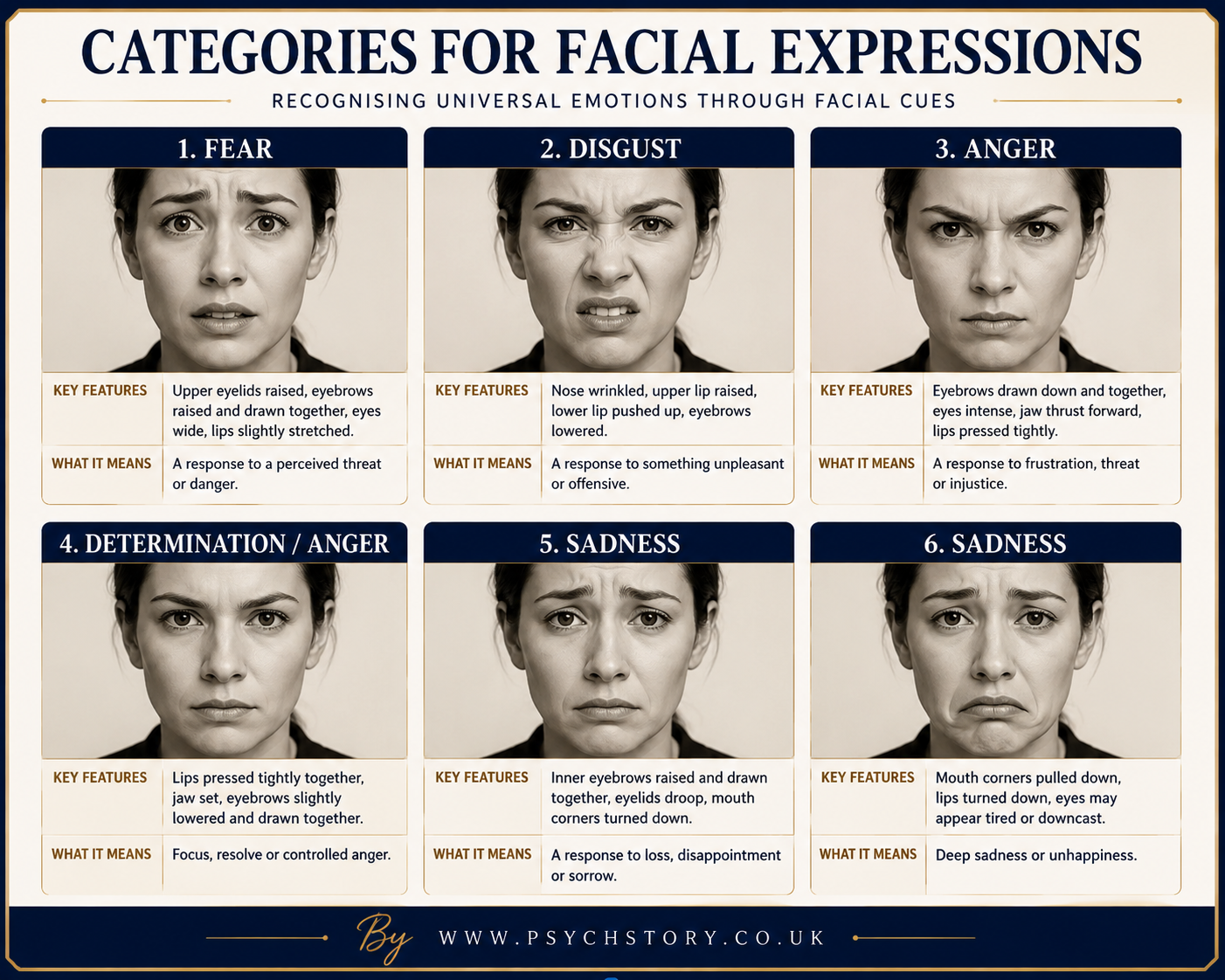

Observational researchers rarely observe behaviour as one vague, general whole. Instead, behaviour is broken down into specific observable categories that can be identified, coded, recorded, counted, or compared systematically. Researchers may therefore construct behavioural categories for:
• facial expressions
• micro expressions
• body language
• posture
• gestures
• eye contact
• interpersonal distance
• tone of voice
• physical appearance
• clothing
• movement patterns
• signs of anxiety or aggression
• social interaction styles
• dominance or submission cues
• emotional displays
• attraction behaviour
• attachment behaviour
• non-verbal communication
For example, a researcher investigating emotion might create behavioural categories for facial expressions such as fear, disgust, sadness, or anger. Another researcher studying deception may focus on micro expressions, gaze aversion, facial tension, or delayed reactions. Similarly, body language can be operationalised into observable categories such as crossed arms, leaning forward, avoiding eye contact, open posture, fidgeting, mirroring behaviour, or defensive positioning. Observational research, therefore, depends heavily on coding behaviour into categories that can actually be observed and recorded objectively. Otherwise, observation becomes vague, subjective, and difficult to replicate scientifically. This is why coding schemes and behavioural categories are such a major part of observational research methodology. They attempt to transform messy human behaviour into organised observational data.
EVENT SAMPLING
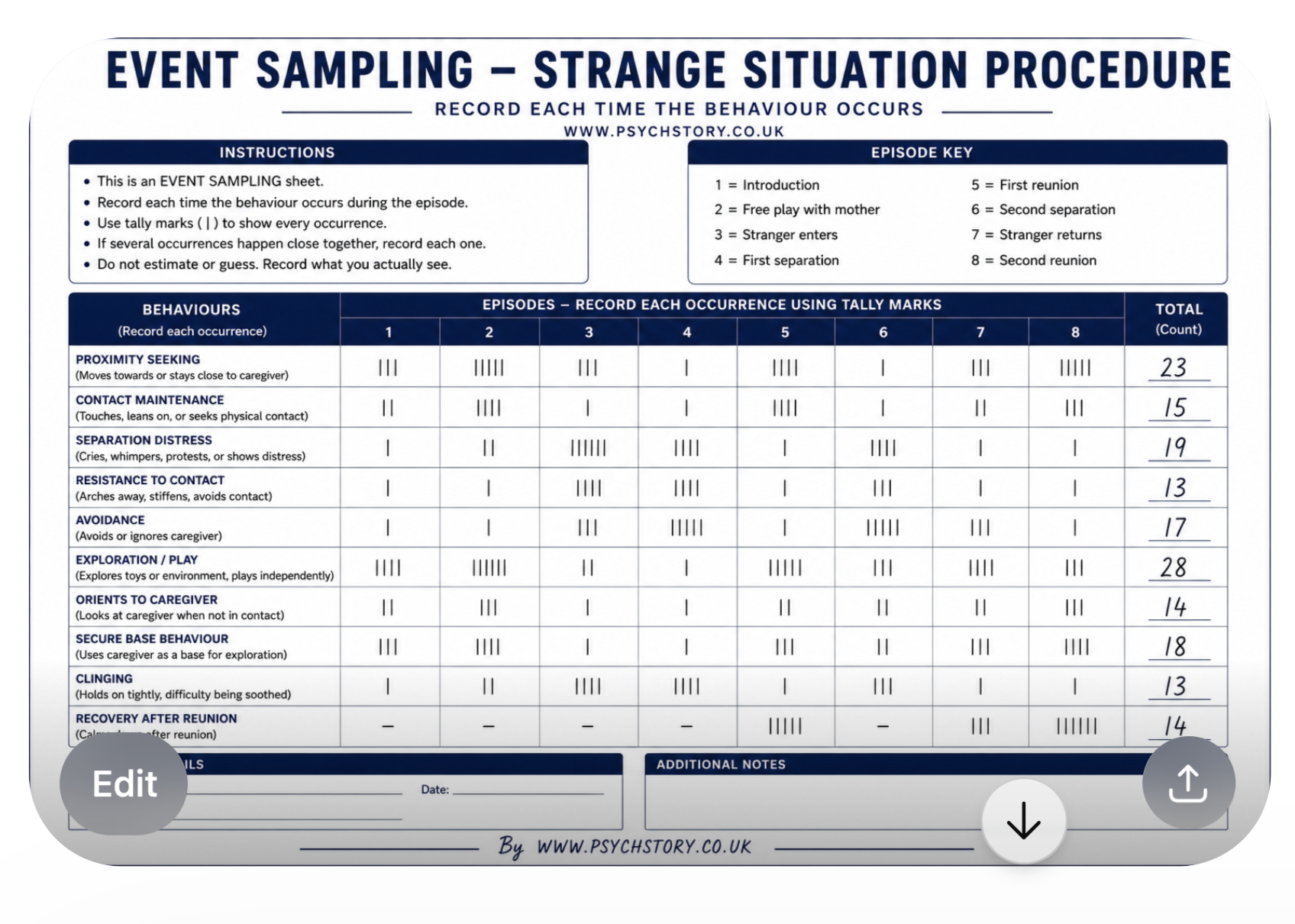
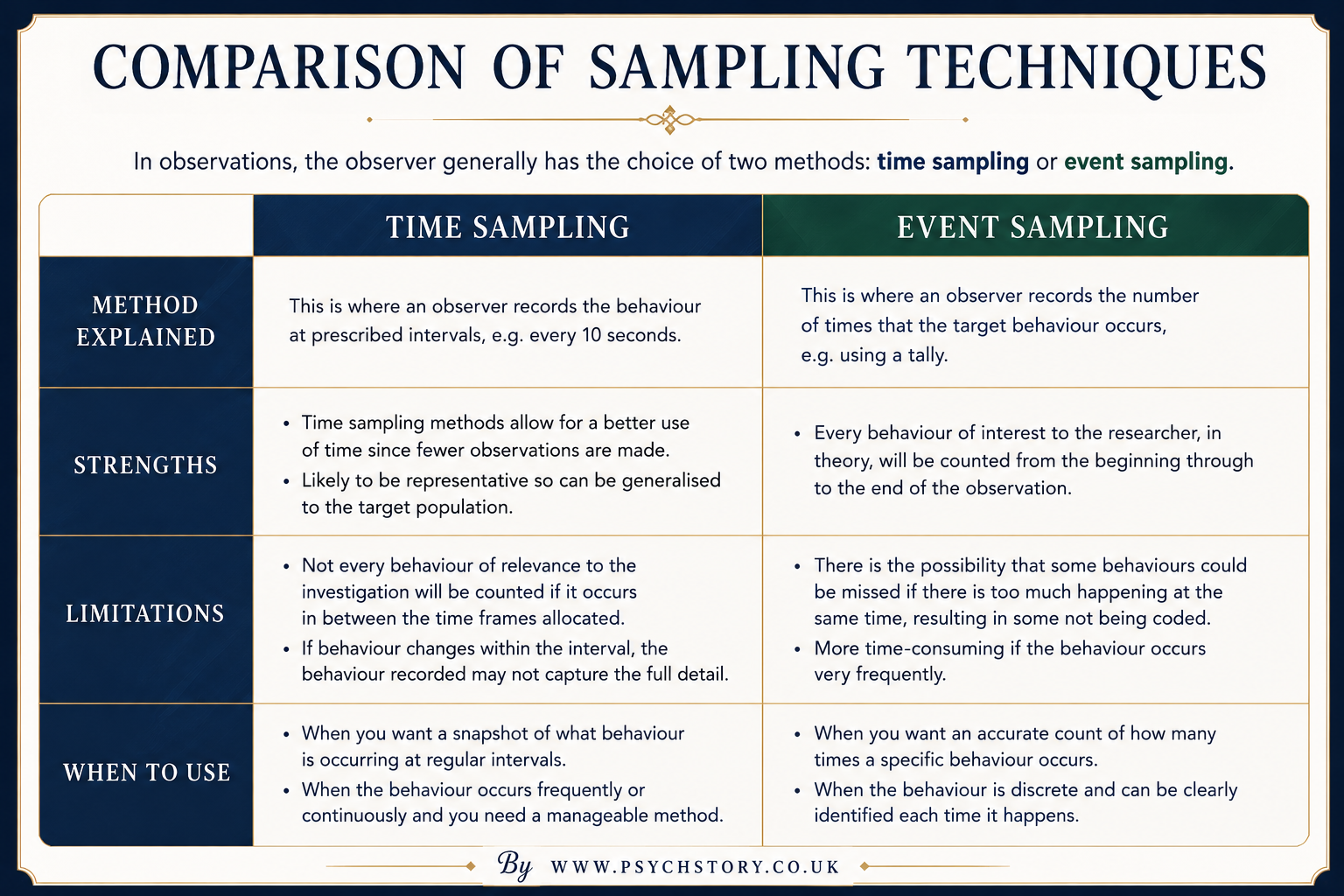
Event sampling is an observational technique in which the researcher records every occurrence of a specific behaviour as it happens. Unlike time sampling, which records behaviour only at predetermined intervals, event sampling focuses entirely on the behaviour itself. Every time the target behaviour occurs, the observer records it immediately. For example, a researcher studying classroom behaviour may decide to record every instance of aggression, shouting, hand-raising, nose-picking, or helping behaviour during a lesson. Each time the behaviour occurs, the observer records it using a tally, tick, code, or behavioural checklist. The key idea behind event sampling is that the observation is triggered by the behaviour rather than by the clock. This means the researcher attempts to capture all occurrences of the target behaviour throughout the observation period rather than taking occasional snapshots across time. Event sampling is particularly useful when studying behaviours that are relatively infrequent, brief, or significant. For example, researchers studying aggression, attachment behaviours, lying, panic attacks, stereotypical behaviours, or social interactions may need an accurate count of how often the behaviour occurs. Because every occurrence is recorded, event sampling can provide far richer and more detailed behavioural data than time sampling. Researchers can examine the frequency, patterns, triggers, or sequence of behaviours across the observation.
However, event sampling also creates practical difficulties. If behaviour occurs very rapidly, repeatedly, or simultaneously, the observer may struggle to record everything accurately. In busy social environments, several behaviours may occur at once, making it difficult for the observer to keep up with the observation in real time. For example, in a nursery observation, several children may begin crying, shouting, laughing, grabbing toys, and interacting simultaneously. The observer may accidentally miss some behaviours whilst trying to record others. Unlike time sampling, which reduces workload by limiting observations to specific intervals, event sampling can become cognitively demanding because the observer must remain continuously alert throughout the observation period. Event sampling, therefore, attempts to produce a more complete record of specific target behaviours, but this increased detail can make the observation more difficult to manage in complex or fast-moving situations.
TIME SAMPLING
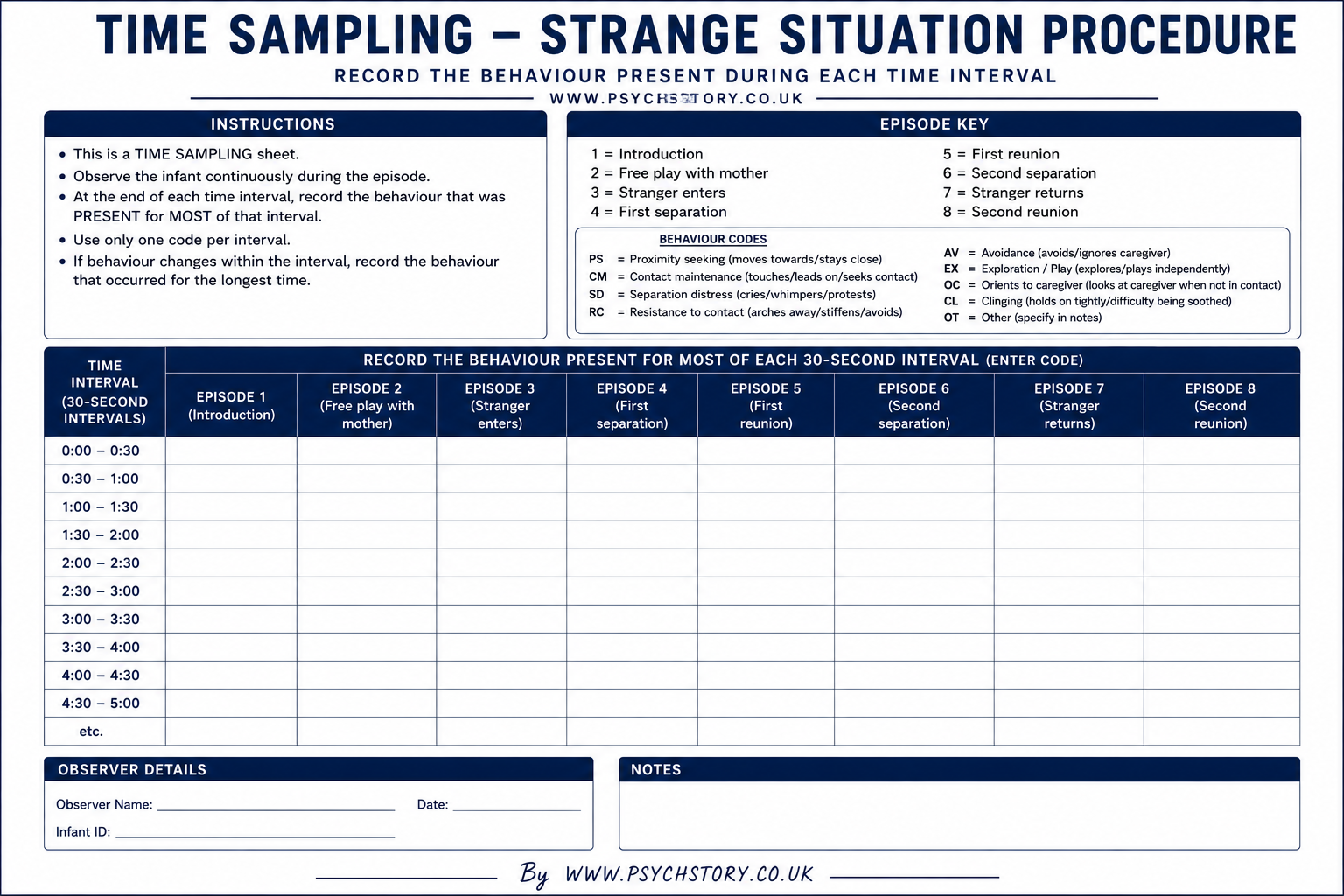
Time sampling is an observational technique in which behaviour is recorded at predetermined time intervals rather than continuously throughout the observation. Instead of trying to record every single behaviour that occurs, the observer only records what is happening at specific moments in time. These intervals may occur every few seconds, every minute, every five minutes, or at any other regular time period decided before the observation begins. For example, a researcher observing classroom behaviour may decide to record a student’s behaviour every 5 minutes over 1 hour. At each five-minute interval, the observer records what the participant is doing at that precise moment, such as reading, talking, fidgeting, looking away, or interacting with others. The observations themselves are usually brief snapshots of behaviour rather than continuous, detailed recordings. Researchers may also record additional information, such as the intensity of involvement, emotional state, social interaction, or level of attention during each interval.
The key idea behind time sampling is that the researcher does not attempt to observe behaviour continuously. Instead, behaviour is sampled at regular intervals over a longer period. This makes time sampling far more manageable when observing behaviour over extended periods, particularly in naturalistic settings where continuous observation would be impractical or overwhelming. Rather than recording hundreds of behaviours every minute, the observer focuses only on behaviours occurring during the selected time points. However, because behaviour is only recorded periodically, important behaviours may be missed entirely if they occur between the observation intervals. For example, if aggressive behaviour occurs thirty seconds after the observer records the behaviour, it may not be captured at all if the next observation point is several minutes later. Time sampling, therefore, provides a snapshot of behaviour across time rather than a complete, continuous record of everything that occurs
INTER RATER RELIABILITY IN OBSERVATIONS
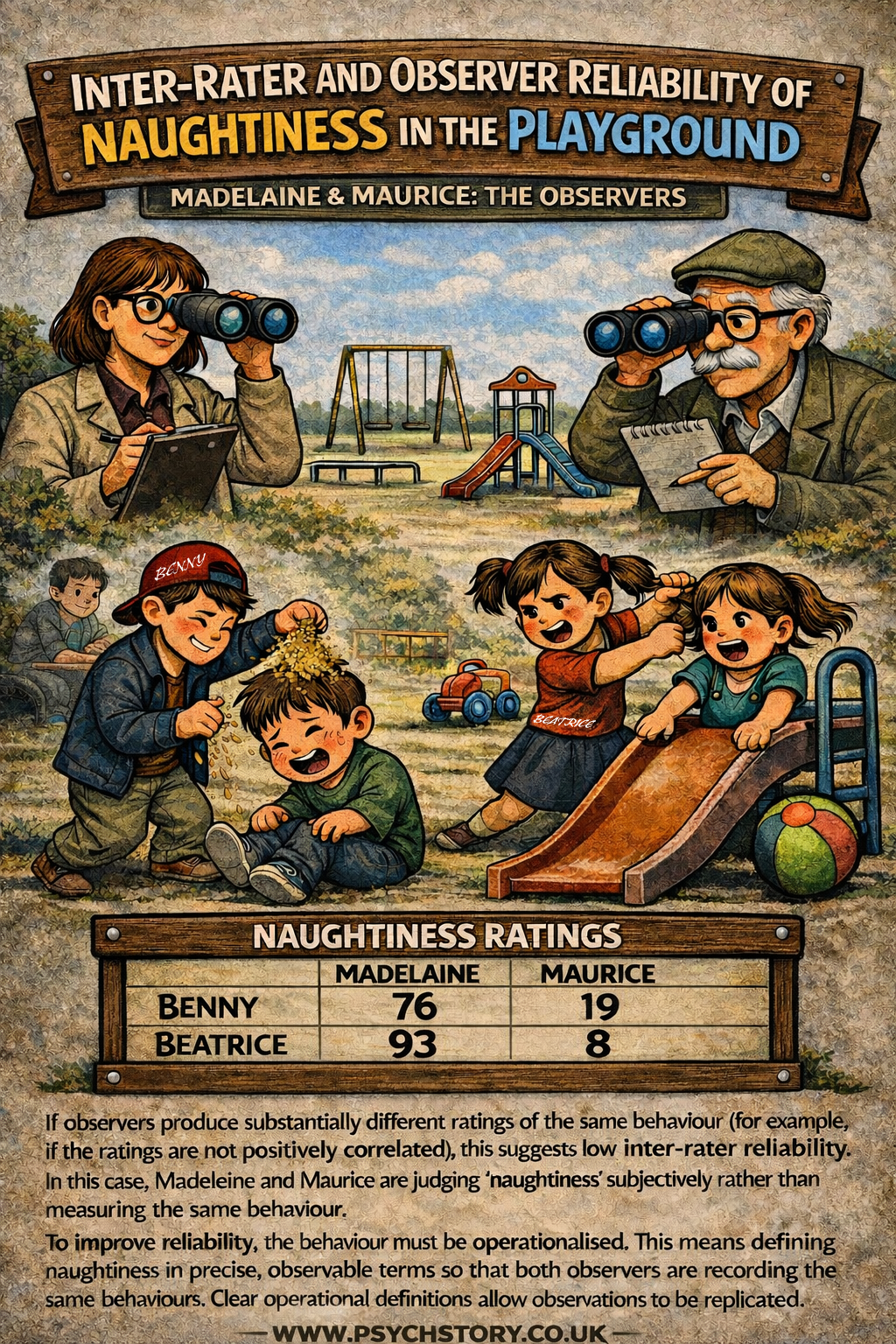
In observational research, behaviour can be subjective and open to interpretation. One observer may classify a behaviour as “aggressive,” whilst another may interpret the same behaviour as “playful” or “assertive.” Interobserver reliability attempts to measure consistency between observers so researchers can judge whether the observation system is reliable.
For example, two observers may independently watch the same child during the Strange Situation procedure and record behaviours using the same coding scheme or behavioural checklist.
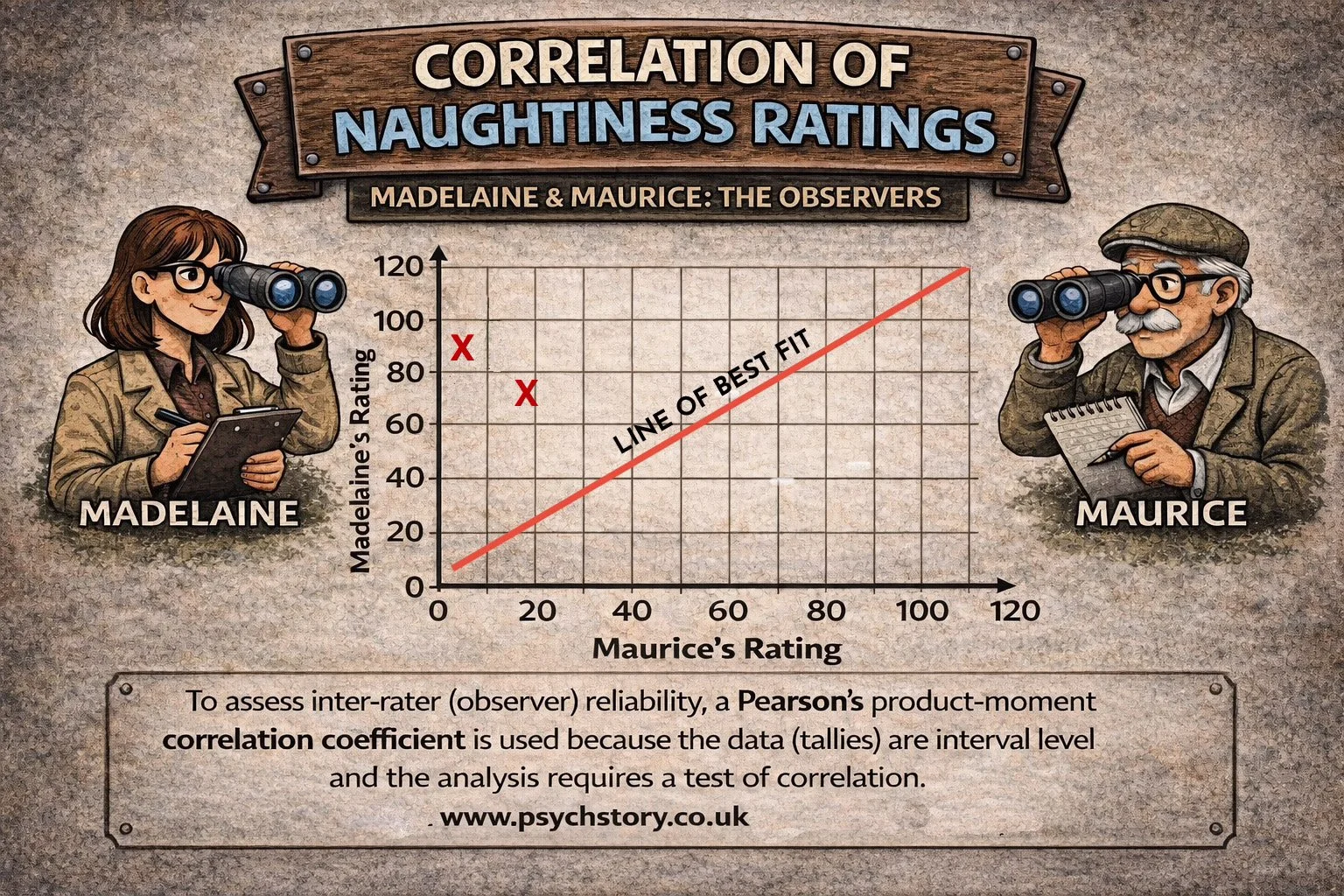
If both observers consistently record similar behaviours at similar times, the observation is said to have high inter observer reliability.
If their recordings differ substantially, the observation system may lack reliability because the behavioural categories are unclear, subjective, overlapping, or poorly operationalised.
Researchers often improve inter observer reliability by:
• creating clear operationalised behavioural categories
• training observers beforehand
• using detailed coding schemes
• conducting pilot observations
• simplifying overlapping categories
• calculating statistical agreement between observers
Interobserver reliability is particularly important in observational research because human judgment can introduce subjectivity and observer bias. The more consistent the observers are, the more confident researchers can be that the data reflect the behaviour itself rather than individual interpretation.