
THE SOMATOSENSORY CORTEX: DIFFERENT BODY PARTS FEEL MORE
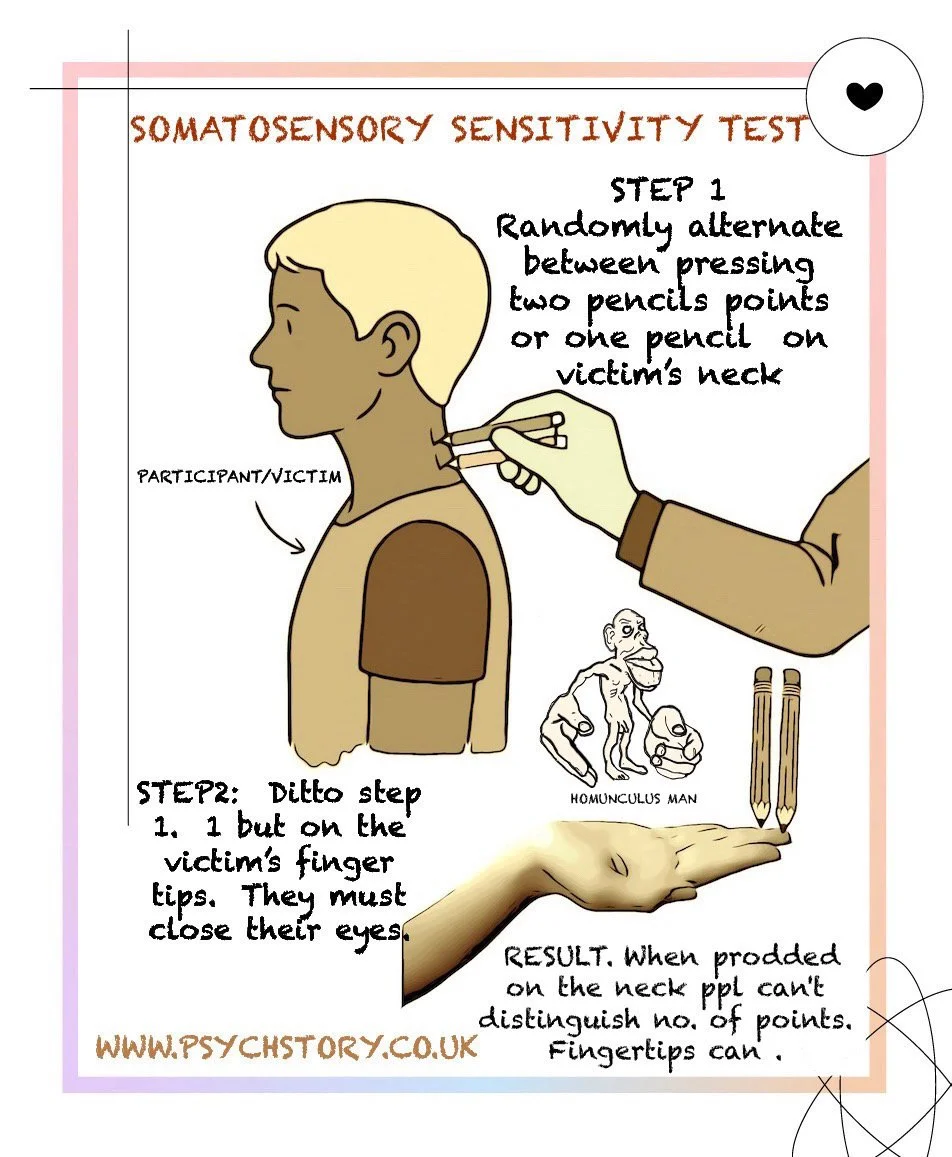
Different body parts feel more, it’s true! Your fingertips could detect a single grain of sugar, while your neck is basically a clueless patch of skin just along for the ride.
Grab a volunteer, two pencils, and put evolution to the test: Nature gave us hyper-sensitive fingers but a neck that can’t tell one slap from two?
Run this quick experiment and watch your somatosensory cortex show off in real time.
OBJECTIVE
Show that touch sensitivity depends on the brain, not the skin, and that not all body parts feel the same experience.
The somatosensory cortex devotes far more neurones to the fingertips because humans constantly use their hands for fine manipulation and exploration, than to the neck, which arguably only needs to feel pain or large movements; we don’t utilise it for precise tasks.
This is localisation of function in action.
MATERIALS
• 2 sharpened pencils (or two-point callipers)
• One willing participant (short hair ideal; or tie long hair back)
PROCEDURE
PART 1: BACK OF NECK
1. Tell the participant:
“I’m going to prod you with one or two pencil tips. Just say whether you can feel ‘one’ or ‘two pencil tips touching the back of your neck’.”
2. Keep tips exactly 1 cm apart for every trial.
3. Participant faces away (eyes open, they can’t see the pencils).
4. Randomly press one or two tips lightly on the back of the neck.
5. Ask: “One or two?” Record answers.
6. Repeat 10 times.
PART 2: FINGERTIP
1. Participant closes eyes, holds one hand palm-up (they can support their upturned hand with their other hand if necessary).
2. Touch the pad of the middle finger with one or two tips (1 cm apart).
3. Follow steps 4–6 from Part 1.
RESULTS
Fingertip: 90–100% correct
Back of Neck: ~50% correct (no better than guessing)
Same 1 cm gap. Same pencils. Same participant. Different part of the somatosensory cortex.
BRAIN SCIENCE EXPLAINED (STEP-BY-STEP)
1. Receptor density and receptive fields
• Fingertips contain thousands of mechanoreceptors per square centimetre, each with a small receptive field (≤2 mm).
• The neck has far fewer receptors, each with a large receptive field (≥10 mm).
→ At 1 cm separation, two points stimulate two distinct receptors on the finger but fall within the same receptive field on the neck, merging into one sensation.
2. Ascending pathway to the somatosensory cortex
• Touch signals travel via the dorsal column–medial lemniscus pathway to the primary somatosensory cortex (S1).
• S1 is located in the postcentral gyrus of the parietal lobe, immediately posterior to the central sulcus.
• The cortex is organised somatotopically as the sensory homunculus.
3. Cortical magnification
• The cortical representation of the fingertips is disproportionately large (comparable in area to the entire leg).
• The neck occupies only a narrow band.
→ Greater cortical area means more neurones devoted to processing input from that region, yielding higher spatial resolution.
4. Localisation of function
• The brain allocates specialised cortical zones to body parts according to functional demand.
• Fingers, used for fine discrimination and tool use, receive massive investment.
• The neck, primarily involved in gross posture and pain detection, receives minimal representation.