
COLLECTIVE LEARNING, MAGIC AND RELIGION
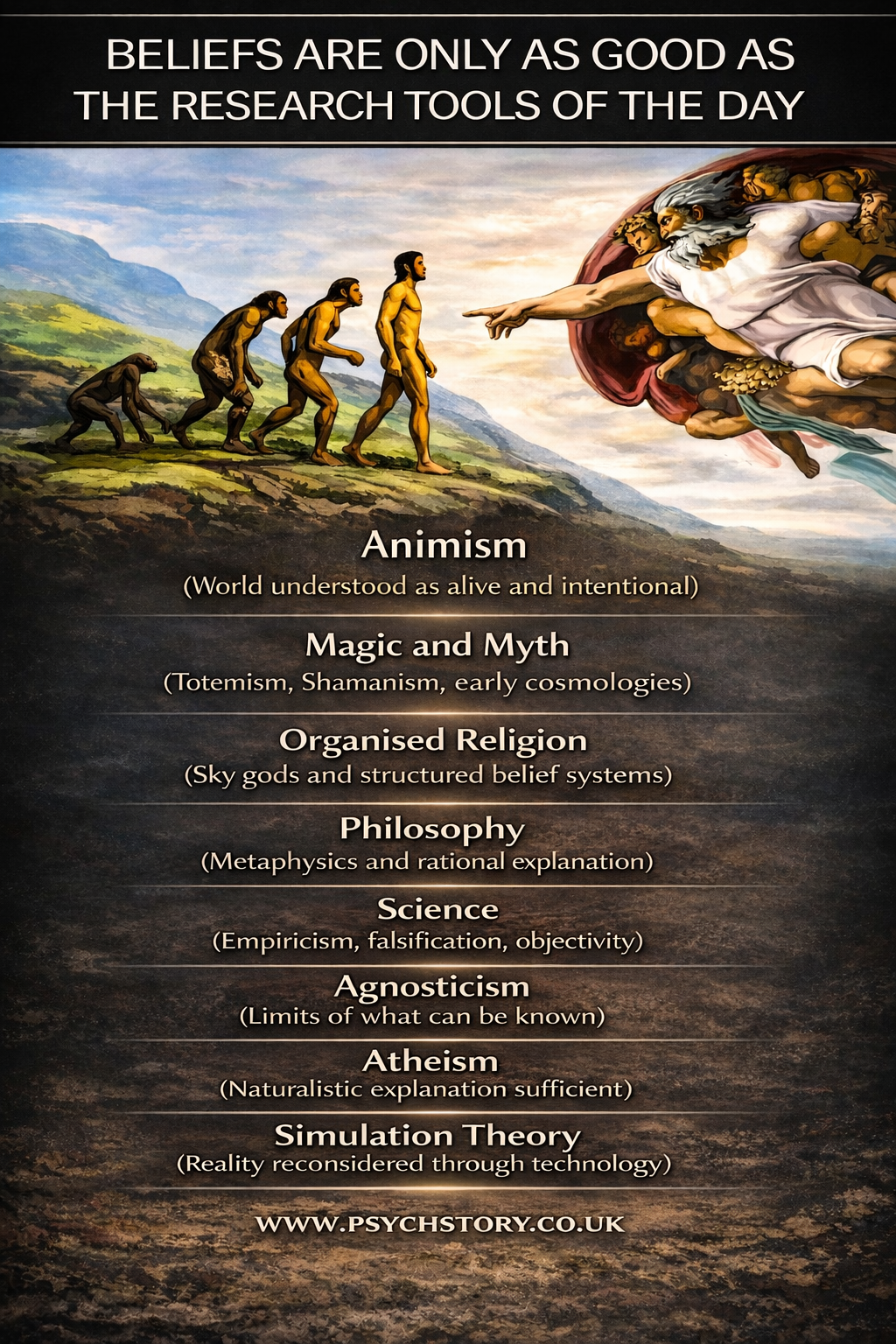
Early humans had no science, no education, no inherited explanations about reality. When lightning struck or the sun disappeared, magic filled the gaps because nothing else existed to explain the world. Those beliefs were not stupidity. They were the best models available with the tools at hand.

As societies grew, magic became religion. Gods organised chaos, gave meaning to death, and imposed order on an unpredictable world. Religion was not a break from learning but an upgrade: a shared system for explaining existence before evidence could decide anything.

Then philosophy changed the focus. Instead of asking what to believe, thinkers began asking whether beliefs made sense at all. Logic became an alternative to revelation. Contradictions mattered. Ideas had to survive reasoning, not just tradition.

Science arrived when questions finally met instruments. Telescopes, microscopes, and experiments forced nature to answer. Explanations no longer survived because they were comforting or ancient, but because they worked.

Each stage reflects the same human instinct: we explain the unknown using the best tools we possess. Magic used imagination. Religion used narrative. Philosophy used reason. Science uses evidence.

And now, in a computational age, some even ask whether reality itself might be a simulation.

The pattern never changed. Only the tools did.

.
Rebecca Sylvia

I am a Londoner with over 30 years of experience teaching psychology at A-Level, IB, and undergraduate levels. Throughout my career, I’ve taught in more than 40 establishments across the UK and internationally, including Spain, Lithuania, and Cyprus. My teaching has been consistently recognised for its high success rates, and I’ve also worked as a consultant in education, supporting institutions in delivering exceptional psychology programmes.

I’ve written various psychology materials and articles, focusing on making complex concepts accessible to students and educators. In addition to teaching, I’ve published peer-reviewed research in the field of eating disorders.

My career began after earning a degree in Psychology and a master’s in Cognitive Neuroscience. Over the years, I’ve combined my academic foundation with hands-on teaching and leadership roles, including serving as Head of Social Sciences.

Outside of my professional life, I have two children and enjoy a variety of interests, including skiing, hiking, playing backgammon, and podcasting. These pursuits keep me curious, active, and grounded—qualities I bring into my teaching and consultancy work. My personal and professional goals include inspiring curiosity about human behaviour, supporting educators, and helping students achieve their full potential.

https://psychstory.co.uk
Previous
Previous

THE JOURNEY FROM MAGIC, TO RELIGION AND TO SCIENCE

Next
Next

THE SOMATOSENSORY CORTEX: DIFFERENT BODY PARTS FEEL MORE