
THE JOURNEY FROM MAGIC, TO RELIGION AND TO SCIENCE
Synopsis: Throughout history, humanity has grappled with fundamental questions about existence, the purpose of life, and the structure of reality. Human intellectual development has unfolded through four pivotal stages: magic, religion, philosophy, and science.
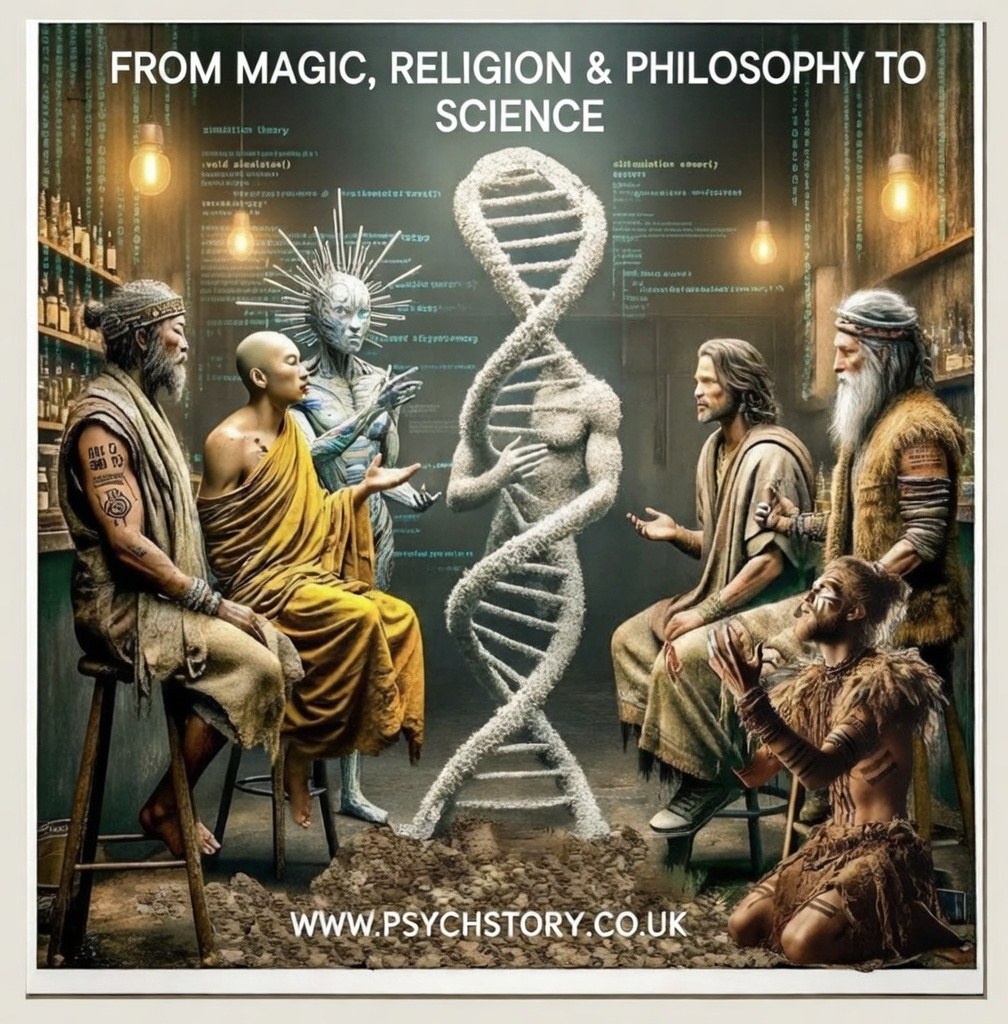
PHILOSOPHICAL BRAINS
The first Homo Sapiens evolved in Africa approximately 300,000 - 350,000 years ago during the Middle Palaeolithic era. By this time, humans had become incredibly intelligent beings who could not only reflect on themselves and the world around them but also on their existence within the world; in other words, they realised they were the objects of their consciousness; they had become self-aware.
With this level of perception, it was only natural that early humans would develop philosophies about the meaning of life and death. The earliest known human burial, dating back to approximately 100,000 BCE in the Middle East, suggests that some level of ideational thinking had already begun. However, people must have developed philosophical ideas before this date, as thinking abstractly and creatively is a result of having a sophisticated cerebral cortex.
The topic of exactly when and where philosophy first began to develop is still a matter of debate. Still, the most straightforward answer is that it likely started the first time someone asked why they were born, what their purpose was, and how they were supposed to understand their lives at any point in the distant past.
The term philosophy may apply to a formalised secular or religious system of thought, personal constructs, or communal understanding of belief. Still, in each case, the purpose of the system is to develop theories about existence, such as:
What is the purpose of life?
What is the meaning of existence?
Who am I?
What is my nature?
Where do I go when I die?
Picture this: you are one of the human beings living hundreds of thousands of years ago. You're out on the plains of the Serengeti, shooting the breeze with your fellow hunter-gatherers, when one of them asks the group,
“What is death, and where do we go when we die?
COLLECTIVE LEARNING
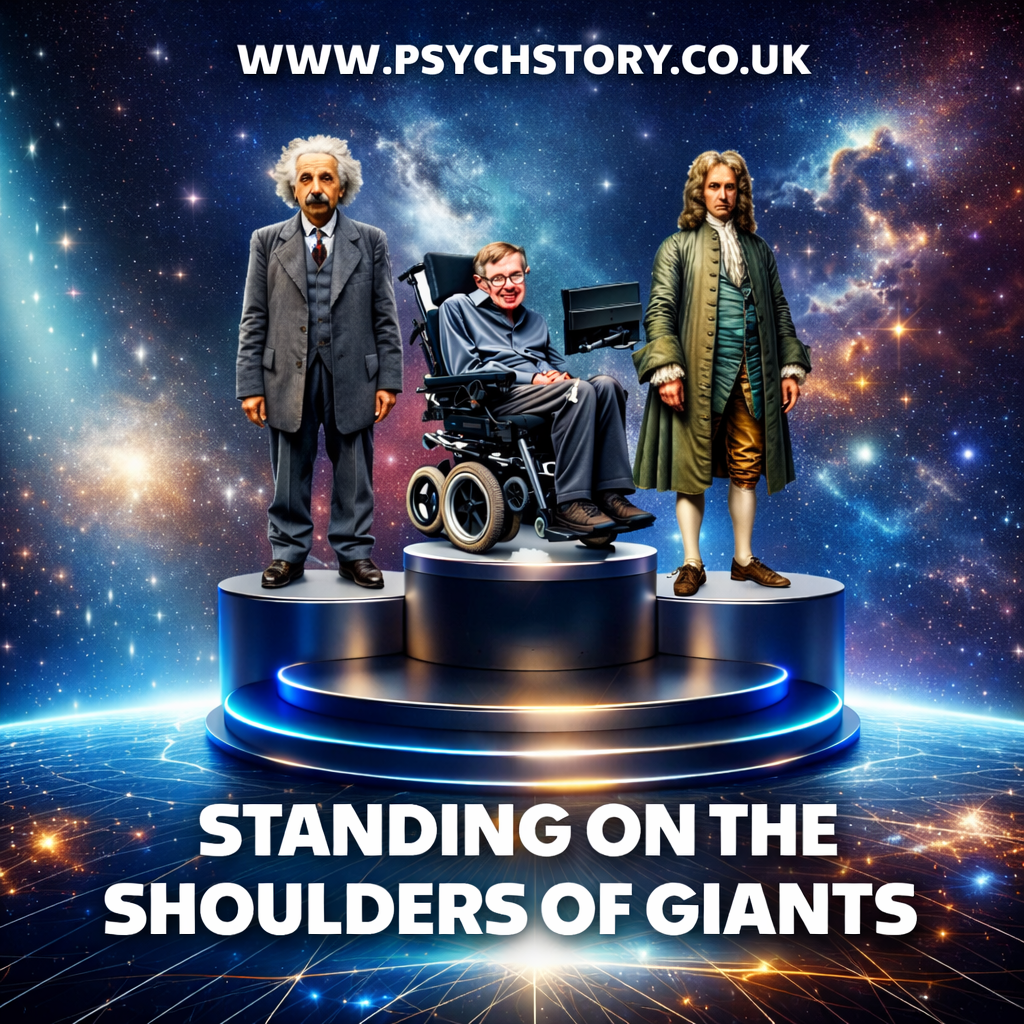
"If I have seen further, it is by standing on the shoulders of giants."
Because early man lived in the Palaeolithic age, he couldn’t access education or the insights of other people’s wisdom, as these didn’t yet exist. The knowledge base of the twenty-first century didn’t happen suddenly; it took a couple of hundred thousand years to accumulate. “Standing on the shoulders of giants” is a metaphor that means building on the insights of major thinkers born before you to make intellectual progress. Isaac Newton exemplified this perfectly by explaining that his ideas didn’t come from him alone. He said that he relied on the ideas of those who had already made significant contributions to scientific knowledge. As a result, Newton didn’t regard himself as a genius.
In short, collective learning is the uniquely human ability to share, preserve, and build upon knowledge over time. People rely on collective learning when reading a book, attending school, or watching a documentary. The history of science is the story of collective learning. Historians piece together evidence across time and continents and show how our collective knowledge developed.
The middle Palaeolithic era was the very start of this collective learning journey. At the beginning of man’s existence, there were no social constructs, objective truths about existence, and no scholars to learn from. Therefore, anything was possible, and all early theories were equal. Moreover, living in small, nomadic groups meant little interaction, so the spread of any idea was greatly restricted.
Unsurprisingly, the people who lived during this period would have had primitive and mystical ideas about their existence and the objects that inhabited their world. “….so that enormous ball of yellow in the sky” could have been anything: a god, another world, an “all-seeing eye”, or even an evil force. The people back then would have been perplexed about the behaviour of celestial bodies like the sun.
“Why was it so luminous some days but hid behind fluffy white things on other days, disappeared altogether, taking all light and warmth with it? Was it displeased? Did something happen to make it go away? Did it watch them? Would they go to it when they died?”
THEORY OF MIND (TOM)
The ancestral plains were perilous landscapes where hunters who weren't vigilant faced the constant threat of being taken down by the environment—essentially, it was a matter of “kill or be killed.” In such hostile conditions, survival was possible only because humans developed the ability to recognise that other beings—whether predators or prey—possessed independent existences and minds of their own. This cognitive capacity, which psychologists call the "Theory of Mind" (TOM), enabled humans to see others' intentions.
TOM allowed humans to recognise that the actions and behaviours of other beings were purposeful, which played a crucial role in making life-saving decisions. Early man had to quickly assess the intentions of potential predators, asking themselves questions like, 'Is that movement in the meadow a snake? Snakes bite—better run.” The capacity to perceive 'agency' in others was vital for survival in various other contexts, such as mating—' Does that person want to fornicate with me, kill me, or ambush me? However, the exact cognitive mechanisms that allowed humans to interpret the intentions and actions of living beings. TOM helped humans create a framework for understanding their environment when no other explanations were available.
In addition to helping humans make rational decisions, TOM may have planted the seeds for religious thought, laying the foundation for something far more transcendent: the leap into abstract belief by enabling humans to imagine beings untethered from the natural world, and capable of shaping existence from realms unseen
THE BIRTH OF THEORIES BASED ON MAGIC
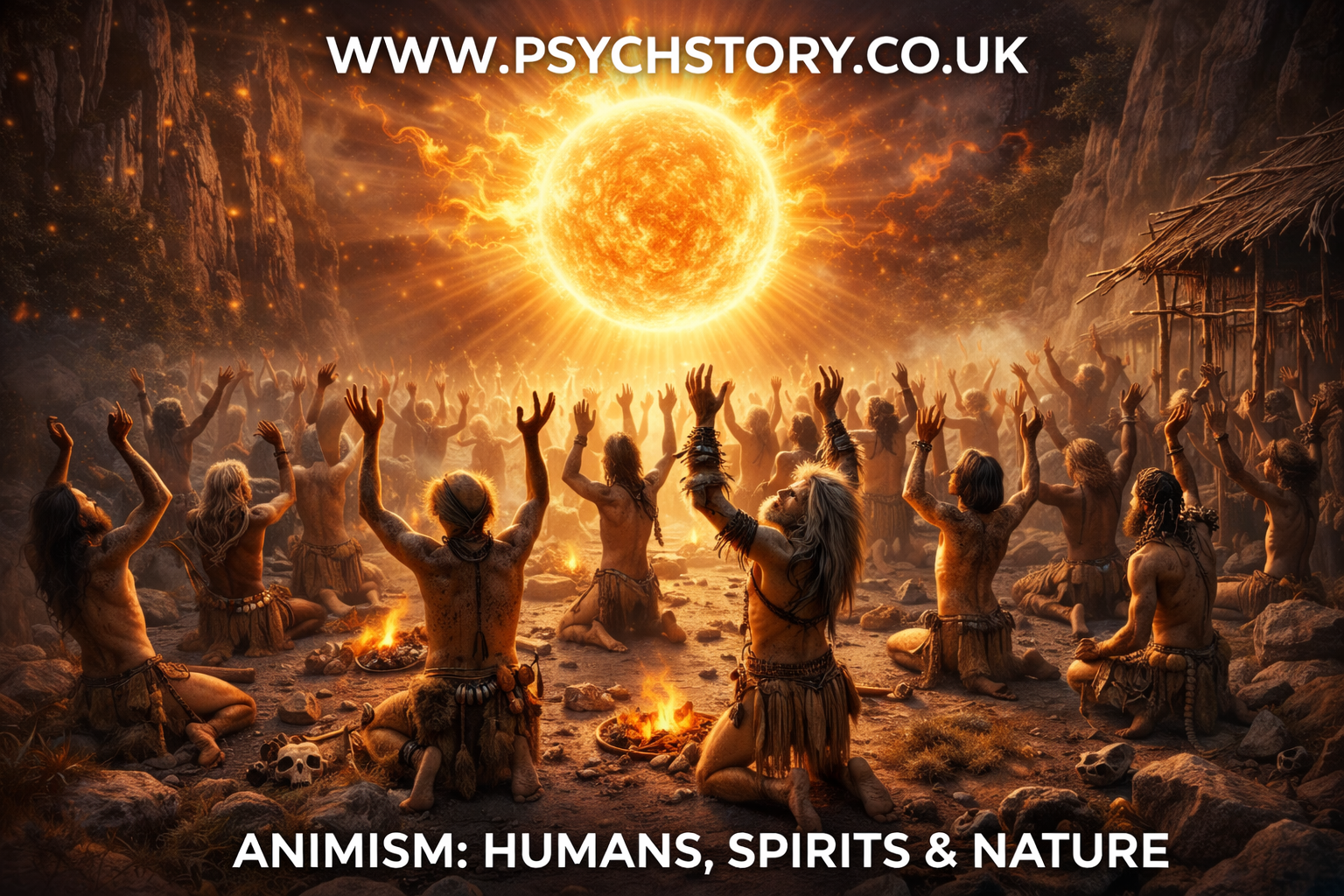
In the early phases of human evolution, early humans feared natural phenomena such as storms, droughts, and floods because of the devastating effects these events could produce on their way of life. This fear was intensified by an inability to clearly distinguish between the sentient and the non-sentient. As a result, Stone Age populations extended Theory of Mind beyond living beings, attributing intention and awareness to objects and natural forces. Mountains, rivers, and skies were not experienced as passive environments but as entities capable of action, mood, and agency.
Environmental catastrophes were therefore interpreted as the actions of unseen beings inhabiting the natural world. The movements of the sun, moon, and stars appeared deliberate and powerful, encouraging the belief that celestial forces possessed intention. In response, early communities directed rituals and reverence toward these forces to maintain harmony and avoid disaster. This tendency to interpret natural events as the work of spirits or supernatural agents came to be known as animism.
Animism formed the basis of many early spiritual systems. It persisted because it offered answers that made experience intelligible, even when outcomes remained unpredictable. Early belief systems like animism, Shamanism, and Totemism operated on perceived cause-and-effect that appeared rational within the limits of available knowledge. Rather than rejecting reason, early humans applied it with limited information and explanatory tools.
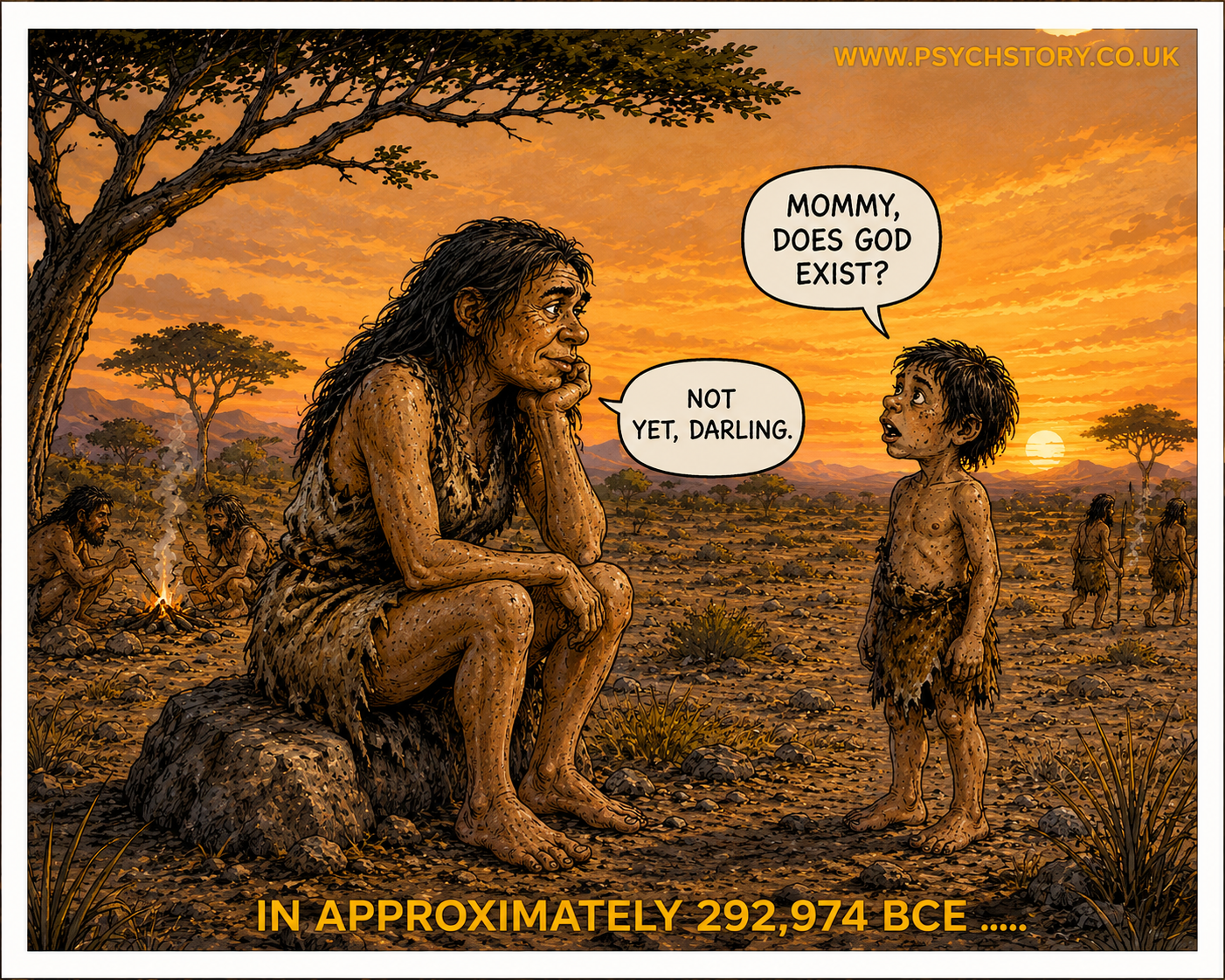
THE TRANSITION FROM MAGIC TO RELIGION
The relationship between magic, religion, and later scientific thinking is often misrepresented as a simple progression from ignorance to enlightenment. In reality, magic and organised religion remained closely connected. Both assumed unseen forces could be engaged through human action, whether through spells, rituals, or prayer. Their overlap reflects a persistent human tendency to explain uncertainty through invisible causes.
Religion emerged from the limits of magic rather than replacing it outright. Magic attempted to influence events within the observable world and therefore risked visible failure when outcomes did not occur. A failed rain ritual or a charm that offered no protection exposed weaknesses in explanations directly tied to results. Religion shifted causation beyond observable testing, locating meaning in unseen and transcendent powers such as sky gods. Because these explanations could not be disproved through everyday experience, religion proved more durable, sustaining meaning even when events remained uncertain.
Both magic and religion addressed uncertainty, but in different ways. Magic sought control; religion offered interpretation. Through shared worship, moral codes, and collective narratives, religion stabilised larger communities and reinforced cooperation. Its authority rested not on measurable success but on its ability to preserve meaning regardless of outcome, allowing societies to maintain cohesion during instability and change.
As societies expanded, belief systems became increasingly structured. Deities acquired human traits, making divine forces psychologically relatable. Gods capable of anger, love, or justice provided understandable models of order, while the concept of the soul offered continuity of identity beyond physical life.
Over time, however, bigger distinctions emerged. Magical practices were typically individual and informal, focused on immediate goals. Religions developed collective identities, institutional authority, and formal moral systems. Where magic centred on personal intention, religion increasingly organised societies around shared belief, doctrine, and structured leadership expressed through scriptures and clergy.
EVOLUTION OF RELIGIOUS THOUGHT
As religion developed, it changed not only what humans believed but how they understood themselves. Religion gave language to experiences people already sensed but could not explain, shifting attention from survival toward questions of consciousness, death, and purpose. Through symbols, stories, and shared language, private impressions became collective understanding. As explanations expanded, humans began interpreting existence itself rather than isolated events, moving from immediate experience toward ideas of order, continuity, and destiny.
THE EMERGENCE OF MORAL FRAMEWORKS
Religion also transformed morality by lifting it beyond human opinion. Behaviour was no longer judged solely by communities but understood as part of a wider cosmic order. The idea of divine judgment suggested that actions were always observed and carried consequences beyond immediate life, turning morality inward as well as outward. Ethical rules, whether expressed through commandments or concepts such as dharma, framed right and wrong as alignment with universal principles rather than obedience to temporary authority. This reshaped human psychology, introducing guilt, redemption, and personal responsibility as internal experiences rather than as mere external enforcement. By linking personal conduct to cosmic meaning, religion guided behaviour through belief as much as law, embedding morality within everyday life.
PHILOSOPHICAL AND EXISTENTIAL INSIGHTS
The attempt to understand the divine gradually became an attempt to understand existence itself, bridging myth and reason and laying the foundations for later philosophical inquiry.
THE RISE OF CRITICAL THOUGHT
Religious belief never existed without criticism. From the earliest theological traditions, believers and sceptics alike struggled to reconcile religious claims with lived experience. If a god were just, why did innocent people suffer? If divine law reflected perfect morality, why did it contain punishments that appeared cruel, arbitrary, or culturally inconsistent? If God were merciful, how could eternal damnation exist? And if human actions were foreknown or predetermined by divine will, in what sense could humans possess free will and deserve reward or punishment? These were not just modern objections imposed from outside religion; they arose from within religious thinking itself.
As religious systems grew more complex, so did the tensions inside them. Laws presented as universal often differed dramatically across cultures, suggesting moral rules were shaped by societies rather than handed down unchanged from heaven. Ritual purity codes, dietary restrictions, and systems of retribution sometimes appeared disconnected from compassion or justice, raising questions about whether obedience or morality was the true aim. The problem was not simply disbelief but inconsistency. If truth were singular, why did sincere believers reach incompatible conclusions about gods, souls, and salvation? Comparison forced reflection. Theology unintentionally created the conditions for critique.
Different thinkers responded to these problems for different reasons. Some sought to defend religion by refining it; others attempted to reconcile belief with reason; still others concluded that supernatural explanations were unnecessary. What united them was not agreement but method. Increasingly, explanations were expected to make logical sense, remain internally consistent, and correspond with observable reality rather than rely solely on authority or tradition.
Questions surrounding evil became especially destabilising. Natural disasters, disease, and random misfortune challenged the idea of a morally ordered universe. If suffering served divine justice, its distribution appeared irrational. Philosophers explored alternatives: perhaps events followed natural necessity rather than moral intention; perhaps suffering arose from material processes rather than punishment. The issue shifted from divine motives to causal explanation.
Free will produced another enduring conflict. Religious doctrine often required moral responsibility while simultaneously asserting divine omniscience or predestination. If every action were known or determined in advance, punishment and reward seemed unjust. Philosophical inquiry examined whether human choice could be explained by reason, character, and causation rather than supernatural judgment. Responsibility began to be analysed as a feature of human reasoning and social life rather than solely a theological condition.
Some thinkers removed divine agency entirely from explanation. Lucretius described a universe governed by natural processes, where invisible particles moved according to necessity rather than divine will. His aim was practical as much as theoretical: to eliminate fear produced by interpreting natural events as supernatural punishment. Thunder, plague, and disaster no longer required appeasement of gods; they required understanding.
Others pursued a different path. Aristotle did not primarily argue against religion; he reoriented explanation toward causes observable in nature. Instead of asking what the gods intended, he examined how processes unfolded. Order became something discoverable through investigation. Knowledge was no longer derived solely from sacred narrative but from systematic observation and reasoning.
Later thinkers extended these developments in divergent ways. Spinoza rejected the image of a personal, interventionist deity, proposing instead that reality itself followed necessary laws. This reframed divinity not as a judging agent but as the structure of existence. Kant, confronting morality, argued that ethical obligation could not depend entirely on divine command. Humans recognise moral duties through rational consistency: principles must be capable of applying universally if they are to count as moral at all. Moral reasoning, therefore, survived independently of theology.
Across these debates, the significant change was not agreement about conclusions but a transformation in how questions were approached. Religious doctrines were no longer accepted solely because they were inherited; they became subjects of analysis. Thinkers compared claims, exposed contradictions, tested coherence, and proposed alternatives grounded in logic, observation, or human experience. Reasoning increasingly functioned as an alternative route to understanding existence, morality, and causation without appealing exclusively to supernatural explanation.
The central questions never changed. Humans continued asking why suffering exists, whether life has purpose, how justice should operate, and whether choice is real. What changed was intellectual development itself. Explanations were gradually expected to justify themselves through argument and evidence rather than authority alone. In this way, philosophical thinking did not replace religion but expanded the range of acceptable ways to seek truth, laying the cognitive groundwork from which scientific inquiry would later emerge
FROM PHILOSOPHY TO SCIENCE
“Philosophy is dead. Philosophy has not kept up with modern developments in science, particularly physics. Scientists have become the bearers of the torch of discovery in our quest for knowledge.”
— Stephen Hawking
For centuries, philosophy and metaphysics carried humanity’s search for truth as far as reason alone could take it. Logic produced powerful arguments, yet opposing conclusions could coexist indefinitely because reasoning alone could not determine which reflected reality. Science emerged not because philosophical questions disappeared, but because new tools finally allowed those questions to confront evidence.
John Locke recognised this limitation early, arguing that knowledge ultimately arises from experience rather than pure reasoning. The mind could speculate endlessly, but truth required observation. Philosophy had reached a boundary: reasoning could organise ideas, but reality had to be encountered directly. Seeing, in effect, became believing.
The decisive change was therefore technological as much as intellectual. Science is only as powerful as the instruments that enable observation. Telescopes extended human sight into the heavens, microscopes revealed invisible life, and later machines measured forces, particles, and brain activity beyond ordinary perception. Questions once debated abstractly could now be answered by looking, measuring, and repeating.
One of philosophy’s oldest questions concerned humanity’s place in existence: are humans central to creation? Religious cosmology and Aristotelian philosophy placed Earth at the centre of the universe. The heliocentric revolution, confirmed through Galileo’s telescope, overturned this belief. Observing Jupiter’s moons demonstrated that celestial bodies did not revolve solely around Earth, displacing humanity from cosmic centrality. A metaphysical claim became an empirical correction.
Another enduring philosophical debate concerned whether the universe was eternal or created. Modern cosmology transformed this question into physics. Edwin Hubble’s observation that galaxies are receding revealed an expanding universe, leading to the Big Bang model supported by redshift and cosmic microwave background radiation. At its boundary lies the concept of a singularity, where space and time themselves originate. Creation moved from theology into measurable cosmology, and even time acquired a beginning rather than eternal continuity.
Physics also addressed the philosophical question of what reality fundamentally is. Classical philosophy imagined solid substance; modern physics revealed matter composed of interacting quantum fields and quarks, governed by probabilistic laws. Quantum mechanics challenged determinism itself, demonstrating that uncertainty is built into nature rather than imposed by human ignorance. Ancient metaphysical speculation about substance gave way to experimentally verified structure.
The philosophical problem of free will likewise shifted domains. For centuries, thinkers debated whether humans freely choose their actions or merely follow causal chains. Neuroscience introduced measurable evidence. Benjamin Libet’s experiments showed that neural readiness potentials precede conscious awareness of decision, suggesting that the brain initiates action before subjective intention. Free will did not disappear as a question, but it ceased to be purely philosophical; it became a problem of brain timing and neural processes.
Religion and philosophy also struggled with the problem of evil and immoral behaviour. Traditionally explained as sin, moral weakness, or flawed character, behaviour is increasingly understood to have biological foundations. Research into hormones, neural circuitry, and genetics shows how aggression, impulse control, and empathy emerge from brain systems shaped by evolution and environment. Variants such as the MAOA-L gene, particularly when combined with early adversity, influence emotional regulation and aggression risk, demonstrating that behaviour arises from measurable biological interaction rather than purely moral essence.
Philosophers further questioned whether identity and personality were fixed features of the soul. Neuroscience has answered differently, based on evidence of brain plasticity. Experience, learning, trauma, and recovery physically reshape neural connections across the lifespan. Addiction, once moralised as vice, is now understood as a disorder involving dopamine reward systems, reinforcement learning, and genetic vulnerability. The self is no longer an immutable metaphysical entity but a dynamic biological process continually modified by experience.
Science has also begun addressing the origin of life itself. Where religion invoked vital forces and philosophy debated essence, biochemistry investigates how self-organising molecules could produce replication and metabolism under early Earth conditions. The boundary between living and nonliving matter is now experimentally explored rather than philosophically assumed.
Einstein’s relativity reshaped metaphysical assumptions about time, revealing it as relative rather than absolute. Extreme spacetime curvature theoretically permits trajectories resembling time travel, transforming ancient philosophical speculation about time’s nature into questions governed by physical law.
AI, CONSCIOUSNESS, AND THE SIMULATION QUESTION
Humanity now stands at another threshold where philosophical questions reappear under scientific conditions. Artificial intelligence performs tasks once thought uniquely human, composing music, generating language, solving complex problems, raising renewed questions about consciousness and identity. If intelligence can be engineered, consciousness becomes an empirical investigation rather than a purely metaphysical mystery.
The simulation hypothesis similarly revisits philosophy’s oldest sceptical problem: how can we know reality is real? Once confined to thought experiments, it is now examined through computation, information theory, and physics. Whether validated or rejected, the question has shifted from speculation toward testable constraints.
The transition from religion to philosophy and from philosophy to science, therefore, represents continuity rather than replacement. Humanity has always asked the same questions about origins, morality, agency, and consciousness. What changed was not curiosity but method. Philosophy framed the problems; science increasingly provides evidence-based answers, constrained by observation and enabled by tools that extend human understanding beyond the limits of thought alone
THE INESCAPABLE NEED FOR BELIEF
“Religion is the sigh of the oppressed creature, the heart of a heartless world, and the soul of soulless conditions. It is the opium of the people.”
— Karl Marx
Despite the explanatory power of science, belief persists. Scientific knowledge has answered many questions once reserved for religion and philosophy, yet it has also introduced conclusions that many people find emotionally intolerable. Science suggests that consciousness emerges from brain activity, that death is likely permanent, that loved ones are not reunited beyond the grave, and that existence may have no inherent cosmic purpose. For many, these implications create an existential vacuum that explanation alone does not fill. Religion, as Marx observed, functions not merely as doctrine but as psychological relief, offering comfort against suffering, injustice, and mortality.
Modern naturalistic thinkers have starkly framed this tension. If human beings are, as Daniel Dennett suggests, products of evolutionary processes rather than divine intention, then thoughts, dreams, and achievements may be understood as emergent properties of biological systems shaped by survival pressures. Consciousness becomes a process generated by neural computation rather than evidence of a soul. This raises unsettling philosophical questions: if humans are ultimately sentient biological organisms, does life possess meaning beyond reproduction and survival? Are purpose and value intrinsic features of reality, or narratives constructed by minds seeking coherence?
Human beings appear uniquely burdened by this awareness. Other animals live within immediate experience, guided by instinct and environment, largely free from sustained reflection on mortality or existential purpose. Humans, by contrast, possess metacognition — the capacity to think about thinking itself. This self awareness allows art, science, and moral reasoning, yet it also introduces anxiety about death, futility, and insignificance. Consciousness becomes both humanity’s greatest achievement and its psychological burden.
For those who reject religious explanations, the implications can feel profoundly bleak. Awareness of suffering, injustice, and the apparent indifference of the universe may intensify rather than relieve existential distress. The clearer reality becomes through scientific understanding, the more some individuals long for ignorance or transcendence. The desire for belief may therefore arise not from intellectual weakness but from an emotional response to existential knowledge itself.
Thomas Ligotti expresses this pessimistic interpretation with unusual bluntness:
“Being alive is not OK, as suffering mostly cancels out pleasure. The only complete escape from the predicament of consciousness is either to undergo ego death, which very few humans successfully achieve, or for humanity to cease existing, preferably through voluntary human extinction.”
TIMELINES AND RELIGIOUS TRIVIA

FROM MAGIC, RELIGION, PHILOSOPHY TO SCIENCE: A COMPREHENSIVE TIMELINE
This timeline traces humanity’s intellectual journey from magical beliefs to philosophical reasoning, organised religions, and the rise of scientific understanding, highlighting key developments and figures that have shaped our worldview.
100,000 - 50,000 YEARS AGO: MAGIC AND SPIRITUALITY
EARLY BELIEF SYSTEMS
Animism: Early humans saw spirits and consciousness in nature. This worldview, often called animistic thinking, was a practical attempt to make sense of life-threatening phenomena, such as storms or predator attacks.
Shamanism: Shamans emerged as intermediaries between humans and the spirit world, performing rituals for healing and guidance.
Totemism: Humans developed symbolic relationships with animals and plants, seeing them as protectors or ancestors.
KEY EVENTS
Ritual burials in places like Qafzeh Cave (c. 100,000 BCE) suggest early concepts of an afterlife.
Art like the Lascaux Cave Paintings (c. 40,000 BCE) points to abstract thinking and the roots of storytelling.
12,000 - 5,000 YEARS AGO: AGRICULTURAL REVOLUTION AND NATURE WORSHIP
THE RISE OF AGRICULTURE
The Neolithic Revolution transformed societies from nomadic to sedentary, giving rise to fertility cults and seasonal rituals.
Göbekli Tepe (c. 9600 BCE) is the earliest temple, showcasing organised spiritual practices.
EARLY GODS
Nature worship evolved into polytheism. Inanna (Mesopotamia), Ra (Egypt), and Marduk (Babylon) were early deities representing fertility, the sun, and cosmic order.
3,300 YEARS AGO: MAGIC AND RELIGION MERGE
MAGIC-INFUSED RELIGION
Practices like Egyptian rituals combined magic and religion with spells to protect the dead in the afterlife (e.g., the Book of the Dead).
Judaism (1312 BCE): Introduced monotheism and ethical codes with the covenant between Moses and Yahweh.
2,500 YEARS AGO: THE RISE OF PHILOSOPHY
GREEK NATURAL PHILOSOPHERS
Thales (c. 624-546 BCE): Believed water was the fundamental substance of the universe.
Democritus (c. 460-370 BCE): Proposed the atomic theory, challenging supernatural explanations of nature.
BUDDHA AND EXISTENTIAL QUESTIONS
Siddhartha Gautama (Buddha) (c. 563–483 BCE): Questioned human suffering and taught the path to enlightenment through the Four Noble Truths and the Eightfold Path.
ZOROASTRIANISM
Zoroaster introduced the ideas of cosmic dualism—good versus evil—and a moral afterlife, which influenced Abrahamic religions.
THE GREEK CLASSICS
Socrates: Promoted ethics and the examined life (“The unexamined life is not worth living”).
Plato: Explored metaphysical ideals in The Republic, introducing concepts of justice and the soul.
Aristotle: Systematised logic, ethics, and empirical observation in works like Metaphysics.
2,000 - 1,500 YEARS AGO: RELIGIOUS CONSOLIDATION
CHRISTIANITY
Jesus of Nazareth’s teachings on love and redemption became the foundation for Christianity.
The Council of Nicaea (325 CE) formalised Christian doctrine, cementing its dominance in the Roman Empire.
GLOBAL RELIGIONS
Hinduism expanded, and the Bhagavad Gita emerged, exploring duty and spirituality.
Shintoism in Japan emphasised reverence for kami (spirits) and ancestral worship.
ISLAMIC GOLDEN AGE
Avicenna and Averroes bridged Greek philosophy with Islamic theology, influencing Western thought during the Renaissance.
500 YEARS AGO: THE RENAISSANCE AND REFORMATION
THE REBIRTH OF REASON
The Renaissance (14th–17th centuries) revived Greek and Roman ideas. Thinkers like Leonardo da Vinci explored science and art, challenging medieval dogma.
Copernicus (1543): Proposed heliocentrism, overturning the geocentric worldview.
THE REFORMATION
Martin Luther (1517): Challenged the Catholic Church’s authority, leading to Protestantism.
400 YEARS AGO: SCIENCE EMERGES
SCIENTIFIC REVOLUTION
Galileo Galilei (1564–1642): Pioneered empirical observation, confirming heliocentrism and inventing modern telescopic astronomy.
Francis Bacon (1561–1626): Developed the scientific method, emphasising experimentation over speculation.
EARLY MODERN PHILOSOPHY
Descartes: “Cogito, ergo sum” introduced the split between mind and body.
Hobbes advocated materialism, viewing life as a “nasty, brutish, and short” struggle for survival.
200 YEARS AGO: DARWIN AND THE ENLIGHTENMENT
DARWIN’S CHALLENGE
On the Origin of Species (1859) undermined creationism, showing that life evolved through natural selection.
Darwin’s work sparked debates about humanity’s place in a universe governed by blind processes.
THE ENLIGHTENMENT
Thinkers like Voltaire and Diderot questioned religion’s authority, advocating for reason, liberty, and progress.
150 YEARS AGO: THE RISE OF EXISTENTIALISM
EXISTENTIALISM’S BIG QUESTIONS
Kierkegaard: Explored faith, angst, and the individual’s relationship with God.
Nietzsche Declared, “God is dead,” critiquing organised religion’s moral authority and heralding the rise of individual will.
Dostoevsky: Examined the psychological and moral crises of faith (The Brothers Karamazov).
70-100 YEARS AGO: LOGIC, SCIENCE, AND HUMAN EXISTENCE
FALSIFIABILITY AND PARADIGMS
Karl Popper: Argued science progresses through falsification, not confirmation.
Thomas Kuhn: Highlighted paradigm shifts in The Structure of Scientific Revolutions, emphasising science’s non-linear progress.
LOGICAL ANALYSIS
Bertrand Russell and Ludwig Wittgenstein formalised logical analysis, reshaping philosophy.
EXISTENTIALISM’S PEAK
Jean-Paul Sartre and Albert Camus explored freedom, absurdity, and the human condition. Sartre’s Being and Nothingness posited that existence precedes essence, while Camus’ The Myth of Sisyphus examined life’s meaninglessness.
20 YEARS AGO: THE MODERN DEBATE
THE NEW ATHEISTS
Thinkers like Richard Dawkins and Christopher Hitchens criticised religion as outdated and harmful, advocating for science and secular ethics.
SIMULATION THEORY
Philosophers like Nick Bostrom suggested reality might be a simulation, sparking debates about metaphysics and epistemology.
BEYOND SCIENCE: GENDER IDEOLOGY AND MODERN BELIEFS
GENDER IDEOLOGY
Critics argue that modern concepts of gender rely more on metaphysical beliefs than empirical science, blending identity politics with sociocultural constructs.
POST-TRUTH AND CANCEL CULTURE
The digital age has brought misinformation and the rejection of scientific and historical principles, fuelling debates about authority and truth.
REFERENCES
Murdock, G. P. (1932). The science of culture: A study of man and civilisation. New York: McGraw-Hill.
Boyer, P. (2001). Religion explained: The evolutionary origins of religious thought. Basic Books.
Guthrie, S. E. (1993). Faces in the clouds: A new theory of religion. Oxford University Press.
Kuhn, T. S. (1996). The structure of scientific revolutions. University of Chicago Press.
Hawking, S. (1988). A Brief History of Time. Bantam Books.
Dennett, D. C. (2006). Breaking the Spell: Religion as a Natural Phenomenon. Viking.
Lévi-Strauss, C. (1963). Structural Anthropology. Basic Books.
Popper, K. R. (1962). The Structure of Scientific Revolutions. University of Chicago Press. ISBN-13: 978-0226578069.
Marx, K., & Engels, F. (1848). The Communist Manifesto. Verso. ISBN-13: 978-1844670865
Pinker, S. (2002). The Blank Slate: The Modern Denial of Human Nature. Penguin.
Tylor, E. B. (1871). "Primitive Culture: Researches into the Development of Mythology, Philosophy, Religion, Art, and Custom". John Murray.
Dawkins, R. (2006). The God Delusion. Bantam Press. ISBN-13: 978-0593058251.
Whitaker, R. (2002). Mad in America: Bad Science, Bad Medicine, and the Enduring Mistreatment of the Mentally Ill. Basic Books.
Joyce, H. (2021). Trans: When Ideology Meets Reality. Oneworld Publications.
Hitchens, C. (2007). God Is Not Great: How Religion Poisons Everything. Twelve.
ATHEISTS AND AGNOSTICS
The concept of atheism, the lack of belief in gods or the denial of their existence, has a long history. However, pinpointing the "first atheists" is challenging due to the evolution of religious and philosophical thought over millennia. However, some ancient figures and schools of thought are often cited as early examples of atheistic or non-theistic beliefs:
ANCIENT INDIAN PHILOSOPHY: In ancient India, several schools of thought questioned the existence of deities. For instance, the Carvaka or Lokayata school, dating back to around the 6th century BCE, is considered one of the earliest forms of explicit atheism. They rejected the supernatural and advocated a materialistic worldview.
CLASSICAL GREEK PHILOSOPHY: Several pre-Socratic Greek philosophers, such as Democritus (c. 460 – c. 370 BCE), who proposed an early form of atomism, are sometimes considered atheistic or agnostic in their views. They did not necessarily deny the existence of gods but often depicted them as unconcerned with human affairs and proposed naturalistic explanations for phenomena traditionally attributed to divine intervention.
EPICUREANISM: Founded by Epicurus in the 3rd century BCE, this school of thought didn't explicitly deny the existence of gods but argued that they were not involved in human affairs. The focus was on seeking happiness by pursuing knowledge and avoiding pain, emphasising the material world.
DIAGORAS OF MELOS: Often referred to as the "first atheist," Diagoras (c. 5th century BCE) was a Greek poet and sophist. He is known for his scepticism towards religion and the existence of gods, although details about his life and beliefs are sparse and mainly known through later sources.
XENOPHANES OF COLOPHON: A pre-Socratic philosopher (c. 570 – c. 475 BCE), Xenophanes is noted for criticising anthropomorphic depictions of gods and challenging traditional religious beliefs of his time
These early examples represent a more sceptical or critical approach to traditional theism than atheism in the modern sense. The term "atheist" itself, especially in ancient times, often had negative connotations and was sometimes used to describe people who rejected the traditional gods of their culture rather than denying the existence of any deities whatsoever.
The development of atheistic thought is intertwined with the broader history of religious and philosophical inquiry, and as such, the concept of atheism has evolved significantly over time.
FROM THE 17TH CENTURY UNTIL THE PRESENT TIME
BARUCH SPINOZA (1632-1677): A Dutch philosopher of Portuguese Sephardi Jewish origin, Spinoza is often considered an early proponent of atheism or radical pantheism. His philosophical work, particularly "Ethics," challenged traditional religious views, proposing a God synonymous with nature and dismissing divine intervention. His ideas led to his excommunication from the Jewish community.
THOMAS HOBBES (1588-1679): Although not strictly an atheist, Hobbes, a materialist, laid the foundation for modern political philosophy in his work "Leviathan." He promoted a secular, naturalistic view of the world, advocating a social contract theory grounded in reason rather than religious authority.
BARON D'HOLBACH (1723-1789): Paul-Henri Thiry, Baron d'Holbach, an 18th-century French philosopher and encyclopaedist, was known for his atheistic and materialistic views. He hosted a renowned salon in Paris for Enlightenment thinkers, becoming a pivotal figure in spreading atheist and freethinker ideologies.
DAVID HUME (1711-1776): Hume, a Scottish philosopher, is recognised for his sceptical approach to religion. His empiricist philosophy and critical analysis of religious claims, especially those concerning miracles, have significantly influenced the philosophy of religion and agnostic thought.
JULIEN OFFRAY DE LA METTRIE (1709-1751): A French physician and philosopher, La Mettrie is known for his materialist and atheistic views. His controversial work "Man a Machine" argued for a mechanistic understanding of human nature, challenging the existence of a soul and traditional religious concepts.
THOMAS HUXLEY (1825-1895): Often called "Darwin's Bulldog," Huxley was a prominent agnostic who defended Charles Darwin's theory of evolution. He advocated for scientific inquiry over religious belief, coining the term "agnostic" to describe his stance on the unknowability of spiritual matters.
CHARLES DARWIN (1809-1882): Famous for his theory of evolution by natural selection, Darwin's work had profound implications for religious beliefs about creation. While his scientific work challenged traditional religious views, Darwin himself did not explicitly identify as an atheist, preferring to describe himself as an agnostic, especially in his later years.
KARL MARX (1818-1883): Marx, a philosopher, economist, and revolutionary socialist, is known for his atheistic views. He considered religion to be "the opium of the people," a tool of oppression that reflects and perpetuates societal inequalities.
FRIEDRICH NIETZSCHE (1844-1900): Nietzsche's philosophy included a radical critique of religion, particularly Christianity. His famous statement "God is dead" reflects his belief that traditional religious values had become irrelevant in the modern world.
SIGMUND FREUD (1856-1939): The founder of psychoanalysis, Freud viewed religious belief as an illusion, a psychological mechanism to fulfil human emotional desires. He considered religion to be a collective neurosis.
BERTRAND RUSSELL (1872-1970): An influential British philosopher and logician, Russell advocated for atheism and rational inquiry. His essay "Why I Am Not a Christian" outlines his reasons for rejecting Christianity and other religions.
ALBERT EINSTEIN (1879-1955): Einstein's views on religion were complex; he did not believe in a personal God and often expressed agnostic views. He used the term "God" metaphorically, referring to the underlying order of the universe.
VICTOR J. STENGER (1935-2014): An American physicist and philosopher, Stenger was a vocal critic of religion and supernatural claims. His book "God: The Failed Hypothesis" argues that science disproves the existence of God.
CARL SAGAN (1934-1996): An American astronomer and science communicator, Sagan was known for his agnostic views. He promoted scientific scepticism and inquiry, emphasising the vast, unexplained mysteries of the universe.
STEPHEN HAWKING (January 8, 1942 – March 14, 2018): The renowned theoretical physicist, celebrated for his scientific contributions and known for his atheist views.
RICHARD DAWKINS (1941-Present): An evolutionary biologist, Dawkins is a leading figure in the New Atheism movement. His book "The God Delusion" critiques religion and argues against the existence of a deity.
DANIEL DENNETT (Born 1942): A philosopher and cognitive scientist, Dennett is one of the "Four Horsemen" of New Atheism. He views religion as a natural phenomenon that should be studied scientifically.
SAM HARRIS (Born 1967): As a neuroscientist and author, Harris is part of the "Four Horsemen" of New Atheism. He criticises religion and advocates for a secular, rational basis for morality.
CHRISTOPHER HITCHENS (1949-2011): A British-American author and journalist, Hitchens was known for his articulate atheism and criticism of religion, notably in his book "God Is Not Great."
MICHAEL SHERMER (Born 1954): Founder of The Sceptics Society, Shermer advocates for scientific scepticism and critiques religious and supernatural claims from a scientific viewpoint.
MICHEL ONFRAY (Born January 1, 1959): A French philosopher, Onfray advocates for atheism and hedonism. He's known for his writings on materialism and atheistic thought.
A.C. GRAYLING (Born 1949): A British philosopher and writer, Grayling is a proponent of humanism and secularism, often engaging in public discourse on religion and ethics.
JERRY COYNE (Born 1949): An American biologist, Coyne is known for his vocal atheism and critiques of creationism and intelligent design, advocating for the acceptance of evolutionary biology.
AYAAN HIRSI ALI (Born 1969): A Somali-born Dutch-American activist and former politician, Hirsi Ali criticises Islam and advocates for atheism and women's rights.
NEIL DEGRASSE TYSON (Born 1958): An American astrophysicist and science communicator, Tyson describes himself as agnostic, emphasising the importance of scientific literacy and a secular worldview.
LAWRENCE KRAUSS (Born 1954): A theoretical physicist and cosmologist, Krauss advocates for atheism and scientific understanding, often discussing the incompatibility of science and religious dogma.
KATHARINE HAYHOE (Born 1972): A climate scientist, Hayhoe is an agnostic who emphasises the compatibility of science and faith, particularly in environmental stewardship.
STEVEN PINKER (Born 1954): A cognitive psychologist and linguist, Pinker approaches human nature from an agnostic perspective, often discussing the intersection of science, reason, and humanism.
CELEBRITIES THAT DON’T BELIEVE IN GOD
Famous individuals who have identified as atheist or agnostic
CHARLIE CHAPLIN (April 16, 1889 – December 25, 1977): Actor and filmmaker known for his agnostic views.
KATHARINE HEPBURN (May 12, 1907 – June 29, 2003): Legendary actress known for her outspoken atheism.
CARL SAGAN (November 9, 1934 – December 20, 1996): Astronomer and cosmologist, identified as an agnostic, promoting scientific scepticism and wonder.
BRUCE LEE (November 27, 1940 – July 20, 1973): Martial artist and actor known for his philosophical views, including elements of agnosticism.
JOHN LENNON (October 9, 1940 – December 8, 1980): Musician and member of The Beatles, expressed atheistic views, especially in "Imagine."
KURT VONNEGUT (November 11, 1922 – April 11, 2007): American author known for his humanist and atheist beliefs.
WARREN BUFFETT (Born August 30, 1930): Investor, described himself as agnostic.
IAN MCKELLEN (Born May 25, 1939): Renowned British actor, identified as an atheist.
LAWRENCE KRAUSS (Born May 27, 1954): Theoretical physicist and cosmologist, advocate for atheism and scientific understanding.
JAMES CAMERON (Born August 16, 1954): Film director known for his agnostic views.
NEIL PEART (September 12, 1952 – January 7, 2020): Drummer for Rush expressed agnostic and atheist views.
BILLY JOEL (Born May 9, 1949): American singer-songwriter, identified as an atheist.
BILL GATES (Born October 28, 1955): Co-founder of Microsoft, Gates has described himself as agnostic when it comes to discussing religious beliefs
PENN JILLETTE (Born 1955): An American magician and author, Jillette is a vocal atheist, often discussing his views on religion and scepticism.
BILL MAHER (Born 1956): An American comedian and political commentator, Maher is known for his satirical critique of religion and identifies as an agnostic.
STEPHEN FRY (Born 1957): An English actor and writer, Fry advocates for humanism and atheism, often addressing religious themes in his work.
JULIA SWEENEY (Born October 10, 1959): Comedian and actress known for her one-woman show "Letting Go of God."
HUGH LAURIE (Born June 11, 1959): British actor known for his atheist views.
SETH MACFARLANE (Born October 26, 1973): Creator of "Family Guy," spoke about his atheism.
KATHY GRIFFIN (Born November 4, 1960): Comedian and actress, self-proclaimed atheist.
GEORGE CLOONEY (Born May 6, 1961): Actor and director, expressed agnostic leanings.
RICKY GERVAIS (Born June 25, 1961): Comedian and actor recognised for his outspoken atheism.
JODIE FOSTER (Born November 19, 1962): Actress and director, expressed agnostic beliefs.
BRAD PITT (Born December 18, 1963): Actor oscillating between atheism and agnosticism.
ANGELINA JOLIE (Born June 4, 1975): Actress and filmmaker, described herself as agnostic.
UMA THURMAN (Born April 29, 1970): Actress known for her agnostic beliefs.
JULIAN ASSANGE (Born July 3, 1971): WikiLeaks founder described himself as an atheist.
LANCE ARMSTRONG (Born September 18, 1971): Former professional cyclist, identified as an atheist.
JOAQUIN PHOENIX (Born October 28, 1974): Actor described his religious views as agnostic.
BJÖRK (Born November 21, 1965): Icelandic singer-songwriter known for her atheist views.
NATALIE PORTMAN (Born June 9, 1981): Academy Award-winning actress, expressed agnostic views.
MARK ZUCKERBERG (Born May 14, 1984): Facebook founder, raised Jewish, described himself as an atheist but recently reconsidered.
ZAC EFRON (Born October 18, 1987): American actor, described himself as agnostic.
KEIRA KNIGHTLEY (Born March 26, 1985): Actress who spoke openly about her atheism.
DANIEL RADCLIFFE (Born July 23, 1989): Actor, identified as an atheist