
THE SENSORY REGISTER, SHORT-TERM MEMORY AND LONG TERM MEMORY
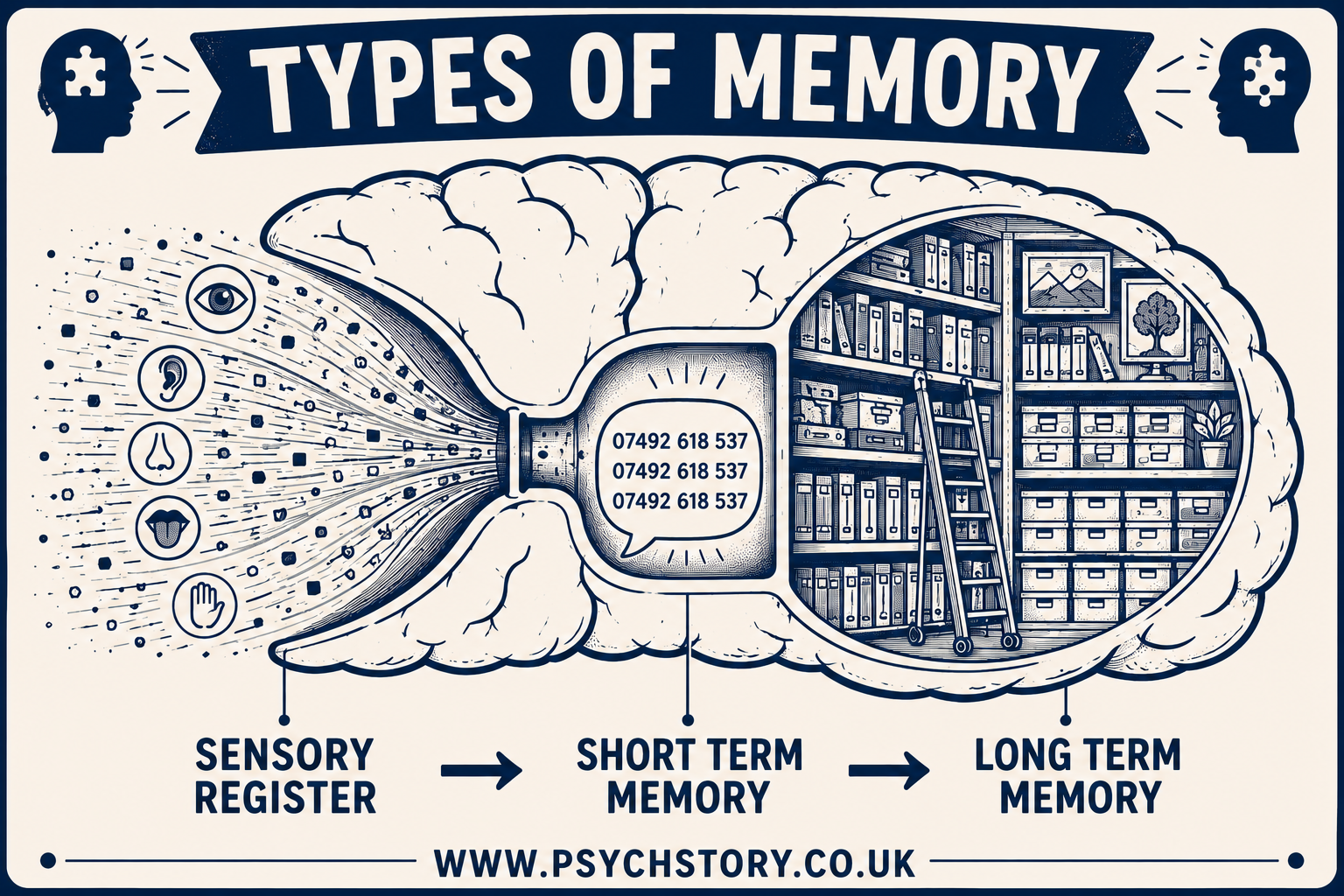
SPECIFICATION: TYPES OF MEMORY: Sensory Register, Short-Term Memory and Long-Term Memory.
KEYWORDS FOR MEMORY
The Sensory Register is the initial stage of memory that briefly captures sensory information from the environment. It includes:
Iconic Memory: Visual sensory memory (images and visual stimuli).
Echoic Memory: Auditory sensory memory (sounds).
Haptic Memory: Tactile sensory memory (touch).
Olfactory Memory: Memory for smells.
Gustatory Memory: Memory for tastes.
SHORT-TERM MEMORY (STM): Short-Term Memory refers to the temporary storage of information that is actively being processed. It typically holds a limited amount of information (around 7 items) for a short duration (approximately 18-30 seconds).
LONG-TERM MEMORY (LTM): Long-Term Memory is the continuous storage of information, which can last from a few minutes to an entire lifetime. It has a much larger capacity than STM and can store different types of information (e.g., declarative and procedural).
TRACE DECAY: Trace Decay is a theory of forgetting in which memory traces (the physical changes in the brain that represent memories) fade and weaken over time when they are not actively rehearsed or used.
TRANSFER OF STM TO LTM: The process through which information moves from Short-Term Memory to Long-Term Memory. This typically requires rehearsal and encoding, in which information is processed deeply enough to be stored in the long term.
FORGETTING THROUGH RETRIEVAL FAILURE: A type of forgetting that occurs when information is stored in Long-Term Memory but cannot be accessed. Retrieval failure often occurs due to a lack of retrieval cues or context.
LINEAR DIRECTION: In the context of memory models, a linear direction refers to the sequential process by which information moves through different memory stores—first to the sensory register, then to STM, and finally to LTM.
FORGETTING THROUGH DISPLACEMENT: Forgetting Through Displacement occurs when new information pushes out older information from Short-Term Memory due to its limited capacity.
UNITARY STORE: A Unitary Store is a memory model concept suggesting that memory is stored in a single, undifferentiated store rather than separate types (e.g., no division between STM and LTM).
MULTIPLE STORES: In contrast to a unitary store, Multiple Stores refer to models of memory that suggest distinct types of memory storage (e.g., Sensory Memory, Short-Term Memory, and Long-Term Memory), each with different characteristics.
REHEARSAL LOOP: The Rehearsal Loop is the process of repeatedly mentally repeating or verbalising information to keep it in Short-Term Memory or to transfer it to Long-Term Memory.
ENCODING|: Encoding is the process of transforming sensory input into a form that can be stored in memory. It is how information is prepared for storage in either Short-Term or Long-Term Memory.
CAPACITY: Capacity refers to the amount of information that can be held in a particular memory store. For instance, STM has a limited capacity (around 7 items), whereas LTM is thought to have a virtually unlimited capacity.
DURATION: Duration is the length of time information can be stored in a memory system. For example, STM has a short duration of around 18-30 seconds, whereas LTM can retain information for much longer, potentially a lifetime.
ACOUSTIC ENCODING: Acoustic Encoding is the process of converting information into sound patterns for storage in memory, often used in STM.
SEMANTIC ENCODING: Semantic Encoding is the encoding of information by its meaning, making it easier to recall. This type of encoding is more common in LTM.
VISUAL ENCODING: Visual Encoding is the process of converting visual information (e.g., images, colours) into a memory trace for storage. This type of encoding is often used in both sensory memory and STM.
WHAT ARE THE DIFFERENT TYPES OF MEMORY
The first chapter on the topic learns about the three basic stores of memory: sensory memory (or the Sensory Register), short-term memory, and long-term memory.
Please note that when students start learning about memory, they always begin with the premise that memory is divided into three stores; it isn’t. Memory is vastly more complicated than that; it is, however, a good place to start. You will learn about the other stores as you learn more about memory.
SENSORY MEMORY/REGISTER (THE FUTURE)
What surface are your feet on? Is your bottom in contact with a chair? Look around the room. Did you check every item as you entered it, or did you assume its contents and spatial dimensions? Can you remember every second of yesterday or only specific episodes? Can you imagine the quality of your existence if you had to regard all of your sensory perceptions constantly; that’s all the sights, sounds, tastes, sensations, and smells that your brain updates every nanosecond of consciousness!
People don’t pay attention to the vast array of sensory stimuli they experience every moment of their waking lives because they can’t; they’d go insane if they did. No human could cope with a constantly changing, unfiltered bombardment of multi-sensory data. Bewildered would be an understatement. Humans are designed to pay attention to only an atom’s worth of the available data, meaning most of their existence is ignored. In short, the essence of Sensory Memory is how your brain conjures up its ever-changing sense of reality.
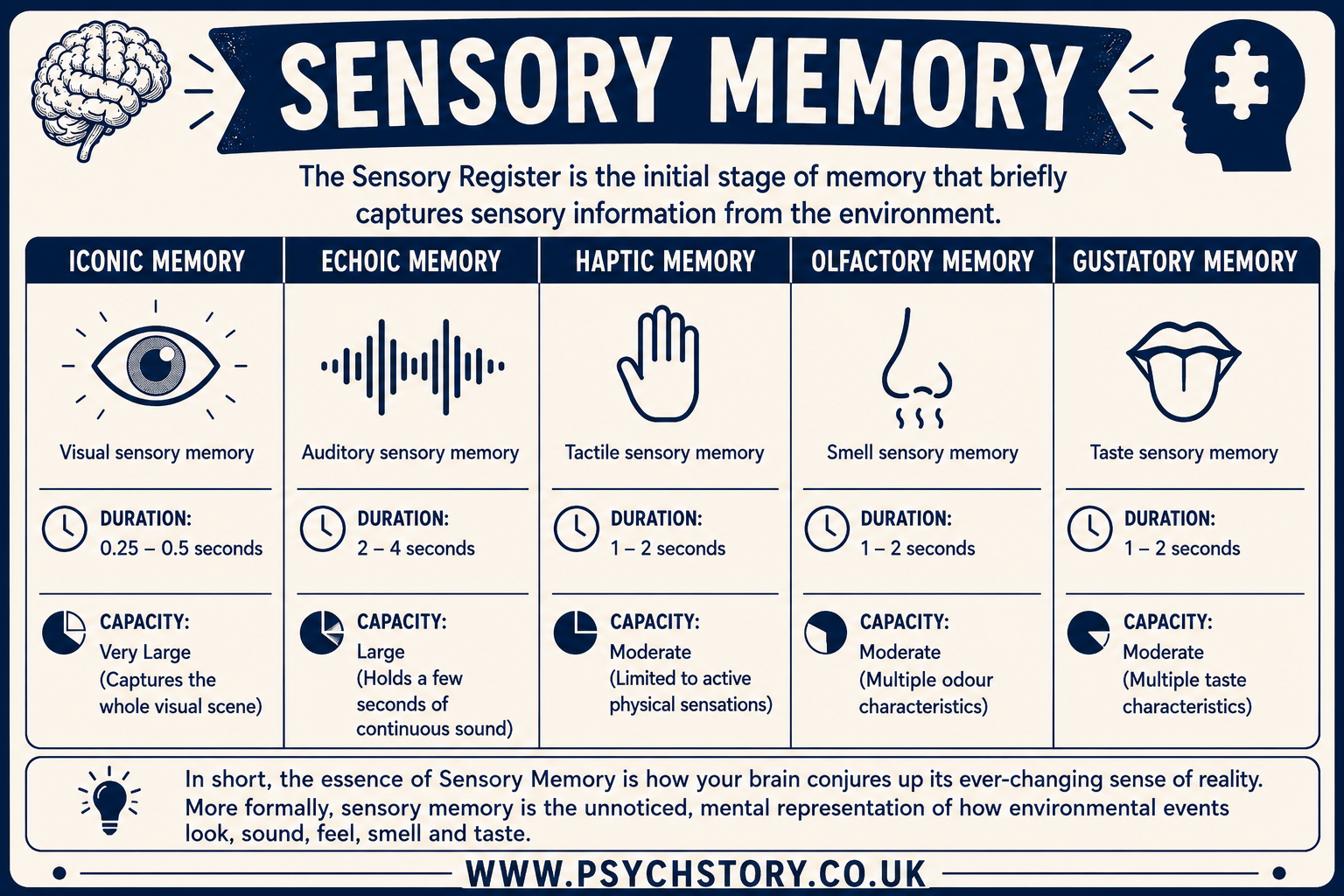
More formally, sensory memory is the unnoticed, mental representation of how environmental events look, sound, feel, smell and taste. It has five sense modalities (faculties): iconic (sight); echoic (sound); haptic (touch); olfactory (smell); gustatory (taste). SM gives humans a representation of the world to help them sense time, space, and physicality at any given moment; otherwise, all things outside their attention (including hypnotic states) would be void. But not with sensory memory, as the world lurks in the background on standby. It is only when sensory memory is noticed or given attention that it is recognised. Thus, it becomes conscious that perceptions become actualities as SM enters short-term memory, and a person becomes cognisant of sight, sound, thought, etc.
NB Sensory register and sensory memory are interchangeable terms, e.g., sensory memory is where the five sense modalities register their data.

ICONIC MEMORY: Iconic memory is the visual component of sensory memory. It briefly stores images and other visual information received by the eyes before it either fades or is transferred to short-term memory. Iconic memory has an extremely short duration, typically lasting between 0.25 and 0.5 seconds. Despite its brief lifespan, it has a very large capacity because it captures most of the visual scene at once. This temporary visual snapshot helps create the illusion of a continuous and stable visual world rather than a series of disconnected images.
ECHOIC MEMORY: Echoic memory is the auditory component of sensory memory. It briefly stores sounds and other auditory information after the original sound has ended. Unlike iconic memory, echoic memory lasts longer, typically between 2 and 4 seconds. This allows the brain to process speech, music, and environmental sounds over time. Research suggests that echoic memory has important temporal characteristics, meaning that the order, timing, and rhythm of sounds influence how they are perceived and remembered. Echoic memory explains why a person can still recall the last few words of a sentence even if attention was briefly diverted.
HAPTIC MEMORY: Haptic memory is the tactile component of sensory memory. It briefly stores information received through the sense of touch, including pressure, vibration, texture, temperature, pain, and bodily movement. Haptic memory is part of the somatosensory system and generally lasts for around 1 to 2 seconds. It allows the brain to maintain a temporary representation of tactile experiences, helping individuals interact smoothly with their environment. For example, haptic memory enables a person to continue perceiving the feel of an object for a short time after contact has ended.
OLFACTORY MEMORY: Olfactory memory is the sensory memory system associated with smell. Odours are detected by receptors in the nose and processed by brain regions closely linked to emotion and long-term memory. Although less extensively studied than iconic or echoic memory, olfactory information can persist long enough to influence perception and behaviour. Smells are particularly powerful retrieval cues and often trigger vivid autobiographical memories.
GUSTATORY MEMORY: Gustatory memory is the sensory memory system associated with taste. It briefly stores information about flavours detected by taste receptors on the tongue. Gustatory memory allows the brain to maintain a short-lived representation of sweet, sour, salty, bitter, and umami tastes, helping to identify food and guide eating behaviour. Like olfactory memory, gustatory memory is less researched than visual and auditory sensory memory, but contributes to the overall sensory experience of the environment
OTHER FACTS ABOUT SENSORY MEMORY
The role of SM is simple; it just snaps a temporary picture of everything we sense. Thus, each sensory modality is brief, and memory is continuously replaced by new information as the previous information decays. Information, once lost from SM, is gone for good, and there is no way to recover it.
SM does not participate in higher cognitive functions, so we are unaware of SM unless we pay attention to sight, sound, etc.
Information received in SM is raw and unprocessed, but high-resolution and detail-oriented.
Information in SM is stored in its specific sense modality (the way a stimulus is sensed). For instance, auditory information is stored only in echoic memory, and visual information is stored in iconic memory. Different SM stores have different durations and capacities.
SM capacity and duration are mostly influenced by genetics (DNA). But mutations to the brain, nerve growth and methylation also affect sensory memory stores.
SHORT-TERM MEMORY: (THE PRESENT)

When an item from Sensory-Memory is noticed, for example, a recognisable person, your phone ringing or something unusual (a loud bang, a dodgy stranger) it enters Short-Term-Memory (STM). The person then becomes aware/cognisant of a sensory perception. STM can, therefore, be likened to our consciousness because whenever we are aware of what we are experiencing (e.g., what we are seeing, hearing or tasting), it is in our STM. STM is the store used for holding small amounts of information in our minds for short periods. For example, short-term memory can be used to remember a phone number that has just been recited or where we hold a conversation. In other words, you are reading right now in your STM because you are engaging with it. All other sensory perceptions in conjunction with reading will be on standby in SM until they are noticed. For instance, stop reading momentarily and pay attention to the sounds around you. Did you notice anything? If you did, you allowed a previously unacknowledged sensory perception to enter your consciousness/STM. STM is very limited in the amount of information it can hold (capacity). For example, on average, people struggle to recall more than five to nine numbers or letters in STM memory tests. The duration (length) of short-term memory is believed to be about 18-30 seconds in neurotypical people. In other words, we don’t hold any thought or sensation for long before it disappears or gets transferred to long-term memory. For example, think about ‘cheese’ for as long as possible to test your STM duration. Try not to let your thoughts about cheese slip from your mind. In contrast, long-term memory holds information indefinitely.
Please note: Short-Term Memory is also sometimes referred to as primary, active, and Working Memory, but there are differences among these definitions. Short-term memory should be distinguished from Working Memory, as it is far more complex and will be discussed further in this topic.
"Short-term memory is related to the primary memory of James (1890) and is a term that Broadbent (1958) and Atkinson and Shiffrin (1968) used in slightly different ways. Like Atkinson and Shiffrin, I take it to reflect the faculties of the human mind that can temporarily hold a limited amount of information in a readily accessible state. One difference between the term “short-term memory” and “primary memory” is that the latter might be considered more restricted. It is possible that not every temporarily accessible idea is, or even was, in conscious awareness. For example, by this conception, if you are speaking to a person with a foreign accent and inadvertently alter your speech to match the foreign speaker’s accent, you are influenced by what was, until that point, an unconscious (and therefore uncontrollable) aspect of your short-term memory. One might relate short-term memory to a pattern of neural firing representing a particular idea. One might consider the idea in short-term memory only when the firing pattern, or cell assembly, is active (Hebb, 1949). The individual might be unaware of the idea during that activation period. Working memory is not completely distinct from short-term memory. It is a term used by Miller et al. (1960) to refer to memory used for planning and carrying out behaviour. One relies on working memory to retain partial results while solving an arithmetic problem without paper, to combine premises in a lengthy rhetorical argument, or to bake a cake without the unfortunate mistake of adding the same ingredient twice. (Your working memory would have been more heavily taxed while reading the previous sentence if I had saved the phrase “one relies on working memory” until the end of the sentence, which I did within my first draft; working memory thus affects good writing.) 'Working memory' became more dominant after Baddeley and Hitch (1974) demonstrated that a single module could not account for all temporary memory." - Nelson Cowan, Department of Psychological Sciences, University of Missouri.
By the way, are you still thinking about cheese? I thought not; I told you so!

LONG-TERM MEMORY (THE PAST)
What happens to our old short-term memories? In other words, where do prior short-term memories go when attending to new short-term memories? According to research, most of our short-term memories decay or get displaced, e.g., they are pushed out of the STM store to make room for new short-term memories; the bottom line is that most are lost forever. Thankfully, some of our STM data gets transferred to long-term memory stores. But what is long-term memory?
In short, long-term memory is the record of who we are as individuals and all we have learned; it is the backstory of our lives, personalities, experiences, and knowledge. Without LTM, we could not speak, identify objects or even walk. The world would be puzzling, chaotic, and meaningless. We would relive the same moments over and over again. It would be akin to being a newborn baby, when the world is without concepts or schemas. Contrary to popular belief, the essence of who we are does not reside in our DNA but lives in our long-term memories - so if you are hoping to achieve eternal life by cloning or reincarnation, then you will be sadly disappointed. All you would achieve by cloning yourself is creating an identical (MZ) twin. And although MZ twins do share identical genes, they are, in fact, two distinct people with different autobiographical histories and memories. Likewise, if you end up being reincarnated after death but can’t remember your previous life and identity, then it is going to be a pretty unrewarding afterlife. Besides, for all you know, you may have been reincarnated several times already. Still, if this is true, you won’t care about your past existences because if you can’t recall previous friends, relatives and experiences, then who are you?
Incidentally, this is why I didn’t rate the film The Matrix. If you saw it, do you remember when the traitor Cypher told Smith that he wanted to have his memory erased and be reinserted into the Matrix because "ignorance is bliss”? But Cypher would have found no more bliss from being reinserted into the Matrix than from being killed. If he did not remember his former existence, how could he benefit from the contented ignorance brought about by taking the blue pill? In reality, the blue Pill and death would have both achieved the same thing: termination of the former self. By the way, all forms of dementia stem from the brain’s inability to transfer short-term memories into long-term memories. Thus, long-term memory can be considered as the total of the self.
To sum up, if you can remember something that happened more than just a few moments ago, whether just hours ago or decades earlier, it is a long-term memory you accessed. Long-term memory also refers to the indefinite storage of memories during a lifetime. This type of memory tends to be stable and has a seemingly never-ending capacity. Long-term memory can be subdivided into explicit (conscious) and implicit (unconscious).
MEMORY QUESTIONS
SENSORY MEMORY
Define sensory memory. What role does it play in processing sensory data?
Name the five types of sensory memory. How does each correspond to a sensory modality?
Why don’t humans consciously perceive all sensory input? How does the brain manage this constant influx of data?
Explain why sensory memory is described as high-resolution but brief. What happens to sensory information that is not attended to?
Which sensory memory is responsible for briefly holding visual information? What about auditory information?
What factors can affect the capacity and duration of sensory memory?
SHORT-TERM MEMORY
One key difference between sensory and short-term memory is that:
a. Information in sensory memory fades in 1-2 seconds, while short-term memories last several hours.
b. Short-term memories can be described, while sensory memories cannot.
c. The quality and detail of sensory memory are far superior to those of short-term memory.
d. Sensory memory stores auditory information, while short-term memory stores visual information.
The simplest way to maintain information in short-term memory is to repeat the information in a process called:
a. Chunking
b. Rehearsal
c. Revision
d. Recall
An instructor gives her students a list of terms to memorise for their biology exam and immediately asks one of them to recite it. Which terms will the student most likely recall?
a. The student won’t recall any terms because they have not used rehearsal to encode them.
b. Since there was no delay, the student will remember the terms at the end of the list (recency effect).
c. Since there was no delay, the student will remember the terms at the beginning of the list (primacy effect).
d. The student will recall only those items to which they have attached some meaning.
What is the function of short-term memory (STM)? How does it differ from sensory memory?
What is the average capacity of STM, and how much information can it hold?
Explain two ways information can be lost from STM.
In your own words, describe how attention plays a role in transferring sensory memory to STM.
How does rehearsal help maintain information in STM? Provide an example.
Which of the following bits of information would be the easiest to chunk and thus encode?
a.1982LOL
b. IEKFES
c. 278392
d. XYZZYX
Jamie wanted to contact his doctor. He looked up the number in his telephone directory. Before he dialled the number, he talked briefly with his friend. Jamie was about to phone his doctor, but had forgotten the number. Explain why Jamie forgot the number.
A mathematics teacher gives her students the following number memorisation for their geometry exam and immediately asks one student to recite it. The number is: 3.141592653589793. According to the primacy and recency effect, which numbers will the student most likely recall?
a. The student won’t recall any terms because they have not used rehearsal to encode them.
b. Since there was no delay, the student will remember the terms at the end of the list (recency effect).
c. Since there was no delay, the student will remember the terms at the beginning of the list (primacy effect).
d. The student will recall only those items to which they have attached some meaning.
e. The students will remember numbers at the beginning because they are now in LTM, and numbers at the end of the list because they are still in STM. The numbers in the middle would have been displaced.
LONG-TERM MEMORY
What is the main difference between short-term and long-term memory?
Explain what happens to short-term memories that are not transferred to long-term memory.
In your own words, describe the role long-term memory plays in shaping who we are. Why is it considered the "record of the self"?
Why would the inability to transfer short-term memories to long-term memory result in conditions such as dementia?