
CODING, CAPACITY AND DURATION OF MEMORY
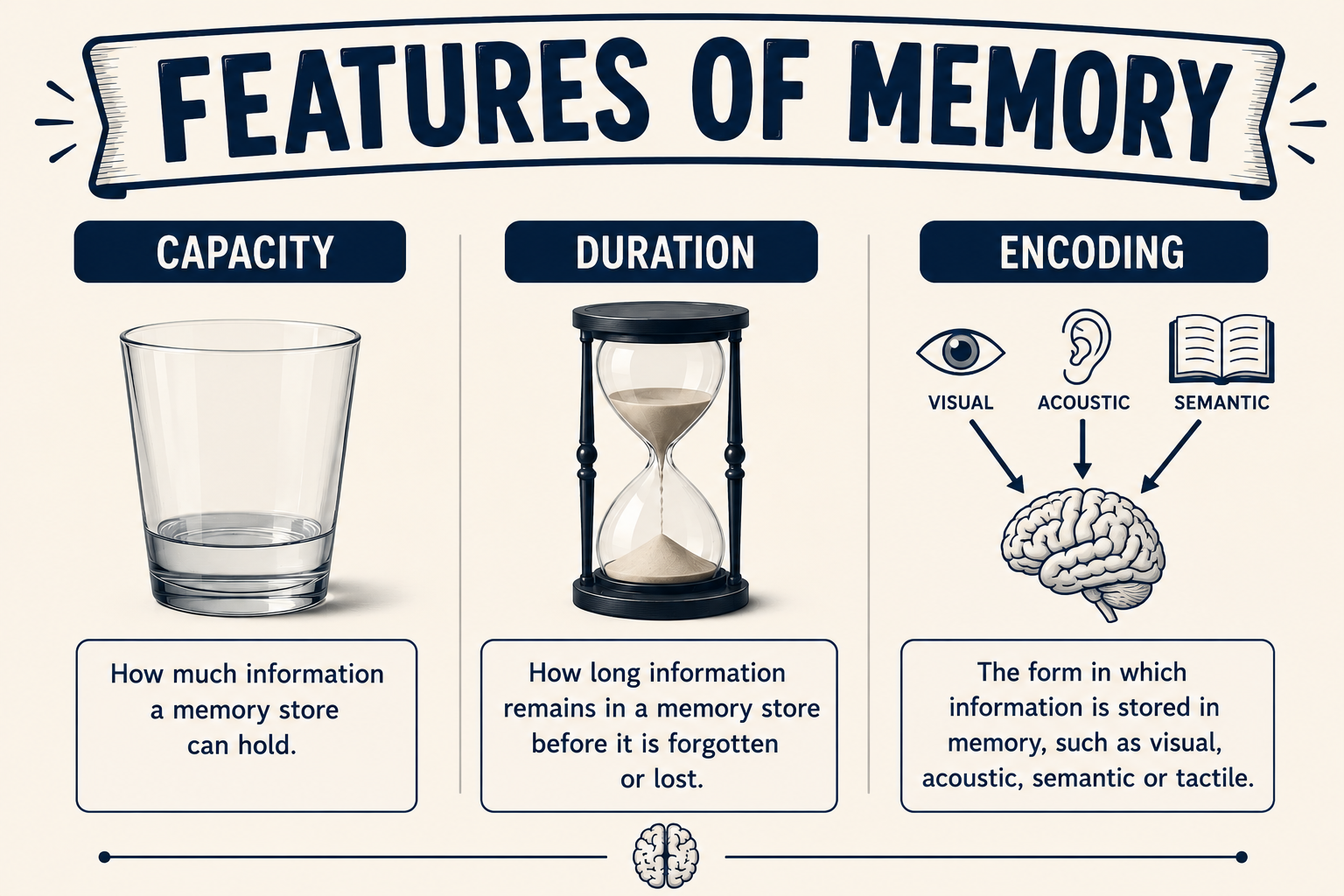
FEATURES OF MEMORY
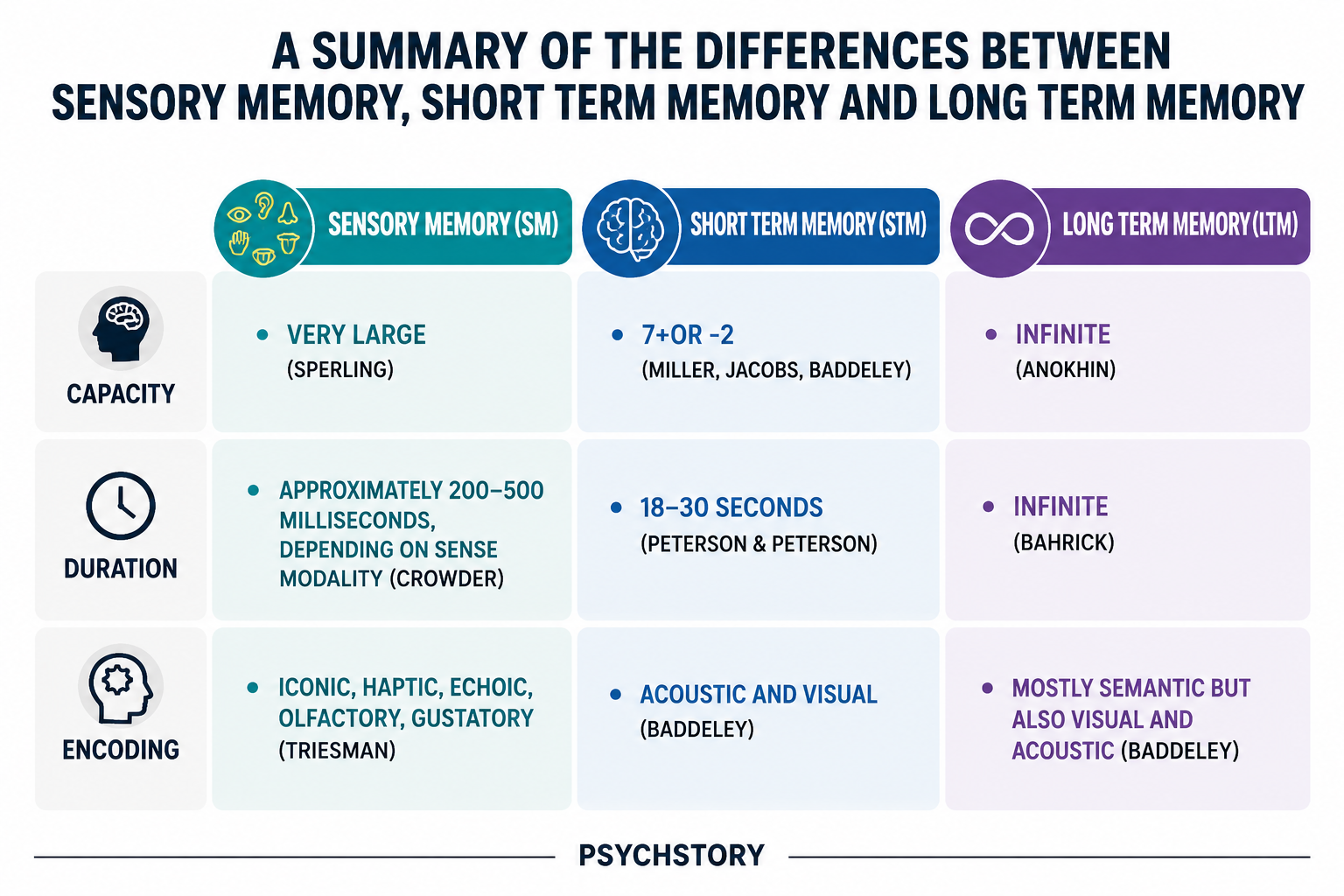
Now that you have learned about the three types of memory, it is time to tell you about the features of each memory store. Memory store features are measured in terms of capacity, duration, and encoding (or coding, as AQA now calls it). The main premise of this section is to prove that the three stores outlined above, i.e., SM, STM, and LTM, are real and distinct from one another. More importantly, that memory is not a unitary module in the brain as previously thought before the 1960s. You may have noticed from the specification that AQA wants you to learn the Multistore Model of Memory by Atkinson and Shiffrin (1968). This model was one of the first theories to suggest that memory was not a single store in the brain but consisted of three multi-stores (hence its name). Atkinson and Shiffrin believed that if they could prove that the three stores were qualitatively different in their encoding capacities and durations, they would have evidence for their model. AQA wants you to learn the differences in capacity, duration, and encoding among SM, STM, and LTM. There are two ways you can be examined regarding this. One is to answer short questions about each store's features, and the other is to use the research studies (findings and conclusions only) as A03 supporting evidence in a Multi-Store Model essay.
Please note that I have included the aims, procedures, findings, and conclusions (APFC) of all studies on capacity, duration, and encoding for two reasons: firstly, students studying other specifications and examinations might be required to learn the APFC for A01. Secondly, even if AQA does not need the aims and procedures of these studies in A01, knowing the full research details is still helpful.
CAPACITY IN MEMORY
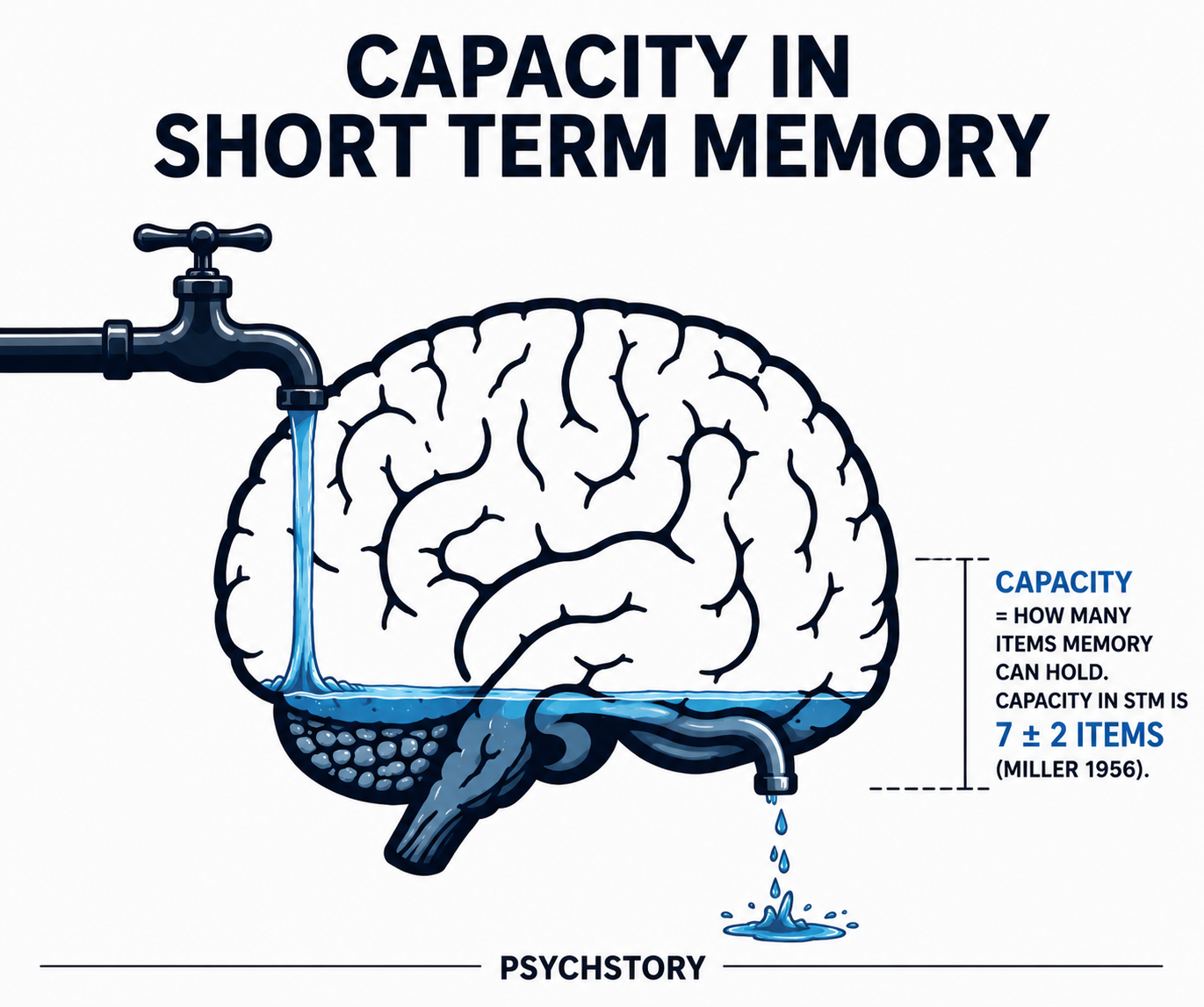
How much information can Memory hold?
CAPACITY RESEARCH IN STM - APFC A01
Miller (1956) Experimental cognitive psychology research
In psychology and neuroscience, memory span is the name given to STM capacity
Memory span is the longest list of items a person can repeat in correct order immediately after presentation, on 50% of trials. Items may include words, numbers, or letters. Another way to test capacity is through the recency effect. We usually remember the last numbers on a list because they are still being rehearsed in our short-term memory.
MILLER’S MAGIC NUMBER SEVEN
According to research, most individuals can store between 5 and 9 items in their short-term memory. This idea was put forward by Miller (1956), who called it the magic number 7. He thought that short-term memory could hold seven plus or minus two items) because it had only a limited number of “spaces” for storing items. It is also called Miller's Law, despite Miller calling the figure "little more than a joke" Cowan (2001) suggests that a more realistic figure is 4±1 items.
Evidence from various studies supports Miller’s theory, such asJacobs’s (1887) digit span test. This used every letter in the alphabet and numbers apart from w and seven because they had two syllables. He found out that people find it easier to recall numbers rather than letters. The average span for letters was 7.3, and for numbers, it was 9.3. He postulated that this was because there were only nine numbers but 26 letters.
It seems strange that so many A-level texts cite Jacobs (1887) as the research study for Miller (1956), since theories are supposed to predate the research! Maybe it should be called “ Jacob’s magic number 7 or Jacob’s law?
WHAT IS CHUNKING IN STM?
Chunking refers to taking individual pieces of information and grouping them into larger units. Miller didn’t specify how much information can be held in each slot, so if we can “chunk” similar information together, we can store much more in our short-term memory. Probably the most common example of chunking occurs in phone numbers, e.g., 07781384778 is easier to remember as 0778 1384778. Grouping items into chunks of 3 can enhance short-term memory capacity, especially if the chunks are meaningful to the individual, e.g., STM and LTM are only meaningful to psychology students.
ACTIVITY ON CHUNKING
Memorise the following sequence for one minute, then cover it and write down what you can remember.
ITVBBCSTMLTMLOLBRBGSH
If that was difficult, it is entirely expected. The sequence contains 21 characters — far beyond the 7 ± 2 limit of short-term memory capacity. Presented as a single unbroken string, the characters are meaningless, and meaningless information is the hardest kind to hold.
Now try again with the same sequence, this time broken up as follows:
ITV — BBC — STM — LTM — LOL — BRB — GSH
The difference should be immediate. The sequence has not changed — the same 21 characters appear in the same order — but breaking them into recognisable units transforms them from random letters into meaningful chunks. Short-term memory does not store individual characters; it stores chunks. And seven chunks fall comfortably within capacity, even if each chunk contains several characters. This is chunking: the process by which information is grouped into meaningful units, effectively expanding what short-term memory can hold without increasing its fundamental limit.
EVALUATION OF STM AND MEMORY CAPACITY
Since the research by Jacobs and then Miller, it has been discovered that STM's storage capacity depends on the information being stored. For instance, the digit span is lower for long words than for short words. Generally, the memory span for verbal content (digits, letters, words, etc.) strongly depends on the time it takes to speak aloud. Certainly, digit spans are higher in languages where numbers and letters have fewer syllables (English and Mandarin), but in languages with more syllables, e.g., Arabic, the memory span is shorter. Some researchers have therefore proposed that the limited capacity of short-term memory for verbal material is not a "magic number" but rather a "magic spell," i.e. a time. Baddeley used this finding to theorise that one component of his model of working memory, the phonological loop, can hold around 2 seconds of sound.
CAPACITY RESEARCH IN LTM - APFC A01
IMPOSSIBLE TO TEST.
Think about it! You can’t experimentally test for this, as it involves intentionally overfilling a participant’s head with memories. How could you even design such a study? Besides, it would take a lifetime. And it would be mind-blowingly boring for the participant. Could a person’s long-term memory drive (store) become full? It isn’t very likely.
CAPACITY OF MEMORY QUESTIONS
Most PIN codes are four digits long and are easy to remember. In contrast, mobile phone numbers are 11 digits long. Most people would not be able to remember a friend’s new mobile phone number unless they could say it to themselves several times without interruption.
DURATION IN MEMORY
HOW LONG DO MEMORIES LAST?
DURATION RESEARCH IN STM- APFC A01
PETERSON & PETERSON : EXPERIMENTAL COGNITIVE RESEARCH
AIMS AND HYPOTHESIS
To investigate the duration of short-term memory.
Lloyd and Margaret Peterson aimed to test the hypothesis that information which is not rehearsed is lost quickly from short-term memory
PROCEDURE
A lab experiment was conducted in which 24 participants (psychology students) had to recall trigrams (meaningless three-consonant syllables), such as TGH and CLS. The trigrams were presented one at a time and had to be recalled after intervals of 3, 6, 9, 12, 15, or 18 seconds for each trial. No two successive trigrams contained any of the same letters. After hearing a trigram, participants were asked to count backwards in threes or fours from a specified random number until they saw a red light appear (at which point they recalled the trigram). This is known as the Brown-Peterson technique, which aimed to prevent rehearsal. The independent variable was the time interval between the experimenter saying the trigram and the participant recalling it (after seeing a red light), e.g., 3, 6, 9, 12, 15, or 18 seconds. The dependent variable was the number of trigrams correctly recalled by the participants after every trial. There were six trials in total.
FINDINGS
Their results showed that the longer each student had to count backwards, the less accurately they could recall the trigram.
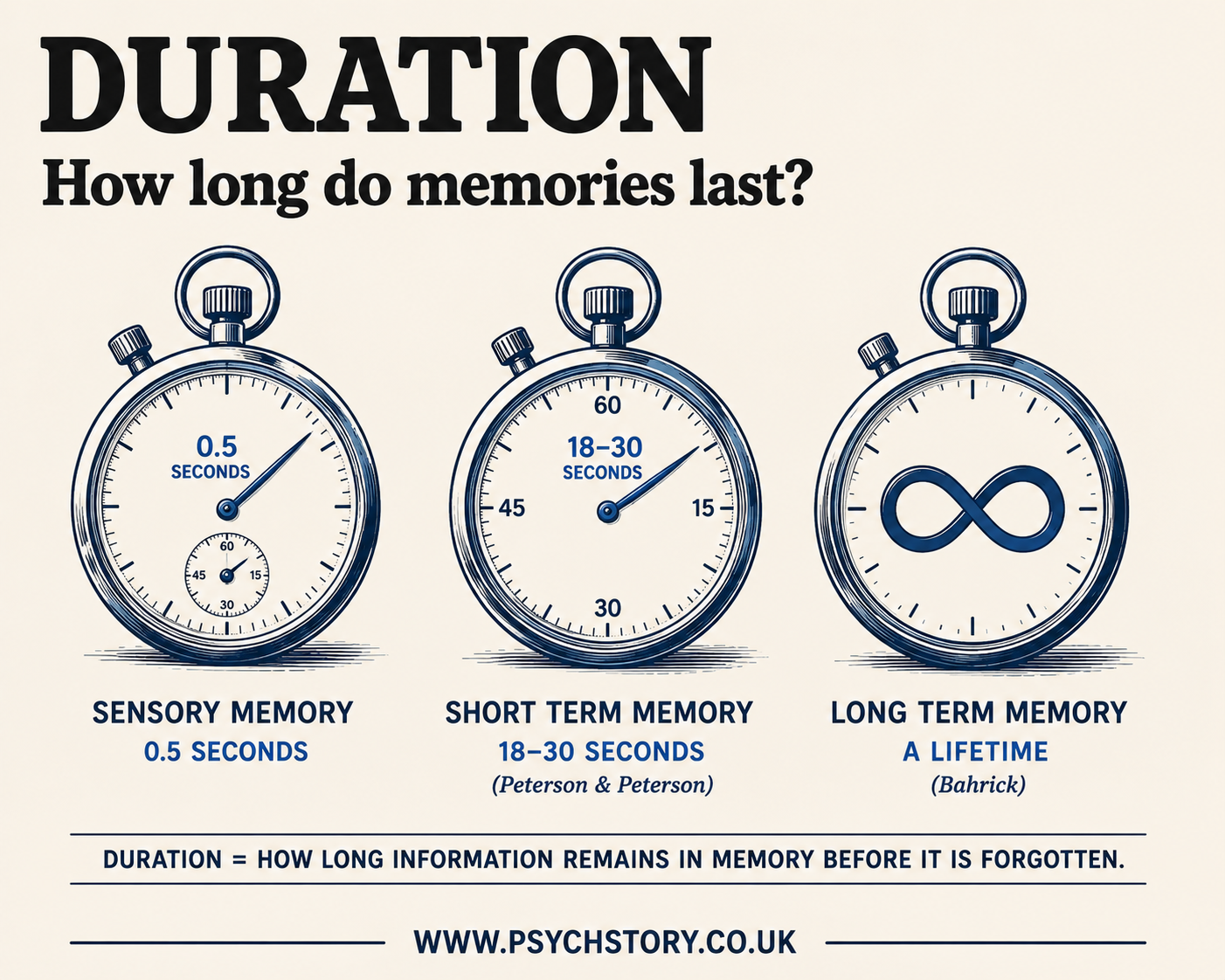
After 3 seconds, 80% of the trigrams were recalled correctly.
After 6 seconds, this fell to 50%.
After 18 seconds, less than 10% of the trigrams were recalled correctly.
DURATION RESEARCH IN LTM
Bahrick (1975) Field experiment
Bahrick investigated the duration of long-term memory using a sample of 392 American university graduates. The graduates were shown photographs from their high school yearbook, and for each photograph, participants were given a set of names and asked to select the name that matched it. Bahrick found that 90% of participants could correctly match names to faces 14 years after graduation, and 60% could do so 47 years after graduation. Bahrick concluded that people could remember certain types of information, such as names and faces, for almost a lifetime. These results support the multi-store model and the idea that our long-term memory has a lifetime duration (at least 47 years) and is semantically encoded.

EVALUATION OF DURATION OF MEMORY
Bahrick’s research used a sample of 392 American university graduates and lacked population validity. Psychologists cannot generalise the results of Bahrick’s research to other populations, such as students in the UK or across Europe. As a result, we cannot conclude whether other populations would demonstrate the same ability to recall names and faces after 47 years.
Furthermore, Bahrick found that the accuracy of long-term memory was 90% after 14 years and 60% after 47 years. His research cannot determine whether long-term memory becomes less accurate over time because of limited duration or whether it worsens with age. This is important because psychologists cannot determine whether our long-term memory has an unlimited duration (as the multi-store model suggests) or a limited one.
Finally, it could be argued that Bahrick’s study has high ecological validity because it used real-life memories. In this study, participants recalled real-life information by matching pictures of classmates with their names. Therefore, these results reflect our memory of real-life events and can be applied to everyday human memory.
DURATION OF MEMORY QUESTIONS
Describe one way in which psychologists have investigated the duration of short-term memory. In your answer, you should include details of stimulus materials used, what participants were asked to do and how duration was measured. Four marks
ENCODING IN MEMORY
How do Memories enter the brain?
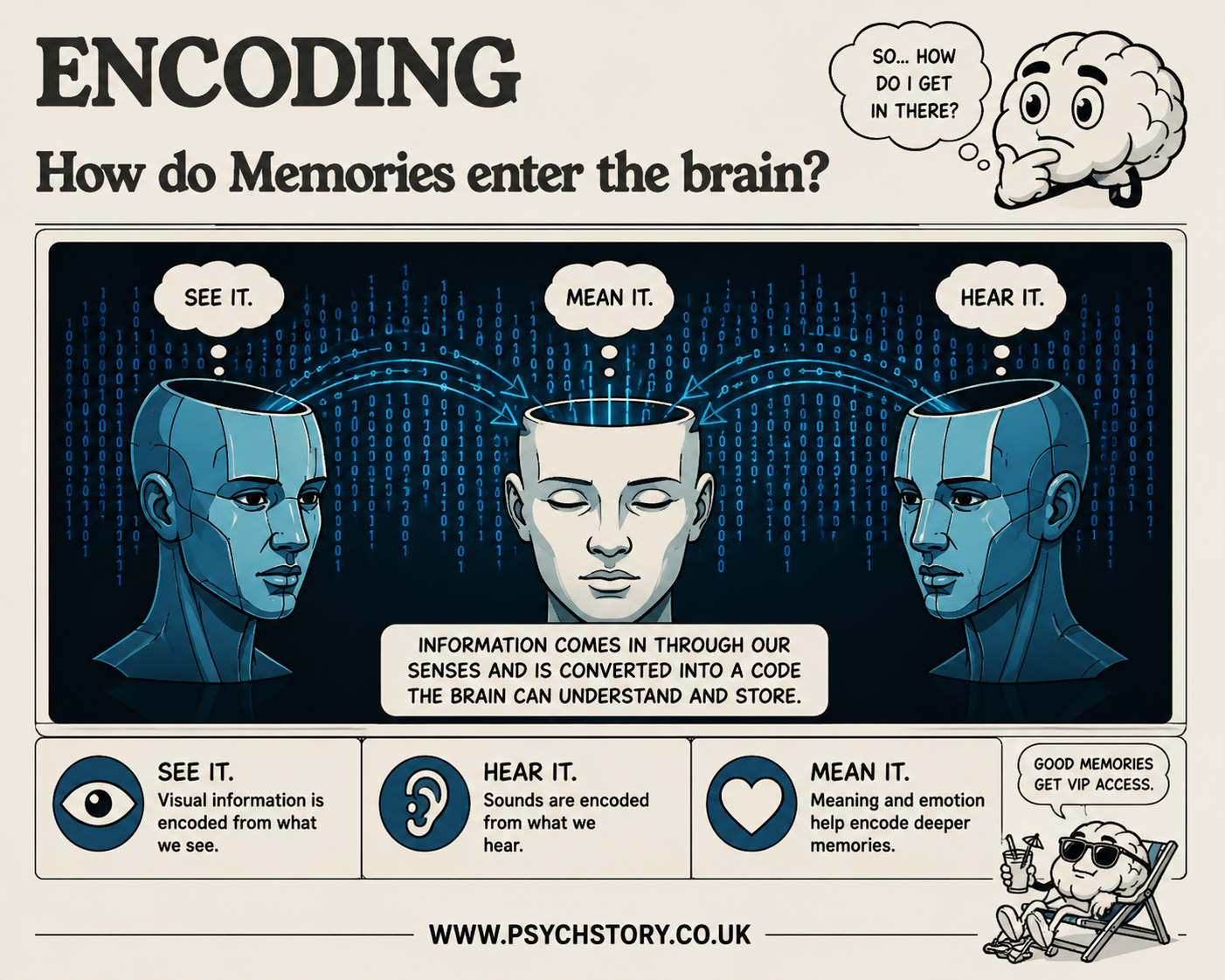
Some students struggle with the concept of encoding. Basically, it means what form of code does information enter the STM or LTM memory store, e.g.,
ACOUSTIC: Did the memory encode by sound/being heard, as in someone telling you something?
VISUAL: Was the memory encoded by sight/seeing something, as in seeing a face?
SEMANTIC: Did the memory encode by meaning/gist, as in being able to repeat a story, theory or gossip in your own words as opposed to repeating it word for word? For example, most of us know the fairy tale “Little Red Riding Hood”, and if asked to retell the story, we would not do it verbatim because we would find it impossible to learn everything we heard by syntax (Syntax describes the correct order of words). Rather, we would learn the gist (or semantics /meaning) and retell our rendition or understanding of Little Red Riding Hood. Lastly, semantics can be likened to synonyms; e.g., synonyms for the colour red are scarlet, crimson, vermilion, ruby, cherry, cerise, cardinal, carmine, wine-coloured, claret, blood red, flame, flaming, coral, cochineal, rose, rosy. etc
Incidentally, semantics is a good measure to test whether or not you understand something you have learned in class, because if you can not write up a theory in your own words and need to copy the syntax from a textbook, then this should alert you to the fact that you do not understand the theory. Therefore, it is unlikely to get stored in your LTM. By the way, Alexa, Siri, and Google don’t understand a word you type or say because they operate on syntax, not semantics, so if they can’t find an exact match to your search, they will not look for contextual clues or make the best guess as they are programmed to just search for matching words or phrases which is why you often get thrown results that don’t match your question. Humans who genuinely understand semantics don’t work like this. Suppose you ask a human, “What is that Oobodoba in the sky? The curved one, and made of strips of colour in red, orange, yellow, green, blue, indigo and violet” Despite Oobodoba being a made-up word, the person you asked could likely glean from the description that you’re giving that it is a rainbow, this is also an example of semantics.
ENCODING RESEARCH IN STM & LTM - BADDELEY
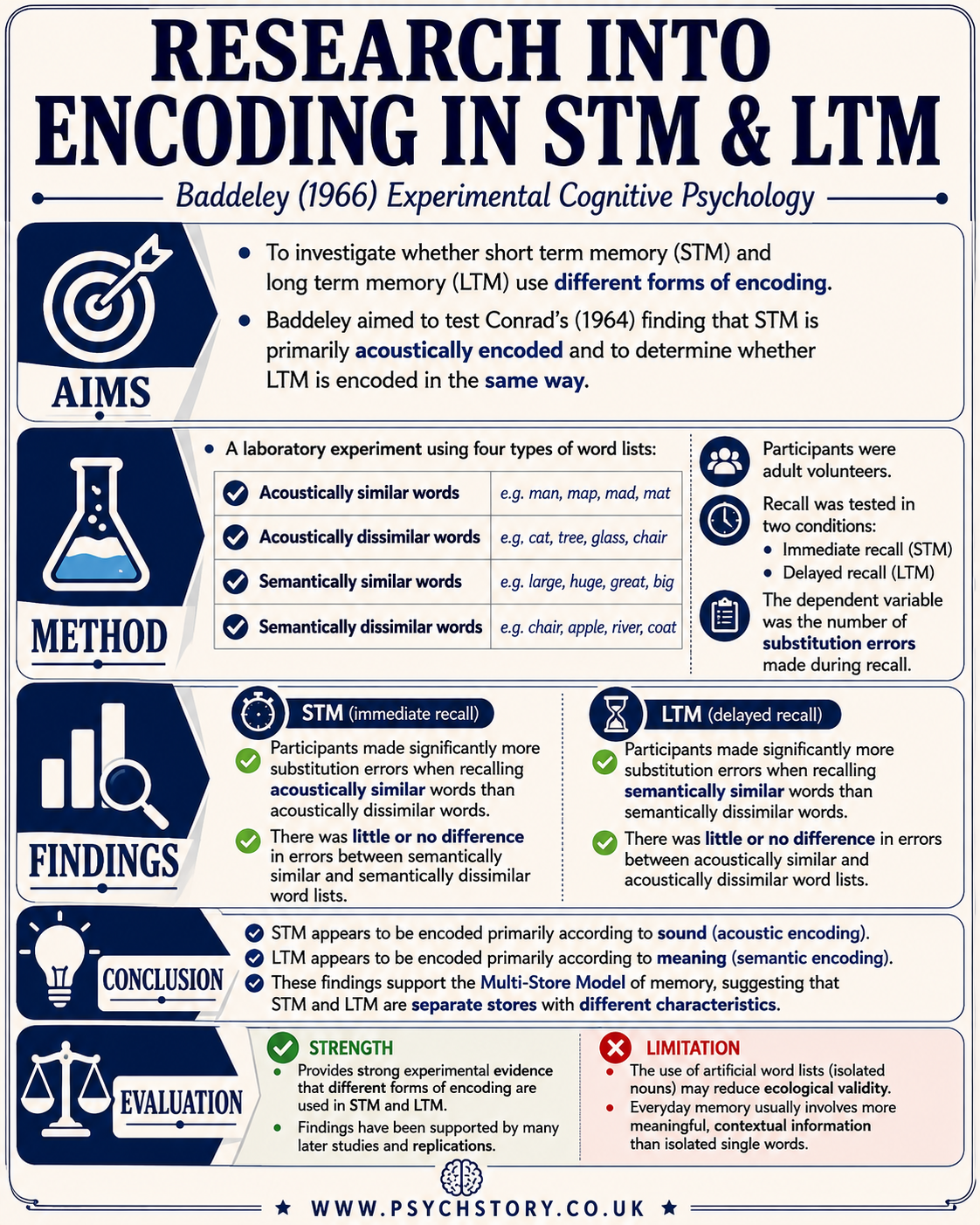
Research into encoding in STM & LTM Baddeley (1966) Experimental cognitive psychology
AIMS/HYPOTHESIS
To explore the effects of acoustic and semantic coding in short-term memory and long-term memory
PROCEDURES/METHOD
In the STM study, participants were asked to recall, immediately after the presentation, a list of five words in serial order drawn from the following categories.
-acoustically similar words (e.g. man, mad, map): Words that sound the same
-acoustically dissimilar words (e.g. pen, day, few): Words that sound different
-semantically similar words (e.g. great, big, large): Words that have the same meaning
-semantically dissimilar words (e.g. hot, old, late): Words that have a different meaning
In the LTM study, each word list was extended to 10 words, and recall was tested after 20 minutes.
FINDINGS
Words with similar sounds were much harder to recall using STM than words with dissimilar sounds.
The similarity of meaning had only a very slight detrimental effect on STM
When participants recalled from LTM, the recall was much worse for semantically similar words than for semantically dissimilar words
Recall from LTM was the same for acoustically similar and acoustically dissimilar words
CONCLUSIONS ON MEMORY ENCODING RESEARCH
STM relies heavily on acoustic coding
LTM primarily makes use of semantic coding
CRITICISMS OF BADDELEY AND HITCH’S STUDY
The use of the experimental method allows a causal link to be drawn between the type of coding used in STM and LTM and the accuracy of recall, since it enables control of extraneous variables, thereby enhancing Validity and Reliability.
It is scientific in its approach, which also adds credibility to the research
The conclusions of this study may not reflect the complexities of encoding. Evidence from other studies shows that, in certain circumstances, both STM and LTM can use other forms of coding.
ENCODING STIRAGE AND RETRIEVAL
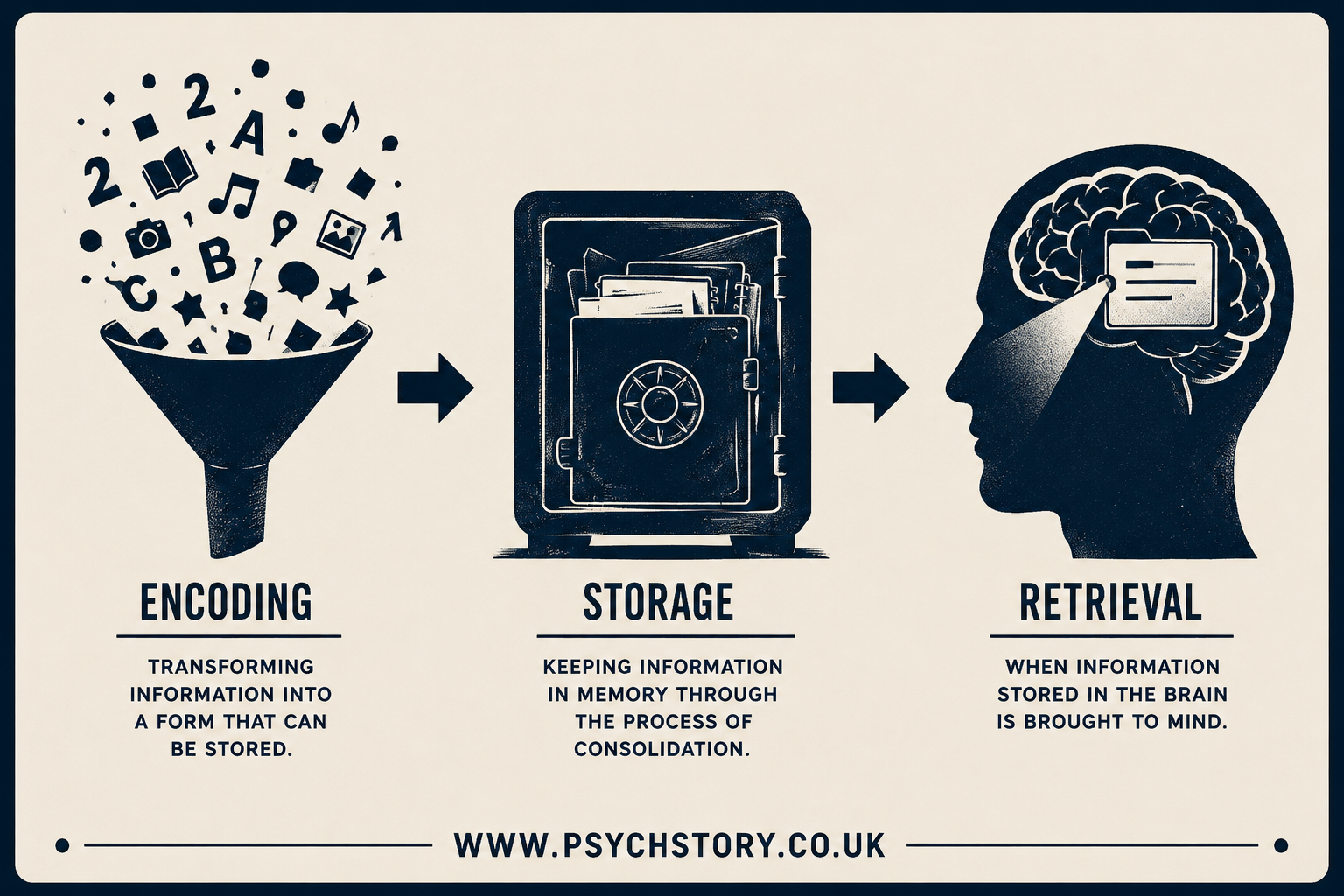
ENCODING
Encoding is the process of converting information from the environment into a form that can be stored in memory. Before information can enter a memory store, the brain must transform it into a mental code. This coding can be visual (based on images), acoustic (based on sound), semantic (based on meaning), tactile (based on touch), olfactory (based on smell), or gustatory (based on taste).
Research suggests that different memory stores tend to rely on different forms of encoding. Baddeley (1966) found that short-term memory mainly encodes information acoustically, whereas long-term memory relies more heavily on semantic encoding. Encoding is therefore the first stage of memory and determines how information is represented within the cognitive system.
STORAGE
Storage refers to the retention of encoded information over time. Once information has been encoded, it must be maintained within a memory store. Storage can last for fractions of a second in sensory memory, around 18 to 30 seconds in short-term memory without rehearsal, or potentially a lifetime in long-term memory.
The duration and capacity of storage differ between memory systems. Sensory memory stores large amounts of sensory information very briefly. Short-term memory has a limited capacity, often estimated at around seven items plus or minus two. Long-term memory appears to have an almost unlimited capacity and can retain information for many years.
RETRIEVAL
Retrieval is the process of accessing information stored in memory and bringing it into conscious awareness. Retrieval allows past experiences, knowledge and skills to be used when needed.
Successful retrieval depends on the strength of the memory trace and the availability of appropriate retrieval cues. Memories are often easier to retrieve when the context or circumstances at recall are similar to those present during encoding. Retrieval may involve recognising information, such as identifying a face, or recalling information without prompts, such as answering an examination question.
Together, encoding, storage and retrieval form the three fundamental processes of memory. Information must first be encoded, then stored, and finally retrieved before it can influence behaviour, thinking and decision making
QUESTIONS ON ENCODING IN MEMORY
Identify the main type of coding used in each of the following components of the multi-store model of memory. 2 marks
Short-term memory
Long-term memory
In an investigation into memory, participants were presented with two different lists of words. Research suggests that the encoding and capacity of short-term memory differ from those of long-term memory.
Explain what is meant by coding. 2 marks
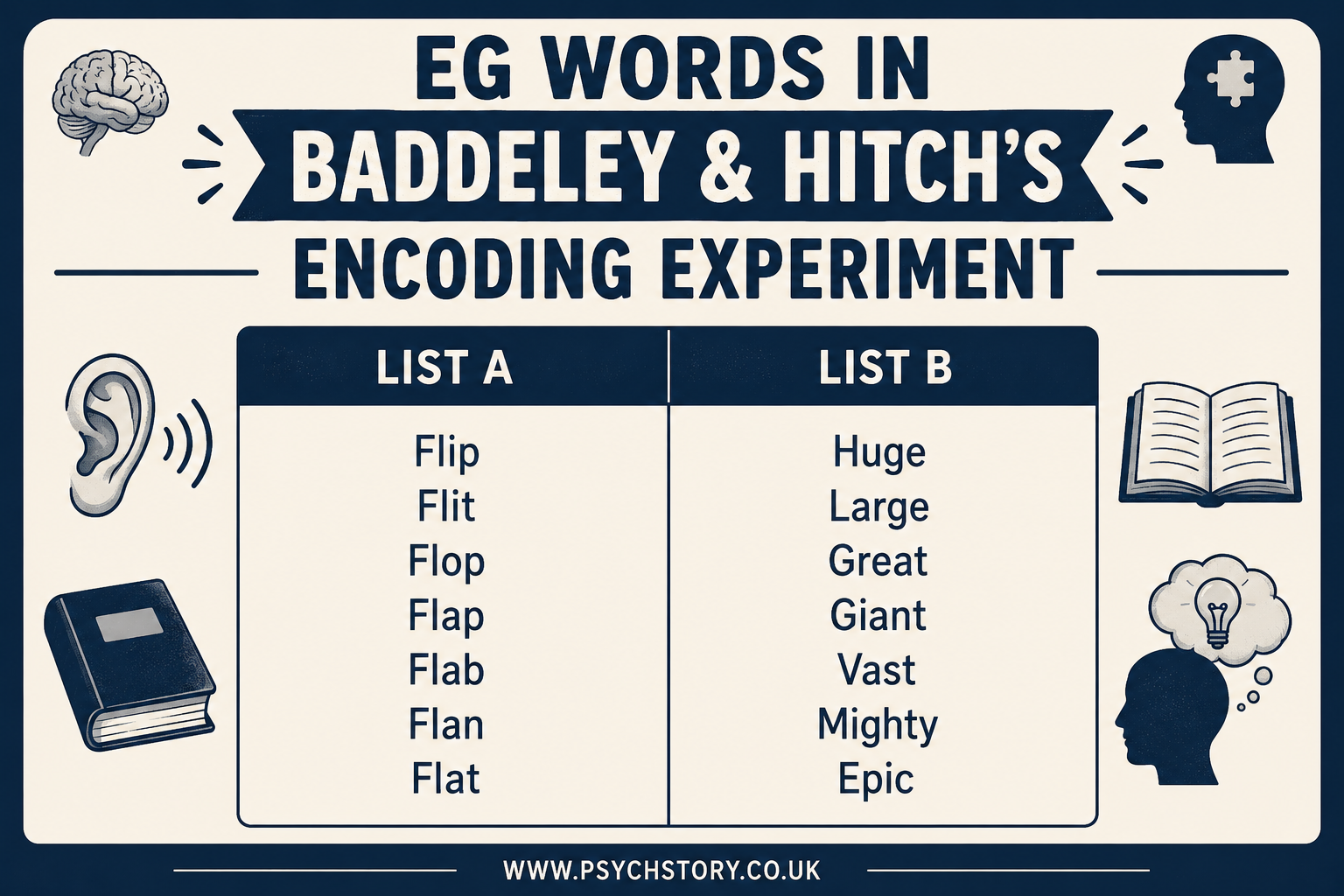
After seeing the lists, participants were tested on their ability to recall the words. When tested immediately, participants found recalling the words from List A in the correct order more difficult.
When tested after 30 minutes, participants found recalling the words from List B in the correct order more difficult.
4. Using your knowledge of coding in memory, explain these findings. 4 Marks
5. Complete the missing parts of the table A, B, C and D about features of the multi-store memory model. 4 Marks

The following are all concepts relating to memory:
A Duration
B Capacity
C Encoding
D Retrieval.
6.In the table below, write which one of the concepts listed above (A, B, C or D) matches each definition. 2 marks

A researcher investigated coding in short-term memory using the same participants in both conditions.
In the first condition, he read out a list of 10 different sounding words.
In the second condition, he read out a list of 10 similar sounding words.
The researcher recorded how many words participants recalled correctly in each condition.
The table below shows the results of his study.

What do the mean values in the table suggest about coding in short-term memory? Justify your answer. 2 marks