
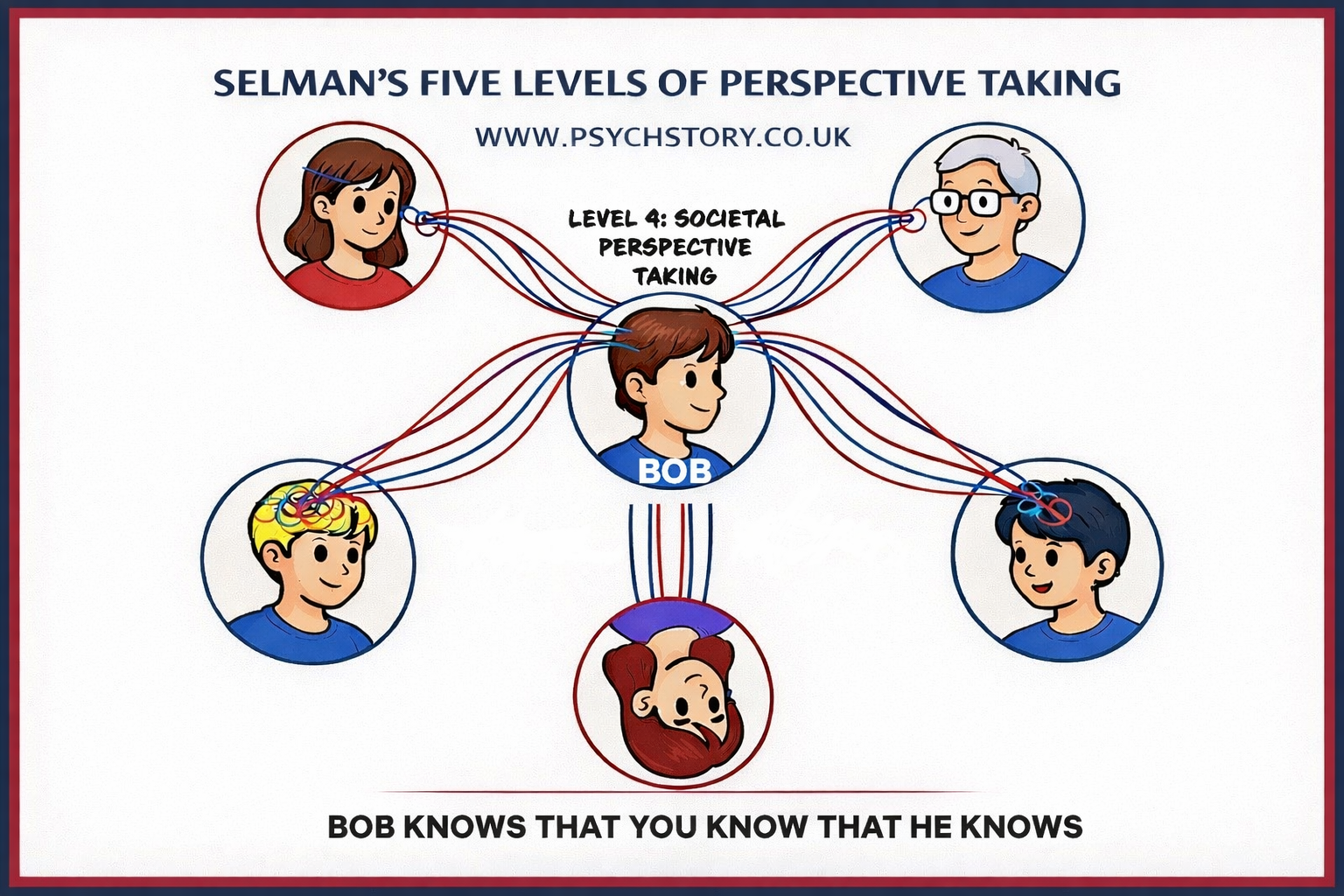
DEVELOPMENT OF CHILDREN’S UNDERSTANDING OF OTHERS
The specification says: Selman’s levels of perspective-taking (That’s it!).
KEY TERMS
SOCIAL COGNITION: Refers to the mental processes we engage in during social interaction. For example, we make decisions about how to behave based on our understanding of a social situation. Social cognition involves the understanding of social behaviour and the cognitive processes that underpin it.
PERSPECTIVE TAKING: Our ability to appreciate a social situation from the perspectives (points of view) of others. This cognitive ability underlies much social interaction. Referred to specifically as social perspective-taking, or sometimes called role-taking, because we take on the role of another and therefore their perspective. Whether to risk upsetting a worried parent by rescuing a kitten is a complex social decision that requires considering everyone's perspective. Perspective-taking involves an understanding that another person has a different perspective (or view) from one’s own and is important for the development of moral reasoning.
PIAGET: Piaget was one of the first psychologists to investigate perspective-taking, using the three mountains task to study egocentrism in preoperational children and decentration in concrete operational children. This is an example of a perceptual perspective-taking task because it was concerned with what the ‘doll’ could perceive. The Sally–Anne task is another example of a test of perspective-taking (a ToM perspective-taking task).
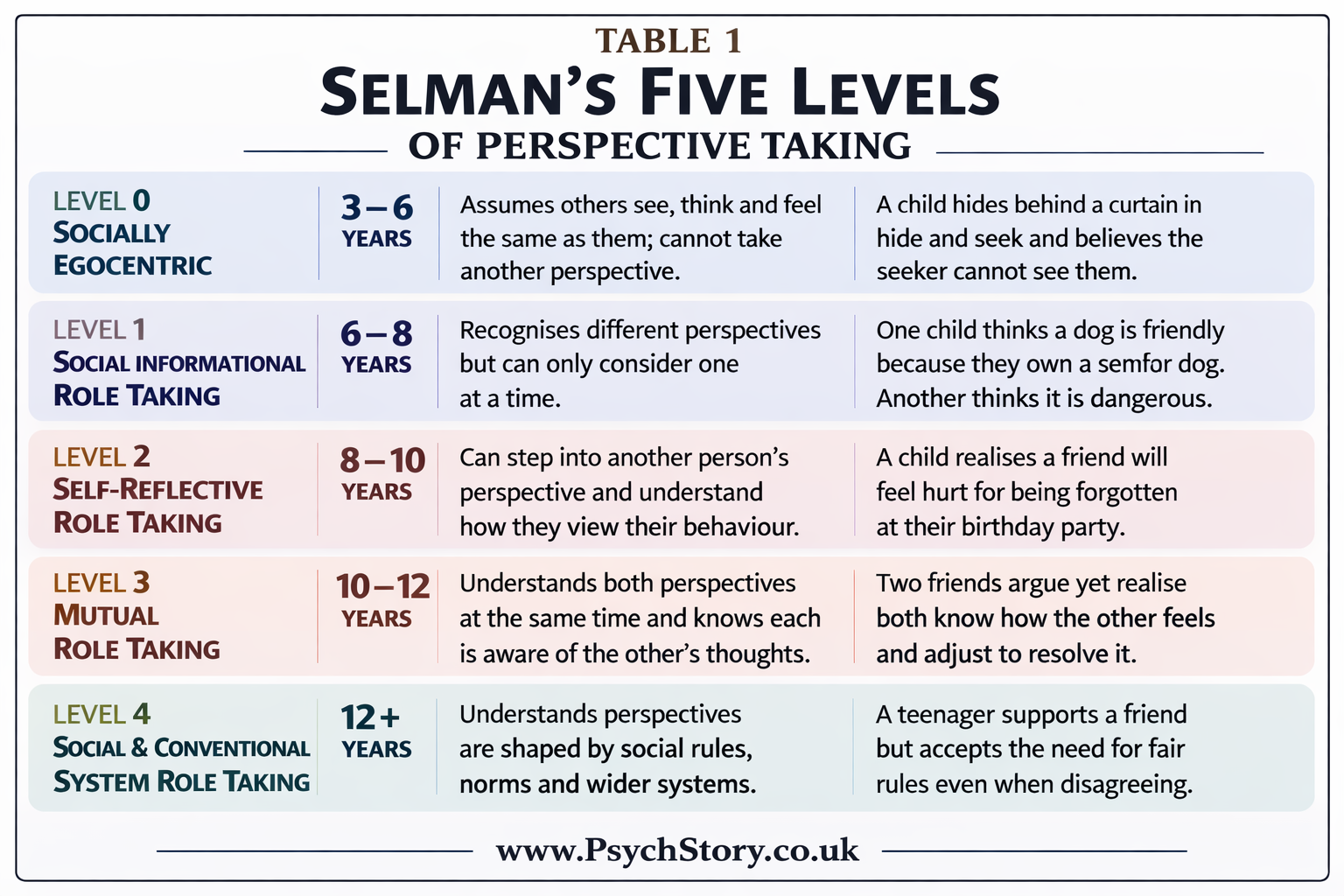
BACKGROUND TO SELMAN’S THEORY OF SOCIAL PERSPECTIVE TAKING
Before psychologists began systematically studying children’s understanding of social relationships, developmental psychology was largely shaped by the work of Jean Piaget. Piaget demonstrated that young children tend to be egocentric in their thinking. In developmental terms, egocentrism refers to the difficulty young children have in recognising that other people may see, know or interpret a situation differently from themselves. For example, in Piaget’s classic “three mountains” task, children often assumed that another observer looking at the scene would see exactly what they themselves could see. Piaget interpreted this as evidence that children initially struggle to separate their own perspective from others'. Over time, however, children gradually become less egocentric as their cognitive abilities develop.
During the late 1960s and early 1970s, researchers began extending Piaget’s ideas beyond perception and logical reasoning into the social domain. Psychologists became increasingly interested in how children understand other people’s thoughts, emotions, intentions and behaviour. This growing area of research came to be known as social cognition. Rather than focusing only on how children understand objects or physical events, researchers began examining how children interpret interactions between people. Questions emerged about how children understand disagreement, cooperation, misunderstanding and conflict, and how they learn to interpret what others are thinking or feeling.
SUMMARY OF SELMA’S THEORY OF SOCIAL PERSPECTIVE TAKING
Within this developing field, Robert Selman began investigating how children understand social situations that involve multiple individuals with potentially different viewpoints. Selman’s work developed directly from the recognition that social understanding requires more than simply accurately perceiving events. Instead, it requires the ability to interpret how different people involved in the same situation might think, feel or react.
To study this process, Selman presented children with short social scenarios involving two or more characters. These scenarios often involved conflicts, misunderstandings or emotionally complex situations. After hearing the story, children were asked questions about what each character in the situation might think, feel or do. Importantly, Selman did not simply record whether the child’s answer was correct or incorrect. Instead, he analysed the reasoning behind the child’s response in order to identify patterns in how children understand other people’s viewpoints.
Through this method, Selman identified systematic changes in how children reason about social situations as they grow older. One of the best-known models to emerge from this work was his stage theory of social perspective taking, formally presented in 1980, although earlier work published in 1971 had already explored these developmental patterns.
Selman used the term "social perspective-taking" to describe the ability to understand how another person perceives, interprets, and responds to a situation. According to Selman, this ability does not appear suddenly but develops gradually alongside general cognitive development. As children mature, they become increasingly capable of recognising that two people involved in the same situation may interpret it differently because they have different experiences, knowledge or intentions. Eventually, children also become able to coordinate multiple perspectives simultaneously.
For example, imagine two children arguing in the playground because one believes the other deliberately pushed them. A younger child may interpret the event entirely from their own point of view and assume that the push must have been intentional simply because it felt that way to them. A slightly older child may begin to recognise that the other child might claim that the push was accidental. An older child may go further and recognise that both children interpret the same event from their own perspective, each influenced by their own information, intentions and feelings. They may also understand that both children are trying to explain the situation from their own perspectives.
This increasing ability to move beyond one’s immediate experience and consider how events appear to others is what Selman sought to describe through his stage model of social perspective-taking. His work, therefore, built on Piaget’s insight that children gradually overcome egocentrism, but extended the idea specifically to social interactions, showing how children progressively develop the ability to understand and coordinate different viewpoints within relationships
PERSPECTIVE TAKING KEY RESEARCH SELMAN (1980)
To investigate how children and adolescents interpret social situations, Selman presented participants with short interpersonal stories and asked them to explain how the characters involved might think, feel, or respond. The aim was not simply to record what decision children made, but to analyse the reasoning they used to explain the situation. By comparing the explanations given by children of different ages, Selman examined how the ability to understand another person’s viewpoint develops over time. Like researchers studying moral reasoning, such as Kohlberg and Eisenberg, Selman used structured dilemmas that required participants to think about the perspectives of several individuals involved in the same situation.
One of the best-known examples used in this research is the story of Holly.
“Holly is an eight-year-old girl who likes to climb trees. She is the best tree climber in the neighbourhood. One day, while climbing a tall tree, she falls off the bottom branch but does not hurt herself. Her father sees her fall and is upset. He asks her to promise not to climb trees anymore, and Holly promises. Later that day, Holly and her friends met Sean. Sean’s kitten is caught in a tree and cannot get down. Something has to be done right away, or the kitten may fall. Holly is the only one who climbs trees well enough to reach the kitten and get it down, but she remembers her promise to her father.” (Selman, 1980)
By examining how children interpreted this situation and how they explained the thoughts and reactions of the different characters involved, Selman identified consistent developmental patterns in children’s ability to understand other people’s viewpoints. These patterns formed the basis of his stage model of social perspective-taking
QUESTIONS WERE ASKED, SUCH AS:
Does Holly know how Sean feels about the kitten?
How will Holly’s father feel if he finds out that she climbed the tree?
What does Holly think her father will do if he finds out she climbed the tree after promising that she wouldn’t?
What would you have done in this situation?
Selman analysed children’s responses to interpersonal dilemmas and examined the reasoning they used to justify their answers. By clustering similar patterns of reasoning together, he identified a sequence of developmental changes in how children understand other people’s viewpoints. From this analysis, Selman proposed a five-stage developmental progression in perspective-taking.
The stages were derived from consistent patterns in responses across different age groups. Children of similar ages tended to produce similar types of explanations, suggesting a relationship between cognitive maturity and the complexity of perspective taking. This method relies on the strength of the correlation between patterns of reasoning and the age range in which they most commonly appear.
However, as with most stage-based developmental models, the boundaries between stages are not rigid. Children do not move abruptly from one level to the next, and individuals may display elements of more than one stage at the same time. Selman, therefore, allowed for overlap between stages to account for individual differences in development.
The five stages of perspective taking are outlined below.:
SELMAN’S FIVE LEVELS OF PERSPECTIVE TAKING
LEVEL 0 – SOCIALLY EGOCENTRIC PERSPECTIVE TAKING (3–6 YEARS)
Children cannot reliably distinguish between their own perspective and that of another person. They recognise that people may have different feelings but assume those feelings arise from the same situation they themselves perceive. Example: A child hides behind a curtain while playing hide-and-seek. Because the child cannot see the seeker, they believe the seeker cannot see them either. The child assumes the other person’s visual perspective is identical to their own.
LEVEL 1 – SOCIAL INFORMATIONAL ROLE TAKING (6–8 YEARS)
Children understand that different perspectives can arise because people possess different information. However, they can only consider one viewpoint at a time and cannot yet coordinate both perspectives simultaneously. Example: Two children see a dog. One child thinks the dog is friendly because they own a similar dog. The other child thinks it is dangerous because they were previously bitten. Each child understands why the other thinks differently, but cannot yet integrate both viewpoints into a single understanding.
LEVEL 2 – SELF-REFLECTIVE ROLE TAKING (8–10 YEARS)
Children can mentally step into another person’s perspective and understand how that person views them. They begin to reflect on their own behaviour from another person’s viewpoint. Example: A child forgets a friend’s birthday party. The child realises that the friend will feel hurt and may think the absence means they do not care. The child anticipates how their behaviour appears to the friend.
LEVEL 3 – MUTUAL ROLE TAKING (10–12 YEARS)
Children can simultaneously coordinate their own perspective with another person’s perspective. They understand that both individuals are aware of each other’s thoughts and feelings. Example: Two friends argue about borrowing a game. One child realises that both of them understand the other’s viewpoint. Each knows the other is aware of their feelings, which influences how they negotiate and resolve the disagreement.
LEVEL 4 – SOCIAL AND CONVENTIONAL SYSTEM ROLE TAKING (12 YEARS AND ABOVE)
Adolescents recognise that perspectives are shaped not only by individuals but also by wider social systems such as rules, norms and shared expectations. Social behaviour is understood within these broader structures. Example: A teenager may sympathise with a friend who cheated on a test but still believes the school must enforce punishment. The teenager recognises that rules exist to maintain fairness and order within the wider social system
TYPICAL RESPONSES AT DIFFERENT AGES
UNDIFFERENTIATED PERSPECTIVE TAKING STAGE
At this earliest stage, children recognise that people have thoughts and feelings, but they struggle to distinguish another person’s perspective from their own. They tend to assume that others see situations in the same way they do. In the Holly dilemma, children often argue that Holly should save the kitten because it would be wrong to let the animal be hurt. They may also assume that her father will approve of this decision because saving the kitten seems like the obvious or correct action. Although children at this stage understand that people have internal states, they do not yet clearly distinguish their own viewpoint from another person's.
SOCIAL INFORMATIONAL PERSPECTIVE TAKING STAGE
Children at this stage begin to recognise that people can hold different perspectives because they possess different information about a situation. They understand that reactions may depend on what someone knows or does not know. In the Holly dilemma, children often explain that Holly’s father will be initially angry because he only knows she broke her promise not to climb trees. However, if he later learns that she climbed the tree in order to rescue the kitten, he may change his opinion. Children, therefore, understand that two people can interpret the same event differently when they have access to different information. Despite this, they still tend to interpret the situation primarily from their own viewpoint.
SELF-REFLECTIVE PERSPECTIVE TAKING STAGE
At this stage, children can imagine how another person might interpret a situation and how their own actions might appear from that person’s perspective. Rather than simply recognising differences in information, they can mentally place themselves in another person’s position. In the Holly dilemma, children may explain that Holly believes her father will eventually understand her decision once he learns why she climbed the tree. They can therefore consider how Holly anticipates her father’s reaction. However, children at this stage still tend to consider each viewpoint separately rather than coordinating both perspectives simultaneously.
MUTUAL PERSPECTIVE TAKING STAGE
Children can now consider multiple perspectives simultaneously and understand that people are aware of one another’s viewpoints. They recognise that both Holly and her father may understand each other’s concerns. In the dilemma, children may explain that Holly knows her father will worry about her safety, while her father may recognise that Holly climbed the tree to help the kitten. At this stage, children can coordinate these viewpoints and understand how each person’s perspective influences their interaction.
SOCIETAL PERSPECTIVE TAKING STAGE
At the most advanced stage, individuals understand that perspectives are shaped not only by personal viewpoints but also by wider social values, cultural expectations, and social rules. In the Holly dilemma, responses may refer to broader principles such as protecting animals while also recognising the importance of safety rules set by parents. Individuals can therefore evaluate behaviour in relation to both personal viewpoints and wider social expectations. This stage reflects an understanding that social interactions take place within broader systems of shared norms and values
Selman proposed that the development of perspective-taking reflects increasing cognitive sophistication in social reasoning. As children mature, they become able to process more complex social information and recognise that individuals may interpret the same situation differently. These interpretations are influenced by factors such as personal knowledge, social roles and situational context.
With further development, children become capable of coordinating multiple perspectives simultaneously. They can consider how different participants in an interaction may understand the same event and how an impartial observer might interpret the situation. Perspective taking, therefore, becomes an important mechanism for understanding both one’s own behaviour and the behaviour of others.
As this ability develops, children are generally better able to anticipate how their actions may affect other people, which can support clearer communication and more stable interpersonal relationships. For this reason, Selman’s theory has also been applied in counselling and educational settings. Interventions that encourage children to consider alternative viewpoints may help them manage social disagreements more effectively and improve their interactions with peers
MORE SELMAN TYPE DILEMMAS
APPLIED EXAMPLE: SPENNY AND LAUREN’S COMPUTER TIME
Selma and Emma have decided to limit the amount of time their children spend playing computer games. Their son Spenny is 11 years old and their daughter Lauren is 7.
Spenny recognises that the restriction is inconvenient for him, but he appears able to understand his mother’s point of view. Lauren reacts very differently. She resists the rule and wants to continue playing. Although she can see that her mother is unhappy about the situation, she struggles to understand why the restriction has been introduced.
Selman’s stages of perspective taking help explain this difference. At around 11 years old, Spenny is likely operating within the mutual perspective-taking stage. At this stage, children can consider both their own and another person’s perspectives simultaneously. They also recognise that each person is aware of the other’s viewpoint. Spenny can therefore understand that his mother’s decision reflects her concern about excessive gaming, while also recognising his own desire to continue playing.
At 7 years old, Lauren is more likely to be in the social-informational perspective-taking stage. Children at this stage begin to recognise that other people may hold different perspectives because they have different information. However, they still tend to prioritise their own viewpoint and find it difficult to coordinate multiple perspectives simultaneously. Lauren can see that her mother is concerned, but she focuses mainly on her own desire to keep playing and struggles to understand the reasoning behind the rule.
Selman’s theory, therefore, explains why children of different ages may respond differently to the same social situation. As perspective-taking ability develops, children become increasingly able to recognise other people’s viewpoints and negotiate disagreements within relationships
SELMAN’S THEORY OF SOCIAL PERSPECTIVE TAKING
Selman’s theory explains how children gradually become able to understand and coordinate different viewpoints within social situations. The central idea is that social understanding develops through the increasing ability to take another person’s psychological role. This ability, often referred to as role-taking or perspective-taking, allows individuals to interpret behaviour not only from their own viewpoint but also from others'.
Selman proposed that perspective-taking develops as children’s cognitive abilities mature. Young children tend to interpret situations mainly from their own perspective. As their thinking becomes more sophisticated, they gradually recognise that other people may interpret the same situation differently. These interpretations may depend on factors such as the information available to each person, their intentions, their social roles, and the broader context in which an interaction occurs.
Social interaction plays an important role in this development because everyday interactions frequently expose children to conflicting perspectives. Disagreements, misunderstandings, cooperation, and negotiation all require individuals to recognise that different people may interpret the same situation differently. In order to manage these interactions successfully, children must learn to consider what others know, what they intend and how they are likely to interpret events.
Peer relationships are particularly important in this process. Interactions between children of similar status often require them to negotiate, justify their actions and resolve disagreements. These situations encourage children to consider alternative viewpoints and gradually improve their ability to coordinate perspectives within social relationships.
As cognitive development progresses, children become able to process increasingly complex social information. They begin to recognise that multiple perspectives can exist simultaneously and that behaviour can be understood differently depending on the viewpoint from which it is interpreted. With further development, individuals can coordinate several perspectives at once, including those of the people directly involved in an interaction and the broader social environment's expectations.
Selman therefore proposed that the development of social understanding reflects the interaction between increasing cognitive maturity and expanding social experience. As children encounter more complex social situations and develop the cognitive capacity to analyse them, their ability to take and coordinate different perspectives becomes progressively more sophisticated
ACTIVITY
USING SELMAN’S PERSPECTIVE-TAKING APPROACH IN PAIR THERAPY
Consider a child who behaves aggressively and bullies other children at school. Design a pair therapy schedule using Selman’s perspective-taking approach.
What areas would you focus on, and how would you help the child develop negotiation skills to form and maintain friendships?
Make a list of the kinds of issues you would address and the social skills you would aim to develop
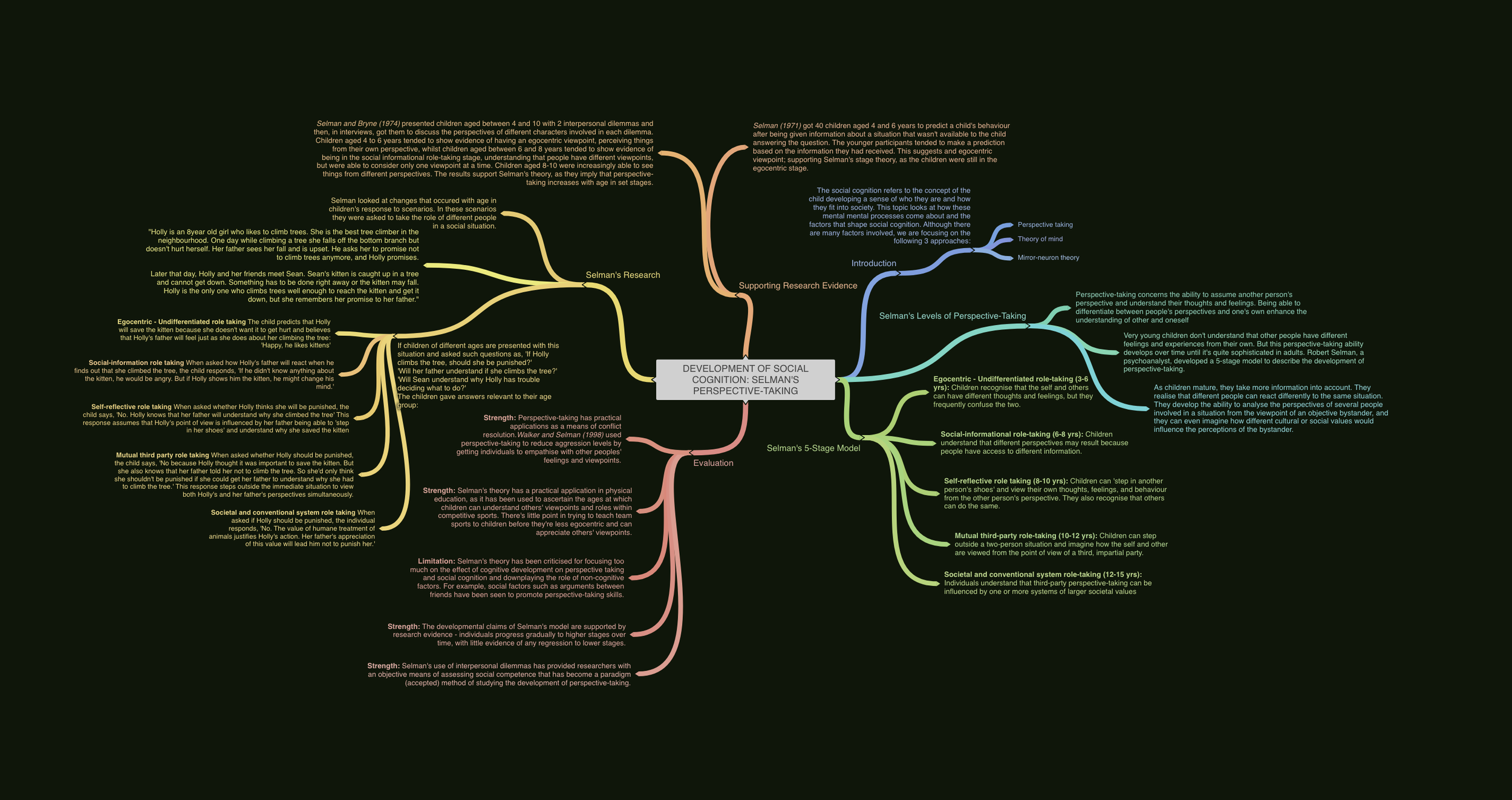
FORMAL PSYCHOMETRIC MEASURES OF PERSPECTIVE TAKING
Several psychological tests have been developed to measure perspective-taking and related aspects of social cognition. These vary from laboratory-based spatial tasks to self-report personality scales and clinical assessments.
SPATIAL ORIENTATION TEST (SOT): The Spatial Orientation Test measures the ability to mentally adopt another spatial viewpoint. Participants are shown an arrangement of objects and are asked to imagine standing at one object while facing another. They must then indicate the direction of a third object from that imagined perspective. The task requires individuals to mentally rotate their viewpoint and, therefore, measures the capacity to shift perspective in a spatial sense. Although primarily used in cognitive psychology, the task captures the basic mechanism underlying the adoption of a perspective other than one's own.
INTERPERSONAL REACTIVITY INDEX (IRI): The Interpersonal Reactivity Index, developed by Davis (1983), is one of the most widely used psychometric measures of empathy and perspective taking. It is a self-report questionnaire consisting of several subscales. The Perspective Taking subscale specifically measures individuals' tendency to spontaneously adopt others' psychological viewpoints in everyday social interactions. Because it measures a dispositional tendency rather than task performance, it is commonly used in research in personality and social psychology.
COGNITIVE EMOTIONAL PERSPECTIVE TAKING (CEPT): The Cognitive Emotional Perspective Taking measure assesses both cognitive and affective components of perspective taking. Participants are presented with social scenarios and must identify what another person in the situation is likely to think or feel. The task, therefore, distinguishes between understanding another person's beliefs and recognising their emotional reactions. This allows researchers to examine how individuals integrate cognitive and emotional information when interpreting social situations.
MULTIPLE PERSPECTIVES INVENTORY (MPI)": The Multiple Perspectives Inventory is a questionnaire designed to assess how individuals incorporate multiple viewpoints when making decisions or interpreting social situations. The measure contains a series of items that evaluate the ability to consider competing interpretations of an event and integrate different perspectives. It is often used in research examining complex social reasoning and decision-making.
TESTS FOR CHILDREN AND CLINICAL ASSESSMENT: Some perspective-taking measures are specifically designed for children or for clinical populations where social cognition difficulties may be present.
PERSPECTIVE TAKING TEST FOR CHILDREN (PTC): The Perspective Taking Test for Children uses illustrated stories and visual scenes to assess how children interpret social situations. Children may be asked what a character in a story can see, what they believe, or how they might feel in a given situation. These tasks allow researchers to examine how children coordinate different viewpoints as their social understanding develops.
THEORY OF MIND TASKS: A number of experimental tasks measure the ability to attribute mental states to others. Examples include false belief tasks and the faux pas recognition task. These tests examine whether individuals can recognise when another person holds incorrect information or unintentionally violates a social rule. Although often discussed within the theory of mind literature, these tasks also require elements of perspective-taking, as participants must consider what another person knows or believes.
GENEVA SOCIAL COGNITION SCALE (GESOCS): The Geneva Social Cognition Scale is a clinical assessment tool used in research on disorders affecting social cognition. The test includes tasks that measure emotional recognition, inference of intentions, and understanding of social situations involving false beliefs. It is often used in clinical populations such as individuals with schizophrenia or autism spectrum conditions to evaluate broader social cognitive functioning.
EDUCATIONAL AND INFORMAL METHODS: Outside laboratory settings, perspective taking is also assessed through educational and reflective exercises designed to encourage individuals to consider alternative viewpoints.
SCENARIO-BASED SOCIAL REASONING TASKS: In these exercises, participants are presented with short social scenarios and asked to predict how different people might react or feel. The tasks require individuals to consider multiple viewpoints and anticipate others' responses in social interactions.
REFLECTION INVENTORIES: Reflection inventories involve sets of questions designed to examine everyday perspective-taking. Participants may be asked whether they adapt their explanations to different audiences or whether they can argue a position opposite to their own. These exercises measure the tendency to consider alternative perspectives in daily life.
CLASSROOM PERSPECTIVE TAKING ACTIVITIES: Educational activities designed to develop social understanding often involve structured role-play or discussions of hypothetical social situations. Students may be asked to explain why two individuals in the same situation might interpret events differently, encouraging the development of perspective coordination skills that are central to social cognition
EVALUATION OF SELMAN’S PERSPECTIVE TAKING
EMPIRICAL SUPPORT FROM SELMAN’S OWN RESEARCH
A strength of Selman’s theory is that it was developed from systematic empirical investigation. Across multiple studies, Selman found clear developmental patterns. Younger children typically interpreted the situation from only one viewpoint and had difficulty recognising that two individuals could interpret the same event differently. As children grew older, they increasingly recognised that people may hold different perspectives and gradually became able to coordinate both viewpoints simultaneously. These age-related patterns were consistent across different dilemmas and participant groups, providing empirical support for Selman’s claim that perspective-taking develops progressively with cognitive maturity. The systematic nature of these findings strengthens the validity of the theory by demonstrating that changes in social reasoning follow identifiable developmental trends rather than occurring randomly:" and this is true
Evidence from cross-sectional studies has also been supported by longitudinal research. For example, Gurucharri and Selman (1982) followed children over time and observed gradual improvements in their ability to understand other people’s perspectives. Because longitudinal studies track the same individuals over time, they provide particularly strong evidence that perspective-taking becomes more sophisticated as children grow older. Overall, findings from both cross-sectional and longitudinal research support Selman’s claim that perspective taking develops in stages and improves with age.
Another strength of Selman’s theory is evidence suggesting that perspective-taking is linked to social behaviour. Buijzen and Valkenburg (2008) conducted an observational study of parent-child interactions in toy shops and supermarkets. They recorded instances in which children attempted to pressure or persuade their parents to buy products for them. The researchers found a negative correlation between coercive behaviour and both age and perspective-taking ability. Children who were better able to take another person’s perspective were less likely to use coercive strategies and tended to behave in more socially appropriate ways. This suggests that perspective-taking may contribute to more effective social interaction.
APPLICATION: PAIR THERAPY
Another strength of Selman’s theory is its practical applications for improving children’s social behaviour. Selman argued that many interpersonal conflicts arise because children have difficulty accurately understanding another person’s viewpoint. If perspective taking can be improved, children should become better able to manage disagreements and resolve conflicts.
This idea led to the development of pair therapy, an intervention designed to improve social competence by strengthening perspective-taking skills. In this approach, two children who experience interpersonal difficulties meet regularly with a trained facilitator. Through structured discussion and guided interaction, the children are encouraged to consider each other’s thoughts, feelings and intentions and to practise negotiating solutions to social conflicts.
Research suggests that interventions based on this approach can improve children’s interpersonal reasoning and behaviour. For example, Selman and colleagues (1983, 1997) reported that programmes designed to strengthen perspective taking helped children develop more effective strategies for managing peer conflict and maintaining relationships.
These findings support Selman’s theory by demonstrating that improving perspective-taking can lead to better social interaction. This suggests that the ability to coordinate viewpoints plays an important role in children’s social competence and that Selman’s framework can be applied to real-world social difficulties
BIOLOGICAL EXPLANATIONS OF SOCIAL COGNITION (A03)
NEUROLOGICAL EVIDENCE FOR SOCIAL COGNITION
A strength of Selman’s Perspective Taking theory is that it draws on scientific evidence that social understanding depends on identifiable brain mechanisms. Research involving individuals with damage to specific brain regions shows that impairments in emotional processing can significantly affect the ability to interpret other people’s behaviour.
For example, Adolphs et al. (1995) studied a patient known as S.M., whose amygdala had been destroyed by a metabolic disorder (Urbach-Wiethe disease). The amygdala plays a central role in processing negative emotions such as fear and anger. S.M. was unable to recognise fear in photographs of faces displaying a range of emotional expressions and also reported rarely experiencing fear herself. Other patients with amygdala damage have shown similar impairments, struggling to recognise fear in facial expressions and body postures.
These findings demonstrate a clear link between emotional perception and social behaviour. The ability to recognise emotional cues such as fear, distress or threat is essential for interpreting other people’s behaviour and anticipating their intentions. If individuals cannot recognise these signals, their ability to infer other people’s mental states becomes far more limited. Consequently, although some elements of the theory of mind might remain intact, the depth and accuracy of social understanding would be substantially reduced.
KEY RESEARCH: JACKSON ET AL. (2005)
Neuroscientific research also suggests that adopting another person’s perspective requires additional cognitive and neural processing. Selman proposed that children initially interpret situations primarily from their own viewpoint and only gradually develop the ability to coordinate different perspectives. Evidence from brain imaging studies suggests that shifting from one’s own perspective to another person’s perspective places greater demands on the brain.
Jackson et al. (2005) investigated how visual perspective influences the ability to imitate actions. Participants were shown and asked to imitate a series of simple hand and foot movements presented from two different visual perspectives: a first-person perspective reflecting the individual’s own viewpoint and a mirror perspective representing a third-person viewpoint.
The researchers predicted that when the visual perspective matched the participant’s own viewpoint, imitation would occur more quickly than when a mirror perspective was used. This prediction was based on the idea that observing and imitating movements elicit stronger activity in the premotor cortex when actions are viewed from a first-person rather than a third-person perspective.
Sixteen participants, eight males and eight females aged between 29 and 65, took part in the study. They were shown five video clips depicting different hand and foot movements, with half presented from a first-person perspective and half from a third-person perspective. Participants watched the clips while undergoing functional magnetic resonance imaging scanning and were instructed either to observe the movements or imitate them.
In the first-person condition, participants observed movements from the same viewpoint they would normally experience when performing the action themselves. In the third-person condition, the movements were presented as if another person facing them was performing the action. A baseline level of brain activity was recorded when participants viewed a static fixation cross.
The results showed that participants were faster at imitating movements when the model was presented from a first-person perspective than from a third-person perspective. The fMRI data also showed that partly distinct neural mechanisms were involved when actions were processed from different visual perspectives.
Although this research does not directly test Selman’s developmental stages, it demonstrates that interpreting another person’s actions from their perspective requires additional cognitive processing. This finding is consistent with Selman’s proposal that coordinating different viewpoints becomes increasingly complex as individuals move beyond interpreting situations purely from their own perspective.
NEURAL SYSTEMS INVOLVED IN UNDERSTANDING OTHERS
Further support for biological explanations of social cognition comes from research examining how the brain processes other people’s experiences. Selman argued that social understanding develops as individuals become increasingly able to recognise that other people may think, feel and respond differently from themselves. To do this successfully, individuals must represent another person’s internal state while maintaining a distinction between their own perspective and that of the other person.
Morrison et al. (2004) investigated this by comparing neural activation when participants experienced pain themselves and when they observed pain in another person. Participants were scanned with functional magnetic resonance imaging while a sharp probe, similar to a needle, was applied to their hand. In another condition, they watched a video showing another person’s hand being pricked by a needle.
The results showed that similar patterns of neural activation occurred in both situations. In particular, activity was observed in the anterior cingulate cortex and the anterior insula, brain regions known to be involved in the emotional processing of pain. This suggests that observing another person in pain activates neural systems that partially simulate the emotional experience of that pain.
However, the neural activity involved in observing pain is not identical to that involved in experiencing pain directly. Different subregions of the anterior cingulate cortex become active depending on whether the pain is experienced personally or observed in another individual. This distinction appears to allow individuals to recognise another person’s emotional state while still maintaining a separation between their own feelings and those of the other person. Decety and Jackson (2004) suggested that this mechanism is important for empathy because it prevents individuals from becoming overwhelmed by another person’s emotional distress.
DISTINGUISHING BETWEEN SELF AND OTHER
Additional evidence comes from research examining brain regions involved in distinguishing between actions generated by oneself and those performed by others. The right temporoparietal junction and surrounding parietal regions have been shown to play an important role in this process.
Blakemore and Frith (2003) suggested that this region helps individuals distinguish between self-generated and externally generated actions. Being able to make this distinction is crucial for perspective-taking because individuals must recognise that another person’s thoughts, feelings or actions originate from a viewpoint that may differ from their own.
Research by Saxe and Wexler (2005) further suggests that this region is involved in theory-of-mind processes. Studies show that the temporoparietal junction becomes active when individuals imagine events or actions from another person’s perspective, but not when they imagine events from their own perspective.
MENTAL SIMULATION AND SOCIAL UNDERSTANDING
Further support for biological explanations comes from research examining mental simulation. Neuroimaging techniques such as positron emission tomography and functional magnetic resonance imaging allow researchers to measure patterns of brain activity while individuals perform different cognitive tasks.
Studies using these methods show that imagining an action or event activates many of the same brain regions involved in actually performing the action. Decety and Ingvar (1990) described this as a conscious reactivation of previously executed actions stored in memory. Hesslow (2002) similarly argued that when actions are mentally simulated, the brain activates the motor systems involved in carrying them out.
Research by Meister et al. (2004) supports this idea. Using functional magnetic resonance imaging, participants played the same piece of music on a silent piano under two conditions: once while physically performing the movements and once while imagining that they were playing the piece. Similar fronto-parietal neural activity was observed in both conditions, indicating that imagining an action can activate neural systems similar to those involved in performing the action itself.
GENERAL LIMITATION OF NEUROSCIENTIFIC EVIDENCE
A limitation of biological explanations of social cognition is that neuroscientific methods cannot directly observe mental states such as beliefs, intentions or perspectives. Brain imaging techniques measure patterns of neural activation during tasks, but they do not reveal what a person is actually thinking or inferring at a psychological level.
Instead, researchers must interpret the findings indirectly. If a particular brain region becomes active during a perspective-taking task, or if damage to a region disrupts social understanding, scientists infer that the region contributes to that function. However, the mental process itself cannot be directly measured. Consequently, neuroscientific findings provide correlational evidence about the neural systems involved in social cognition rather than direct proof of the psychological processes proposed by theories such as Selman’s perspective-taking model.
Nevertheless, these findings remain important because they identify neural mechanisms that support social understanding. Evidence from brain damage studies and neuroimaging, therefore, provides biological plausibility for psychological theories of social cognition and could also support broader explanations, such as the theory of mind, which proposes that humans possess specialised mechanisms for understanding other people’s mental states
MIRROR NEURONS AND PERSPECTIVE TAKING
Mirror neurons are relevant to social cognition, but they do not fully explain higher-level abilities such as perspective-taking or theory of mind. The distinction becomes clearer when the type of process each mechanism performs is examined.
Mirror neurons were first identified by Rizzolatti and colleagues in the premotor cortex of macaque monkeys (Rizzolatti et al., 1996). These neurons fire both when an individual performs an action and when they observe another individual performing the same action. The observer’s brain, therefore, activates the same motor representation that would normally be used to perform the behaviour themselves. In effect, the brain simulates the observed action internally.
This internal simulation provides a mechanism through which an observer may rapidly understand what another individual is doing and infer the likely goal of the behaviour. For example, when someone sees another person grasping a cup, activation of the same motor representation in the observer’s brain may help them interpret the action as an attempt to drink. The brain, therefore, maps the observed behaviour onto its own motor system in order to interpret the action.
Because recognising actions and intentions is an important component of social cognition, mirror neuron activity may contribute to the earliest stages of social understanding. By internally modelling another person’s behaviour, the observer can interpret actions quickly and automatically without requiring deliberate reasoning.
However, this process differs from the abilities described in Selman’s perspective-taking theory or in research on the theory of mind. Perspective-taking involves understanding that two individuals may interpret the same situation differently because they have different experiences or information. Theory of mind goes further by requiring the attribution of mental states such as beliefs, knowledge or intentions to another person. Both of these abilities involve higher-level reasoning about mental states rather than simply recognising physical actions.
Mirror neuron activity, therefore, appears to support a more basic form of social understanding based on action recognition and imitation. Higher cognitive abilities, such as perspective-taking, require additional processes involving reasoning, memory, and the simultaneous representation of multiple viewpoints. These processes are typically associated with brain regions involved in complex social cognition, particularly the prefrontal cortex and the temporoparietal junction.
Consequently, while mirror neurons may contribute to the early stages of social understanding by allowing individuals to simulate and recognise actions, they are unlikely to fully explain the more complex cognitive abilities involved in perspective-taking and theory of mind. Instead, these higher-level abilities appear to depend on broader neural systems that allow individuals to reason about mental states, intentions and beliefs
LIMITATION: STAGE MODEL MAY BE TOO RIGID
However, a limitation of Selman’s theory is that development may not occur in clearly defined stages as the theory proposes. Selman suggested that children progress through qualitatively distinct levels of perspective-taking, but later research indicates that social reasoning often develops more gradually and may vary depending on the interaction context.
Selman’s conclusions were largely based on children’s responses to structured social dilemmas, such as the well-known Holly dilemma tasks. These interviews allowed Selman to identify patterns in how children reasoned about different viewpoints. However, subsequent studies using similar perspective-taking dilemmas have found that children’s reasoning does not always fit neatly into a single stage. Instead, children sometimes display reasoning characteristic of more than one stage depending on the complexity of the situation or their familiarity with the context.
For example, research by Chandler (1973) and Kurdek and Rodgon (1975) found that children often shift between different levels of perspective-taking within the same task. Younger children may show some ability to recognise that another person holds a different viewpoint, but still struggle to coordinate both perspectives simultaneously. This suggests that perspective-taking abilities may emerge gradually rather than appearing suddenly at fixed developmental stages.
In addition, research by Flavell and colleagues on social role taking suggests that children sometimes demonstrate an understanding of others’ viewpoints earlier than Selman’s stage boundaries would predict when tasks are simplified. These findings imply that the development of perspective taking may be more continuous and context-dependent than the rigid stage structure proposed by Selman.
LIMITATION: VERBAL METHODS
Another limitation is that Selman’s research relied heavily on children’s verbal explanations of hypothetical social dilemmas. In Selman’s interviews, children were asked to explain how different characters in a story might think or feel and why they might behave in a particular way. While this method provides insight into children’s reasoning, it also places strong demands on language ability and verbal expression.
Younger children may possess some awareness of another person’s perspective but may not yet have the vocabulary or reasoning skills required to articulate their understanding clearly. As a result, their responses may underestimate their actual level of social understanding.
Research comparing verbal interview methods with observational studies of children’s behaviour supports this concern. In natural peer interactions, children sometimes demonstrate awareness of others’ intentions, expectations and feelings through negotiation, cooperation and conflict resolution, even when they struggle to explain these processes verbally in interview situations.
This suggests that Selman’s method may capture children’s explicit reasoning about social situations rather than their full capacity for perspective taking in everyday interactions. Consequently, the developmental stages identified by Selman may partly reflect differences in verbal reasoning ability rather than purely differences in social cognitive development
LIMITATION: PERSPECTIVE TAKING DOES NOT NECESSARILY PRODUCE PROSOCIAL BEHAVIOUR
Selman’s theory implies that as children become better at understanding other people’s perspectives, their behaviour should become increasingly cooperative. If children can recognise how their actions affect others and understand their viewpoints, they should be more likely to avoid behaviour that damages relationships and instead act in ways that maintain social harmony.
Some research appears to support this idea. Buijzen and Valkenburg (2008) suggested that perspective-taking abilities become more sophisticated with age and may reduce everyday conflicts between parents and children. As children become better able to recognise their parents’ intentions and viewpoints, disagreements in situations such as family decision-making or rule enforcement may be resolved more effectively. This suggests that improvements in perspective-taking could contribute to more constructive social behaviour.
However, other evidence challenges the assumption that perspective taking necessarily produces prosocial behaviour. Gasser and Keller (2009) found that children who engaged in bullying behaviour showed no deficits in perspective-taking ability. Some aggressive children were fully capable of understanding their victims’ thoughts and emotions, but still chose to behave in ways that caused harm.
This suggests that perspective-taking may function primarily as a social skill rather than as a moral mechanism. Understanding another person’s perspective allows individuals to predict reactions, anticipate consequences and navigate social situations effectively. However, this knowledge can be used either to cooperate with others or to manipulate them. Consequently, perspective-taking alone may be insufficient to explain the development of prosocial behaviour. Additional factors such as empathy, moral values and social motivation are likely to influence how this cognitive ability is expressed in real social interactions
LIMITATION: AGE-RELATED IMPROVEMENT MAY REFLECT GENERAL COGNITIVE DEVELOPMENT
Selman interpreted the increasing ability to coordinate perspectives as evidence of a specific developmental process in social cognition. However, the improvement observed with age may partly reflect broader cognitive development rather than a distinct perspective-taking system.
As children grow older, their language ability, working memory and reasoning skills improve significantly. These general cognitive developments make it easier for older children to hold multiple viewpoints in mind and explain their reasoning during interview tasks.
Consequently, the developmental pattern observed by Selman may partly reflect improvements in general intellectual abilities rather than a specialised mechanism responsible specifically for perspective taking
LATER DEVELOPMENTS TO SELMAN’S THEORY
Selman’s later work expanded the original stage theory to include broader aspects of social functioning. He argued that perspective-taking does not operate in isolation but is part of a wider system of interpersonal understanding that guides how individuals manage relationships and social conflicts.
Building on this idea, Schultz, Selman, and LaRusso (2003) proposed that social competence comprises several related components in addition to perspective-taking. One component is interpersonal understanding, which refers to the ability to interpret other people’s thoughts, feelings and motivations within social relationships. A second component is interpersonal negotiation strategies, which describe how individuals manage disagreements, balance competing viewpoints, and resolve social conflicts. A third component is awareness of the personal meaning of relationships, which involves recognising the expectations, responsibilities and emotional significance that develop within ongoing relationships such as friendships.
These later developments suggest that perspective-taking is an important foundation of social cognition, but not the whole of it. Effective social behaviour also requires the ability to negotiate relationships, interpret emotional dynamics and maintain cooperative interactions over time. Selman’s stages of perspective taking may therefore represent one element within a broader system of interpersonal understanding
LIMITATION: MECHANISTIC ASSUMPTIONS OF THE COGNITIVE APPROACH
Selman’s theory is grounded in the cognitive approach, which explains behaviour in terms of internal mental processes such as perspective-taking, inference, and reasoning. Within this framework, social understanding is treated as a cognitive operation in which individuals analyse information about other people’s viewpoints and construct interpretations of their intentions.
A criticism of this approach is that it can present social understanding as a largely mechanistic process similar to information processing in a computer. If supported by neuroscience, these processes may ultimately be described in terms of the neural systems and biological mechanisms underlying social cognition. From this perspective, abilities such as empathy and perspective taking become functions of cognitive and neural systems rather than moral or relational qualities.
This contrasts with more humanistic interpretations of social behaviour, which emphasise character, compassion and moral development as central to understanding why people consider the feelings and viewpoints of others. Consequently, explaining social understanding purely in terms of cognitive processing may provide a narrower account of human social behaviour than approaches that emphasise moral values and interpersonal motivation
APPLICATION TO ATYPICAL DEVELOPMENT
A strength of Selman’s theory is its practical applications for understanding social-cognitive difficulties in atypical development. If perspective-taking is an important component of social reasoning, children who struggle with social interactions might be expected to show impairments in coordinating viewpoints.
Research by Marton et al. (2009) supports this idea. The researchers compared fifty children aged between eight and twelve diagnosed with ADHD with a control group of typically developing children. Participants completed tasks that required them to interpret social scenarios, understand the perspectives of different characters and predict the consequences of their actions.
The results showed that children with ADHD performed significantly worse on these perspective-taking tasks than the control group. They found it more difficult to understand others' intentions and to anticipate the social outcomes of different behaviours.
These findings support Selman’s theory because they suggest that difficulties in coordinating perspectives are associated with real-world social problems. Selman’s framework may therefore be useful for identifying and analysing social cognitive impairments in atypical development
Empathy, moral values, and social norms are likely to play an important role in determining how this ability is used in real social interactions.
EVOLUTIONARY EXPLANATION OF PERSPECTIVE TAKING
Perspective taking may have evolved because the ability to understand how another individual perceives a situation offers a clear survival advantage in social species. Early humans lived in small cooperative groups in which survival depended on successful communication, coordination, and prediction of others’ behaviour. Individuals who could anticipate how others would act, react, or interpret events were better able to form alliances, avoid conflict, and cooperate during activities such as hunting, resource sharing, and childcare.
From an evolutionary perspective, perspective-taking allows individuals to move beyond their immediate perception and consider what another person knows or sees. This ability enables more accurate prediction of behaviour. For example, understanding that another individual has not seen a predator approaching or does not know the location of food would allow a person to anticipate their actions. This capacity would increase the efficiency of group coordination and reduce the risk of misunderstanding or conflict within social groups.
Evidence supporting an evolutionary basis for perspective taking comes from research on other highly social animals. Studies with chimpanzees suggest that they are sensitive to what other individuals can see or know. Subordinate chimpanzees are more likely to approach food that a dominant chimpanzee cannot see, indicating some understanding of others' visual perspective. Similar abilities have been observed in species such as dolphins and corvids, suggesting that basic forms of perspective-taking may have evolved in animals that rely heavily on complex social interactions.
From this perspective, human perspective-taking may represent a more advanced version of a cognitive ability that originally evolved to help individuals navigate social environments. The ability to understand how others perceive the world would have supported cooperation, communication, and social learning, all of which are crucial for survival in complex social groups.
DISTINCTION BETWEEN THE THEORY OF MIND AND PERSPECTIVE TAKING
Theory of mind is closely related to perspective taking because both involve recognising that another person may hold thoughts, beliefs, or intentions that differ from one’s own. In practice, these abilities often operate together, making it difficult to clearly distinguish them as separate psychological processes.
This overlap is illustrated by the Sally-Anne study conducted by Simon Baron-Cohen, Alan Leslie, and Uta Frith (1985). In this experiment, children observe a scenario in which one character places an object in a location and then leaves the room. While the character is absent, the object is moved to a different location. The child is then asked where the character will look for the object upon returning.
To answer correctly, the child must recognise that the character holds a false belief about the object’s location. This has traditionally been interpreted as evidence of the theory of mind because the child must attribute a mental state, specifically a belief, to another person.
However, the same response can also be explained through perspective-taking. The child must ignore their own knowledge of the object’s true location and instead adopt the viewpoint of the character who did not witness the change. In doing so, the child predicts behaviour based on the other person’s perspective.
Because success in this task can be interpreted as both attributing a mental state and adopting another person’s viewpoint, it becomes difficult to determine which cognitive mechanism is responsible for the child’s reasoning. This overlap suggests that the boundaries between theory of mind and perspective-taking are not always clearly defined, which limits the theoretical distinction between the two explanations in social cognition.
LIMITATION: ONE-SIDED EXPLANATION
A limitation of Selman’s account is that it offers a largely cognitive explanation of social cognition. The theory focuses on how children gradually become better at coordinating different viewpoints, but it pays less attention to other psychological processes that influence how people understand and respond to others in social situations.
In reality, successful social behaviour depends on more than simply recognising another person’s perspective. Emotional processes such as empathy, moral reasoning and social motivation also influence how individuals respond to others. A child may be able to understand another person’s viewpoint yet still choose to behave selfishly or aggressively. This suggests that perspective taking represents only one component of a broader set of processes involved in social cognition.
In addition, other psychological theories emphasise different mechanisms that contribute to social understanding. For example, theory of mind research focuses on the ability to attribute beliefs, intentions and knowledge to other individuals, while research on mirror neurons proposes that observing another person’s behaviour may activate corresponding neural representations in the observer’s brain. These approaches highlight that social cognition involves multiple interacting processes rather than a single cognitive skill.
Nevertheless, perspective-taking may still have practical value for identifying social cognitive difficulties. Marton et al. (2009) found that children aged eight to twelve with ADHD performed significantly worse on perspective-taking tasks than neurotypical children. These children struggled to understand the social situation and evaluate the consequences of different characters’ actions.
Findings such as these suggest that difficulties in coordinating perspectives may contribute to the social challenges experienced by some children. As a result, perspective-taking tasks may be useful for identifying social cognitive impairments and for developing targeted interventions to support children who experience difficulties in social understanding
CULTURAL DIFFERENCES MAY ACCELERATE PERSPECTIVE TAKING
Cross-cultural research suggests that the development of perspective-taking may be influenced by the social environment in which children are raised. For example, Keysar and colleagues (2007) found that Chinese children were more accurate than American children at taking another person’s visual perspective in communication tasks. One explanation is that collectivist cultures place greater emphasis on attending to other people’s viewpoints and maintaining social harmony, which may encourage children to practise perspective coordination more frequently.
However, this finding does not necessarily contradict Selman’s theory. Selman proposed that the ability to coordinate perspectives develops as children’s cognitive capacities mature but is strengthened through repeated social interaction. Cultural environments that emphasise awareness of others may therefore accelerate children’s progress through the developmental levels without changing the overall sequence of development.
These findings suggest that perspective taking may reflect an interaction between cognitive maturation and social experience. The underlying developmental structure may be broadly universal, but cultural practices can influence how early and how strongly perspective coordination skills emerge
ASSESSMENT FOR SELMAN’S PERSPECTIVE TAKING
SELMAN’S LEVELS OF PERSPECTIVE-TAKING
Correct stage names used in Selman’s role-taking theory are:
A: Egocentric Role Taking
B: Subjective Role Takin
C: Self-Reflective Role Taking
D: Mutual Role Taking
E: Societal Role Taking
According to Selman’s theory of role taking, which stage of perspective taking is Marcus most likely demonstrating? (2 marks)
According to Selman’s theory, which stage of perspective taking is Isla most likely demonstrating? (2 marks)
Daniel and Priya are trying to limit the amount of time their children spend playing computer games. Their son Marcus, aged eleven, appears able to recognise his parents’ point of view even though he dislikes the restriction. Their daughter, Isla, aged seven, reacts strongly and refuses to accept the rule. She can see that her parents are concerned about her behaviour, but does not understand why they feel this way
According to Selman’s theory of role taking, which stage of perspective taking is Marcus most likely demonstrating? (2 marks)
According to Selman’s theory, which stage of perspective taking is Isla most likely demonstrating? (2 marks)
Tom borrowed his friend Alex’s bicycle without asking because he needed to get home quickly. While using it, the bike was damaged. Alex is angry because Tom did not ask permission, but Tom believes he had a good reason for using the bike.
Explain how a child at the Self-Reflective Role Taking stage might interpret the disagreement between Tom and Alex. (4 marks)
Explain how someone at the Mutual Role Taking stage might understand both Tom’s and Alex’s viewpoints. (6 marks)
Jamie is ten years old. While shopping with his mother, he asked her to buy an expensive video game. His mother explained that they could not afford it at the moment, but Jamie became upset and appeared unable to understand her point of view.
Using Selman’s theory of role taking, what stage of perspective taking might Jamie be operating at? (2 marks)
According to Selman’s theory, why might Jamie find it difficult to understand his mother’s explanation about money? (4 marks)
How might Jamie’s reasoning change if he were operating at the next stage of perspective-taking development? (4 marks)
According to Selman’s theory, why might Jamie find it difficult to understand his mother’s explanation about money? (4 marks)
How might Jamie’s reasoning change if he were operating at the next stage of perspective-taking development? (4 marks)
Describe the characteristics of Egocentric Role Taking (Stage 0). (4 marks)
Explain how reasoning at the Subjective Role Taking stage differs from reasoning at the Egocentric Role Taking stage. (4 marks)
Describe the key features of Self-Reflective Role Taking (Stage 2). (4 marks)
Explain what is meant by Mutual Role Taking (Stage 3). (4 marks)
Using Selman’s theory, explain how a child at the Egocentric Role Taking stage might interpret this situation. (4 marks)
Outline the main characteristics of Societal Role Taking (Stage 4). (4 marks)
Outline Selman’s theory of role taking in social development. (6 marks)
Explain how Selman’s theory of role taking could help explain disagreements between children in friendships. (8 marks)
Discuss Selman’s research on perspective-taking. Refer to the likely outcome of the student’s study in your answer. [8 marks]
Discuss Selman’s research on perspective-taking. Refer to the likely outcome of the student’s study in your answer. [8 marks]
Discuss the theory of mind and Selman’s levels of perspective-taking in the development of social cognition. (10 marks)
Discuss the development of children’s understanding of others. (Total 16 marks)
Discuss Selman’s theory of role taking. (16 marks)