
THE DEVELOPMENT OF SOCIAL COGNITION
SOCIAL COGNITION IN AQA PSYCHOLOGY
Social cognition is not one single process. It is an umbrella term for several related abilities involved in understanding other people and the social world. These include early representational abilities, such as object permanence, perspective-taking, theory of mind, and the biological mechanisms that may support social understanding, such as the mirror neuron system.
These are linked because they all involve social cognition. Object permanence shows that the child can mentally represent something that is not currently visible. Perspective-taking further develops this by allowing the child to understand that another person may see or interpret a situation differently. Theory of mind goes further still by recognising that other people have mental states, beliefs and knowledge that may differ from reality and from one’s own mind. The biological side of the topic then considers whether some aspects of social cognition are supported by specialised brain systems.
In the specification, three areas are studied in detail. The first is Selman’s theory of perspective taking, which explains how children gradually become less egocentric and more able to coordinate different viewpoints. The second is the theory of mind, especially as applied to autism, with the Sally-Anne study as the key research example. The third is the biological basis of social cognition, particularly the proposed role of mirror neurons in empathy, imitation and understanding the actions of others
WHAT IS SOCIAL COGNITION?
Social cognition refers to the mental processes that enable people to perceive, interpret, and respond to others' thoughts, feelings, and intentions. It acts as the brain’s decoder for human behaviour, turning subtle signals—like a fleeting frown, an averted gaze, or a hesitant voice—into educated guesses about what someone else might be experiencing or planning. Imagine navigating a conversation without this: every exchange would feel like trying to understand whether Siri, Grok, or ChatGPT were happy or sad.
This capability forms the backbone of human connections. It enables teamwork in projects, guides ethical choices in difficult situations, makes lying or detecting lies possible, sparks genuine compassion, and lays the groundwork for relationships. Crucially, it helps people sort out who might be a friend, foe, or potential lover by reading cues of trust, hostility, or attraction. It also tunes individuals into others’ emotional states, such as recognising pain, which is crucial for mothers of infants, or embarrassment, which helps people understand why certain topics might be off limits to others. These interpretations allow appropriate responses that strengthen bonds or avert conflict. Studies suggest that while humans have refined this ability to a very high level, traces of it appear in other highly social animals such as chimpanzees, dolphins, and elephants, where similar capacities may support group survival, for example, by detecting danger or coordinating behaviour.
Picture the vast, unforgiving savannas where early humans evolved. Threats lurked everywhere: predators, scarce resources, and rival groups. Survival often depended on outsmarting or outmanoeuvring others. A crucial cognitive shift occurred when humans began to recognise that animals and people alike had internal states that guided behaviour. Movements were no longer interpreted as random events but as actions driven by intentions. Psychologists refer to this capacity as the theory of mind. It allowed early humans to anticipate behaviour, for example, interpreting a lion’s slow stalk as a deliberate ambush rather than a coincidence. The same logic applies to other humans. A stranger approaching a camp might be coming to trade, to attack, or to cooperate. In alliances or mating contexts, reading intentions could prevent betrayal or signal trustworthiness.
Beyond immediate survival, this capacity may also have contributed to broader cultural developments. When natural events such as storms, crop failures, or dreams could not be easily explained, humans sometimes attributed intentionality to unseen agents, imagining spirits or deities influencing them. In this way, the same cognitive tendency that interprets other human minds may also have shaped the development of mythology, religion, and philosophical reflection. Social cognition, therefore, not only supports everyday social interaction but may also have played a role in shaping distinctive aspects of human culture.
WHY IS UNDERSTANDING THE FEELINGS OF OTHERS PART OF THE COGNITIVE APPROACH
The cognitive perspective does not approach behaviour in the same way as many other psychological approaches. Rather than focusing primarily on what causes social cognition, it is more interested in understanding the internal mechanisms that enable it. In developmental cognitive psychology, the emphasis is on how these mechanisms emerge and develop over time and on which mental components are involved.
In the case of social cognition, the question becomes: what cognitive processes allow people to understand the emotions and intentions of others? Researchers, therefore, examine the components involved and how each contributes to the interpretation of social information.
Sometimes the precise biological location of these processes cannot yet be identified. Current neuroscience techniques cannot read a specific memory or thought directly; instead, they detect patterns of neural activity or synaptic networks associated with mental processing. For this reason, many cognitive theories cannot always be tested directly at the biological level.
However, this does not mean the theories lack value. Cognitive and biological approaches are often complementary rather than contradictory. Cognitive psychology proposes models of mental processing, while neuroscience investigates the neural systems that might support those processes. If neuroscientists identify brain structures or networks that align with predicted cognitive functions, this can strengthen the plausibility of the cognitive model.
Within the cognitive approach, explanations often incorporate both innate and environmental influences. Some theories propose biological predispositions or developmental stages (a more nativist perspective), while others emphasise learning through interaction with the environment. For example, social interaction and guidance from others play a role in development in Vygotsky’s work, while Piaget emphasised how children construct knowledge through active exploration of the physical world. In this sense, the cognitive approach does not attribute social cognition to a single cause. Instead, it seeks to understand the internal information-processing systems that enable humans to interpret others' thoughts and emotions.
SOCIAL COGNITION AS A SYSTEM
Social cognition does not emerge from a single brain structure or from a single isolated psychological process. It is better understood as a coordinated system comprising multiple cognitive components that work together. These components develop over time through the interaction of biological maturation, social interaction, and environmental experience. Developmental psychology suggests that several foundational cognitive abilities appear first and gradually combine to produce the complex social understanding seen in adults. The following concepts represent key stages and mechanisms involved in this progression.
OBJECT PERMANENCE AND REPRESENTATIONAL THINKING
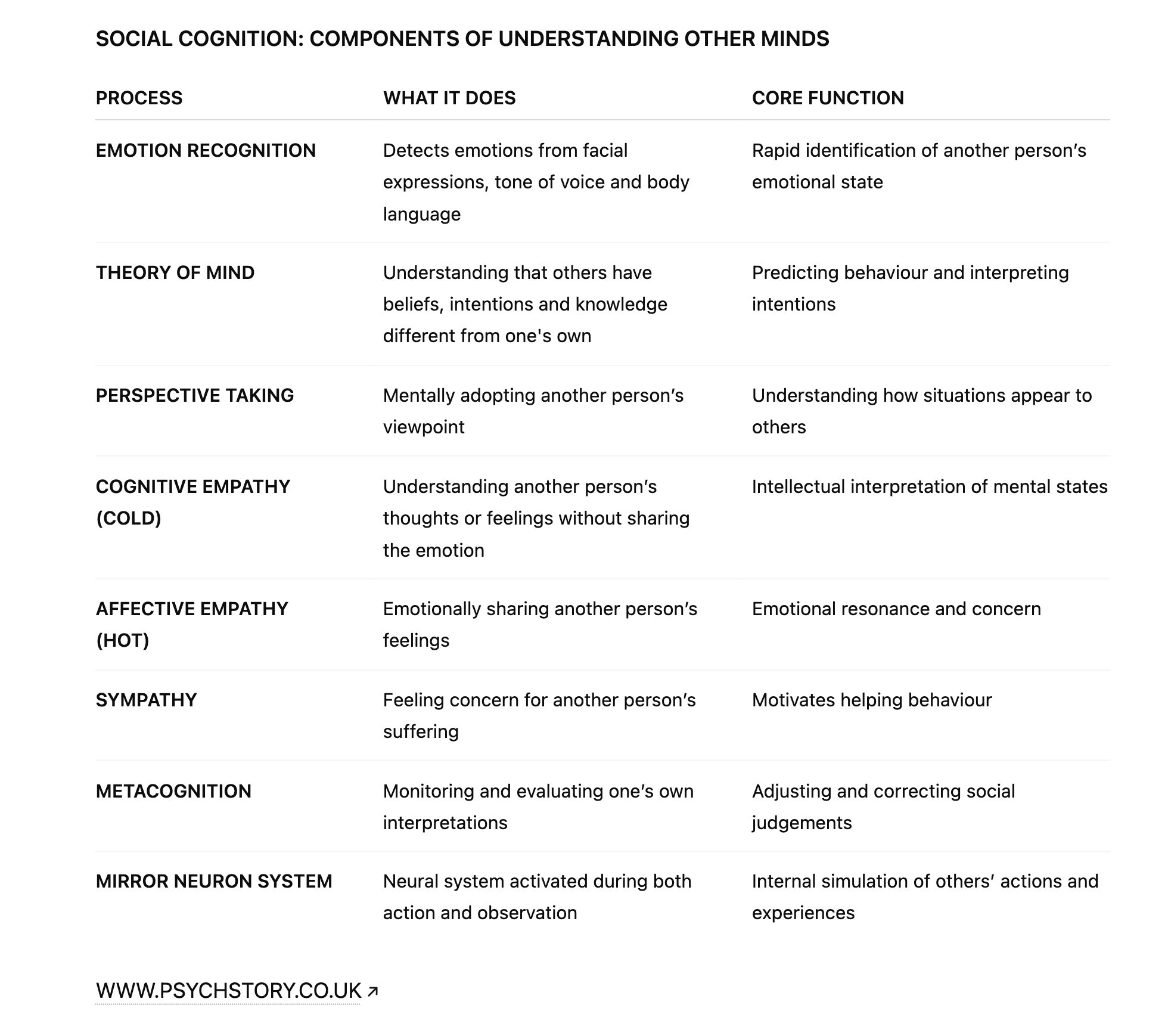
Early cognitive development begins with the ability to represent objects mentally. One of the first demonstrations of this is object permanence, described by Piaget. Infants gradually learn that objects continue to exist even when they are no longer visible. Piaget originally suggested that this ability appears around eight months of age, although later research using more sensitive methods indicates that elements of it may emerge earlier. This ability marks an important shift in cognition. The child is no longer dependent solely on immediate perception but can construct internal representations of things that are not physically present. Representational thinking provides the cognitive foundation for later social understanding. In order to infer another person’s thoughts or beliefs, the brain must be able to represent states that cannot be directly observed. Object permanence, therefore, forms an early step toward the ability to represent unseen mental states in others.
PERSPECTIVE TAKING
Perspective-taking refers to the recognition that others may perceive the world differently from oneself. Young children initially assume that others share their knowledge and viewpoint. As cognitive development progresses, children begin to recognise that individuals can possess different information, experiences, and interpretations. Research suggests that by around age 3 or 4, children begin to demonstrate this shift. They start predicting behaviour based on what another person knows rather than what they themselves know. Perspective-taking is, therefore, a crucial step toward social reasoning. It allows individuals to anticipate reactions, resolve disagreements, and negotiate social situations by considering another person’s viewpoint.
THEORY OF MIND
Theory of mind extends perspective-taking further by allowing individuals to attribute internal mental states to others. These include beliefs, desires, intentions, and knowledge. A classic demonstration is the Sally Anne false-belief task. In this experiment, one character moves an object while another character is absent. Children with a developed theory of mind recognise that the absent character will search in the original location because they hold a false belief about the object’s location. This ability usually becomes clear around 4 years of age. It is essential for understanding complex social behaviour such as deception, sarcasm, irony, and strategic cooperation. Without a theory of mind, interpreting the motivations behind behaviour becomes significantly more difficult.
METACOGNITION
Metacognition refers to the ability to think about and monitor one’s own thinking. In social contexts, this involves reflecting on interpretations of other people’s behaviour. For example, a person may initially assume that someone’s facial expression indicates anger, but after reconsidering the context, they may reinterpret it as concern or stress. Metacognition, therefore, acts as a regulatory system that evaluates and refines social interpretations, improving accuracy and reducing misunderstanding.
COGNITIVE AND AFFECTIVE EMPATHY
Modern researchers often distinguish between two components of empathy. In everyday language, these are sometimes described as “cold” and “hot” empathy. In scientific terminology, they are more precisely referred to as cognitive empathy and affective empathy.
Cognitive empathy refers to the ability to understand another person’s mental state. It involves perspective-taking and theory-of-mind processes, which depend heavily on cortical regions such as the temporoparietal junction and medial prefrontal cortex.
Affective empathy refers to the emotional sharing of another person’s state. It involves automatic emotional responses to others' feelings and depends more strongly on limbic structures such as the amygdala, anterior insula, and anterior cingulate cortex.
This distinction helps explain different patterns of social behaviour in certain conditions. Individuals with autism spectrum conditions often show difficulties with cognitive empathy, meaning they may struggle to infer another person’s thoughts or intentions. However, when emotional signals are clearly understood, many individuals with autism show intact or even heightened emotional responsiveness.
By contrast, individuals with psychopathic traits often show the opposite pattern. They may possess relatively intact cognitive empathy and can accurately infer other people’s thoughts or vulnerabilities, yet they show reduced affective empathy due to diminished emotional responses to distress cues. This combination can allow manipulation without emotional concern for the other person.
These findings suggest that empathy is not a single ability but a system composed of multiple interacting processes. Understanding another person’s mind and sharing their emotional state rely on partly distinct neural mechanisms that can vary independently across individuals.
DEVELOPMENT AND DISRUPTIONS IN SOCIAL COGNITION
Because social cognition relies on several interacting cognitive systems, disruptions to these systems can affect social understanding.
Autism spectrum conditions are often associated with delays or differences in the development of the theory of mind. Individuals may struggle to infer others' intentions or beliefs, leading to difficulties interpreting social cues.
Psychopathy and antisocial personality disorder present a different pattern. Individuals may possess cognitive theory-of-mind abilities but display reduced emotional empathy, allowing them to understand others’ mental states without sharing their own emotional responses.
Narcissistic personality traits can also affect social cognition by limiting perspective-taking and prioritising one’s own viewpoint over that of others.
Research also suggests that biological factors such as hormonal influences, including testosterone, may affect aspects of empathy and social sensitivity, although these relationships are complex and remain under investigation.
Studying these conditions helps researchers understand which components of social cognition are necessary for different aspects of social behaviour.
BIOLOGICAL MECHANISMS
Although the cognitive approach focuses on mental processes, neuroscience has identified several brain systems that contribute to social cognition. These mechanisms help explain how humans recognise emotions, interpret intentions and regulate their responses to others.
The amygdala plays a central role in detecting emotionally significant stimuli, particularly signals related to fear, threat and distress. Damage to the amygdala can impair the ability to recognise fear in facial expressions, as shown in research by Ralph Adolphs. The amygdala also appears to contribute to emotional empathy by responding to others' distress cues. Reduced amygdala activation has been reported in individuals with psychopathic traits, which may partly explain their diminished emotional responsiveness to the suffering of others.
The prefrontal cortex is involved in higher-level aspects of social cognition, including moral judgment, behavioural regulation and decision-making in social contexts. Regions such as the ventromedial prefrontal cortex help integrate emotional signals from structures like the amygdala with reasoning processes, allowing individuals to regulate impulses and evaluate the consequences of their actions. Damage to frontal regions can produce striking changes in personality, empathy and social behaviour, as illustrated historically by cases such as Phineas Gage.
Another important area is the temporoparietal junction, which has been strongly associated with perspective-taking and theory of mind. Activity in this region increases when individuals attempt to infer another person's beliefs, intentions, or knowledge. This ability to represent another mind is essential for navigating complex social interactions.
Hormonal influences also appear to shape social behaviour. Testosterone has been linked to dominance, competition and reduced sensitivity to social threat cues in some contexts. Elevated testosterone levels can reduce amygdala responsiveness to fearful facial expressions, potentially altering how individuals interpret social signals. In contrast, hormones such as oxytocin have been associated with social bonding, trust and emotional attunement, suggesting that biological systems regulating affiliation also influence social cognition.
One of the most widely discussed neural mechanisms linked to social cognition is the mirror neuron system. Mirror neurons were first identified in the premotor cortex of macaque monkeys by Giacomo Rizzolatti and colleagues. These neurons fire both when an individual performs an action and when they observe another individual performing the same action. In humans, similar networks appear to exist in premotor and parietal regions, allowing the brain to internally simulate observed actions and experiences.
Together, these interacting systems illustrate that social cognition does not depend on a single brain region. Instead, it emerges from coordinated activity across emotional processing centres, higher cognitive control systems, hormonal influences and neural circuits capable of internally modelling the experiences of others
ARE HUMANS WIRED TO FEEL EACH OTHER
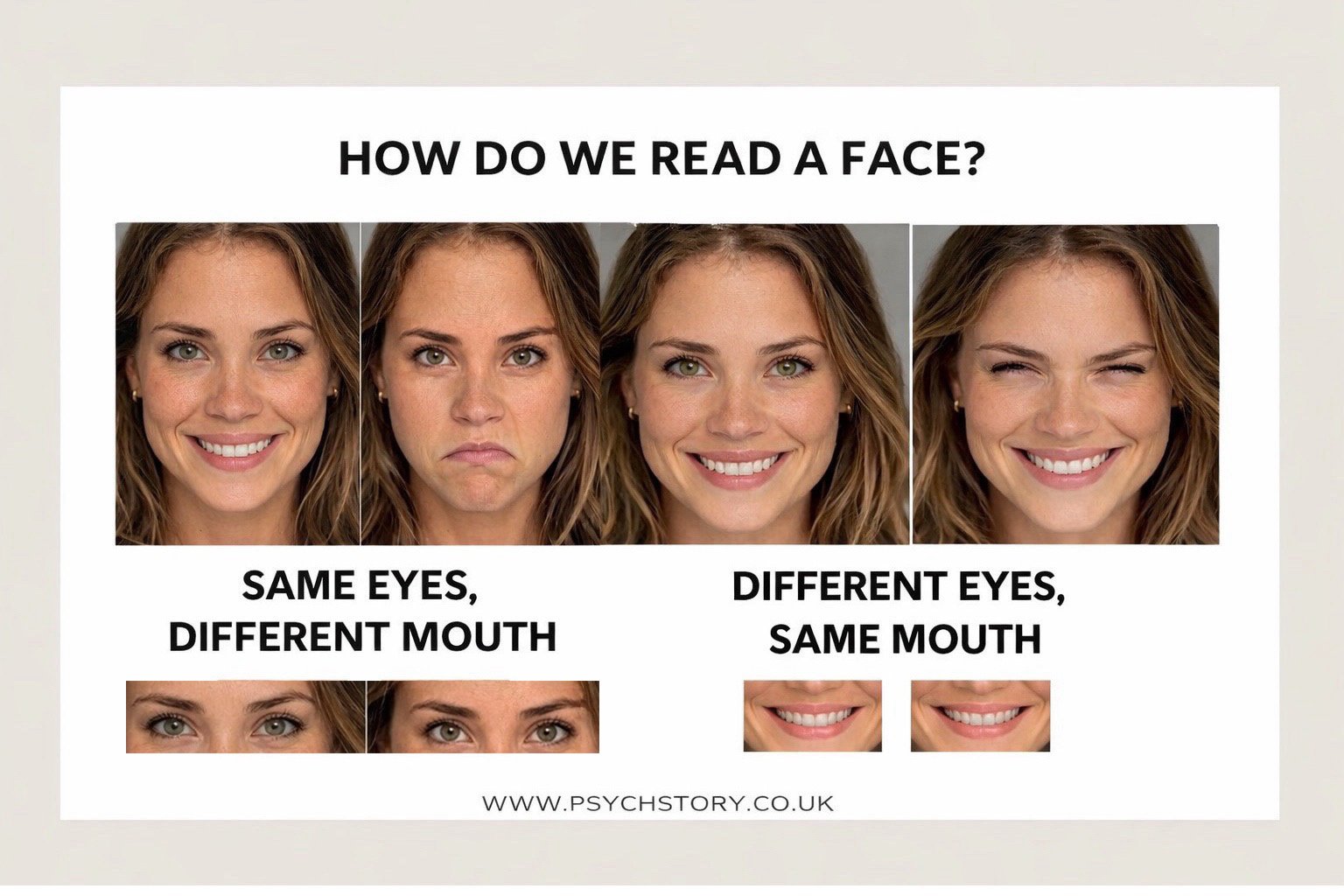
Human social behaviour often reveals a striking tendency to mirror others' actions and emotional states. People instinctively yawn when they see someone else yawn, adopt a similar posture when interacting with people they like, and unconsciously mimic facial expressions (social contagion) during conversation. When someone nearby shows distress or grief, observers frequently reproduce elements of that same expression on their own face. These reactions occur rapidly and without deliberate intention.
One explanation is that observing another person’s action or emotion activates overlapping neural systems in the observer. When the motor cortex responds to an observed action, the brain partially recreates the internal pattern associated with performing that action. This means that watching someone move, express pain or display emotion can trigger a weaker internal version of the same state. In effect, the observer’s brain models the experience rather than merely registering it visually.
This helps explain why people sometimes feel another person’s discomfort almost automatically. Observers often flinch when they see someone injured, even though they themselves are unharmed. Experiments involving body ownership illusions illustrate this clearly. In variations of the rubber hand illusion, a participant’s real hand is hidden while a realistic artificial hand is placed in view and stroked in synchrony with the unseen real hand. After a short time, the brain begins to treat the artificial hand as part of the body schema. When the fake hand is suddenly struck with a hammer or threatened with a knife, participants frequently recoil and show physiological stress responses such as increased skin conductance. The brain reacts defensively even though the individual knows the hand is not real.
Facial expressions appear to play a similar role in emotional understanding. When people observe another person expressing sadness, anger or joy, they often produce subtle versions of the same facial expression themselves. These microexpressions can activate corresponding emotional responses within the observer. In this sense, emotional understanding may partly arise from physically reproducing another person’s expression and allowing the associated emotional state to emerge internally.
This mechanism also helps explain why individuals with psychopathic traits often show reduced emotional empathy. Some research suggests they can recognise emotions cognitively but do not automatically reproduce the corresponding emotional responses. Instead of spontaneous mirroring, they may mimic emotional expressions deliberately as a social strategy.
BOTOX
An interesting implication concerns the effects of cosmetic procedures such as Botox. Botox temporarily paralyses specific facial muscles by blocking the release of acetylcholine at the neuromuscular junction. Because facial muscles cannot contract normally, the subtle mimicry that often occurs when observing another person’s expression may be reduced. Some researchers have suggested that this can interfere with the feedback signals normally sent from facial muscles to the brain. If emotional understanding partly relies on reproducing another person’s expression, then restricting facial movement may weaken the emotional feedback that contributes to empathy. Studies have found that individuals with Botox injections sometimes show slightly reduced accuracy in recognising emotional expressions or slower responses when interpreting emotional language.
However, explaining empathy purely as mechanical mimicry would be overly reductionist. The cognitive approach has often been criticised for portraying social understanding as an intellectual process involving perspective-taking or mental inference alone. The evidence above suggests something more complex. Emotional understanding appears to involve an interaction between bodily simulation, perceptual systems and higher cognitive interpretation. Mirror responses may provide the initial embodied signal, but cognitive processes such as perspective-taking, memory, and social knowledge shape how that signal is interpreted.
Taken together, these findings suggest that social cognition is not purely abstract or intellectual, nor is it simply a reflexive motor response. Instead, it emerges from the interaction between perception, bodily simulation and cognitive interpretation. The brain appears able to internally echo others' experiences while still maintaining the physical boundary between self and other. In that sense, another person’s experience may be closer to our own than it appears, separated physically by skin but partially reproduced within the observer’s neural systems
MIRROR NEURONS
One of the most widely discussed neural mechanisms related to social cognition is the mirror neuron system. Mirror neurons were first identified in the premotor cortex of macaque monkeys by Giacomo Rizzolatti and colleagues. These neurons fire both when an individual performs an action and when they observe the same action performed by another individual. In humans, similar networks appear to exist in premotor and inferior parietal regions, allowing the brain to internally simulate observed actions and experiences. For example, these neurons activate both when an individual performs an action and when they observe another individual performing the same action. In humans, similar neural systems appear to exist within networks involving the premotor cortex, inferior parietal regions, and the insula.
These systems allow the brain to internally simulate observed actions and emotional expressions. For example, observing someone smile may activate neural circuits associated with smiling in the observer. This mechanism may contribute to imitation, emotional resonance, and the learning of social behaviours.
SOCIAL COGNITION RESEARCH
NEUROSCIENTIFIC EVIDENCE FOR EMPATHY AND SOCIAL PAIN: A wide range of neuroscientific findings support the idea that the brain partially simulates the experiences of others, providing a biological basis for empathy and social cognition.
PAIN OBSERVATION STUDIES: Research by Tania Singer demonstrated that observing another person in pain activates the observer’s anterior cingulate cortex and anterior insula. In her experiment, participants watched a romantic partner receive mild electric shocks while undergoing fMRI scanning. Even though the observer felt no physical pain, the brain regions associated with the emotional component of pain became active. This suggests the brain internally represents another person’s distress.
RUBBER HAND AND THREAT RESPONSE: The rubber hand illusion developed by Matthew Botvinick and Jonathan Cohen shows how easily the brain incorporates external objects into body representation. When a rubber hand is stroked in synchrony with a participant’s hidden real hand, individuals begin to experience the fake hand as part of their body. When the rubber hand is suddenly struck with a hammer or threatened with a knife, participants often show strong physiological reactions such as increased skin conductance, demonstrating that the brain has temporarily mapped the object onto the body schema.
MIRROR NEURON RESEARCH: Work by Giacomo Rizzolatti and colleagues identified mirror neurons in the premotor cortex of macaque monkeys. These neurons fire both when an individual performs an action and when they observe the same action performed by another. Human neuroimaging studies suggest a similar system exists in the premotor cortex and inferior parietal regions, allowing the brain to internally simulate observed actions.
TOUCH AND SENSORY MIRRORING: Research by Christian Keysers showed that when participants observe another person being touched, areas of the observer’s somatosensory cortex become active. In effect, the observer’s brain represents the sensation as if it were occurring on their own body, though without producing the full conscious tactile experience.
AMYGDALA AND EMOTIONAL EMPATHY: Damage to the amygdala disrupts the ability to recognise fear and emotional distress in others. Classic research by Ralph Adolphs studied a patient known as S.M., whose amygdalae were destroyed by a genetic disorder. She showed profound difficulty recognising fear in facial expressions. This supports the idea that the amygdala plays a crucial role in emotional aspects of social cognition.
REDUCED AMYGDALA ACTIVITY IN PSYCHOPATHY: Research on psychopathy also highlights the role of the amygdala in empathy. Studies by James Blair found that individuals with psychopathic traits show reduced amygdala responses when viewing distress cues such as fearful or sad faces. This reduced emotional reactivity is thought to contribute to impaired emotional empathy and reduced concern for others.
AUTISM AND MIRROR SYSTEM DIFFERENCES: Some researchers have suggested that differences in mirror neuron functioning may contribute to social cognition difficulties in autism. Work by Marco Iacoboni and colleagues reported reduced activation of the mirror system in individuals with autism during imitation tasks, although this explanation remains debated.
Together, these findings suggest that multiple brain systems contribute to empathy and social cognition, including mirror neuron networks involved in action understanding, somatosensory regions involved in sensory simulation, and limbic structures such as the amygdala that process emotional significance