
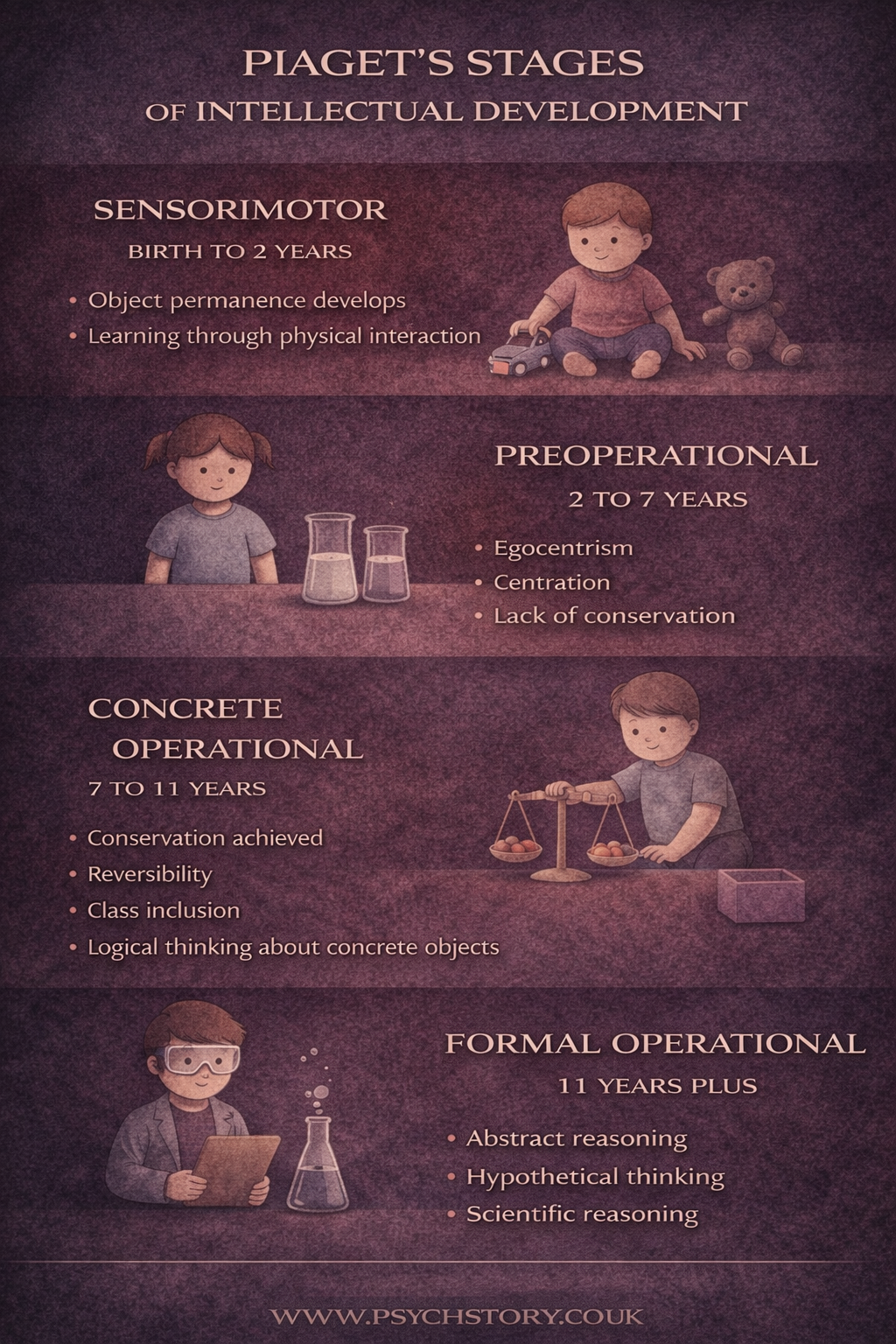
Specification: Piaget’s stages of intellectual development. Characteristics of these stages, including object permanence, conservation, egocentrism and class inclusion
KEY WORDS
SENSORIMOTOR STAGE APPROXIMATELY BIRTH TO TWO YEARS: Learning during this stage occurs through sensory experience and physical action. Infants begin life equipped with reflexes such as sucking and grasping, but gradually develop coordinated and intentional behaviour. A major achievement is the development of object permanence, the understanding that objects continue to exist even when they are no longer visible.
PRE OPERATIONAL STAGE APPROXIMATELY TWO TO SIX YEARS: This stage is marked by rapid language development and the emergence of symbolic thought. Children can mentally represent objects and events, but reasoning remains limited. Thinking is often egocentric, meaning that children struggle to adopt perspectives other than their own. Judgements are influenced by appearance rather than logical principles, and conservation tasks are typically failed.
CONCRETE OPERATIONAL STAGE APPROXIMATELY SEVEN TO ELEVEN YEARS: Logical reasoning becomes more systematic when dealing with concrete information. Children develop abilities such as classification, ordering and conservation. They can understand that quantity remains constant despite changes in shape or arrangement. However, reasoning remains tied to concrete examples and has not yet extended comfortably to abstract situations.
FORMAL OPERATIONAL STAGE APPROXIMATELY TWELVE YEARS AND ABOVE: This final stage involves the capacity for abstract and hypothetical reasoning. Individuals can consider multiple possibilities, test ideas systematically and evaluate evidence logically. Scientific reasoning and complex problem-solving become possible at this level of development.
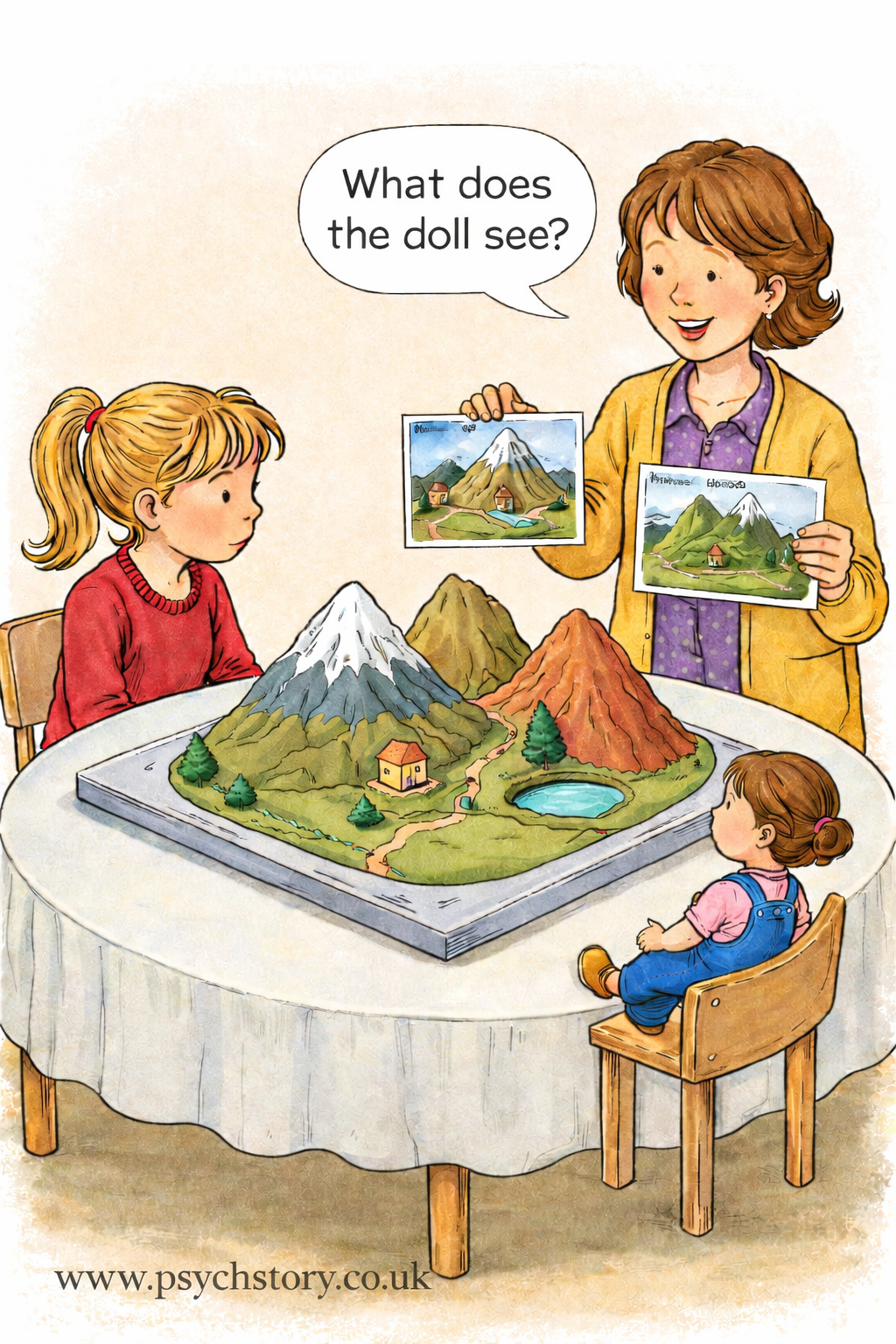
EGOCENTRISM: Egocentrism describes the cognitive limitation in which children assume that others perceive the world in the same way they do. It does not imply selfishness but reflects developmental constraints in perspective-taking. Egocentric thinking is characteristic of the pre-operational stage and gradually declines as cognitive abilities mature. Example: In the three mountains task, children select the photograph showing their own viewpoint rather than the perspective of a doll positioned elsewhere.
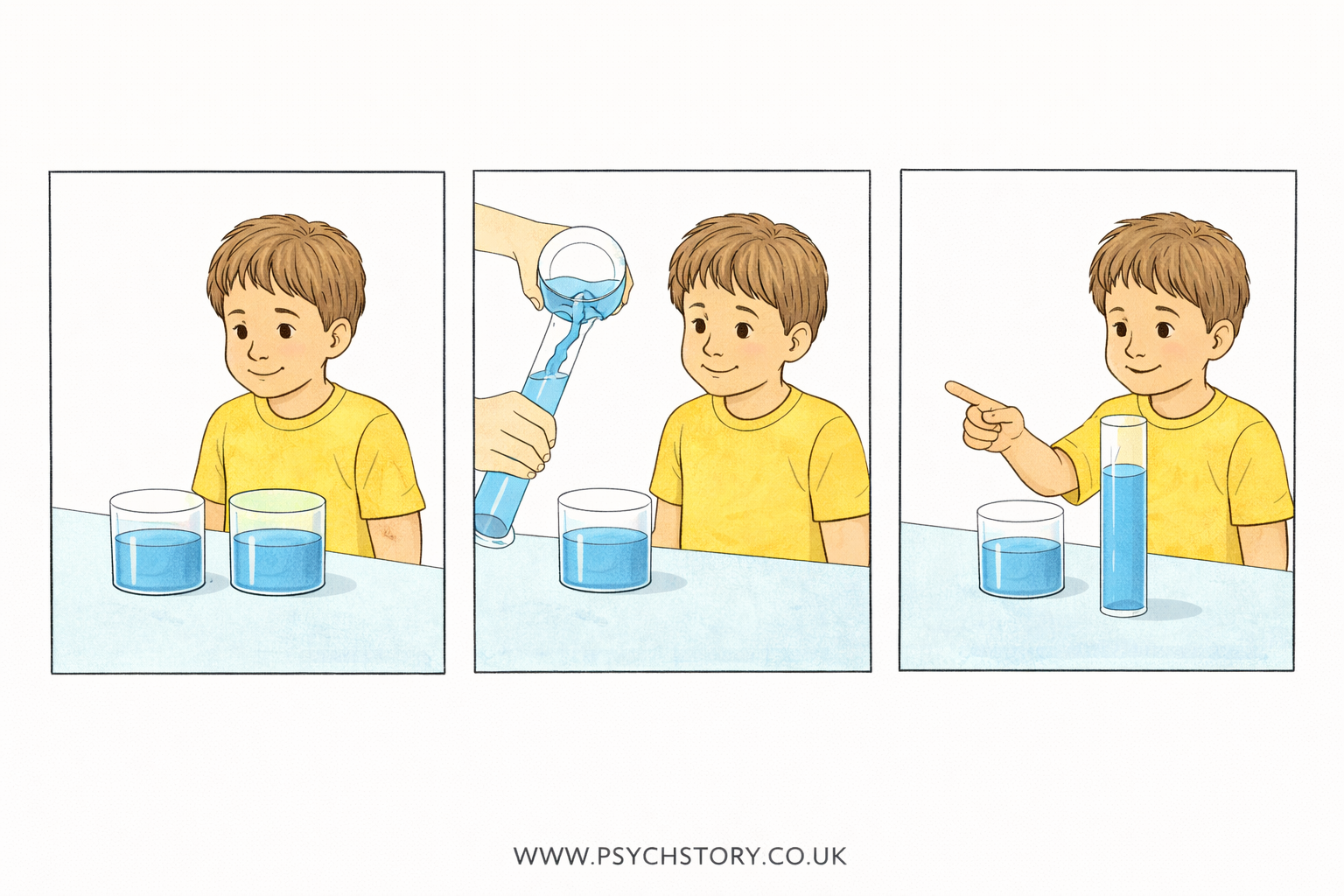
CONSERVATION: Conservation is the understanding that physical quantities remain constant despite changes in appearance, arrangement or form. Mastery of conservation demonstrates logical reasoning, as the child recognises that transformations do not alter the underlying quantity. Conservation develops during the concrete operational stage. Example: When water is poured from a short, wide glass into a tall, thin glass, younger children believe the taller glass contains more, whereas older children understand the amount is unchanged.
REVERSIBILITY: Reversibility refers to the ability to mentally reverse a sequence of actions or transformations. It is a logical operation that develops during the concrete operational stage. For example, if clay is rolled into a sausage shape, a child with reversibility can think: the clay could be rolled back into the original ball. The child understands the transformation can be undone. Reversibility is, therefore, a type of logical reasoning.
THE RELATIONSHIP BETWEEN CONSERVATION AND REVERSIBILITY: Reversibility helps children explain conservation. When a child realises the liquid could be poured back into the original container, they understand that the quantity has not changed. However, reversibility itself is simply the mental operation of undoing a transformation, whereas conservation is the concept that quantity remains constant. Reversibility helps children explain conservation. When a child realises the liquid could be poured back into the original container, they understand that the quantity has not changed. However, reversibility itself is simply the mental operation of undoing a transformation, whereas conservation is the concept that quantity remains constant.
CENTRATION:
DECENTRATION: Decentration is the ability to consider multiple features of a situation simultaneously rather than focusing on a single perceptual aspect. This cognitive shift enables logical reasoning and supports success on conservation tasks. Example: A child considers both the height and width of a container when judging volume rather than focusing only on height.
FORMAL OPERATIONAL THINKING: Formal operational thinking refers to the ability to reason abstractly and hypothetically. Individuals can generate hypotheses, systematically test possibilities and think beyond direct experience. This stage allows scientific reasoning and complex problem-solving. Example: Adolescents can solve algebraic problems or predict outcomes based on hypothetical scenarios without needing physical objects present.
OPERATIONS: Operations are internalised mental actions that follow logical rules. In the concrete operational stage, children can perform logical operations on tangible objects. In the formal operational stage, operations extend to abstract and hypothetical ideas.
MENTAL REPRESENTATION: Mental representation is the ability to form internal images or symbols of objects and events. This ability develops during the later sensorimotor stage and underpins object permanence and symbolic thought. Without mental representation, thinking is limited to immediate sensory experience.
SYMBOLIC THOUGHT: Symbolic thought refers to the use of words, images or objects to represent something else. It becomes prominent in the pre-operational stage and allows pretend play and language development. However, symbolic thinking at this stage is not yet governed by logical operations.
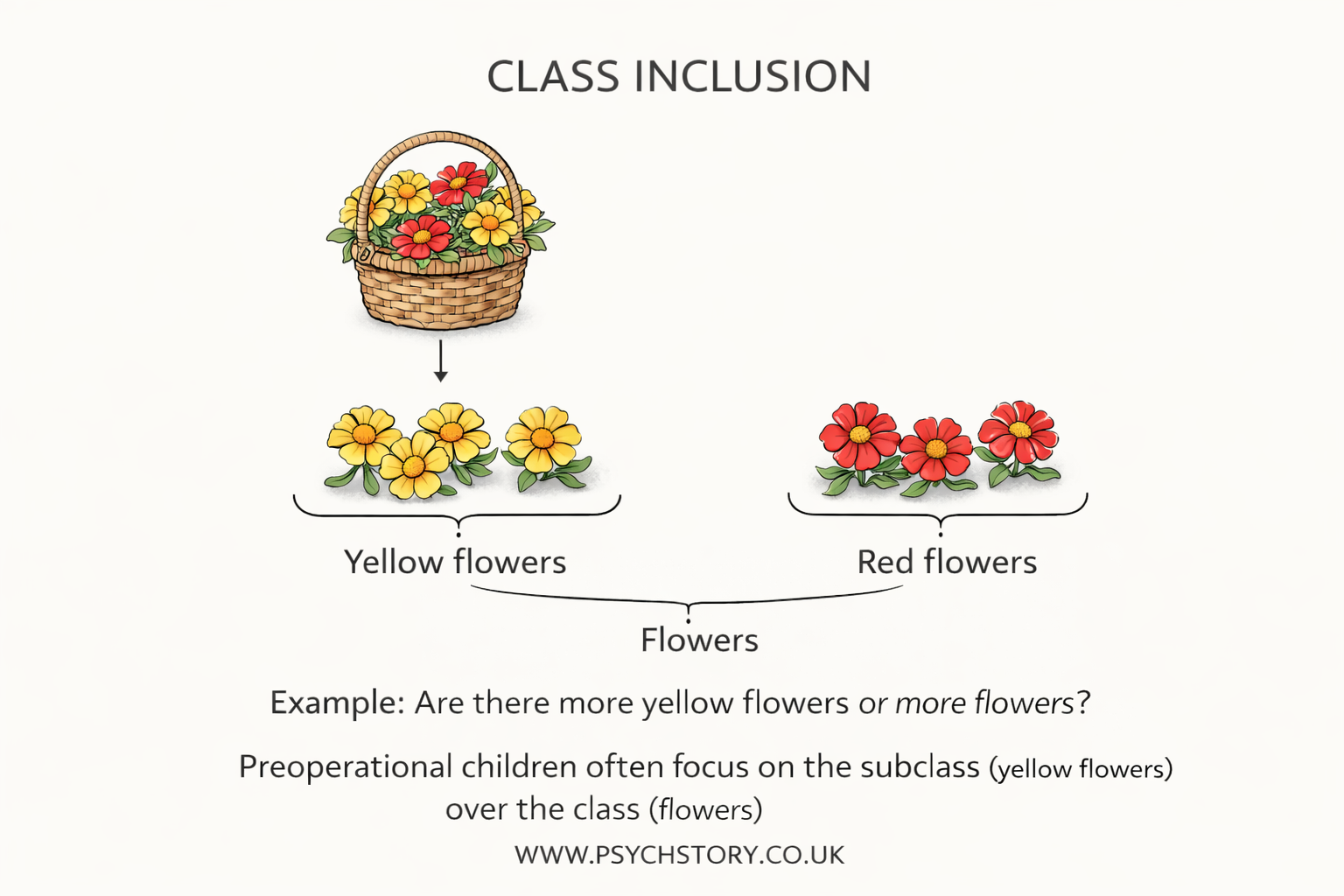
CLASS INCLUSION: Class inclusion is the ability to understand hierarchical relationships between categories and subcategories. It requires logical reasoning because the child must simultaneously consider part-whole relationships. Example: When shown five roses and two daisies, younger children state there are more roses, whereas older children correctly identify that there are more flowers overall.
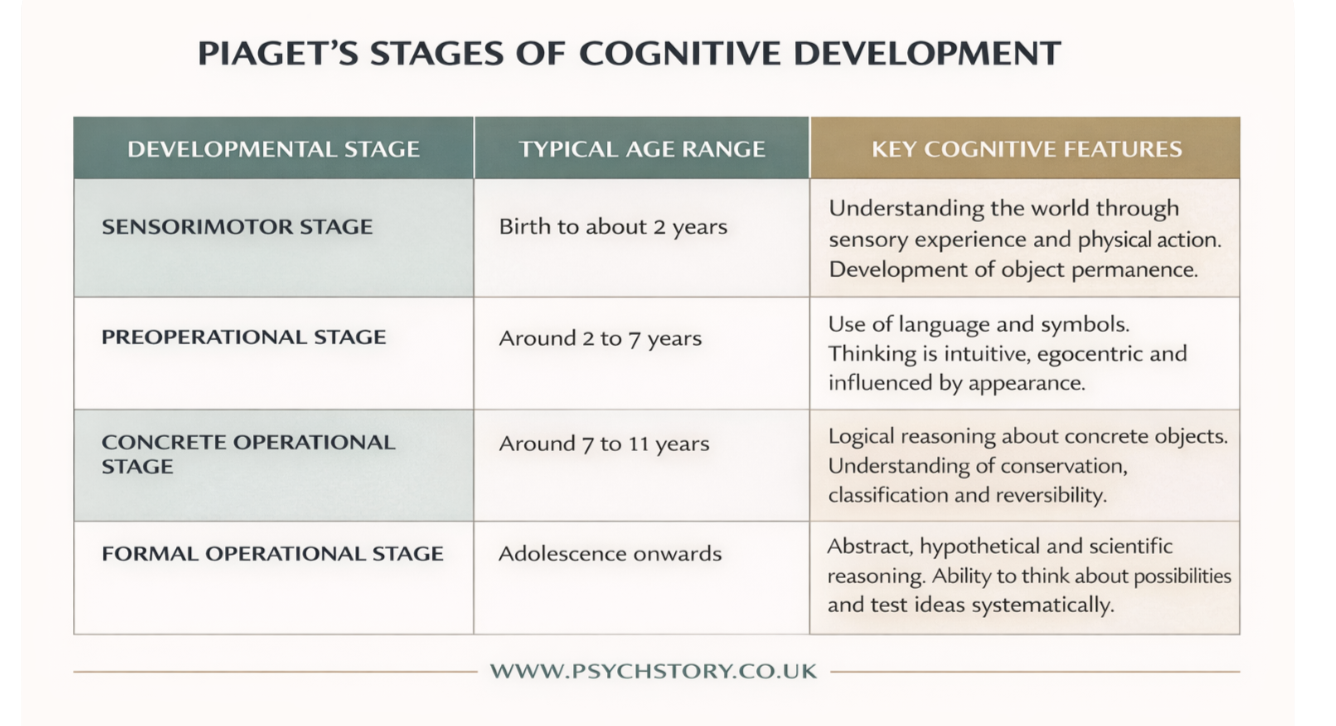
PIAGET’S THEORY OF INTELLECTUAL DEVELOPMENT
Jean Piaget (1896 to 1980) was born in Switzerland and initially trained as a zoologist. His early scientific work focused on biological adaptation and the way organisms adjust to their environments. This background strongly influenced his later psychological thinking. Piaget approached human intelligence in the same way a biologist might approach growth in living organisms. He believed that thinking develops through a process of gradual adaptation to the environment.
Piaget later worked with Alfred Binet in Paris, helping to analyse the results of early intelligence tests. Binet was primarily interested in whether children answered questions correctly, as the tests were designed to measure intellectual ability. Piaget, however, became fascinated by the answers children gave when they were wrong. He noticed that children of similar ages often made the same types of mistakes. Rather than viewing these errors as signs of ignorance, Piaget concluded that they reflected the way children were thinking at that stage of development.
From these observations, Piaget proposed that children do not simply know less than adults. Instead, they think in fundamentally different ways. Children construct their understanding of the world through active interaction with their environment. As they grow, their ways of thinking change systematically.
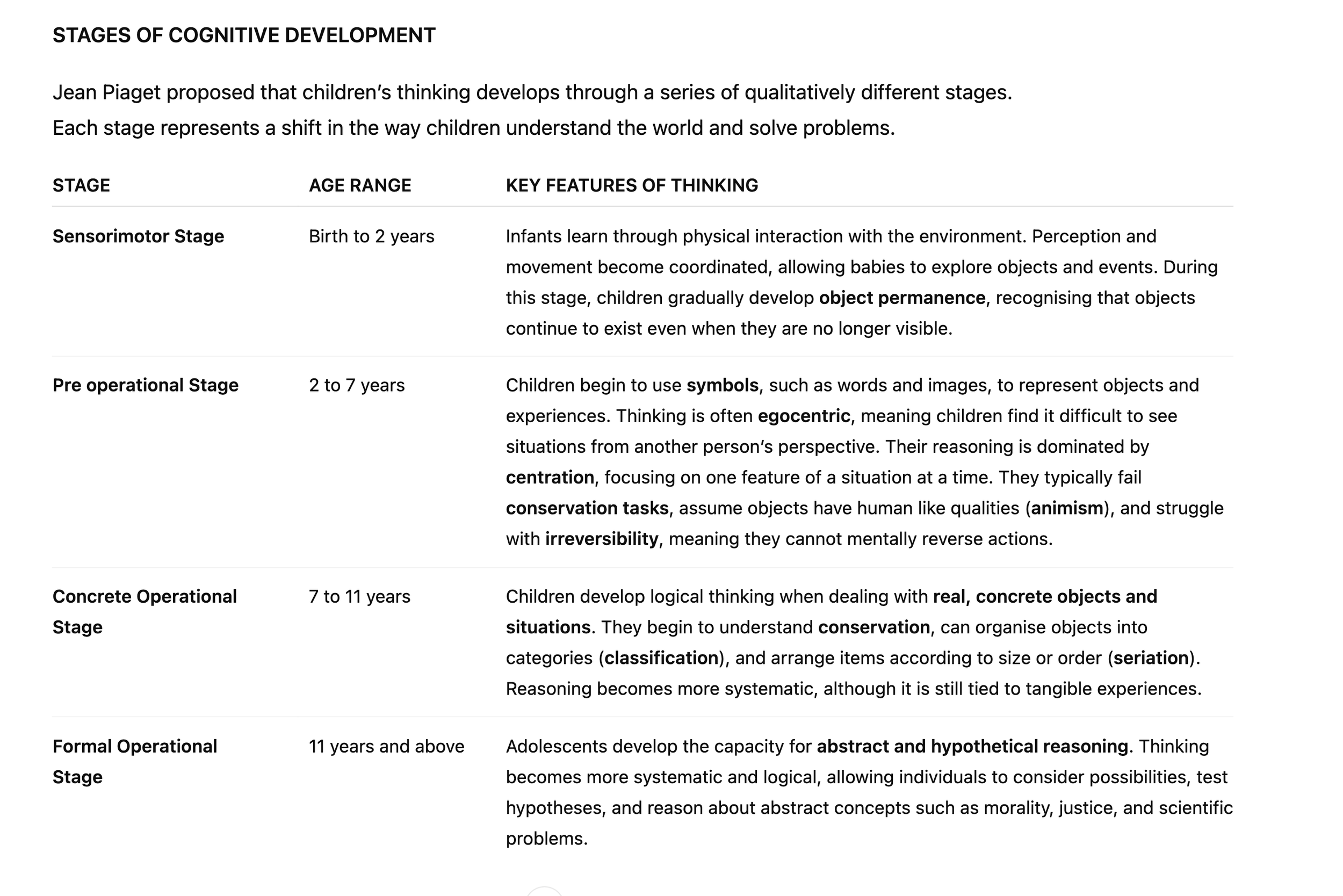
Piaget argued that cognitive development progresses through four universal stages that occur in a fixed sequence. A stage refers to a period of development in which thinking follows a particular structure or pattern. Each stage represents a qualitatively different way of reasoning about the world. Children cannot skip stages, and each stage builds on the mental structures developed in the previous one. Although the exact age at which children move through the stages can vary, the sequence itself remains constant.
This view was very different from many earlier theories of development. At the time, children were often regarded as simply less capable versions of adults whose knowledge gradually increased with age. Piaget rejected this idea. He argued that development involves fundamental reorganisations of thinking rather than the steady accumulation of information.
Piaget’s theory is therefore described as a cognitive developmental theory. It focuses on internal mental processes such as reasoning, understanding, and problem-solving. The theory attempts to explain observable behaviour by examining the structures of thought that underlie it.
THE COGNITIVE DEVELOPMENTAL APPROACH
The cognitive developmental approach examines how thinking changes as people grow older. It is concerned with mental processes such as perception, reasoning, memory, and problem-solving. Rather than focusing solely on behaviour, this approach seeks to understand the cognitive structures that guide behaviour.
Although much of the research in this approach focuses on childhood, the principles can be applied throughout the lifespan. Piaget was particularly interested in how children gradually develop increasingly complex ways of thinking about the world.
In Piaget’s view, development involves both biological maturation and interaction with the environment. Children are born with the capacity to organise their experiences, but knowledge is constructed through active exploration and engagement with the world. Cognitive development, therefore, reflects an ongoing process of adaptation between the individual and their environment
HOW CHILDREN LEARN
Piaget emphasised that children actively construct knowledge rather than passively absorb it. Key factors include:
• BIOLOGICAL MATURATION: Brain development enables increasingly complex reasoning as children age.
• INTERACTION WITH THE ENVIRONMENT: Through exploration and manipulation of surroundings, children test and refine their ideas.
• SOCIAL EXPERIENCES: Interactions with others introduce new viewpoints, challenging and reshaping existing understandings.
• EQUILIBRATION: When new information conflicts with current schemas, children reorganise their thinking to achieve balance.
THE FOUR DEVELOPMENTAL STAGES
SUMMARY OF THE CORE PRINCIPLES Of PIAGET’S THEORY
• Children advance through Piaget’s cognitive stages in a set order, though the pace differs among individuals.
• Not all people reach the highest stage, such as formal operational thinking.
• Cognitive growth stems from the interplay of biological maturation and active environmental interaction.
• Each stage involves a different quality of thinking, not merely more accumulated knowledge.
• Stages represent unique forms of intelligence and ways of structuring experiences.
• Development is about restructuring thought processes, not just adding information.
SENSORIMOTOR STAGE (BIRTH TO APPROXIMATELY 2 YEARS)
Piaget’s description of the sensorimotor stage was based on intensive naturalistic observation of infants, including systematic study of his own three children. He observed that newborn behaviour is initially reflex-driven and poorly coordinated. Gradually, infants begin to differentiate their own actions from external events. For example, an infant who sees a hand moving in front of their eyes eventually recognises that this moving object is part of their own body. Through repeated action and feedback, sensory input and motor output become integrated, leading to the construction of new action-based schemas.
At the beginning of this stage, infants can grasp and manipulate objects but lack an understanding that objects continue to exist independently of perception. If an object is hidden from view, the infant behaves as though it has ceased to exist. This phenomenon is often summarised as “out of sight, out of mind.” The infant’s world is therefore restricted to immediate sensory experience: what can be seen, heard, touched, tasted or smelled. Early interaction with the environment depends largely on innate reflexes such as sucking and grasping.
Piaget described the repetitive behaviours infants engage in as circular reactions. These are actions that are accidentally discovered and then repeated because they produce interesting or pleasurable outcomes. Through primary, secondary and tertiary circular reactions across six sub-stages, behaviour shifts from reflexive to intentional. Over time, actions become more deliberate and goal-directed as neural maturation and environmental interaction refine cognitive organisation.
The central developmental achievement of the sensorimotor period is the emergence of object permanence. This refers to the understanding that objects continue to exist even when they are no longer perceptually available. By around 8 to 12 months, infants begin searching for hidden objects, although they may commit the A not B error. By approximately 18 months, object permanence is securely established. At this point, infants will systematically search for a hidden object and show surprise if it is not located where it was last seen.
PRE OPERATIONAL STAGE (APPROXIMATELY 2 TO 7 YEARS)
During the pre-operational stage, children can represent the world through language, images and symbols, but their reasoning is not yet organised by logical operations. An operation, in Piaget’s theory, refers to a mental rule or internalised action that allows information to be manipulated logically. Because these operations have not yet developed, children rely on intuitive forms of reasoning.
Their thinking is strongly influenced by appearance and immediate experience. Judgements are often based on what seems obvious rather than on consistent logical relationships. Children may focus on a single striking feature of a situation while overlooking other relevant aspects.
Reasoning in this stage can also appear magical or animistic. Children may assume that events occur because of intention, desire or purpose rather than physical causes. For example, they may believe that objects move because they “want” to move, or that natural events occur for human reasons.
Animism is particularly common. Children may attribute life, feelings or intentions to inanimate objects such as toys, the sun or clouds. This reflects a tendency to interpret the world through human experience rather than through physical or scientific explanations.
Overall, pre-operational reasoning is intuitive, perception-driven, and often guided by personal experience or imaginative explanations rather than by systematic logic. Logical rules that allow children to analyse relationships between objects and events emerge later in the concrete operational stage
The stage is divided into two qualitatively different sub-stages.
Preconceptual thinking (approximately 2 to 4 years) is characterised by limited classification ability. Children tend to group objects based on superficial similarity rather than hierarchical organisation. For example, all four-legged animals may be labelled “dog.” This overextension reflects an early categorical schema that has not yet been refined. Children at this stage also exhibit animistic thinking, attributing life and intention to inanimate objects. A broken doll may be described as feeling pain. Such responses indicate that children project internal states onto external objects.
Intuitive thinking (approximately 4 to 6 or 7 years) marks a transitional phase. Children begin to use mental operations to address simple problems, yet they cannot articulate the logical principles underlying their answers. When shown an image containing seven boys and four girls and asked whether there are more boys than girls, the child will typically answer correctly. However, when asked whether there are more boys or more children, the child may incorrectly focus on the most visually salient category and respond “more boys.” This reflects centration and difficulty coordinating class inclusion relationships.
Although intuitive thought moves closer to adult logic than earlier preconceptual reasoning, it remains limited. Performance on conservation tasks demonstrates these constraints. Children in this stage tend to judge quantity by perceptual appearance rather than logical invariance. For example, if liquid is poured into a taller, thinner container, they often conclude that there is more liquid because the level appears higher.
Language develops rapidly throughout the pre-operational period and becomes an increasingly important representational tool. Children use words, symbols and images to engage with their environment. Nevertheless, cognitive competence is constrained by identifiable limitations, such as egocentrism, centration, and irreversibility. Notably, this stage is often defined by the operations children are not yet able to perform rather than by the logical structures they have already mastered.
FEATURES OF THE PRE-OPERATIONAL STAGE
EGOCENTRIC THOUGHT: Egocentrism, in Piaget’s theory, refers to a child’s difficulty in taking another person’s perspective. It does not mean selfishness. It describes a cognitive limitation in which the child assumes that others see, think and feel the same way they do. Egocentrism is most evident during the preoperational stage, typically between ages two and seven. At this stage, children can represent the world symbolically and use language, but their thinking is still centred on their own viewpoint. The Three Mountains Task was designed to measure this. A child is shown a model landscape with three different mountains. A doll is placed at a different position around the table. The child is asked to select the picture that shows what the doll can see. Preoperational children often choose the picture that matches their own view rather than the doll’s. This suggests they cannot yet mentally shift perspective. Egocentrism also appears in everyday behaviour. For example, a young child who covers their eyes may believe they are hidden from others. They struggle to understand that other people have a separate visual perspective. Importantly, Piaget did not claim that children are unaware of the existence of others. Rather, he argued that they cannot yet coordinate multiple perspectives simultaneously. This limitation is linked to centration. The child focuses on one aspect of a situation and cannot decentre to consider alternative viewpoints. As children move into the concrete operational stage, egocentrism declines. They become able to mentally represent viewpoints other than their own. This reflects a structural reorganisation of thinking rather than simple learning. Later research has suggested that Piaget may have overestimated the extent of egocentrism. When tasks are simplified or made more meaningful, younger children sometimes demonstrate perspective-taking earlier than Piaget predicted. However, the general pattern of developmental change remains supported
IRREVERSIBLE THINKING: Reversibility involves recognising that a transformation can be mentally undone and that quantity remains constant despite a change in appearance. Pre-operational children struggle with this concept. Piaget demonstrated irreversibility using several conservation tasks. In the number task described above, younger children frequently claim that the longer, spread-out row contains more counters, even though no counters have been added or removed. Their judgment is based on perceptual appearance rather than logical reasoning, indicating that they have not grasped the principle of conservation.
CENTRATION: Centration describes the tendency to focus on a single salient dimension of a situation while ignoring others. Instead of considering transformation over time, the child attends only to the most obvious static feature, such as height or length. This limitation underlies many errors in conservation tasks during the pre-operational stage. Key limitations of pre-operational thinking include egocentrism, irreversibility and centration.
CONCRETE OPERATIONAL STAGE AGES 7-11
Between roughly 7 and 11 years of age, children enter the concrete operational stage. In Piaget’s theory, concrete thinking refers to reasoning that is based on real, observable objects or events. Children can think logically, but their reasoning works best when it applies to situations involving real-world objects. Children in the concrete operational stage can solve problems when they involve objects they can see, manipulate, or directly represent. Their thinking is tied to real situations rather than abstract ideas
During this period, intuitive reasoning is gradually replaced by logical operations applied to concrete material. Thinking becomes more systematic, although it remains tied to tangible objects and real situations. Children at this stage can consider multiple aspects of a stimulus simultaneously. This ability to decentre enables successful performance on conservation tasks. In a volume task, for instance, the child must take into account both the height and the width of the container rather than focusing on height alone. They begin to appreciate that a taller container may also be narrower, resulting in equivalent overall volume. Perspective-taking also improves. Concrete operational children can recognise viewpoints other than their own and understand that others may hold different perspectives. They develop classification skills, including grouping objects according to shared characteristics and arranging them in logical order. However, their reasoning remains limited to concrete contexts. Hypothetical or abstract problems continue to present difficulty. Although logical thinking strengthens during this stage, abstract reasoning does not become fully established until the formal operational stage, which typically begins around 12 years of age. Consequently, children in the concrete operational period may struggle with purely abstract classification tasks.
FEATURES OF THE CONCRETE OPERATIONAL STAGE
CLASSIFICATION: Classification is the process of grouping objects by shared characteristics. This involves recognising that certain items belong together because they share defining features, such as colour, shape, size or function. In Piaget’s theory, true classification develops during the concrete operational stage. Younger children in the preoperational stage can sort objects perceptually, for example, placing all red blocks together. However, they often struggle with hierarchical classification. Hierarchical classification requires understanding that a category can be part of a larger class. For example, if a child is shown five roses and two tulips and asked whether there are more roses or more flowers, a preoperational child may say there are more roses because roses are the most visible group. They fail to recognise that roses are a subset of the broader category “flowers.” Concrete operational children, by contrast, understand that roses and tulips are both members of a higher order class. This reflects a structural change in thinking. They can coordinate relationships between parts and wholes rather than focusing on one category at a time.
SERIATION: Seriation is the ability to arrange objects in a logical order according to a specific dimension, such as length, weight or volume. It requires systematic comparison rather than simple matching. In a typical task, children may be asked to arrange sticks from shortest to longest. Preoperational children may correctly compare two sticks at a time but struggle to consistently coordinate the entire series. They may create partial sequences rather than a complete ordered set. Concrete operational children can mentally coordinate relationships across multiple items. They understand that if stick A is longer than stick B, and stick B is longer than stick C, then stick A must also be longer than stick C. Seriation, therefore, demonstrates the development of logical operations. It requires coordination of relationships rather than reliance on immediate perception.
TRANSITIVITY: Transitivity is closely linked to seriation. It refers to the ability to deduce logical relationships between items that have not been directly compared. For example, if a child is told that David is taller than John, and John is taller than Mike, transitive reasoning allows them to conclude that David must be taller than Mike. This ability reflects internalised logical structure. The child does not need to physically see the three individuals side by side. Instead, they mentally coordinate the relationships. Transitivity emerges during the concrete operational stage and reflects a move away from intuitive reasoning towards rule-based logical thinking.
DECENTRING: Decentring is the ability to consider multiple aspects of a situation simultaneously. In earlier stages, children tend to focus on one salient feature. Piaget called this centration. For example, in a conservation-of-liquid task, a preoperational child may focus only on the height of the liquid in a glass. If the liquid is poured into a taller, thinner container, they may say there is now more liquid because it looks higher. They centre on height and ignore width. Decentring allows the child to take both height and width into account simultaneously. They understand that although the liquid appears taller, the container is also narrower. This shift represents an important structural reorganisation in thinking. It allows children to integrate multiple variables rather than relying on a single perceptual cue.
REVERSIBILITY: Reversibility refers to the understanding that actions can be mentally undone. It is the ability to imagine a process being reversed and returning to its original state. In conservation tasks, reversibility is crucial. A child who understands reversibility can reason that if water is poured from one container into another, it can be poured back, and the quantity would remain unchanged. Preoperational children typically lack reversibility. They see transformations as one-way processes. Once something's appearance changes, they assume it has changed in quantity. Concrete operational children can mentally reverse transformations. This reflects a more flexible and coordinated cognitive structure.
CONSERVATION: Conservation is the understanding that certain physical properties remain constant despite changes in appearance. These properties include number, mass, volume and length. In a conservation-of-number task, two rows of counters may initially be aligned evenly. When one row is spread out, a preoperational child often claims that the longer row contains more counters. Their reasoning is guided by perception rather than logic. Concrete operational children understand that spreading out the counters does not change the quantity. They can decentre, apply reversibility and use logical reasoning to justify their answer. Conservation, therefore, represents the integration of several cognitive operations. It is not a single skill but the outcome of structural reorganisation.
ABILITY TO VIEW THINGS FROM ANOTHER PERSON’S PERSPECTIVE: A child in the concrete operational stage is no longer egocentric and can appreciate viewpoints other than their own. Key mental processes during the concrete operational stage include the move from trial-and-error strategies to more logical, systematic reasoning. Younger children may attempt random combinations and may or may not arrive at the correct answer. Older children tend to adopt a more structured approach, excluding possibilities methodically until they reach a solution. They begin to use abstract reasoning to develop and test hypotheses.
LINK TO PIAGET’S STAGE THEORY: These abilities are all characteristic of the concrete operational stage. They reflect a shift from intuitive, perception-bound thinking to logical, rule-based reasoning. Before this stage, children’s reasoning is dominated by appearance and single features. After this stage, they can coordinate relationships, reverse processes mentally and understand invariance despite transformation. In Piaget’s framework, these changes do not occur simply because children learn new facts. They occur because the underlying structure of thought has reorganised. Classification, seriation, transitivity, decentring, reversibility and conservation are behavioural indicators of that structural change
FORMAL OPERATIONAL STAGE
The final stage in Piaget’s theory of cognitive development is the formal operational stage, which typically begins around age 11 and continues into adulthood. At this stage, thinking becomes abstract, logical, and systematic. Children are no longer limited to reasoning about concrete objects or directly observable situations. Instead, they can think about hypothetical possibilities, theoretical ideas, and complex relationships. One key feature of this stage is hypothetical deductive reasoning. Individuals can form a hypothesis, test it systematically, and draw logical conclusions. For example, when solving a scientific problem, they can consider several possible explanations and evaluate each one logically. Another feature is the ability to think about abstract concepts such as justice, morality, politics, and philosophy. Younger children tend to rely on direct experience, whereas adolescents in the formal operational stage can reason about ideas that are not physically present. Piaget believed this stage represented the highest level of cognitive development because individuals can now think scientifically, reason logically about possibilities, and consider multiple variables at once. However, later research suggests that not all adults consistently use formal operational thinking in everyday situations.
IN SUMMARY
PIAGET’S EXPERIMENTS
TESTING A CHILD’S UNDERSTANDING OF CONSERVATION
Piaget designed a series of experimental tasks to examine whether young children understand conservation of number, mass and liquid volume. Conservation refers to the principle that certain properties remain constant despite changes in outward appearance or spatial arrangement. In other words, quantity does not alter simply because form or layout changes. To assess conservation of number, a child was shown two parallel rows of coloured counters arranged so that both rows were clearly equal in length and number. The child was first asked to confirm that each row contained the same number of counters. Once agreement was established, the researcher altered the display by spreading out one row while leaving the other unchanged. The child was then asked again whether the two rows still contained the same number of counters.
THREE MOUNTAINS TASK TESTING EGOCENTRISM
KEY RESEARCH: The Three Mountains Task was developed by Jean Piaget and Bärbel Inhelder in 1956 to investigate children's egocentrism.
AIM: The task was designed to test whether young children could understand that another person may see the same scene differently from their own viewpoint. In other words, it tested children’s ability to take another person’s visual perspective (egocentrism)
PROCEDURE: Children were shown a model landscape containing three mountains. Each mountain had a distinctive feature, such as snow on the top, a small house, or a cross. The child looked at the model from one position. A doll was then placed at different positions around the model to represent another observer. Children were shown photographs of the mountains from different viewpoints and asked to select the one that showed what the doll could see.
FINDINGS: Children younger than approximately seven years, corresponding to the pre-operational stage, typically select the image that reflects their own viewpoint rather than the doll’s location. This pattern of response was interpreted as evidence of egocentric thinking.
CONCLUSION: Piaget concluded that children in the pre-operational stage show egocentrism. This means they struggle to understand that another person may see the world differently from themselves. The ability to take another person’s perspective develops later during the concrete operational stage. Piaget and Inhelder developed the Three Mountains task in the 1940s to explore how children mentally represent spatial perspectives. The model consisted of three distinct mountains, each marked by a unique feature, making them easy to differentiate. For example, one mountain might have snow at the peak, another a cross, and the third a small house
PIAGET’S CONSERVATION TASKS
Piaget conducted numerous conservation experiments across the pre-operational and concrete operational stages. One well-known procedure involved testing the conservation of liquid volume. Two identical containers were filled with equal amounts of water so that the child could clearly see the equivalence. The liquid from one container was then poured into a different-shaped glass, typically taller and thinner than the original.
The transformation occurred in full view of the child. Despite observing that no water had been added or removed, many children at the pre-operational stage stated that the taller, thinner glass contained more liquid. Their judgment was guided by the water level's increased height rather than by logical reasoning about volume. Piaget reported that approximately seventy per cent of children in this age range failed the task.
A similar approach was used to test conservation of mass. A ball of clay was presented to the child, and its size was acknowledged to be equal to that of a comparison piece. The clay was then reshaped into a long, sausage-like form without removing any material. Younger children frequently claimed that the elongated shape contained more clay, again relying on perceptual change rather than invariance of quantity.
ACTIVITY: PIAGET’S THREE MOUNTAINS TASK
Piaget argued that young children have difficulty adopting another person’s viewpoint and used the Three Mountains task to illustrate this limitation. After reviewing the procedure, consider the following:
What are the main problems associated with investigating egocentrism in this way?
Think about how you would devise another task that would address the problems you identified above.
When you have completed this activity, examine the research conducted by Hughes (1975) and consider how his findings differed from Piaget’s conclusions.
EVALUATION OF PIAGET’S THEORY OF COGNITIVE DEVELOPMENT
EMPIRICAL EVIDENCE AGAINST PIAGET’S CLAIMS
Although Piaget’s methods were considered innovative at the time, later research has suggested that his findings are highly dependent on the exact procedures used. When tasks are made more meaningful and child-friendly, younger children often demonstrate competence earlier than Piaget proposed.
SENSORIMOTOR STAGE
Bower and Wishart showed objects to infants aged between one and four months. When the light was turned off just as the infant reached for the object, infrared observation revealed that the infant continued reaching even though the object was no longer visible. Bower later reported that one-month-old babies expressed surprise when an object disappeared behind a screen and failed to reappear, suggesting early object permanence.
BAILARGEON’S CRITICISM OF PIAGET
Renée Baillargeon challenged Piaget’s claim that infants lack object permanence during the sensorimotor stage. According to Piaget, children under approximately 8 months of age do not understand that objects continue to exist when out of sight. He based this conclusion on search tasks. If a toy was hidden under a cloth and the infant did not actively search for it, Piaget interpreted this as evidence that the infant believed the object had ceased to exist. Baillargeon argued that Piaget underestimated infant competence because his methods relied on motor responses. Very young infants may understand more than they can physically demonstrate. Failure to search does not necessarily mean absence of understanding. It may reflect limited coordination, memory or physical ability. To address this, Baillargeon developed the violation-of-expectation method. Instead of requiring infants to search for hidden objects, she measured how long they looked at events that either conformed to or violated physical expectations. In one well-known study, infants watched a screen rotate like a drawbridge. In the possible condition, the screen rotated 180 degrees with nothing behind it. In the impossible condition, a solid box was placed behind the screen, yet the screen appeared to rotate fully through the box. If infants understand that solid objects cannot pass through one another, they should find the impossible event surprising and look at it longer.
Baillargeon found that infants as young as three to five months looked significantly longer at the impossible event. She concluded that even very young infants possess a basic understanding of object permanence and physical solidity. This directly contradicts Piaget’s claim that object permanence does not develop until later in the sensorimotor stage. Baillargeon argued that knowledge of object continuity emerges much earlier than Piaget proposed. However, some psychologists suggest that a longer looking time may not reflect full conceptual understanding. It could indicate perceptual novelty rather than logical reasoning. Infants may detect perceptual inconsistencies without possessing an adult-like concept of object permanence. Despite this debate, Baillargeon’s work significantly revised the understanding of infant cognition. It suggests that Piaget may have underestimated early cognitive abilities due to methodological limitations.
In summary, Baillargeon’s research challenges the timing of Piaget’s stages, particularly in relation to object permanence, and demonstrates that infants may understand more about the physical world than their motor behaviour initially suggests
DISTINCTION BETWEEN COMPETENCE AND PERFORMANCE
A major criticism of Piaget’s research is that it does not clearly separate competence from performance. Competence refers to the knowledge or cognitive ability a child possesses, whereas performance refers to how successfully that ability is expressed in a particular task. A child may understand a concept but still perform poorly if the task places additional demands on attention, memory, language comprehension, or motor coordination. Many of Piaget’s conclusions were based on children's failure to complete experimental tasks, particularly in studies of object permanence, conservation, and perspective-taking. Critics argue that these failures may sometimes reflect the difficulty of the task rather than the absence of the underlying concept. If a task requires remembering several steps, interpreting complex instructions, or coordinating physical actions, performance may underestimate what the child actually understands. Evidence for this distinction comes from research using violation-of-expectation methods with infants. Studies by Renée Baillargeon showed that infants who fail traditional object permanence search tasks nevertheless look longer when objects appear to violate basic physical principles, such as passing through a solid barrier. This pattern suggests that infants may already possess some understanding of object permanence even though they cannot demonstrate it through coordinated search behaviour.
Similarly, tasks that reduce memory or motor demands often reveal earlier competence than Piaget originally proposed. These findings suggest that children may possess a partial or emerging understanding that is not always captured by the specific experimental procedures used. Overall, this criticism implies that Piaget may sometimes have underestimated children’s cognitive abilities because performance limitations can mask underlying competence
EVALUATION OF THE PRE-OPERATIONAL STAGE
Rose and Blank criticised Piaget’s conservation procedure on the grounds that asking the same question twice may have confused younger children. In Piaget’s original method, children were asked whether two displays were the same and then asked the identical question again after the transformation. A pre-operational child may assume that a repeated question implies that a different answer is expected. This demand characteristic may lead the child to change their response even if they understand that nothing has changed. When Rose and Blank asked the question only once, after the transformation, pre-operational children performed better, although age differences remained.
Margaret Donaldson argued that children are often more capable than Piaget's tests suggested, provided the tasks make "human sense" (are presented in a familiar, real-world context). This was tested using a glove puppet that accidentally altered one row of counters during a number conservation task. Children performed better under these conditions than in the standard Piagetian task. However, later research suggested that the puppet may have distracted children from noticing the transformation. When the puppet actually removed or added a counter, children still reported no change, indicating that the distraction itself influenced their responses.
Samuel and Bryant conducted a large-scale study involving four age groups, three conservation tasks, and three presentation methods: the standard method, the single-question method, and a no-visual-transformation condition. Children performed significantly better when only one judgement was required, supporting Rose and Blank’s findings. Nevertheless, older children consistently outperformed younger children, supporting Piaget’s broader claim that cognitive abilities develop with age.
CRITICISM OF THE THREE MOUNTAIN TASK
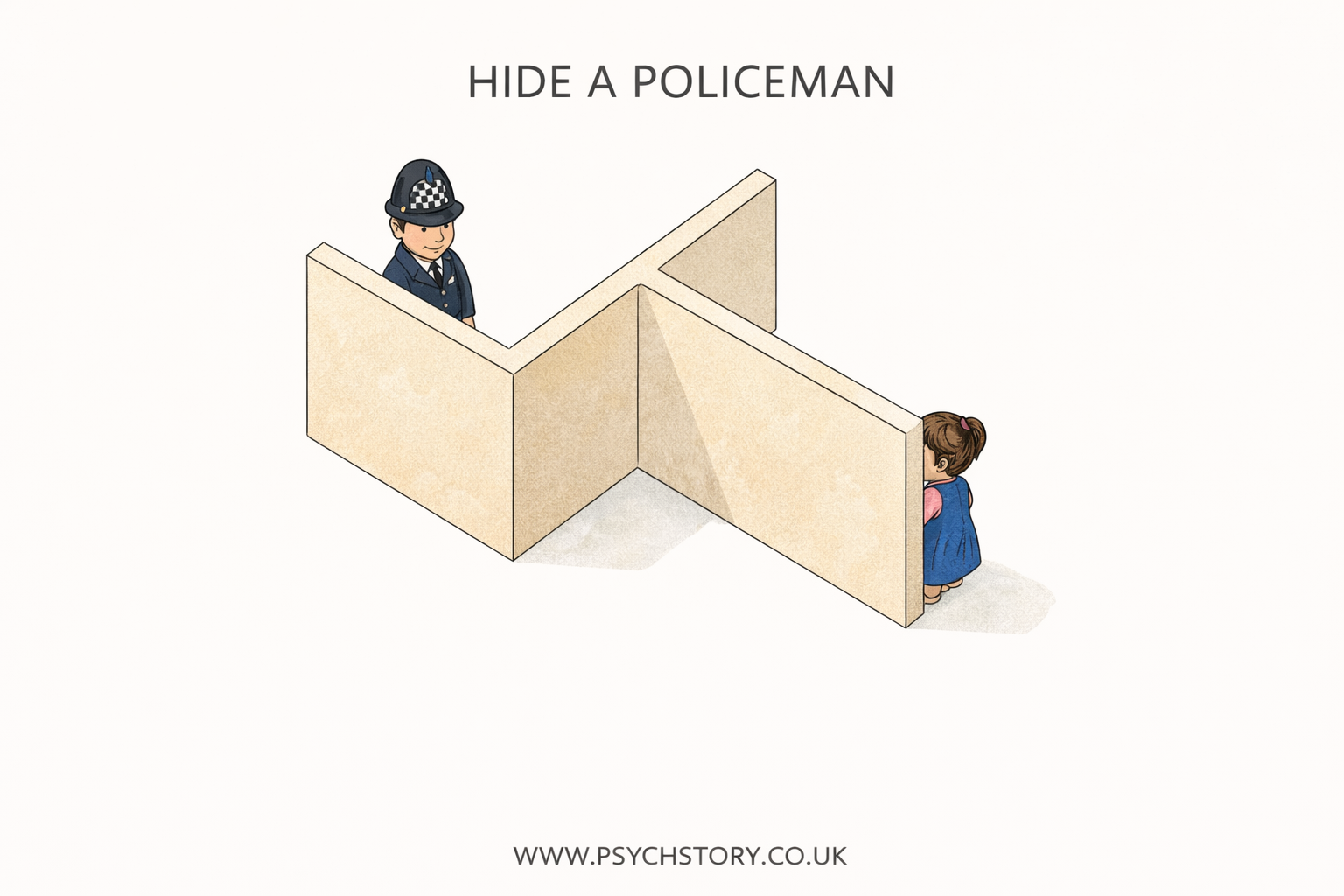
Margaret Donaldson also suggested that children’s egocentric responses in Piaget’s original three mountains task may reflect misunderstanding rather than genuine egocentrism. The three mountains task requires left-right reversals and abstract perspective taking, which may be linguistically and conceptually demanding. By contrast, the policeman's task is meaningful and embedded in a familiar context. Children understand the concept of hiding and can infer motives and intentions, making the task more accessible
HUGHES’ “HIDE A POLICEMAN” TASK (1975): The Hide-a-Policeman task was developed by Martin Hughes (1975) to test Piaget’s claim that children in the preoperational stage are strongly egocentric and unable to understand another person’s point of view.
AIM: To investigate whether young children are truly egocentric, as Piaget suggested, or whether they are capable of understanding what another person can see.
PROCEDURE: Children were shown a model consisting of two intersecting walls arranged in a cross shape. A small boy doll and several policeman dolls were also used. The child’s task was to hide the boy doll so that the policeman could not see him. In the simplest version, one policeman was placed at the end of a wall. The child had to position the boy doll behind a wall so that the policeman’s line of sight was blocked. In later trials, a second policeman was introduced. The child then had to hide the boy so that neither policeman could see him.
RESULTS: Approximately 90 per cent of children aged three to five successfully hid the doll from the policemen, even when two policemen were present.
CONCLUSION: The results indicated that children as young as 3 to 5 years old can take another person’s visual perspective. To hide the doll successfully, children had to imagine what the policeman could and could not see.
EVALUATION AND SIGNIFICANCE: The findings challenged Piaget’s conclusion that children remain egocentric until about age seven. Hughes argued that Piaget’s Three Mountains Task was too abstract and unfamiliar for young children. In contrast, the policeman's task resembled a game of hide-and-seek, which children could easily understand. It appears that Piaget may have underestimated infants' and young children's abilities at certain ages. However, Piaget argued that the critical issue is not the precise age at which specific abilities emerge, but the fixed sequence in which developmental changes occur. When assessing young children’s cognitive abilities, it is essential to design tasks that are meaningful and provide an accurate measure of their understanding. This suggests that Piaget may have underestimated children’s abilities because his tasks were overly complex and lacked real-world meaning
SIEGAL’S LANGUAGE CRITICISM ON CONSERVATION TASKS.
Siegel also argued that children’s failure on conservation tasks may result from misunderstandings of conversational rules rather than genuine cognitive limitations. When an experimenter asks an obvious question or repeats a question after a child has already answered, children may assume their first response was incorrect and change it. This creates the appearance that they do not understand conservation when the issue may simply be confusion about the adult’s intentions in the conversation.
PIAGET, MUNDANE REALISM AND ECOLOGICAL VALIDITY
Piaget’s tasks are often criticised for lacking mundane realism. Mundane realism refers to the extent to which the experimental situation resembles everyday life. Many Piagetian tasks use artificial materials and unfamiliar situations, such as miniature landscapes, identical glasses of liquid, or abstract classification tasks. Children rarely encounter such situations in real life, which may make the task's purpose unclear.
As already discussed in relation to Margaret Donaldson, this lack of meaningful context can lead children to misunderstand what they are being asked to do. However, later research suggests a broader pattern across several Piagetian tasks: when tasks are simplified or placed in more familiar contexts, children often demonstrate the relevant abilities at younger ages than Piaget originally proposed. For example, research by John H. Flavell found that some forms of perspective-taking appear earlier when tasks reduce perceptual and linguistic complexity. Similarly, conservation tasks redesigned with simpler instructions or more meaningful materials have shown that some children can demonstrate conservation before the age Piaget suggested. These findings do not reject Piaget’s concepts, but they indicate that the ages he proposed may sometimes be underestimated because the original tasks were difficult for reasons unrelated to the cognitive concept being tested. Consequently, Piaget’s theory remains influential in identifying important features of children’s thinking, such as egocentrism and conservation. However, later research suggests that the development of these abilities may occur earlier and more gradually than Piaget proposed, partly because his experimental tasks were sometimes unfamiliar or difficult for children to interpret.
RELIABILITY AND REPLICATION
A limitation of Piaget’s research concerns reliability. Many of his tasks produced variable results because procedures were not fully standardised. Piaget used the clinical interview method, in which questions were often adjusted during the interaction based on the child's responses. Children were therefore not always given the same wording or sequence of questions. Failure to standardise instructions introduces a confounding variable because differences in performance may be caused by the way the task is presented rather than by the child’s level of cognitive development. This reduces reliability and makes exact replication difficult.
However, later research using more controlled procedures has replicated the overall developmental pattern Piaget described. Studies consistently show that younger children rely more on perceptual cues, whereas older children increasingly apply logical operations such as conservation and classification. This suggests that although the exact ages and outcomes can vary across studies, the broader claim that cognitive development progresses in systematic, age-related stages remains supported.
FORMAL OPERATIONAL THINKING MAY NOT BE UNIVERSAL
Research has questioned Piaget’s claim that formal operational reasoning emerges universally during adolescence. Piaget argued that around the age of eleven or twelve, individuals develop the capacity for abstract thinking, hypothetical reasoning, and systematic problem solving. However, empirical studies suggest that many adolescents and adults do not consistently demonstrate these abilities, particularly outside formal testing situations. Performance on formal operational tasks often depends heavily on education and experience with scientific reasoning. Individuals who have received training in subjects such as mathematics or science are more likely to approach problems using hypothesis testing and systematic logic. In contrast, individuals with less exposure to formal schooling or abstract academic tasks may rely more on practical or concrete reasoning. This indicates that success on formal operational tasks may reflect familiarity with certain types of problem-solving rather than the spontaneous emergence of a universal cognitive stage.
Cross-cultural research also challenges the universality of formal operations. Studies conducted in non-Western societies have found that many adults rarely use hypothetical deductive reasoning unless tasks are directly relevant to their everyday activities. In such contexts, reasoning is often embedded in practical knowledge and real-world experience rather than abstract logical systems. These findings suggest that cognitive development may be shaped by cultural expectations, education, and environmental demands. Overall, this evidence implies that formal operational thinking may not represent a universal stage achieved by all individuals. Instead, it may be better understood as a specialised form of reasoning that develops in environments that encourage abstract thinking, scientific reasoning, and formal education
LIMITATIONS OF PIAGET’S SAMPLE
A further limitation of Piaget’s research concerns the sample he used. Much of his early work was based on observations of his own children and a small number of children from similar backgrounds. This creates a clear sampling bias because the participants were not representative of the wider population. His children grew up in an educated, middle-class, Western environment, meaning their experiences, language exposure, and educational stimulation may not reflect those of children from different social, cultural, or economic backgrounds.
This also raises issues of temporal validity. Piaget’s research was conducted in the early twentieth century, when childhood experiences, schooling, and access to information were very different from those today. Modern children are exposed to formal education, media, and technology from an earlier age, which may influence the development of reasoning and problem-solving skills. As a result, the ages at which certain abilities appear may vary across historical periods. The sample also lacked cultural and ethnic diversity. Because Piaget’s observations were largely based on Western children, it is difficult to assume that the same developmental patterns apply universally across cultures. Later cross-cultural research has shown that cognitive development can be influenced by cultural practices, schooling systems, and environmental demands.
Consequently, Piaget’s findings may be limited in terms of population validity. While his theory provides a valuable framework for understanding cognitive development, the original evidence was based on a narrow and culturally specific sample.
PRACTICE EFFECTS
Piaget argued that children cannot be trained into a higher stage of cognitive development before they are biologically ready. In his view, development is driven primarily by maturation and the gradual restructuring of cognitive schemas, meaning practice alone should not produce genuine stage advancement.
However, research has shown that children’s performance on some Piagetian tasks can improve with training and repeated exposure. For example, when children are given practice with conservation tasks or are shown strategies for comparing quantities, they often begin to give correct responses earlier than Piaget predicted. Similarly, instruction in logical reasoning can improve performance on tasks associated with formal operational thinking. These findings suggest that cognitive performance may be more responsive to teaching and experience than Piaget assumed. Nevertheless, some researchers argue that improved task performance does not necessarily indicate a true stage transition. Children may learn specific rules or strategies that help them answer particular problems correctly without undergoing the deeper cognitive restructuring that Piaget described. Consequently, practice effects may reflect improved task performance rather than genuine movement to a new stage of cognitive development
ALTERNATIVE EXPLANATIONS FOR FAILURES IN PIAGET’S TASKS
Some of the errors Piaget interpreted as evidence of conceptual limitations may instead reflect performance factors. In several tasks, children must manage additional cognitive demands that are not directly related to the concept being tested.
For example, the A not B error may reflect limitations in inhibitory control and working memory rather than a failure to understand object permanence. After repeatedly retrieving an object from location A, the child must suppress the previously rewarded response and remember that the object has now been hidden at location B. Young infants may therefore reach incorrectly because they cannot inhibit the earlier response or maintain the new location in working memory.
Similarly, performance on conservation tasks can be influenced by attentional demands and memory load. The child must compare two displays, remember the original state of the materials, and interpret the experimenter’s repeated questioning. These additional demands may make the task difficult even when the child has some intuitive understanding of quantity.
These findings suggest that failure in Piagetian tasks does not always indicate the absence of the underlying concept. Instead, errors may arise because the task requires cognitive control, attention, or memory abilities that are still developing. This raises the possibility that Piaget sometimes underestimated children’s competence by interpreting performance errors as evidence of conceptual absence
INDIVIDUAL DIFFERENCES AND UNEVEN DEVELOPMENT
Piaget proposed that cognitive development progresses through universal stages that occur in the same sequence for all children. However, research shows considerable variation in the rate at which children move through these stages. Some children demonstrate logical reasoning earlier than others, while some take longer to reach the same level of understanding. Piaget’s stage theory provides little explanation for why children differ in the speed of their cognitive development.
Closely related to this is the issue of uneven development across task types. Piaget suggested that once a child enters a stage, the underlying cognitive structures should support similar reasoning across a range of problems. In practice, children’s performance is often inconsistent. A child may succeed on one conservation task but fail another, or show strong reasoning in numerical problems while struggling with spatial or classification tasks. This uneven pattern suggests that cognitive abilities may develop gradually and independently in different areas rather than appearing simultaneously across all forms of reasoning. Instead of large-scale shifts in thinking occurring at clear stage boundaries, development may be more fragmented, with specific skills emerging at different times. Piaget’s stages may therefore represent broad trends in development rather than uniform changes that occur across all domains at once
ENVIRONMENTAL EXPERIENCE AND GENDER
Environmental experience may influence the development of particular cognitive skills through differences in play and activity patterns associated with gender socialisation. Children are often encouraged toward different types of toys and activities from an early age. Boys are more frequently given construction toys, vehicles, puzzles and mechanical objects, while girls are more often given dolls, craft activities and domestic role-play toys. These differences in experience may expose children to different problem-solving strategies. Construction toys and spatial puzzles often involve manipulating objects, understanding balance and movement, and exploring spatial relationships. Dolls and role-play activities more often involve storytelling, imitation of social roles, and extended verbal interaction.
As a result, children may practise different cognitive skills depending on the activities they engage in most frequently. Some research has suggested that boys tend to perform better on certain spatial tasks, while girls sometimes perform better on verbal or social reasoning tasks. These patterns may partly reflect differences in early play experiences rather than purely biological differences in ability. This suggests that environmental opportunities, including those shaped by gender expectations, can influence the kinds of cognitive skills children repeatedly practise during development
CRITIQUE OF PIAGET’S EDUCATIONAL APPROACH USING VYGOTSKY AND BRUNER
VYGOTSKY’S CRITICISM OF PIAGET
Vygotsky’s work challenges several assumptions within Piaget’s explanation of intellectual development. One major criticism concerns Piaget’s reliance on independent performance as evidence of cognitive ability. Piaget frequently concluded that if children failed a task, the relevant concept had not yet developed. Vygotsky argued that this confuses actual understanding with unsupported performance. When guidance, prompts or collaboration are provided, children often demonstrate abilities earlier than Piaget’s stage theory would predict. This suggests that Piaget may have underestimated children’s competence.
A second criticism concerns Piaget’s emphasis on individual discovery. Vygotsky argued that this overlooks the fundamentally social nature of learning. In everyday development, children rarely work out concepts entirely on their own. Adults and more capable peers regularly guide problem-solving, model strategies, and explain ideas. Through these interactions, children acquire culturally transmitted ways of thinking that they would struggle to generate independently. Piaget’s theory, therefore, underplays the role of teaching and cultural knowledge in intellectual development.
Vygotsky also criticised Piaget for placing insufficient emphasis on language. Piaget tended to treat language as a product of cognitive development. Vygotsky, instead, viewed language as one of the main mechanisms that drive cognitive growth. Through dialogue, instruction and explanation, children learn how to organise their thinking and regulate their behaviour. If language actively shapes thought, then development cannot be understood purely as an individual cognitive process.
Taken together, these criticisms weaken Piaget’s claim that intellectual development progresses primarily through independent exploration and internally driven stages. They suggest that social interaction, guidance and cultural transmission play a much larger role in shaping cognitive development than Piaget originally proposed.
BRUNER: THE IMPORTANCE OF STRUCTURED TEACHING
Jerome Bruner also challenged Piaget’s strong emphasis on discovery learning when applied in its pure form. Bruner agreed that active engagement is important for learning, but argued that leaving children to discover concepts entirely on their own can be inefficient and sometimes leads to incorrect conclusions.
His criticism was that learners often require structure, guidance, and carefully organised instruction to grasp complex ideas. Without this support, children may struggle to identify the relevant features of a task or may form inaccurate explanations. Structured teaching helps direct attention, organise information and build understanding in a more reliable way.
This challenges the assumption that learning should primarily emerge from independent exploration. Bruner argued that effective education often involves structured guidance that helps learners progress through material in a logical and manageable way, rather than relying solely on spontaneous discovery
INFORMATION PROCESSING CRITICISM OF PIAGET
Information-processing approaches challenge Piaget’s stage theory by suggesting that cognitive development may not occur through discrete, qualitative stages. Instead, developmental change may reflect gradual improvements in underlying cognitive processes such as working memory capacity, processing speed and inhibitory control.
Many of Piaget’s tasks require children to coordinate several mental operations at once. For example, conservation tasks require the child to remember the original quantity, compare two displays simultaneously and ignore misleading perceptual changes such as increased height or length. Younger children may fail not because they lack the concept of conservation, but because their working memory cannot yet maintain and coordinate all of these elements simultaneously.
Processing speed also increases with age. Faster processing allows children to analyse information more efficiently and apply rules more consistently. Behaviour that Piaget interpreted as evidence of a new stage of reasoning may therefore reflect improvements in the efficiency with which information is handled rather than a fundamental reorganisation of thought.
Inhibitory control provides another explanation for some of Piaget’s findings. Many tasks require children to suppress attention to salient perceptual features or inhibit previously rewarded responses. In the A not B task, infants must inhibit the tendency to search in the location where the object was previously found. Failure may therefore reflect immature inhibitory control rather than the absence of object permanence.
This perspective weakens the idea that development proceeds through rigid stages. If success depends partly on memory capacity, attentional control, and processing efficiency, then performance will vary with the cognitive demands of a particular task. This helps explain why some research has shown that children can succeed on conservation tasks when they are presented in ways that reduce memory load or linguistic complexity. It also explains why children sometimes show uneven performance, succeeding on some tasks associated with a stage while failing others. Such variability suggests that development may be gradual and domain-specific rather than organised into clear stage boundaries.
EVIDENCE SUPPORTING PIAGET
Despite substantial criticism, Piaget’s work remains influential because his central insight about intellectual development appears broadly correct, even if the stage structure is not. Children’s reasoning does become progressively less dependent on perception and more capable of coordinating multiple aspects of a problem. What later research has challenged is the claim that these changes occur in rigid, universal stages at fixed ages.
Some evidence supports elements of Piaget’s description of developmental change. For example, research on perspective taking by John H. Flavell showed that younger children frequently assume that others see or understand the world exactly as they do, whereas older children increasingly recognise that different viewpoints can exist. This supports Piaget’s claim that egocentrism declines with development and that children gradually become better at coordinating multiple perspectives.
Similarly, work by Piaget and Bärbel Inhelder on scientific reasoning found that older children were more likely to approach problems systematically by isolating variables, whereas younger children tended to vary several factors simultaneously. This pattern supports the broader idea that intellectual development involves increasing coordination, control and logical strategy.
However, more recent research supports only the general direction of change, not Piaget’s stage boundaries. Studies using more sensitive methods often find that some abilities appear earlier than Piaget proposed. For example, Renée Baillargeon’s violation-of-expectation studies suggest that infants show evidence of object permanence months before Piaget believed it emerged. These findings imply that Piaget’s experimental tasks sometimes underestimated children’s competence because they required motor responses or placed heavy demands on memory and attention.
Taken together, the evidence suggests a more nuanced conclusion. Piaget’s research methods were limited, and his stage model appears too rigid, but his central claim that children’s thinking becomes progressively more coordinated, less perceptually dominated and more logically organised over development remains broadly supported.
EXAMINATION QUESTIONS ON PIAGET’S INTELLECTUAL DEVELOPMENT
Stage Feature
Which of the following abilities typically develops by the end of the sensorimotor stage? [1 mark]
object permanence
symbolic thought
conservation
abstract reasoning
Stage Identification
2. A child who can think logically about concrete events but struggles with abstract concepts is most likely in which stage of Piaget’s theory? [1 mark]
3. What is the typical age range for the pre-operational stage? [1 mark]
4. Write the letter of your chosen answer in your answer booklet. [1 mark]
A. The inability to understand abstract and hypothetical ideas.
B. The inability to understand that people still exist when out of sight.
C. The inability to understand that things are the same even if they look different.
D. The inability to understand things from different points of view. Read the item and then answer the questions that follow.
5. Which one of the following best describes Piaget’s concept of conservation? Write the correct letter in your answer book. [1 mark]
A Understanding that things can be different even when they look the same.
B. Understanding that things are different when they look different.
C. Understanding that things are the same even though they look different.
D. Understanding that things are the same when they look the same. Define schema
Define assimilation [2 marks]
Define accommodation [2 marks]
Outline what Piaget meant by conservation. [2 marks]
Briefly suggest TWO examples of a conservation task that the psychologist might have used in the study. [2 marks]
Outline what Piaget meant by conservation. [2 marks
Explain what is meant by assimilation in Piaget’s theory. (2 marks)
What is meant by egocentrism in the pre-operational stage? *(3 marks)
What did Piaget mean by object permanence, and at what stage of development is it acquired? *(4 marks)
What is meant by conservation in Piaget’s theory of cognitive development? Give one example. *(4 marks)
What did Piaget mean by class inclusion? *(4 marks)
Evaluate one limitation of Piaget’s theory of cognitive development. (4 marks)
Outline one strength and one limitation of Piaget’s research into conservation. [6 marks]
A three-year-old child plays hide-and-seek by covering their eyes, believing that because they cannot see others, others cannot see them. Using Piaget’s theory of cognitive development, explain why the child behaves in this way. 6 marks
Two identical glasses of water are placed in front of a child. The water from one glass is poured into a taller, thinner glass. The child says the taller glass contains more water. Use Piaget’s theory to explain the child’s response. 6 marks
An eight-year-old struggles to understand abstract algebra, while a fourteen-year-old can solve the same problems easily. Using Piaget’s stages of cognitive development, explain this difference in ability. 6 marks
Outline the sensorimotor stage and the concrete operational stage of Piaget’s theory of cognitive development. Use examples of children’s behaviour in your answer.
Evaluate Piaget’s theory of cognitive development, including both supporting evidence and criticisms. (10 marks)
Discuss the view that Piaget underestimated the cognitive abilities of younger children and overestimated the abilities of adolescents (16 marks)
Discuss the research methods used by Piaget to investigate cognitive development, such as the Three Mountains Task, and evaluate the limitations of these methods. (16 marks)
Evaluate Piaget’s contribution to our understanding of cognitive development. (16 marks)
Discuss Piaget’s intellectual development (16 marks).