
PIAGET KEY TERMS/DEFINITIONS
SPECIFICATION:
Piaget’s theory of cognitive development: schemas, assimilation, accommodation, equilibration,
COGNITION: Cognition refers to mental processes such as thinking, reasoning, remembering, and problem-solving. The study of cognitive development examines how these mental abilities change across childhood and adolescence. Psychologists argue that the distinction between children and adults is not simply quantitative, in terms of how much is known, but qualitative, in terms of how thinking itself is structured and organised.
SCHEMATA
A schema is a mental framework or organised unit of knowledge that allows an individual to interpret and respond to experiences. Schemas develop through interaction with the environment and become increasingly complex as understanding grows. Piaget argued that children are active learners who constantly build and refine schemas rather than passively absorbing information. Early schemas are action-based, such as sucking or grasping, whereas later schemas become cognitive and conceptual.
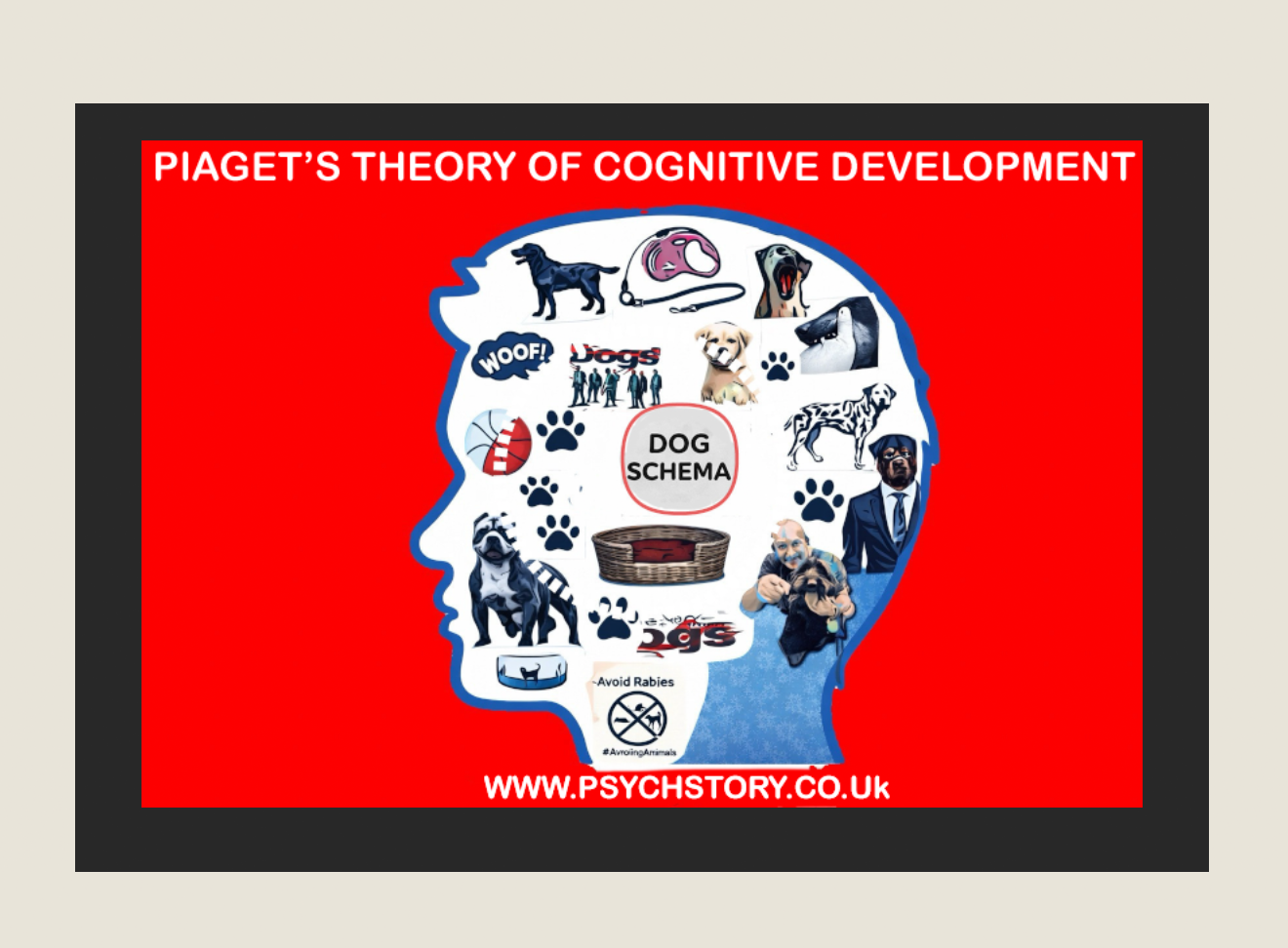
Example: A toddler may initially develop a “dog” schema based on observable features such as four legs and fur. As experience increases, the schema becomes more precise and distinguishes between dogs, cats and other animals.
SCRIPT
A script is a type of schema that represents a stored mental outline of the typical sequence of events in a familiar situation. It contains expectations about the order of actions, the roles of people involved, and the objects usually present. Scripts allow individuals to predict what will happen next and guide behaviour efficiently without conscious effort.
Scripts are sequential and context-specific. They operate automatically once the situation is recognised. If events occur in an unexpected order, the individual experiences cognitive disruption because the stored script no longer fits the situation.
Example: A “restaurant script” typically includes entering, being seated, reading a menu, ordering, eating, paying and leaving. If asked to pay before food is served, the script is violated and must be adjusted.
Scripts reduce cognitive load by allowing routine behaviour to run on an organised mental template rather than requiring constant active decision-making. However, they can also distort memory, as individuals may recall script-consistent details that did not actually occur.
ASSIMILATION
Assimilation is the process of interpreting new experiences using existing schemas. The individual incorporates new information without changing their current understanding. Assimilation allows continuity in thinking because new experiences are understood in familiar terms. However, excessive assimilation can lead to misunderstandings when new information is inaccurately classified.
Example: A child seeing a horse for the first time may call it a dog because it fits their existing schema for four-legged animals.
ACCOMMODATION
Accommodation occurs when existing schemas must be modified or new schemas created because new information cannot be explained by the current understanding. This process represents genuine cognitive change. Accommodation requires the child to adjust their thinking rather than force new experiences into old categories.
Example: After correction and repeated exposure, the child develops a new schema for “horse,” separating it from the dog schema.
ADAPTATION
Adaptation refers to the overall process by which individuals adjust their thinking in response to environmental demands. It consists of assimilation and accommodation working together. Adaptation ensures that cognitive structures remain functional and increasingly accurate representations of reality.
REFLEX ACTION SCHEMAS
In early infancy, schemas are primarily biological reflexes such as sucking and grasping. These reflex-action schemas form the foundation for more complex cognitive schemas during the sensorimotor stage.
EQUILIBRATION
Equilibration is the regulatory process that drives cognitive development. Piaget proposed that individuals seek cognitive balance between assimilation and accommodation. When new experiences conflict with existing schemas, disequilibrium ensues, producing cognitive discomfort. The child resolves this imbalance through accommodation, restoring equilibrium and advancing understanding.
Example: Confusion caused by mislabelling animals motivates the child to reorganise their categories correctly.
EQUILIBRIUM
Equilibrium is the state of cognitive balance achieved when schemas successfully account for experience. When equilibrium is maintained, understanding feels coherent and stable. Development progresses through cycles of equilibrium, disequilibrium and re-equilibrium.
DISEQUILIBRIUM
Disequilibrium is the cognitive imbalance that occurs when new information cannot be explained using existing schemas. Piaget argued that learning is triggered when an individual recognises that their current understanding is insufficient. This state creates psychological tension, which motivates the child to adjust their thinking through accommodation. Disequilibrium is therefore not a failure of thinking but the engine of development.
Example: A child who believes that all four-legged animals are dogs becomes confused when corrected about a cow. That confusion represents disequilibrium and prompts restructuring
OBJECT PERMANENCE
Object permanence refers to the understanding that objects continue to exist independently of sensory perception. During early infancy, objects that disappear from view are treated as though they no longer exist. The emergence of object permanence during the sensorimotor stage marks the development of mental representation.
Example: A young infant stops searching when a toy is hidden, whereas an older infant lifts the cloth to retrieve it, demonstrating awareness of continued existence.
SCHEMAS
INTRODUCTION
At every moment of waking life, the human brain is confronted with vast quantities of sensory information. Light, sound, temperature, movement, texture and language all compete for limited attentional and processing capacity. The nervous system cannot register everything in equal depth. Selection is therefore necessary. Some stimuli are prioritised while others are filtered out. If you briefly pause and attend carefully to your surroundings, you may notice sounds, sensations or visual details that were previously ignored. This illustrates that perception is not a complete recording of reality. It is selective and purposeful. The mind constructs a workable representation of the present environment that is sufficient for action. Without such filtering, cognition would quickly become overloaded. For example, most individuals recognise familiar faces instantly yet would struggle to reproduce their precise details from memory. This is not because those faces have never been seen, but because they were processed in outline rather than stored in full detail. The mind retains what is functionally necessary rather than every perceptual feature.
COGNITIVE ECONOMY AND MENTAL EFFICIENCY
Human cognition operates under constraints. Attention, working memory and processing resources are limited. As a result, the mind conserves effort. It relies on simplified representations, pattern recognition and prior knowledge to interpret incoming information quickly. Exhaustive analysis of every stimulus would be inefficient and evolutionarily disadvantageous. The mechanism that allows this efficiency is the schema. Schemas are organised mental frameworks containing knowledge about objects, people and situations. Rather than analysing each new experience from scratch, the brain interprets it using existing schemas. These frameworks guide both perception and judgement.
FROM ATTENTION TO SCHEMAS
Consider walking through a park and noticing someone behind you who appears tense, walks unusually close, and matches your pace. You may immediately interpret the situation as potentially threatening. This reaction occurs because a pre-existing “danger” schema directs your attention to specific cues, such as distance, posture, and facial expression. You could be mistaken. The individual may simply be walking in the same direction. However, the brain does not initially evaluate every alternative explanation. It uses an existing framework to produce a rapid judgement. This shortcut may protect you. Occasionally, it may mislead you. This is cognitive efficiency in action.
THE DEVELOPMENT OF SCHEMATA
A schema is a way of organising knowledge in the mind. Each schema represents a category or pattern in the world. Piaget described them metaphorically as an index card filing system. Each “card” contains information about how to approach or react to a particular concept. Schemas are, therefore, the building blocks of knowledge. When a child is born, there are very few “cards on file.” Early learning occurs through direct physical interaction with the environment. Looking, touching and manipulating objects gradually produce expectations about how things behave. Through repeated encounters, the infant forms their first basic categories. These early schemata are simple and broad.
As development progresses, they become more detailed and more differentiated. A child who encounters various animals begins to notice similarities and differences. Objects are no longer isolated sensations but members of categories. This reflects organised thinking rather than imitation. Schemas are not limited to physical objects. They also apply to actions and events. For example, children develop scripts for everyday routines such as going shopping or travelling in a car. As experience increases, these scripts become more complex and flexible.
JEAN PIAGET
Jean Piaget placed this efficiency within a developmental framework. For Piaget, children are not passive recipients of information. They actively construct mental structures known as schemata. From the very beginning of life, the infant is not simply absorbing impressions but organising experience. What starts as basic patterns of perception and action gradually becomes structured knowledge. Piaget did not see babies as miniature adults with ready-made ideas, nor as empty vessels waiting to be filled. He believed that knowledge has to be built. Early experience is initially practical and action-based, but it becomes organised through repeated interaction. Over time, these organised patterns stabilise into schemata — structured frameworks that allow the child to recognise, anticipate and interpret events. A schema is, therefore, the child’s way of making experience coherent. It is an organised packet of knowledge about objects, events or relationships that allows new experiences to be interpreted in light of previous ones. Once a schema exists, new information does not stand alone. It is understood through what is already known. Without schemata, every encounter would feel entirely new and disorganised. There would be no continuity between one moment and the next. With schemata, the world becomes predictable and manageable. Instead of analysing every feature of an object from first principles, the child can categorise it and respond appropriately. A familiar object is recognised as fitting an existing structure; a new variation may refine that structure. For Piaget, cognitive development is the progressive organisation and reorganisation of these schemata. As children grow, their mental structures become more differentiated, interconnected and internally consistent. Schemata reduce cognitive load while preserving meaning. They are the mechanism through which experience becomes knowledge rather than isolated sensation
MECHANISMS UNDERLYING PIAGET’S DEVELOPMENTAL STAGES
Piaget argued that cognitive development is partly biological and partly experiential. As children grow, their brains mature. However, development does not happen automatically with age. It occurs when new experiences challenge the child’s current way of thinking.
Two conditions are necessary for development to take place. First, the child must have reached a level of biological readiness. Second, they must encounter information that does not quite fit their existing understanding. It is this mismatch that triggers cognitive change.
Piaget used the term schema to describe organised units of knowledge. For the purposes of understanding development, what matters is that these knowledge structures are constantly being adjusted in response to experience
SCRIPT
A script is a specialised type of schema representing the typical sequence of actions in a familiar situation. For example, a “restaurant script” includes entering, being seated, reading a menu, ordering, eating and paying. Scripts allow behaviour to run efficiently on structured expectations.
If the sequence is violated — for example, being asked to pay before eating — cognitive disruption occurs. The script no longer fits the situation. This demonstrates that schemata are not merely categories but organised expectations about how events unfold.
ASSIMILATION
Piaget argued that intellectual development is driven by two complementary processes.
Assimilation occurs when new information is interpreted using an existing schema. For example, a young child who has developed a schema for “dog” will recognise different breeds as dogs, even if they vary in size or colour. The new experience is fitted into an existing category without altering its structure.
Assimilation enables efficient learning by avoiding unnecessary restructuring.
ACCOMMODATION
Accommodation occurs when existing schemas are modified in response to new information. If a child sees a horse for the first time and initially calls it a dog, they are assimilating the animal into their existing dog schema. When corrected, they must adjust their understanding. They either refine the dog schema or create a new schema for “horse.”
Accommodation, therefore, involves structural change. It may mean modifying an existing schema or creating a new one. In either case, cognitive development has occurred
EQUILIBRATION
Piaget argued that equilibration is the central mechanism of cognitive development. It is the process that regulates the relationship between assimilation and accommodation. Without equilibration, schemas would either remain rigid or change randomly.
At any point in time, a child’s thinking is relatively stable. Their schemas allow them to interpret events, predict outcomes, and behave appropriately in familiar situations. This state of relative stability is an equilibrium. It does not mean the child’s thinking is correct in an adult sense. It simply means their internal cognitive structures are working consistently with their current experience.
For example, a four-year-old may believe that all living things move and that anything that moves is alive. Within their experience, this works reasonably well. Dogs move. People move. Birds move. Their schema of “living” fits most of what they have seen. At this stage, they are in equilibrium. Their understanding feels coherent and reliable to them.
DISEQUILIBRIUM
Disequilibrium occurs when new information cannot be easily assimilated into existing schemas. It is a state of cognitive imbalance or conflict. The child realises, consciously or unconsciously, that their current explanation no longer works.
Returning to the example, the child might see a car moving down the road. According to their schema, movement equals life. So they may initially say the car is alive. When corrected, they encounter a contradiction. The schema “if it moves, it is alive” no longer fits. This creates disequilibrium.
Disequilibrium is uncomfortable. The child’s predictions fail. Their explanation produces errors. They may ask repeated questions, hesitate, or appear confused. This discomfort is not accidental. Piaget believed it is essential. It motivates the child to modify their thinking.
HOW EQUILIBRATION WORKS
Equilibration is the active process of resolving disequilibrium. The child attempts to restore balance between internal schemas and external reality. This usually involves accommodation.
In the example above, the child may refine their schema of “living” to include additional criteria such as breathing, growing, or needing food. The schema becomes more precise. Once this adjustment has been made, the child reaches a new equilibrium. Their understanding now explains more of the world accurately.
Crucially, this new equilibrium is more advanced than the previous one. Equilibration therefore drives qualitative change in thinking. It is not simply adding more information. It is restructuring how concepts are organised.
Another example can be seen in conservation tasks. A child may initially believe that when liquid is poured into a taller, thinner glass, there is more liquid. This belief forms part of their existing schema about quantity. When repeatedly shown that the amount does not change, and when they begin to understand reversibility, their old schema becomes unstable. Disequilibrium occurs. Through accommodation, they restructure their thinking and reach a new equilibrium in which they understand that quantity remains constant despite changes in appearance.
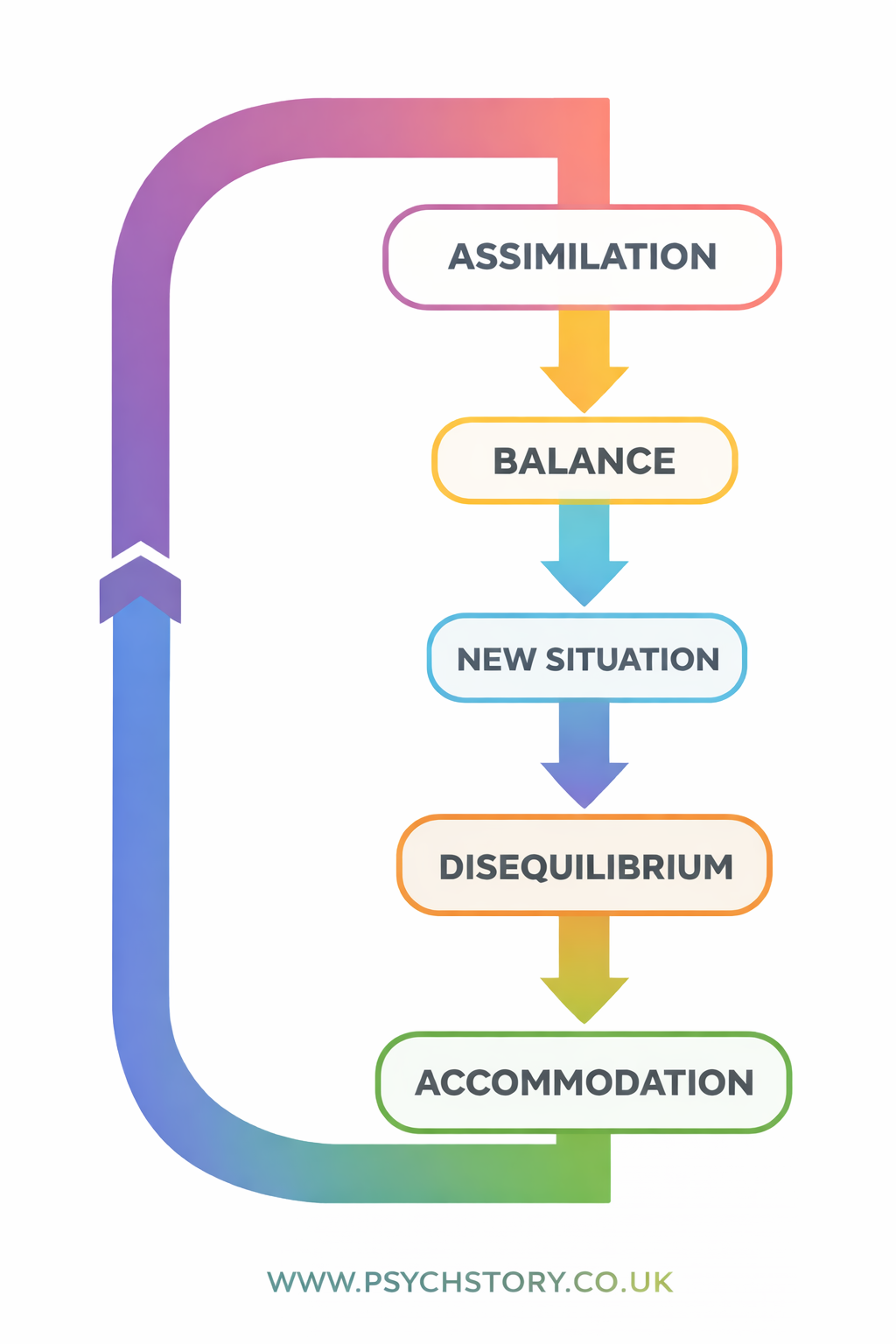
Thus, equilibration involves a continuous cycle:
Existing equilibrium based on current schemas.
Encounter with contradictory evidence.
Disequilibrium, producing cognitive conflict.
Accommodation to resolve the conflict.
New equilibrium at a higher level of reasoning.
ERROR AS A SIGN OF DEVELOPMENT
Piaget emphasised that errors reveal the structure of thinking. A wrong answer is not random. It reflects the child’s current schema operating logically within its own limits.
When a child says a car is alive because it moves, the error demonstrates the rule they are applying. The mistake shows the boundaries of their schema. It provides insight into how they are organising knowledge.
Children typically attempt assimilation first because it preserves stability. They apply existing schemas as widely as possible. Only when assimilation repeatedly fails, producing ongoing disequilibrium, does accommodation occur.
Therefore, an error often marks the precise point where development is about to happen. It indicates that the child’s current framework is being stretched beyond its limits. The breakdown of that framework triggers cognitive growth.
SOCIAL SCHEMATA AND GENERALISATION
The same principles apply to social understanding. Children develop schemas about roles, groups and situations. For example, a young child may form a schema that “teachers are kind and help you.” In most early experiences, this works. The schema supports prediction and behaviour.
If the child encounters a strict or unhelpful teacher, disequilibrium may occur. The child must either ignore the evidence and assimilate it into the old schema or accommodate by refining the schema to include variation.
Overgeneralisation happens when accommodation does not occur. A child might form a broad schema about a social group based on limited experience and continue assimilating new individuals into that category despite contradictory evidence. In Piagetian terms, rigid stereotyping reflects insufficient accommodation.
Equilibration in social cognition requires updating schemas when reality challenges them. Without accommodation, schemas become fixed and inaccurate. With accommodation, social understanding becomes more differentiated and realistic.
In summary, equilibration is the self-regulating mechanism of cognitive development. It ensures that schemas are neither permanently rigid nor endlessly unstable. Through cycles of equilibrium, disequilibrium and accommodation, the child’s thinking becomes progressively more complex and better aligned with reality
EVALUATION OF PIAGET’S THEORY OF SCHEMATA AND EQUILIBRATION
PIAGET’S CONTRIBUTION TO SCHEMA THEORY
Piaget did not originate the concept of schemas, and it is important to acknowledge that the idea had earlier roots in both philosophy and psychology. Immanuel Kant had already argued that the mind uses organising structures to make sense of experience, and Frederic Bartlett later used the term schema to describe organised knowledge structures involved in memory. Piaget’s contribution, however, was more ambitious and more psychologically powerful than either of these earlier uses.
What Piaget added was a developmental account of how schemas change. He did not treat schemas as static mental categories or simply as storage systems for knowledge. Instead, he placed them at the centre of a theory of cognitive development and argued that they are constantly modified through assimilation and accommodation. In this way, Piaget transformed the schema from a descriptive concept into an explanatory mechanism. He was not merely saying that children possess mental structures. He was trying to explain how those structures grow, reorganise themselves, and become more complex over time. That is a major theoretical strength, because it gives schema theory developmental movement rather than leaving it as a passive description of how knowledge is stored.
SCHEMAS ARE ABSTRACT AND DIFFICULT TO MEASURE
One important limitation of Piaget’s schema theory is that schemas are internal cognitive structures and cannot be directly observed. Researchers cannot see the schema itself. They can only infer its presence from patterns in behaviour, language, or problem-solving. This creates a methodological problem because the theory depends heavily on constructs that are psychologically plausible but difficult to operationalise with precision.
If a child consistently sorts objects in a particular way, overgeneralises a word, or gives a predictable wrong answer, it may be reasonable to infer that a particular schema is guiding that response. However, the schema itself cannot be independently verified. The evidence comes from the behaviour, and the behaviour is then explained by referring back to the schema. This risks circularity. The schema is inferred from the very thing it is supposed to explain.
This also weakens the scientific status of the concept. Unlike measures such as reaction time, recall accuracy, or neural activation, schemas do not have clear boundaries, units, or universally agreed-upon indicators. Researchers cannot easily determine their size, organisation, or structure in a consistent and replicable way. Because of this, different psychologists may interpret the same behaviour as evidence for different schemas, which creates problems for reliability.
A related criticism is that schema theory can become difficult to falsify. If almost any pattern of behaviour can be explained by proposing an appropriate schema, then the theory risks becoming too flexible. A strong theory should not merely accommodate outcomes after they occur. It should specify what kinds of evidence would count against it. Piaget’s theory is rich and suggestive, but at times it lacks that level of precision. This does not make the idea of schemas useless, but it does mean that the theory is harder to test scientifically than more tightly operationalised cognitive models.
A STRUCTURAL STRENGTH: SCHEMA THEORY EXPLAINS PATTERNED ERRORS
Despite this limitation, one of the most impressive features of Piaget’s theory is that it explains why children’s mistakes are often systematic rather than random. Before Piaget, a child’s wrong answer might simply have been interpreted as ignorance or lack of knowledge. Piaget’s insight was that children’s incorrect answers often reveal an underlying logic. In other words, the child is not merely wrong. The child is reasoning according to a cognitive structure that is developmentally coherent, even if it is not yet logically mature.
For example, when a young child says that the sun is alive because it moves, or calls many four-legged animals “dog,” the response is not arbitrary. It reflects the operation of an existing schema that is being applied too broadly. This is a genuine strength because it allows psychologists to learn from children’s mistakes rather than dismiss them. Piaget’s theory, therefore, shifted developmental psychology away from a deficit model, in which children are simply judged against adult standards, and towards a richer understanding of how children think at a particular point in development.
This explanatory strength remains important. Schema theory helps us see errors as windows into reasoning. That is a substantial contribution because it makes children’s cognition intelligible. Piaget was not simply measuring whether children succeeded or failed. He was trying to reconstruct the structure of their thinking.
THE PROBLEM OF OVEREMPHASISING FAILURE
At the same time, Piaget’s theory can be criticised for relying too heavily on children’s failures in formal tasks. Many of his conclusions were drawn from situations in which children failed at conservation, class inclusion, or perspective-taking tasks. He interpreted these failures as evidence that certain cognitive structures had not yet developed. However, later critics argued that this can underestimate children’s competence.
A child may fail a task for reasons other than an absence of the relevant schema. Language comprehension, attention, working memory, task demands, social pressure, and misunderstanding of the question can all influence performance. This means that failure in a Piagetian task does not necessarily map neatly onto the absence of competence. In some cases, children may possess a partial or intuitive understanding that is not expressed well under the conditions of the task.
This criticism is especially important when considered alongside schema theory itself. If schemas develop gradually through assimilation and accommodation, then one might expect intermediate forms of understanding, partial reorganisations, and unstable reasoning during transition. Yet Piaget’s tasks often produce a fairly rigid classification of success or failure. This can make development look more discontinuous and stage-like than it really is. In that sense, Piaget’s own methods may sometimes be less nuanced than the theory he proposed.
Nevertheless, it would be unfair to say that Piaget simply ignored children’s competence. He deliberately analysed mistakes because he believed they exposed the structure of the child’s current thinking. The criticism is not that errors are useless, but that performance on formal tasks may not capture the full complexity of developing cognition.
CONTEMPORARY RELEVANCE OF SCHEMA THEORY
Another strength of Piaget’s theory is that, despite its age and imprecise terminology, it remains conceptually relevant to modern cognitive science. Many contemporary theories continue to assume that perception, interpretation, and memory are shaped by prior knowledge. People do not encounter the world as passive receivers of neutral sensory data. They interpret new information in relation to what they already know. This is fundamentally a schema-like idea, even when the terminology differs.
Piaget also recognised that learning is not simply the accumulation of isolated facts. Instead, it involves reorganising existing knowledge. This idea remains highly influential. Modern work on conceptual change, mental representations, and prior knowledge all supports the view that new information is integrated into existing cognitive frameworks, which may then be modified or restructured.
His theory also captured an important truth about cognition more generally: people strive for coherence. Beliefs, expectations, and interpretations tend to form organised systems. Contradictions matter because they disrupt that coherence and may trigger revision. Even if Piaget’s own terms are sometimes too broad, the general insight that cognition involves structured systems adapting through experience remains powerful. That enduring relevance is a major strength.
RESEARCH SUPPORT FOR ACTIVE KNOWLEDGE CONSTRUCTION
Research has also supported Piaget’s broader claim that children actively construct knowledge rather than merely copying information from others. Howe et al. investigated how children developed scientific understanding through discussion and shared problem-solving. Children who engaged with the same materials and observed the same events did not all produce identical explanations afterwards. Instead, they interpreted the experience somewhat differently.
This supports Piaget’s emphasis on active construction. The children were not simply absorbing knowledge from the outside world in a uniform way. They brought prior understanding to the task and reorganised it as they engaged with the evidence. This is consistent with schema theory, because it suggests that experience is filtered through pre-existing cognitive frameworks.
However, the support is not definitive. Differences between children’s explanations might reflect differences in intelligence, prior knowledge, reasoning ability, or language rather than uniquely structured schema construction. In other words, the study shows variation in cognitive outcomes, but it does not prove that schemas, in Piaget’s specific sense, are the mechanism responsible. The research therefore lends indirect support to Piaget’s general constructive view of learning, while remaining less conclusive about the precise workings of schema theory.
EQUILIBRATION: A POWERFUL IDEA THAT REMAINS UNDER SPECIFIED
Equilibration is one of the most theoretically important but also one of the most problematic aspects of Piaget’s account. Piaget used it to explain how development progresses. It is supposed to be the self-regulating process through which the child moves from a state of cognitive imbalance towards a more stable and adequate understanding. When existing schemas no longer fit experience, disequilibrium occurs, and accommodation eventually restores balance.
This is an elegant idea, but it is under-specified. The problem is not that equilibration is meaningless, but that Piaget does not define its mechanism with enough precision. It can sometimes function more as a broad metaphor for developmental progress than as a clearly testable causal process. One issue is whether equilibration is supposed to be automatic. Piaget often writes as though contradiction naturally generates cognitive reorganisation. Yet people, including children and adults, often persist in their beliefs in the face of contradiction. They ignore disconfirming evidence, reinterpret it, or treat it as an exception. If equilibration is assumed to happen too smoothly, then the theory may underestimate resistance to change.
A second issue is whether equilibration depends on reflective thought. Some forms of conceptual change appear to involve a degree of metacognition, where the learner recognises that an old explanation no longer works and actively considers alternatives. If that is true, then equilibration may not be a universal developmental engine but may depend on the child’s emerging capacity to monitor and regulate their own thinking.
A third issue is whether equilibration is often socially triggered. Contradictions do not arise only from interactions with the physical world. They also arise in conversation, disagreement, correction, and explanation. If so, then cognitive change may be more dependent on language and social interaction than Piaget fully acknowledged. This point links directly to later socio-cultural critiques.
The main criticism, then, is that equilibration is theoretically important but insufficiently defined. It helps Piaget describe how development moves forward, but it does not always specify clearly enough why change happens when it does, what conditions will produce it, or what exact process converts conflict into a new schema.
ASSIMILATION AND ACCOMMODATION MAY BE HARDER TO DISTINGUISH THAN PIAGET SUGGESTED
Piaget treated assimilation and accommodation as distinct processes. Assimilation occurs when new information is interpreted through an existing schema, while accommodation occurs when the schema itself is changed. This distinction is useful and remains conceptually valuable. However, in practice, the two processes may be less cleanly separable than Piaget implied.
Knowledge is not organised in isolated units but in nested, hierarchical systems. A single learning event may involve assimilation at one level and accommodation at another. A child who learns that humans and apes belong to the broader category of primates may be assimilating that information into a general animal schema while simultaneously accommodating a more specific taxonomy of biological classification. In such cases, the same cognitive change involves both processes operating together.
This creates empirical difficulties. If assimilation and accommodation can occur simultaneously at different levels of conceptual structure, then distinguishing them in research becomes problematic. The theory remains insightful, but the underlying mechanisms may be less discrete than Piaget’s vocabulary suggests. This again points to a broader weakness in precision. The concepts are psychologically rich but not always sharply bounded.
DISEQUILIBRIUM AS A MOTIVATIONAL FORCE
Piaget’s idea that disequilibrium drives cognitive change is one of the most compelling parts of the theory. There is obvious psychological plausibility in the claim that contradictions, mismatches, and failed expectations can stimulate learning. When experience no longer fits an existing schema, the learner may be prompted to revise that schema. This gives Piaget’s theory a dynamic quality and explains why development is not simply passive accumulation.
However, disequilibrium is probably not sufficient on its own. In many situations, individuals do not accommodate when confronted with contradiction. Instead, they preserve existing interpretations. Stereotypes are a good example. People often encounter counterexamples but do not revise the stereotype itself. They simply label the contradictory case as unusual. This suggests that conflict does not automatically produce restructuring.
Other factors clearly matter. Motivation, prior commitment, emotional investment, language, social support, and intellectual readiness may all affect whether disequilibrium results in genuine accommodation. Piaget was right to identify mismatch as important, but he may have overstated its centrality as the main engine of change.
Related to this is the point that development may sometimes proceed through gradual accumulation of experience rather than sharp moments of conflict. A child may gradually learn that not all four-legged animals are dogs through repeated exposure, increasing vocabulary, and maturation of categorisation skills, without any dramatic experience of cognitive imbalance. This suggests that disequilibrium may be one mechanism among several, rather than the sole or dominant driver of development.
APPLICATION TO EDUCATION: A GENUINE STRENGTH, BUT NOT THE WHOLE STORY
Piaget’s theory had a major influence on education, and this is one of its clearest practical strengths. He challenged the older view that knowledge could simply be transmitted from teacher to child through repetition and memorisation. In its place, he proposed that children actively construct understanding. This shifted educational thinking towards discovery learning, child-centred teaching, play-based exploration, and readiness-based curriculum design.
This influence can be seen in the Plowden Report and in later developments in primary education, where exploration, activity, and developmental appropriateness became central concerns. Piaget’s framework also encouraged teachers to carefully consider whether a task aligns with the child’s stage of reasoning. There is obvious value in recognising that some forms of understanding require a degree of readiness and cannot simply be forced through instruction.
However, this educational strength is also tied to one of Piaget’s weaknesses. Later theorists, especially Vygotsky, argued that Piaget underestimated the role of direct teaching, language, collaboration, and cultural tools. Piaget was right to reject the idea that children are passive recipients of information, but he may have gone too far in the opposite direction. In real classrooms, learning is rarely either pure discovery or pure transmission. It is usually a mixture of active construction and guided participation.
This means Piaget’s educational legacy is best understood as partial rather than complete. He made an important correction to rote models of learning, but later theory shows that instruction and social support are not minor additions. They are central to cognitive development.
SOCIAL AND SYMBOLIC LIMITATIONS
This leads to a broader criticism of Piaget’s account. Although he did acknowledge the role of social interaction, his theory places the main weight on the child’s individual constructive activity. For Piaget, development occurs when the child reorganises their own schemas. Social input may trigger this change, but it is not treated as the primary mechanism.
Vygotsky challenged this strongly. He argued that higher mental functions are fundamentally social in origin and that language, dialogue, and interaction with more knowledgeable others are not optional supports but central drivers of development. From this perspective, Piaget underestimates the extent to which cognitive growth is scaffolded by other people and by cultural tools.
This criticism matters because many of the abilities Piaget discusses are not merely discovered through solitary exploration. They are mediated by language, instruction, symbol systems, and participation in a shared culture. Piaget’s theory remains powerful in explaining active construction, but it is weaker in explaining how culture enters the mind.
OVERALL JUDGEMENT
Piaget’s theory of schemata and equilibration remains one of the most important attempts to explain how knowledge develops. Its strengths are substantial. It gives children’s thinking internal structure, explains patterned errors, treats learning as active reorganisation rather than passive accumulation, and remains conceptually relevant in modern cognitive science. It also had a major practical influence on education.
Its weaknesses, however, are equally important. Schemas are difficult to measure, the theory can become difficult to falsify, equilibration is under-specified as a mechanism, assimilation and accommodation are not always easy to distinguish, and the role of social and cultural processes is underdeveloped. In addition, Piaget may at times have over-interpreted failure as a lack of competence and overestimated the centrality of disequilibrium.
The fairest conclusion is not that schema theory is wrong, but that it is powerful at the level of broad cognitive insight and weaker at the level of precise mechanism. Piaget captured something essential about learning, namely that children actively organise and reorganise experience. What later psychology has shown is that this process is more variable, more socially mediated, and more difficult to measure than Piaget originally suggested
HOW TO STRUCTURE PIAGET EVALUATION USING PEEL
PEEL helps organise the evaluation clearly in essays.
P = Point
E = Evidence
E = Explain
L = Link back to the theory
EXAMPLE 1: SCHEMAS ARE DIFFICULT TO MEASURE
POINT
A limitation of Piaget’s schema theory is that schemas are internal cognitive structures that cannot be directly observed.
EVIDENCE
Researchers must infer schemas from children’s behaviour, such as how they classify objects or solve problems.
EXPLAIN
Because the schema itself cannot be measured independently, it is difficult to test whether the inferred schema actually exists. Different researchers might interpret the same behaviour as evidence for different schemas.
LINK
This makes schema theory difficult to falsify scientifically, which weakens the empirical testability of Piaget’s explanation of cognitive development.
EXAMPLE 2: DISEQUILIBRIUM MAY NOT ALWAYS PRODUCE CHANGE
POINT
Piaget argued that cognitive development is driven by disequilibrium, but cognitive conflict does not always lead to accommodation.
EVIDENCE
People often maintain stereotypes even when they encounter individuals who contradict them.
EXPLAIN
Instead of restructuring their schema, individuals may treat the contradictory case as an exception or ignore it entirely.
LINK
This suggests that cognitive conflict alone may not be sufficient to trigger schema change, meaning development may depend on additional factors beyond disequilibrium.
EXAMPLE 3: PATTERNED ERRORS SUPPORT SCHEMA THEORY
POINT
A strength of Piaget’s schema theory is that it explains why children make systematic errors.
EVIDENCE
Young children often classify moving objects such as the sun or cars as “alive”.
EXPLAIN
This occurs because they are applying an existing schema that defines living things as objects that move.
LINK
The pattern of errors therefore supports Piaget’s claim that children interpret the world through organised schemas rather than random guessing.
EXAMPLE 4: SOCIAL INTERACTION CRITICISM
POINT
Piaget may have underestimated the role of social interaction in cognitive development.
EVIDENCE
Vygotsky proposed that learning occurs through guidance from more knowledgeable others within the Zone of Proximal Development.
EXPLAIN
Through dialogue, instruction and collaboration, children can reach higher levels of reasoning than they could achieve independently.
LINK
This suggests that cognitive development may depend more on social interaction and cultural transmission than Piaget’s individual constructivist model implies.
QUICK STUDENT RULE
A good AO3 paragraph should answer four questions:
What is the criticism or strength?
What research or example supports it?
Why does that matter?
What does that mean for Piaget’s theory?
If the final link back to the theory is missing, the paragraph is usually only AO1 description, not AO3 evaluation
EXAMINATION QUESTIONS FOR PIAGET’S COGNITIVE THEORY OF DEVELOPMENT
PIAGET’S THEORY OF COGNITIVE DEVELOPMENT: SCHEMAS, ASSIMILATION, ACCOMMODATION, EQUILIBRATION, STAGES OF
Describe what Piaget meant by equilibration. [4 marks]
Leonard and Felix are primary school teachers. They discuss the methods they use in their classrooms. Leonard says, “Children need to experiment with the right sort of task. They learn well if they make mistakes until they get it right.” Felix says, “Children need various levels of guidance to achieve their potential. The more able children can really help the ones who are struggling.”
Use your knowledge of theories of cognitive development to explain the comments made by Leonard and Felix. [8 marks]
Briefly outline what Piaget meant by ‘class inclusion’. (Total 2 marks)
Amy is three years old. She is playing hide-and-seek with her older brother, Sam, who is twelve years old. When it is Amy’s turn to hide, she runs to the curtains to cover her face, but her legs and feet are still easily seen. Sam finds her straight away, which surprises Amy. ‘How did you know I was there?’ she asks.
Use your knowledge of Piaget’s theory of cognitive development to explain why Amy is surprised that Sam finds her straight away. (Total 2 marks)
A psychologist interested in Piaget's work selected two groups of children for an experimental study. The children in one group were 10 years old, and the children in the other group were 5 years old. Each child was individually presented with the two rows of beads shown in the diagram below. Each child was asked to state whether the number of beads in each row was the ‘same’ or whether ‘one row had more’. The psychologist recorded each child’s answer as correct or incorrect. (a) Name and outline the experimental design in this study.
Identify the dependent variable in this study.
Name and outline the cognitive ability that the psychologist is testing in this experiment.
The psychologist concluded from this study that there is a difference in the thinking of children aged 5 and 10 years.
Outline and evaluate one other difference in cognitive ability between children of these two age groups that has been identified by Piaget. (Total 16 marks)
Outline and evaluate Piaget’s research into object permanence. (Total 8 marks)
Outline Piaget’s explanation of the processes involved in schema development. Discuss this explanation. Refer to examples of schema development in your answer. (Total 16 marks)
Discuss Piaget’s theory of cognitive development. (Total 16 marks)