
VYGOTSKY’S THEORY OF COGNITIVE DEVELOPMENT
SPECIFICATION: Vygotsky’s theory of cognitive development, including the zone of proximal development and scaffolding
VYGOTSKY KEYWORDS
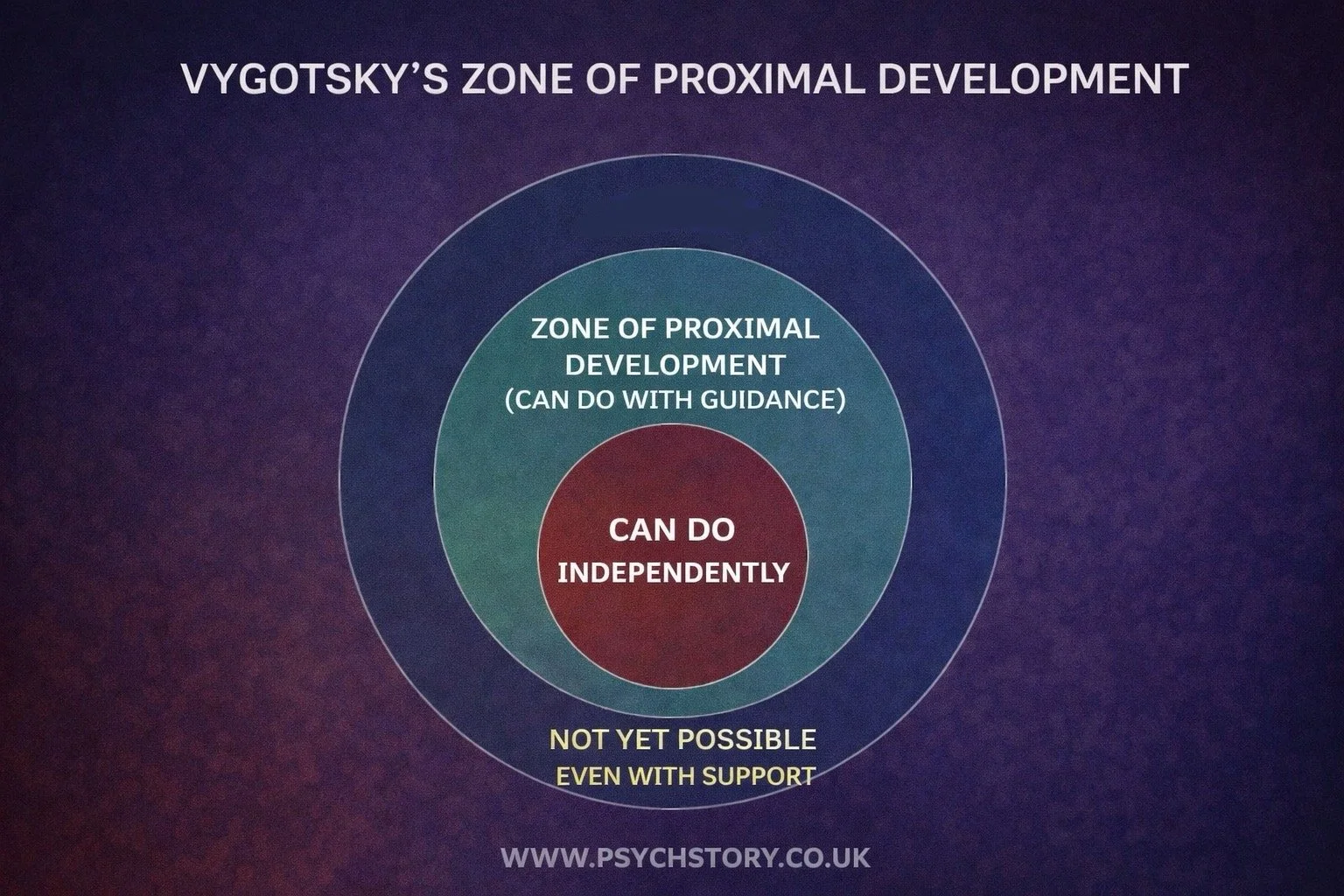
ZONE OF PROXIMAL DEVELOPMENT (ZPD: The gap between what a child can do independently and what they can achieve with guidance from a more knowledgeable person.
MORE KNOWLEDGEABLE OTHER (MKO): A person who has a greater level of knowledge, skill or understanding than the learner and who can assist the learner in completing a task.
SOCIAL INTERACTION: The process through which learning occurs through interaction with other people. Cognitive development is viewed as emerging first through social activity before becoming internalised.
PRIVATE SPEECH: Speech directed at oneself that helps children guide their thinking and behaviour when solving problems. It represents a transitional stage between social speech and internal thought.
INTERNALISATION: The process by which social activities and external dialogues become internal mental processes used for thinking and self-regulation.
GUIDED PARTICIPATION: A learning process in which an adult or more capable peer actively supports and structures a child’s participation in tasks.
PEER COLLABORATION: Learning that occurs when children work together to solve problems or complete tasks, allowing them to share knowledge and strategies.
SOCIOCULTURAL THEORY: The view that cognitive development is shaped by social interaction, cultural tools and language within a particular cultural environment.
BRUNER’S KEYWORDS
SPIRAL CURRICULUM: An educational approach in which key ideas are revisited repeatedly over time, with each encounter increasing in complexity and depth.
ENACTIVE REPRESENTATION: A form of knowledge representation based on physical action and direct manipulation of objects.
ICONIC REPRESENTATION: A form of representation based on images, diagrams or visual models that stand for objects or ideas.
SYMBOLIC REPRESENTATION: A form of representation based on language, symbols and abstract reasoning.
DISCOVERY LEARNING: An approach to education in which students actively explore problems and ideas rather than simply receiving information from a teacher.
SCAFFOLDING: Instructional support provided by a teacher that structures the learning process, gradually withdrawn as the learner becomes more capable. SOMETIMES ATTRIBUTED TO VYGOTSKY, but actually the work ofBruner and colleagues.
READINESS FOR LEARNING: The idea that instruction should be organised so that learners are developmentally prepared to understand the material being presented.
THE PROCESS OF EDUCATION:THE PROCESS OF EDUCATION: Bruner’s educational principle that teaching should focus on the underlying structure of a subject rather than memorising isolated facts. Bruner argued that any subject can be taught at any age if it is presented in a form appropriate to the learner’s level of understanding. This idea underpins the spiral curriculum.
SUMMARY OF VYGOTSKY’S SOCIOCULTURAL THEORY OF COGNITIVE DEVELOPMENT
Cognitive development occurs through social interaction rather than through isolated discovery.
Children learn through interaction with a More Knowledgeable Other (MKO) such as a teacher, parent, or more capable peer.
Learning takes place within the Zone of Proximal Development (ZPD), the gap between what a child can do independently and what they can achieve with guidance.
Scaffolding occurs when support is provided to help the child complete a task and is gradually removed as competence increases.
Language plays a central role in development. Social speech becomes private speech and eventually internal speech, which guides thinking and problem-solving.
Cognitive skills are first experienced socially (between people) and then become internalised (within the individual).
Knowledge is transmitted through cultural tools, including language, symbols, writing, and education.
Cognitive development is therefore influenced by culture, social interaction, and instruction, not just biological maturation.
Learning can precede development, meaning children can perform tasks earlier with guidance than they could independently.
LEV VYGOTSKY(1896–1934): A QUICK BIOGRAPHY
Lev Semyonovich Vygotsky was born in 1896 in Orsha, Russian Empire (now Belarus), and grew up in the town of Gomel. He came from a Jewish middle-class family and received a broad humanistic education that included literature, philosophy and languages. Vygotsky entered Moscow University in 1913, where he formally studied law, though he also attended lectures in psychology, philosophy, and history. His intellectual interests were wide-ranging, and he initially worked as a teacher and literary critic. After the Russian Revolution of 1917, he returned to Gomel, where he taught and became increasingly involved in psychology and education. In the early 1920s, he began publishing academic work on psychology and language. In 1924, he presented a paper at a major Russian psychology conference in Leningrad, which attracted attention and led to him being invited to join the Institute of Psychology in Moscow. This marked the beginning of his professional career in psychology. Vygotsky worked in Moscow during the 1920s and early 1930s, producing a large body of research on child development, language and education. His career, however, was unusually short. He suffered from tuberculosis for much of his life and died in 1934 at the age of 37. After his death, the political climate within the Soviet Union changed significantly.
During the late 1930s, Soviet science and psychology became increasingly shaped by strict ideological control under Stalin. Psychological approaches were expected to align closely with official Marxist doctrine and to emphasise practical, materialist explanations of behaviour. Vygotsky’s work, which drew on philosophy, linguistics and cultural analysis, was regarded by some authorities as too theoretical and insufficiently aligned with the new ideological direction. In addition, parts of his research were associated with the field of pedology, an interdisciplinary study of child development that was officially banned by the Soviet government in 1936. When pedology was condemned as unscientific and politically suspect, many works connected with it were removed from circulation, including some of Vygotsky’s writings.
As a result, a large portion of his manuscripts remained unpublished or difficult to access for several decades. His ideas, therefore, remained largely unknown outside the Soviet Union until translations of his work began to appear in the West during the 1950s and 1960s. Once translated, his theory of the social and cultural foundations of cognitive development became highly influential in educational psychology, particularly during the 1960s and 1970s.
THE CONNECTION BETWEEN VYGOTSKY AND BRUNER
Vygotsky and Bruner did not work together. Vygotsky died when Bruner was still a student. Their connection is historical rather than collaborative.
When Vygotsky’s work began to be translated and published in English during the 1950s and 1960s, Bruner and other Western psychologists recognised its significance for education and child development. Bruner helped introduce Vygotsky’s work to Western educational psychology and incorporated several of its themes into discussions about teaching and learning. As a result, Vygotsky’s earlier work from the 1920s and 1930s became integrated into educational psychology several decades later, partly through the influence of psychologists such as Bruner.
JEROME BRUNER(1915–2016)A QUICK BIOGRAPHY
JEROME SEYMOUR BRUNER (1915–2016)
Jerome Seymour Bruner was born in New York in 1915. He studied psychology at Duke University and later completed his PhD at Harvard University in 1941. Bruner became one of the central figures in the cognitive revolution of the mid-twentieth century, a movement that shifted psychology away from behaviourism and toward the study of internal mental processes. During the 1950s and 1960s, Bruner became heavily involved in research on learning and education. At Harvard, he established the Centre for Cognitive Studies and produced influential work on perception, thinking and educational reform.
In particular, Bruner introduced the concept of scaffolding, describing the temporary support provided by a more knowledgeable person that enables a learner to complete tasks beyond their independent ability. Although the term was introduced by Bruner and his colleagues, it closely reflects the learning process implied in Vygotsky’s Zone of Proximal Development, in which development occurs through guided interaction. Bruner was also directly involved in educational policy. In 1960, he chaired the Woods Hole Conference in the United States, which examined improvements in science education. His book The Process of Education (1960) emerged from this meeting and became one of the most influential educational texts of the twentieth century.
Bruner continued writing and teaching for many decades and remained academically active well into old age. He died in 2016 at the age of 100.
ZONE OF PROXIMAL DEVELOPMENT
Vygotsky’s theory represents a major shift from the view that children primarily develop through independent exploration of the world. In contrast to Piaget, who emphasised biological maturation together with discovery through interaction with the physical environment, Vygotsky argued that intellectual development is fundamentally social. According to Vygotsky, the most important advances in thinking occur when children interact with people who already possess the knowledge, skills and cultural understanding that the child has not yet acquired.
In this sense, learning is not simply a matter of individuals rediscovering knowledge for themselves. Human knowledge accumulates across generations. Scientific ideas, mathematical systems, language, writing and technologies were all developed long before a child is born. Children, therefore, enter a world that already contains a complex body of shared knowledge. Through communication, instruction and participation in everyday activities, they gradually gain access to this cultural inheritance. Learning, therefore, occurs through engagement with others who introduce children to ways of thinking that they could not easily discover on their own.
To explain how this process operates, Vygotsky introduced the concept of the Zone of Proximal Development (ZPD). The ZPD describes the range of tasks that a learner cannot yet perform independently but can successfully complete with assistance from someone more knowledgeable. It represents the gap between what a child can already do on their own and what becomes possible with guidance. For example, a child might not yet be able to solve a particular mathematical problem independently because the reasoning required is beyond their current understanding. However, when a teacher demonstrates the method step by step, asks guiding questions and draws attention to important features of the problem, the child can follow the reasoning and reach the correct solution. The child is therefore able to perform the task with assistance, even though they could not initially solve it alone. Over time, as the child practises and begins to understand the reasoning involved, the skill becomes internalised, and the child can perform the task independently.
Vygotsky argued that learning is most effective when it occurs within this zone because the learner is being challenged just beyond their current level of ability while still receiving the support needed to succeed. If a task is too easy, no new learning occurs. If it is too difficult, the learner cannot progress. The ZPD, therefore, represents the optimal space for development, where guidance allows children to acquire new skills, concepts and ways of thinking that eventually become part of their independent cognitive abilities
MORE KNOWLEDGABLE OTHER (MKO)
The person who provides this assistance is what Vygotsky described as the More Knowledgeable Other (MKO). The MKO is someone who possesses a greater level of knowledge, understanding or skill in relation to the task being learned. This person helps the learner progress through the Zone of Proximal Development by demonstrating strategies, explaining concepts, asking guiding questions and correcting misunderstandings.
In the earlier mathematics example, the teacher acts as the MKO by breaking down the problem into steps and guiding the child’s reasoning. However, the MKO does not have to be a teacher. Vygotsky argued that the guiding figure may be any individual who has greater competence in the relevant area. This might include a parent helping a child learn to read, an older sibling explaining how to play a game, or a more capable classmate demonstrating how to solve a problem.
Consider the mathematics example again. A child struggling with a fraction problem may not understand how to convert one fraction into another with a common denominator. A teacher might first demonstrate the method, then ask questions such as “What number do we need to multiply here?” or “What must happen to the bottom number if we change the top one?” These prompts help the child focus on the relevant steps. Gradually, the child begins to apply the procedure independently. What initially required guidance eventually becomes something the child can do on their own. In this way, learning first occurs between people and is later internalised as individual knowledge. Because the MKO can sometimes be another student, Vygotsky’s theory has influenced the development of peer tutoring. In this approach, a learner who has already mastered a concept guides another student's learning. Tutors are often slightly older or more advanced because they can explain ideas in ways that are still close to the learner’s level of understanding. They are also more likely to remember the difficulties they experienced when first learning the material.
Research suggests that peer tutoring can be effective. Rambert (1989) examined the performance of six and seven-year-old children on conservation and perspective-taking tasks. Children who received brief sessions of peer tutoring from slightly older tutors performed better than those who did not receive tutoring. Evidence from different cultural contexts supports similar conclusions. Ellis and Gauvain (1992) compared seven-year-old Navajo children and Euro-American children working together on maze-solving tasks. The children were guided by either one or two tutors whose understanding of the task was greater. In both cultural groups, learners benefited more from paired tutors than from a single tutor. However, the teaching styles differed: Euro-American tutors tended to provide more verbal instruction, whereas Navajo tutors often used quieter demonstration and observation.
COLLABORATION IN LEARNING
Vygotsky’s theory places strong emphasis on collaboration because cognitive development emerges through interaction with others. When learners work together, they exchange ideas, challenge each other’s reasoning, and encounter perspectives they might not have considered on their own. These interactions create opportunities for thinking to develop within the shared Zone of Proximal Development.
Forman and Cazden (1985) demonstrated this process by studying children working together on an experiment involving chemical reactions. During the early stages of the task, collaboration was essential because the children had to organise the apparatus and coordinate their actions. At this stage, cooperation helped them understand how to set up the experiment. However, once the apparatus was assembled and the children had to decide which combinations of substances might produce particular reactions, disagreement became more productive than simple cooperation. Different children proposed different explanations, and these competing ideas forced the group to reconsider their reasoning. Through this process of debate and negotiation, the children refined their understanding of the experiment.
This finding illustrates an important point about learning in Vygotsky’s framework. Social interaction does not simply involve agreement or shared activity. Productive learning can also emerge from conflict, discussion and the need to justify ideas to others. Both collaboration and intellectual disagreement can therefore play an important role in cognitive development.
LEARNING THROUGH PLAY
Vygotsky also argued that play provides a powerful environment for cognitive development. During imaginative play, children often operate beyond their everyday level of behaviour and demonstrate abilities that are not normally visible in routine situations.
As Vygotsky (1978, p.102) famously observed: “In play, the child functions above his average age, above his usual everyday behaviour; in play, it is as though he were a head taller than himself.”
Imaginative play allows children to experiment with social roles, rules and forms of language that reflect the culture in which they are growing up. For example, a child pretending to be a doctor may organise their actions according to the sequence of a medical examination, use specialised vocabulary, and interact with others in line with the expectations of that role. Similarly, children playing “shop” or “school” must follow rules, negotiate roles and coordinate their behaviour with others. Through these activities, children practise cultural behaviours and forms of reasoning that they are still learning to master in everyday life. Play, therefore, creates a social setting in which children rehearse ideas, language and problem-solving strategies that contribute to their cognitive development
LANGUAGE
Language plays a central role in Vygotsky’s account of cognitive development because it is the primary tool through which knowledge is transmitted and thinking is organised. According to Vygotsky, children first encounter ideas through social speech, the conversations they have with adults or more capable peers during shared activities. In these interactions, the adult explains, questions, corrects and guides the child’s attention, helping them understand how to approach a task. Importantly, the More Knowledgeable Other (MKO) must adjust their language to be understandable to the learner. Explanations, instructions and questions need to match the child’s current level of understanding so that the learner can follow the reasoning and gradually take control of the task. As children begin to work more independently, they often start talking aloud to themselves while solving problems. Vygotsky referred to this as private speech. Rather than being meaningless self-talk, private speech helps children organise their thinking and guide their behaviour. For example, a child completing a puzzle might say, “This one doesn’t fit here… try the bigger piece… turn it around.” In this way, the child is using language to structure their actions and keep track of the problem-solving process.
Over time, this audible self-guidance gradually becomes internalised. The child no longer needs to speak aloud because the same guidance occurs silently as inner speech. Inner speech forms the basis of internal thought and self-regulation, allowing individuals to plan actions, evaluate decisions and control their behaviour. Through this process, language that originally occurs between people during social interaction becomes a mental tool used within the individual. This transformation illustrates Vygotsky’s broader claim that higher cognitive functions first appear in social activity and only later become internal psychological processes.
These ideas form the basis of sociocultural theory, which proposes that cognitive development is shaped by cultural tools, language and social interaction within a particular cultural environment. Vygotsky’s ideas have had a strong influence on educational practice. Teaching can be understood as helping learners perform tasks within their ZPD. As Tharp and Gallimore (1988) described it, teaching involves assisting performance at the point where learners need support. Within this framework, teachers guide learning by explaining concepts, modelling strategies, and gradually allowing learners to take increasing control of the task.
Vygotsky also emphasised the importance of collaborative learning. When learners work together, they exchange ideas, explain concepts and challenge each other’s thinking. These interactions allow knowledge to circulate within a group, helping individuals extend their understanding beyond what they could achieve on their own. Finally, Vygotsky argued that play is an important context for development. In imaginative play, children often behave beyond their usual abilities. As Vygotsky observed, in play, “the child is a head taller than himself”. Through pretend roles and symbolic activity, children practise language, social rules and problem solving, all of which contribute to cognitive development
THE INFLUENCE OF BRUNER’S THEORY
How Bruner’s work built on Vygotsky’s ideas. These include:
Simplifying tasks
Providing direction
Helping to motivate and encourage the learner
Highlighting critical features of the task
Demonstration (modelling what needs to be done so that it can be imitated)
When Vygotsky’s work began to gain recognition in Western psychology during the 1950s and 1960s, Jerome Bruner played an important role in drawing attention to its significance for education. Bruner did not simply promote Vygotsky’s ideas; he extended and refined them, particularly regarding how learning can be structured and supported in educational settings. Bruner argued that learning is an active process in which learners construct new ideas by linking them to what they already understand. Children are therefore not passive recipients of instruction but active participants who explore, question and attempt to solve problems. Bruner described this transition using the handover principle: early in learning, an adult or expert plays a major role in guiding the task, but as competence develops, responsibility gradually shifts to the learner until the learner can regulate their own thinking and actions independently.
BRUNER AND SCAFFOLDING
A major concept associated with Bruner is scaffolding, first described by Wood, Bruner and Ross (1976). The term is frequently misattributed to Vygotsky, but it was Bruner and his colleagues who formally introduced it. Scaffolding refers to the structured support provided by a teacher or more experienced person that allows a learner to complete a task that would otherwise be too difficult. As the learner becomes more competent, the support is gradually reduced until the learner can perform the task independently.
Scaffolding often operates through carefully adjusted language. Adults naturally modify their speech when teaching someone new. A familiar example is motherese, the simplified and exaggerated form of speech adults use with infants. Sentences are shorter, vocabulary is simpler and key words are emphasised so that the child can follow the meaning even before full language competence develops.
A similar adjustment occurs throughout education. Primary school teachers frequently break complex ideas into smaller steps, using simple explanations, demonstrations and guiding questions. For instance, when introducing fractions, a teacher may begin by cutting a cake or pizza into parts before introducing numerical notation. As students progress through school, explanations gradually become more abstract and specialised.
However, effective scaffolding depends on the distance between the learner’s knowledge and the teacher’s expertise. If the gap becomes too large, communication breaks down. A university professor explaining advanced theoretical concepts to a secondary school student without simplifying the language would likely lose the student’s understanding. Teachers, therefore, need to simplify explanations, use familiar examples and gradually introduce more complex language so that learners can move from their current level of understanding to the next stage.
Research on parent-child interactions illustrates how scaffolding operates in practice. Moss (1992), reviewing studies of mothers helping preschool children learn new skills, found that adults often guide children by demonstrating strategies, encouraging effective approaches and discouraging ineffective ones. Similarly, Wood observed that when mothers helped their children complete a puzzle, they adjusted the level of assistance depending on the difficulty the child experienced. When the child struggled, the mother provided more guidance; when the child began to succeed, the support was gradually reduced.
BRUNER’S OTHER CONTRIBUTIONS
Another of Bruner’s most influential contributions to education is the spiral curriculum. Bruner argued that complex subjects should not be postponed until children reach a supposedly appropriate developmental stage. Instead, any subject can be taught in an intellectually honest way at any age if it is presented in a form that matches the learner’s level of understanding. As learners develop, the same ideas can be revisited repeatedly, each time at a deeper and more abstract level. In this way, knowledge is gradually expanded and refined.
Bruner also proposed that understanding can be represented in three different ways, known as modes of representation. The enactive mode involves learning through actions and direct manipulation of objects. The iconic mode involves visual representations such as images or diagrams. The symbolic mode involves language, mathematical notation and abstract symbols. Effective teaching often involves moving between these modes so that learners can approach difficult ideas in ways that match their current level of understanding.
In The Process of Education (1960), Bruner also highlighted several principles that remain influential in educational practice. He argued that readiness for learning depends less on biological stage than on how the material is presented. He emphasised the importance of intrinsic motivation, suggesting that curiosity and interest in the subject matter are more powerful drivers of learning than external rewards such as grades. He also argued that education should encourage intuitive thinking, allowing learners to explore ideas and form hypotheses rather than relying solely on formal analytical reasoning.
Finally, Bruner emphasised that knowing is a process rather than a finished product. Education should therefore focus not simply on memorising information but on helping learners participate in the process of thinking, questioning and discovery. By gradually transferring responsibility for problem-solving from teacher to learner, education enables students to develop the intellectual tools needed to generate new ideas for themselves.
BRUNER’S BOOKS
THE PROCESS OF EDUCATION n (1960/1977), Bruner highlights a range of issues relevant to educational practice:
Readiness for learning – Bruner argued that the concept of readiness was unnecessary because subjects were made too difficult. He believed that children (even very young ones) are capable of learning any subject that can be taught effectively and honestly to any child at any stage of development (Bruner 1960). For Bruner, those concerned with learning must consider the appropriateness of the material to the individual’s learning needs, including the selection of an appropriate mode of representation. This underpins the spiral curriculum, which involves structuring material so that complex ideas are presented in a simplified form and then later at more complex levels.
MOTIVES FOR LEARNING – Bruner argues that interest in the material is the best stimulus for learning rather than the use of external goals (such as grades).
Intuitive versus analytical thinking – Although the role of analytical thinking is emphasised in schooling, intuition can often be overlooked. Bruner viewed intuition to be an essential aspect of thinking and reasoning that should be encouraged through schooling and the curriculum.
Knowing is a process rather than a product – Education should focus on teaching children to participate in the process of learning rather than learning lots of facts; the emphasis is more on the process of learning rather than on what is learned as content. Teachers should help the learner go beyond the information that is presented to form new ideas and thoughts of their own. Vygotsky’s approach
CRITICAL EVALUATION OF VYGOTSKY’S THEORY
LIMITATIONS OF THE VYGOTSKIAN APPROACH: TUTORS ARE INEFFECTUAL
Durkin (1995) identified several problems with the Vygotskian assumption that learning naturally occurs through guidance from a more knowledgeable other. Central to Vygotsky’s theory is the idea that a skilled tutor supports the learner within the zone of proximal development through scaffolding and guided interaction. However, critics argue that the model assumes an idealised learning relationship that does not always exist in real educational settings.
One limitation is the assumption that the tutor will always provide effective and supportive guidance. In reality, tutors do not necessarily understand how to scaffold learning appropriately. They may give too much help, preventing independent thinking, or too little help, leaving the learner confused. As Salomon and Globerson (1989) argued, collaborative learning situations often fail because the tutor lacks the skill or motivation to guide the learner effectively.
Another issue concerns the status difference between the tutor and the learner. If the tutor is perceived as much more knowledgeable or authoritative, the learner may become passive and simply follow instructions rather than actively engaging with the task. This undermines the very mechanism through which Vygotsky believed learning should occur, because genuine cognitive development requires the learner to actively participate in constructing understanding.
Salomon and Globerson also identified the risk that learners may disengage from the task when working with others. Rather than contributing meaningfully, the learner may rely on the tutor to complete the task. This reduces the cognitive effort required and therefore limits the potential for learning. A related problem is what Salomon and Globerson called “ganging up on the task.” In this situation, the tutor and learner implicitly agree that the learner will do the work independently, with little or no assistance from the tutor. Although the activity appears collaborative, the interaction that Vygotsky considered essential for learning does not actually occur. Empirical evidence also raises questions about the effectiveness of tutoring. Howe, Tolmie, and Rodgers (1992) found that tutoring itself offered limited benefits. Instead, what proved more helpful for learning was encouraging learners to think about the underlying principles of the task. This suggests that cognitive development may depend more on active reasoning and conceptual understanding than on guided interaction alone.
Together, these criticisms suggest that while Vygotsky’s theory highlights the importance of social interaction in learning, the effectiveness of tutoring and scaffolding may depend heavily on the quality of the interaction and the level of engagement from both participants
COUNTER ARGUMENT
The criticism partly misrepresents what Vygotsky actually argued. Vygotsky did not claim that the mere presence of a tutor automatically improves learning. His central claim was more precise: learning is most effective when guidance occurs within the learner’s Zone of Proximal Development (ZPD), the gap between what a child can achieve independently and what they can accomplish with appropriate support.
The concept of the More Knowledgeable Other (MKO) reflects this principle. The MKO is not simply a person with authority or higher status, but someone whose understanding is slightly more advanced than the learner’s. If the gap between tutor and learner is too large, explanations may exceed the learner’s current cognitive structures and fail to promote understanding. For this reason, Vygotsky emphasised peer collaboration, since a slightly more capable peer may often be more effective than a highly knowledgeable adult whose explanations are cognitively too distant.
The concept commonly referred to as scaffolding also addresses the concern that tutoring may be ineffective. Although the term was later introduced by Wood, Bruner, and Ross (1976), the underlying idea is present in Vygotsky’s work. Effective instruction requires the tutor to adapt explanations, prompts and feedback so that complex tasks are broken into manageable stages. As the learner’s competence increases, the level of support is gradually withdrawn. Learning, therefore, depends not simply on the presence of a tutor but on the tutor’s ability to calibrate assistance to the learner’s current level of understanding.
Research on guided participation supports this interpretation. Studies of collaborative learning consistently show that instruction is most effective when support is contingent, meaning that the teacher adjusts the level of help in response to the learner’s progress. Too much assistance can reduce independent thinking, whereas too little support prevents progress. Effective learning, therefore, emerges from this responsive interaction rather than from the simple existence of a tutor.
REINTERPRETING THE HOWE, TOLMIE AND RODGERS FINDINGS
The findings reported by Howe, Tolmie and Rodgers do not necessarily contradict Vygotsky’s theory. One possible explanation is that the participants were older children who had already experienced many years of guided instruction, modelling and feedback. Through repeated exposure to teaching, learners gradually internalise these strategies. Vygotsky described this process as internalisation, in which social dialogue becomes inner speech that regulates independent thinking. What appears to be self-directed reasoning may therefore reflect earlier scaffolding that has already been internalised.
In addition, the criticism focuses mainly on the tutor while neglecting the learner’s internal cognitive characteristics. Factors such as intelligence, working memory capacity, attentional control, motivation and prior knowledge influence how effectively a learner benefits from guidance. Two children receiving identical instructional support may therefore show different learning outcomes because their cognitive resources differ.
Scaffolding also depends on the learner possessing the necessary prerequisite knowledge. If a child lacks the conceptual framework needed to interpret new information, even well-calibrated guidance may fail because the material cannot be meaningfully integrated. Conversely, learners with stronger prior knowledge may appear to learn independently because the conceptual foundations have already been established.
A more balanced interpretation, therefore, recognises that learning reflects an interaction between external social guidance and internal cognitive processes. While Vygotsky emphasised the role of social interaction in introducing new knowledge and supporting higher mental functions, the learner’s own cognitive capacities determine how effectively that guidance is understood and internalised
IS VYGOTSKY’S APPROACH ONLY SUITED TO SOME TASKS?
Durkin (1995) argued that the Vygotsky approach may be better suited to some kinds of tasks than to others. Many of the successful uses of scaffolding have involved children working on a task involving understanding motion down an incline.
Durkin’s criticism is often presented unclearly because it relies on a narrow set of studies without explaining the broader implications. The real issue is task specificity. Many demonstrations of scaffolding come from structured problem-solving tasks, such as predicting how objects move down a slope, balancing blocks, or solving puzzles. These tasks have clear rules, visible outcomes, and step-by-step reasoning. Because the structure of the task is transparent, an adult can guide the child through prompts, hints, or demonstrations that gradually build understanding.
However, not all learning tasks have this structure. Highly procedural, perceptual, or automatic skills may benefit less from scaffolding. For example, motor skills such as balance, handwriting fluency, or sporting coordination rely heavily on repeated practice and sensorimotor feedback rather than verbal guidance. Similarly, some aspects of language acquisition in early childhood appear to emerge spontaneously through exposure rather than explicit instructional support.
Durkin’s argument, therefore, is not that scaffolding fails, but that evidence for it comes disproportionately from certain types of tasks. When research focuses mainly on structured cognitive problems with clear solutions, it becomes difficult to determine whether the same mechanism applies equally well to open-ended tasks such as creativity, exploratory play, or implicit skill learning.
A further limitation concerns methodological inference. Durkin does not demonstrate that scaffolding is ineffective for other tasks. Rather, he observes that much of the evidence base comes from a restricted set of experimental contexts. This is a problem of external validity, not a direct refutation of the theory. The existing research shows that scaffolding works in structured learning environments, but it does not automatically prove that the same process operates in all forms of learning.
Consequently, Durkin’s point is best interpreted as a caution about overgeneralisation. Scaffolding appears highly effective for tasks involving guided reasoning, conceptual explanation, or problem-solving. Its role in domains dominated by automatic practice, perception, or motor coordination remains less clearly established.
Finally, cultural differences influence how social learning takes place. While the mechanisms of guided learning may be broadly similar across societies, the way children interact with adults, receive instruction, and participate in learning activities varies significantly between cultures. In some societies, learning occurs through direct explanation and formal teaching, whereas in others, children acquire skills by observing adults and gradually participating in everyday activities. This suggests that although the underlying principles of socially guided learning may be widespread, the forms and practices through which learning occurs are shaped by cultural traditions and social organisation.
LIMITATION: ASSUMPTION OF UNIFORM LEARNING FROM SOCIAL INTERACTION
One criticism of Vygotsky’s sociocultural theory is that it may overestimate how similar children's learning is from shared experiences. If development is primarily driven by social interaction, it could be assumed that children exposed to the same interactions with the same peers should develop similar understanding and reasoning abilities. However, research suggests that children often interpret shared experiences differently.
Howe et al. (1992) investigated children's observations of the same physical event involving the movement of an object down a slope. Despite witnessing the identical demonstration, children generated different explanations and interpretations of what they had observed. This suggests that learning is not determined solely by social interaction. Individual differences in prior knowledge, reasoning ability, and interpretation also influence cognitive development. The findings, therefore, challenge the idea that social experience alone can account for developmental change
RESEARCH SUPPORTING VYGOTSKY AND BRUNER
There is convincing evidence that scaffolding provided by peers or teachers can be highly effective in promoting learning at school. A substantial body of research conducted from the 1970s onwards supports the core ideas proposed by Vygotsky and later extended by Bruner, particularly the roles of social interaction, guided learning, private speech and scaffolding in cognitive development.
One of the earliest empirical demonstrations of scaffolding was provided by Wood, Bruner and Ross (1976). In their study, young children were asked to construct a three-dimensional pyramid using wooden blocks. When children attempted the task alone, most were unable to complete it successfully. However, when adults provided structured assistance, such as simplifying the task, demonstrating correct strategies, highlighting relevant features and maintaining the child’s motivation, performance improved dramatically. Importantly, the adults gradually reduced their support as the child became more competent. This study showed that temporary instructional support enables children to complete tasks that would otherwise be beyond their independent abilities.
Research has also examined contingent teaching, the idea that effective support varies with the learner’s performance. Wood (1980) investigated how mothers helped their children complete jigsaw puzzles. The mothers did not provide a fixed level of assistance. Instead, they adjusted their help in response to the child’s behaviour. When the child struggled, the mother increased guidance by pointing out relevant pieces or demonstrating how they might fit together. When the child began to succeed, the mother withdrew assistance and allowed the child to take control of the task. This flexible adjustment of guidance illustrates the responsive teaching process central to scaffolding.
Further support comes from studies of private speech, which Vygotsky proposed as an intermediate stage between social speech and internal thought. Berk (1986) observed children aged five to ten while they worked on problem-solving tasks. The study found that children frequently talked to themselves while solving difficult problems. These self-directed verbal comments often included instructions, reminders or attempts to organise the task. Importantly, private speech increased when tasks became more challenging and decreased as children gained mastery. This pattern supports Vygotsky’s claim that language initially used in social interaction becomes internalised as a tool for thinking and self-regulation.
Research has also examined the role of a more knowledgeable partner in learning tasks. Rambert (1989) studied six and seven-year-old children performing conservation and perspective-taking tasks. Some children were given short tutoring sessions by slightly older children, aged seven and eight, who already understood the concepts. Those who received tutoring performed significantly better than children who attempted the tasks on their own. This suggests that interaction with someone who already possesses the relevant knowledge can help learners reach higher levels of understanding.
Cross-cultural evidence also supports this principle. Ellis and Gauvain (1992) compared Navajo and Euro-American children aged seven who were learning to solve maze tasks. The children worked with tutors whose understanding of the task exceeded their own. The results showed that children from both cultures benefited from guided assistance. Interestingly, learning was most effective when two tutors were present rather than one, suggesting that exposure to multiple explanations or strategies may enhance understanding.
Evidence for the role of guided learning in education also comes from classroom research. Tharp and Gallimore (1988) proposed that teaching can be defined as assisting performance within the Zone of Proximal Development. According to their analysis, effective teaching occurs when assistance is provided precisely at the point where the learner needs help to progress.
Roazzi and Bryant (1998) studied four to five-year-old children estimating the number of sweets inside a box. Children who worked with an older or more experienced peer produced significantly more accurate estimates than those who attempted the task alone. The researchers concluded that interaction with a more advanced partner improved the children’s ability to make logical inferences. This supports Vygotsky’s claim that cognitive development can be enhanced through guided social interaction.
SUPPORTING EVIDENCE FOR SCAFFOLDING
Further evidence comes from research examining how adults adjust support during learning tasks. Conner and Cross (2003) conducted a longitudinal study in which 45 mother-child pairs completed problem-solving tasks over a three-year period.
The researchers found that mothers gradually reduced the amount of help they provided as children became more competent. At the same time, children showed increasing independence and success in solving the tasks. This pattern of decreasing assistance supports the concept of scaffolding, proposed by Bruner and based on Vygotsky’s theory. It demonstrates how support is initially provided to help a learner progress through the ZPD, but is gradually withdrawn as the child develops greater understanding and skill.
Taken together, research spanning several decades supports the central claims of Vygotsky and Bruner. Learning frequently occurs through guided participation, in which assistance from a more capable individual enables the learner to perform tasks that would otherwise be beyond their independent ability. Over time, these externally supported activities become internalised as independent cognitive skills.
LIMITATION OF THE THEORY
Despite its influence, Vygotsky’s theory does not specify precisely how much guidance is optimal or how scaffolding should be implemented in practice. Teachers must still rely on professional judgement to determine the appropriate level of support for different learners and tasks. This makes the theory conceptually valuable but less precise as a practical instructional framework.
Overall, the core insight that learning is shaped by social interaction and guided support remains widely accepted. Modern educational practice continues to use these ideas, although they are now integrated with findings from cognitive psychology about memory, attention, and instructional design.
HOW DO YOU MEASURE THE ZPD?
However, one limitation is that the concept of the zone of proximal development is difficult to measure precisely. Determining the exact boundary between what a child can do independently and what they can achieve with assistance is complex and varies across tasks and contexts. This makes the concept challenging to operationalise in experimental research.
STRENGTH: STRONG EMPIRICAL SUPPORT FOR GUIDED LEARNING
SOCIAL TRANSMISSION OF KNOWLEDGE
STRENGTH: STRONG EMPIRICAL SUPPORT FOR GUIDED LEARNING
A major strength of the Vygotskian perspective is that it aligns with a broader principle observed in human societies: knowledge spreads through collective learning rather than being independently rediscovered by each individual.
Humans do not repeatedly reinvent tools, ideas or solutions from scratch. Once a discovery is made, it can be transmitted through teaching, language and shared practice. This allows knowledge to accumulate across individuals and generations. In this sense, learning functions as a form of horizontal transmission, in which information spreads socially among members of a group rather than through biological inheritance.
The result is cumulative cultural knowledge. Complex technologies, scientific ideas and social practices develop gradually because each generation builds upon what previous generations have already discovered. A child learning to write, calculate or use digital technology is not inventing these skills independently but inheriting a body of knowledge created collectively over time.
This parallels the concept of collective learning in human evolution, in which the rapid expansion of human knowledge is explained by individuals' ability to share and refine information within social groups. Humans therefore advance culturally not because each individual solves every problem alone, but because knowledge can be transmitted, improved and preserved across the group.
The importance of guided learning in education reflects the same principle. Instruction allows learners to access knowledge that has already been developed rather than reconstructing it independently. In this way, teaching and collaboration allow individuals to participate in the accumulated intellectual achievements of their culture
AI AND DIGITAL SCAFFOLDING
Modern educational technology increasingly applies principles similar to those proposed by Lev Vygotsky and Jerome Bruner. Digital systems can now provide forms of scaffolding that were previously limited to human tutors. Educational software, adaptive learning platforms, and AI systems analyse a learner’s responses and adjust the level of explanation, hints, or prompts accordingly. This mirrors the idea that instruction should operate within the learner’s zone of proximal development, where tasks are slightly beyond what the learner can achieve independently but are achievable with guidance.
For example, many modern platforms present problems in stages, offer step-by-step hints, provide worked examples, or gradually reduce support as competence increases. This reflects the principle of scaffolding described by Bruner and colleagues, where assistance is initially high and then progressively withdrawn as the learner develops mastery.
Artificial intelligence systems extend this principle by allowing scaffolding to become adaptive and individualised. Algorithms can track patterns in a learner’s mistakes, response time, and conceptual misunderstandings. Based on this information, the system can modify explanations, present alternative examples, or change the difficulty level. In effect, AI attempts to approximate the responsive interaction that Vygotsky believed occurred between a learner and a more knowledgeable other.
Educational videos and interactive tutorials also perform a form of non-social scaffolding. They break complex material into sequential steps, use visual demonstrations, and highlight key information to guide understanding. Although these tools lack real-time dialogue, they still structure learning in ways that reduce cognitive complexity and direct the learner’s attention to relevant aspects of a task.
SELF SCAFFOLDING
Modern AI systems can also support what might be described as self-scaffolding. When learners interact with conversational systems such as ChatGPT, they can ask follow-up questions, request clarification, or adjust the level of explanation. This allows learners to regulate their own learning process by seeking assistance only when needed. The interaction, therefore, becomes a hybrid between independent learning and guided instruction.
Consequently, contemporary technology demonstrates that the core principles underlying Vygotsky’s theory remain relevant. Social guidance is no longer limited to human tutors; it can also be embedded within digital tools that structure learning, adapt explanations, and provide graduated support as learners develop competence.
IMPACT ON EDUCATION
The ideas of Lev Vygotsky and Jerome Bruner had a substantial influence on modern education, particularly through concepts such as scaffolding, guided discovery learning, and the zone of proximal development. Many contemporary classroom practices still reflect these principles. Teachers routinely break complex tasks into smaller steps, provide hints or prompts, model strategies, and gradually withdraw support as pupils become more competent. Collaborative learning, peer tutoring, and structured teacher questioning are also derived from this approach.
However, modern educational research tends to adopt a more balanced view. While guided support is widely accepted as effective, evidence suggests that pure discovery learning without structure is often ineffective, particularly for novices. Research in cognitive science and instructional design shows that learners benefit from explicit instruction combined with guided practice, rather than being left to construct knowledge entirely on their own. In this sense, contemporary perspectives retain the principle of scaffolding but emphasise stronger teacher guidance than some early interpretations of constructivism suggested.
Large bodies of educational research indicate that structured guidance improves learning, particularly in domains requiring complex conceptual understanding, such as mathematics and science. Instructional methods such as worked examples, modelling, and explicit explanation reduce cognitive load and allow students to gradually develop expertise. These approaches are compatible with Vygotsky’s emphasis on guided learning within the learner’s developmental level.
VYGOTSKY — TEACHER CHILD INTERACTION AND SOCIAL LEARNING
Vygotsky argued that cognitive development is fundamentally shaped by social interaction. Children acquire knowledge through communication with people who already possess the relevant skills or understanding. Language, instruction, and collaboration allow learners to access cultural knowledge accumulated across generations.
In educational settings, this perspective emphasises guided learning within the Zone of Proximal Development. Teachers structure tasks so that learners receive assistance when they encounter difficulty and gradually become able to perform tasks independently. Learning therefore occurs through dialogue, explanation, modelling and collaboration rather than through isolated discovery.
Where Piaget emphasised individual exploration, Vygotsky emphasised instruction and shared problem solving, highlighting the importance of social interaction in the development of thinking
SUMMARY OF THE DIFFERENT APPROACHES TO EDUCATION
Piaget — Child-centred (“discovery learning”)
Vygotsky — Teacher-child interaction (“social learning”)
Information processing — Development of skills, strategies, and rules
VYGOTSKY’S THEORY PRACTICE TEST
MULTIPLE CHOICE QUESTIONS
1 What are the two key concepts introduced by Vygotsky that are essential for understanding cognitive development?
A. Cognitive load and working memory
B. More knowledgeable other (MKO) and zone of proximal development (ZPD)
C. Constructivism and behaviourism
D. Scaffolding and inquiry-based learning
2 Which of the following individuals can serve as a more knowledgeable other (MKO) in a child’s learning process?
A. A parent or teacher with more expertise
B. A sibling with similar knowledge
C. A child of the same age
D. An unrelated adult with no experience
3 How can the zone of proximal development (ZPD) influence a child’s learning process according to Vygotsky’s theory?
A. It allows children to learn solely through independent study.
B. It emphasises the role of social interaction in enhancing cognitive abilities.
C. It suggests that all learning occurs without any external assistance.
D. It indicates that children should only learn from their parents.
4 The distance between the actual developmental level as determined by independent problem solving and the level of potential development is known as:
A. Cognitive load
B. Cultural mediation
C. Behavioural conditioning
D. Zone of proximal development
5 How does the concept of the zone of proximal development (ZPD) relate to a child’s learning process according to Vygotsky’s theory?
A. It defines the range of tasks a child can perform independently.
B. It emphasises the importance of cultural tools in learning.
C. It represents the gap between what a child can do alone and what they can achieve with guidance.
D. It suggests that learning occurs solely through individual exploration.
6 In a classroom setting, a teacher observes that a student struggles with a maths problem but can solve it when working with a peer. Based on Vygotsky’s theory, what instructional strategy should the teacher implement?
A. Assign the student more independent work to build confidence.
B. Encourage collaborative learning by pairing the student with a more knowledgeable other for guided practice.
C. Provide direct instruction without peer interaction.
D. Limit the student’s interactions with peers to focus on individual tasks.
7 Imagine you are teaching a group of students who struggle with a complex maths concept. How would you implement instructional scaffolding based on Vygotsky’s theory to enhance their understanding?
A. Use mini-lessons to introduce the concept, followed by collaborative peer discussions and targeted feedback.
B. Provide a lecture on the concept without interaction.
C. Assign the students to work independently on the problem without guidance.
D. Allow students to figure out the concept on their own without any support.
8 In a classroom setting, a teacher uses peer discussions and mini-lessons to enhance student learning. How does this approach exemplify Vygotsky’s principles of the zone of proximal development and instructional scaffolding?
A. It encourages students to work independently without assistance.
B. It allows students to learn solely from textbooks.
C. It focuses on rote memorisation rather than conceptual understanding.
D. It provides structured support that enables students to tackle more complex tasks with peer and teacher guidance.
9. What is the main focus of Vygotsky’s sociocultural theory of cognitive development?
A. Influence of social interaction and cultural context
B. Individual exploration and discovery
C. Biological maturation of cognitive abilities
D. Adaptation to environmental demands
10. What term does Vygotsky use to describe the range of tasks that a learner can perform with guidance but not independently?
A. Cognitive load theory
B. Constructivist learning
C. Zone of proximal development (ZPD)
D. Scaffolding
11. Imagine you are teaching a group of students who struggle with a complex maths concept. How would you implement instructional scaffolding based on Vygotsky's theory to enhance their understanding?
A. Provide a lecture on the concept without interaction.
B. Assign the students to work independently on the problem without guidance.
C. Use mini lessons to introduce the concept, followed by collaborative peer discussions and targeted feedback.
D. Allow students to figure out the concept on their own without any support.
12. In a classroom setting, a teacher uses peer discussions and mini-lessons to enhance student learning. How does this approach exemplify Vygotsky's principles of the zone of proximal development and instructional scaffolding?
A. It encourages students to work independently without assistance.
B. It allows students to learn solely from textbooks.
C. It provides structured support that enables students to tackle more complex tasks with peer and teacher guidance.
D. It focuses on rote memorisation rather than understanding concepts.
13. What is the main focus of Vygotsky's sociocultural theory of cognitive development?
A. Individual exploration and discovery
B. Biological maturation of cognitive abilities
C. Influence of social interaction and cultural context
D. Adaptation to environmental demands
14 What term does Vygotsky use to describe the range of tasks that a learner can perform with guidance but not independently?
A. Zone of proximal development (ZPD)
B. Cognitive load theory
C. Scaffolding
D. Constructivist learning
VYGOTSKY’S THEORY OF COGNITIVE DEVELOPMENT, INCLUDING THE ZONE OF PROXIMAL DEVELOPMENT AND SCAFFOLDING.
EXAM PRACTICE QUESTIONS
Leonard and Felix are primary school teachers. They discuss the methods they use in their classrooms. Leonard says, “Children need to experiment with the right sort of task. They learn well if they make mistakes until they get it right.”Felix says, “Children need various levels of guidance to achieve their potential. The more able children can really help the ones who are struggling.”
Use your knowledge of theories of cognitive development to explain the comments made by Leonard and Felix.
[8 marks]Describe and evaluate Vygotsky’s theory of cognitive development.
[16 marks]Outline Vygotsky’s theory of cognitive development. Explain one or more strengths of Vygotsky’s theory.
[6 marks]Outline Vygotsky’s theory of cognitive development.
[6 marks]
APPLICATION SCENARIO
Leonard and Felix are primary school teachers. They discuss the methods they use in their classrooms. Leonard says, “Children need to experiment with the right sort of task. They learn well if they make mistakes until they get it right.” Felix says, “Children need various levels of guidance to achieve their potential. The more able children can really help the ones who are struggling.”
5. Use your knowledge of theories of cognitive development to explain the comments made by Leonard and Felix. [12 marks].
Leonard’s comment reflects Piaget’s theory of cognitive development. Piaget argued that children construct knowledge through active discovery learning. According to Piaget, children learn by interacting with the environment, experimenting with tasks and sometimes making mistakes. Through processes such as assimilation and accommodation, children gradually modify their schemas and develop a more complex understanding. Leonard’s emphasis on experimenting and learning through trial and error, therefore, reflects Piaget’s view that children learn best when they discover solutions themselves.
Felix’s comment reflects Vygotsky’s sociocultural theory of cognitive development. Vygotsky argued that learning occurs through social interaction and guidance from others. His concept of the zone of proximal development (ZPD) refers to the gap between what a child can do independently and what they can achieve with assistance from a more knowledgeable other. Felix’s suggestion that more able children can help those who are struggling reflects the idea that peers can act as more knowledgeable others. Through scaffolding, guidance, and collaboration, children can complete tasks that would otherwise be beyond their current abilities.
6. Explain ONE OR MORE strength(s) of Vygotsky’s theory. [8 marks]
One strength of Vygotsky’s theory is its practical application in education. Many modern teaching strategies are based on Vygotsky’s ideas, particularly the concepts of scaffolding and guided learning. Teachers often structure lessons so that pupils receive temporary support while learning a new skill and gradually become more independent as their competence increases. This suggests that Vygotsky’s theory has strong educational relevance in real-world contexts.
Another strength is research support for collaborative learning. Studies show that children often perform better when working with more knowledgeable peers or adults compared with working alone. Peer tutoring and cooperative learning strategies can improve understanding and problem-solving, which supports Vygotsky’s claim that cognitive development occurs through social interaction.
7. Outline and evaluate Vygotsky’s theory of cognitive development. [8 marks]
Vygotsky proposed that cognitive development occurs primarily through social interaction. He argued that children learn through communication and collaboration with more knowledgeable individuals, such as parents, teachers or skilled peers. A key concept in his theory is the zone of proximal development (ZPD), which refers to the difference between what a child can achieve independently and what they can achieve with guidance. Learning occurs most effectively within this zone. Support provided by a more knowledgeable other is often described as scaffolding, where assistance is gradually reduced as the learner becomes more competent.
One strength of Vygotsky’s theory is its educational usefulness, as many teaching strategies incorporate scaffolding, guided learning and peer collaboration. However, a limitation is that the ZPD can be difficult to measure precisely, making it challenging to test scientifically. In addition, the theory may underestimate the role of independent discovery learning, which Piaget emphasised as an important part of cognitive development.
MARK SCHEME
Leonard and Felix are primary school teachers. They discuss the methods they use in their classrooms. Leonard says, “Children need to experiment with the right sort of task. They learn well if they make mistakes until they get it right.” Felix says, “Children need various levels of guidance to achieve their potential. The more able children can really help the ones who are struggling.” Use your knowledge of theories of cognitive development to explain the comments made by Leonard and Felix. [16 marks]
Possible content A01
Social interaction and culture govern cognitive development as the child internalises others' thinking.
Role of language: external speech develops into inner speech and internalised thought.
Scaffolding: more knowledgeable experts act as a framework which is gradually withdrawn until the child becomes independent.
Zone of proximal development: the gap between the child’s current ability and what can be achieved with assistance. This incorporates the idea of potential.
The child is seen as an apprentice developing the tools of the culture, for example, language.
Possible evaluation
Use of evidence to support or challenge the theory, such as the effectiveness of scaffolding (e.g., Wood and Middleton, 1975) and the cultural transmission of skills (Greenfield and Lave, 1982).
The theory can account for cultural differences, unlike Piaget's.
Contrast with Piaget’s view of cognitive development as a fixed sequence occurring at specific ages and his view of the child as a lone scientist.
The emphasis on social interaction may mean that biological maturation and individual cognitive processes are treated as less important.
Educational implications, such as peer tutoring.
The theory focuses on processes rather than outcomes, making it difficult to test empirically.
Links to wider debates, such as the nature versus nurture issue
Possible application A02
Leonard refers to children learning through making mistakes until they get things right. Piaget’s theory suggests children learn through active exploration and trial and error.
Leonard refers to learning through experimentation. Piaget described children as scientists exploring their environment.
Leonard refers to “the right sort of tasks”. Piaget suggested that schema development occurs when children are given appropriate materials that encourage active exploration.
Felix refers to more able children acting as partners in learning. Vygotsky viewed the child as an apprentice learning from a more knowledgeable other.
Felix refers to different levels of guidance, such as demonstration or prompts. Vygotsky’s theory includes scaffolding, where others provide varying levels of support.
Felix refers to achieving potential. This reflects Vygotsky’s concept of the zone of proximal development (ZPD).
Credit other relevant material, such as links between the scenario and schema development
Possible content A03
Vygotsky argued that social interaction and culture are fundamental to cognitive development, with the child internalising others' thinking.
The child is seen as an apprentice who develops the tools of the culture, such as language and technology.
Emphasis on the role of language and signs in cognitive development. External social speech develops into egocentric speech and then into inner speech and thought.
More knowledgeable others provide a framework for learning through scaffolding.
Stages of concept formation: vague syncretic concepts, complex concepts, systematic concepts and mature concepts.
The zone of proximal development describes the gap between what a child can achieve independently and what can be achieved with assistance.
Possible strengths
Provides useful insights for education, such as scaffolding, group work and peer tutoring.
Highlights the active role of parents and teachers in supporting children’s learning.
Cross-cultural differences in concept development support the importance of social interaction in cognitive development.
Considered an improvement over some earlier theories, such as Piaget’s view of the child as largely passive in learning situations.
Evidence supporting improved learning through scaffolding, for example, Pratt (1992), demonstrated parental scaffolding during mathematics homework.
Credit other relevant material
ESSAY EXEMPLARS
Ao3 VYGOTSKY PEELED
CRITICAL EVALUATION OF VYGOTSKY’S THEORY (AO3 – PEEL FORMAT)
LIMITATION: THE “HELPFUL TUTOR” ASSUMPTION
Point: Vygotsky’s theory may overestimate the effectiveness of tutors in learning situations.
Evidence: Durkin (1995) argued that the idea of a consistently helpful tutor may be unrealistic. Salomon and Globerson (1989) found that collaborative learning can sometimes lead to “ganging up on the task”, where one student completes the work while others disengage.
Explain": This suggests that guided learning does not automatically produce effective outcomes. Differences in status, motivation, or engagement between tutor and learner can reduce the effectiveness of scaffolding.
Link: Therefore, the success of learning within the ZPD depends heavily on the quality and responsiveness of the tutor.
COUNTER ARGUMENT: LEARNING DEPENDS ON THE ZONE OF PROXIMAL DEVELOPMENT
Point: The criticism may misrepresent Vygotsky’s original claim.
Evidence: Vygotsky argued that learning is most effective when assistance occurs within the Zone of Proximal Development (ZPD), the gap between what a learner can do independently and what they can achieve with guidance.
Explain: If the gap between tutor and learner is too large, explanations may exceed the learner’s current cognitive level and fail to produce learning. This is why slightly more capable peers can sometimes be more effective than adults.
Link: Therefore, Vygotsky did not claim that any tutor improves learning, but that guidance must be appropriately matched to the learner’s developmental level.
LIMITATION: TASK SPECIFICITY OF SCAFFOLDING
Point: Vygotsky’s approach may be more effective for some tasks than others.
Evidence: Durkin (1995) noted that many successful demonstrations of scaffolding involve structured problem solving tasks such as predicting motion down an incline or solving puzzles.
Explain: These tasks have clear rules and visible outcomes, making it easier for adults to guide children step by step. However, skills such as motor coordination or handwriting rely more on repeated practice than verbal guidance.
Link: This suggests that scaffolding may be particularly effective for conceptual reasoning tasks but less clearly applicable to all forms of learning.
COUNTER ARGUMENT: LIMITED GENERALISATION OF THE EVIDENCE
Point: Durkin’s criticism highlights a limitation in the evidence base rather than the theory itself.
Evidence: Most research on scaffolding focuses on structured experimental tasks.
Explain: This means the issue is one of external validity, because the theory has mainly been tested in specific contexts. It does not demonstrate that scaffolding is ineffective in other domains.
Link: Consequently, the criticism suggests caution about generalising findings rather than directly refuting Vygotsky’s theory.
LIMITATION: ROLE OF THE LEARNER’S COGNITIVE ABILITIES
Point: Vygotsky’s theory may place too much emphasis on external guidance.
Evidence: Some critics argue that the approach focuses mainly on the tutor’s behaviour while neglecting internal cognitive factors within the learner.
Explain: Factors such as intelligence, working memory capacity, attention, motivation, and prior knowledge influence how effectively a child can benefit from scaffolding. Two learners receiving identical support may show different outcomes due to these internal differences.
Link: This suggests that cognitive development depends on an interaction between social guidance and the learner’s own cognitive abilities.
COUNTER ARGUMENT: INTERNALISATION
Point: Vygotsky acknowledged that social learning eventually becomes independent thinking.
Evidence: He described internalisation, where social dialogue gradually becomes internal thought or private speech.
Explain: As children gain experience, externally guided learning strategies become internal cognitive tools that regulate independent reasoning.
Link: Therefore, apparent independent learning may actually reflect previously scaffolded cognitive skills.
STRENGTH: EMPIRICAL SUPPORT FOR SCAFFOLDING
Point: There is strong empirical evidence supporting the effectiveness of guided learning.
Evidence: Wood, Bruner and Ross (1976) found that children successfully constructed a pyramid puzzle when adults provided structured assistance but struggled when working alone.
Explain: Adults simplified the task, demonstrated strategies, and gradually reduced support as competence increased. This process reflects scaffolding within the ZPD.
Link: This provides empirical support for Vygotsky’s claim that guidance enables children to perform tasks beyond their independent ability.
FURTHER RESEARCH SUPPORT
Point: Additional research supports Vygotsky’s theory of social learning.
Evidence: Berk (1986) found that children frequently used private speech during problem solving, particularly when tasks were difficult.
Explain: This supports Vygotsky’s claim that language used in social interaction becomes internalised as a cognitive tool for self-regulation.
Link: Therefore, research evidence supports the role of social interaction in cognitive development.
APPLICATION: MODERN EDUCATION AND AI SCAFFOLDING
Point: Vygotsky’s ideas remain influential in modern education and technology.
Evidence: Educational software and AI systems adapt explanations, hints and difficulty levels in response to a learner’s performance.
Explain: These systems provide step-by-step guidance and gradually reduce support as competence increases, mirroring the principle of scaffolding within the ZPD.
Link: This demonstrates that Vygotsky’s theory continues to inform contemporary learning environments, including digital and AI-assisted education.
LEV VYGOTSKY AND SOCIAL MEDIATION
Jean Piaget’s theory depicted the cognitive growth of a child as largely the result of maturation. The Russian psychologist, Lev Vygotsky, challenged this notion. Instead, Vygotsky, as did George Mead, asserted that mental processes have social origins (Feinman, 1991; Wertsch & Tulviste, 1992). According to Vygotsky’s theory of cultural development:
Neither caregivers nor children behave in fixed ways without regard to the other’s behaviour. Their interactions are mutually regulated in a dynamic and adaptable system.
Loving, mutually responsive early care is essential for the child to develop into an emotionally secure and confident individual. If the infant is treated with love and kindness, he or she feels worthy of love and becomes capable of feeling and expressing love and kindness towards others.
“Any function in the child’s cultural development appears twice, or on two planes.
First, it appears on the social plane, and then on the psychological plane.
Second, it appears between people as an interpsychological category, and then within the child as an intrapsychological category. This is equally true with regard to voluntary attention, logical memory, the formation of concepts, and the development of volition...It goes without saying that internalisation transforms the process itself, changing its structure and functions. Social relations or relationships among people genetically underlie all higher functions and their relationships” .
In this view, an individual’s functioning derives from the internalisation and mastery of social processes, that is, from the internalisation of what occurs between people. With respect to young children, Vygotsky argued that there exists a “zone of proximal development”, a potential level of cognitive functioning, which the child can achieve with the guidance and collaboration of a more experienced, perceptive and responsive adult.
This idea has much in common with Werner & Kaplan’s theory of symbol formation (1963), in which the child acquires complex concepts on the basis of the “primordial sharing situation”. This sharing situation is a meeting point between the child’s developing capacities and the symbolic medium provided by a caregiver. The caregiver mediates the child’s experience of the world by structuring it and giving it cultural meaning. The adult points out and explains objects and events. In this way, the adult simplifies and personalises the child’s experience so that it takes a form the child, at her current level of development, can use.
1 Genetically means developmentally in this context.
Interactions between caregivers and children that are sensitive to the child’s cognitive functioning – complementing and extending the child’s capacity – are essential for the child’s cognitive development and acquisition of cultural meaning (Rogoff & Wertsch, 1984). When caregivers successfully instruct young children, they do so by providing a scaffold consisting of linguistic and situational props, contingent on the child’s efforts and errors. The caregiver might move an object closer, point to something, or name an action to help the child overcome an obstacle on the way to achieving a particular goal.
Developmental psycholinguistics
Enormous advances were made in developmental psycholinguistics when knowledge about the pragmatics of communication, how people try to influence others with words and communicative gestures, was applied to pre-speech communication between infants and their caregivers (Austin, 1962). By this view of communication,
The infant’s growing use of language requires first that the infant become competent at influencing their caregivers through the communication of their emotional and motivational states (Bruner, 1975).
Caregiver-child interaction during the first few months of the child’s life – the reciprocal and turn- taking interchange of looks, expressions and vocalisations – is a proto-dialogue or preverbal conversation (Bretherton & Bates, 1979; Stern, 1977). Caregiver and child alternate “utterances”, vocalisations, gestures and facial expressions in what are called proto-conversations (Stevenson et al., 1986). Caregivers attribute meaning to the utterances, gestures and actions of infants and respond according to inferred meanings and the baby’s intentions. The caregiver might ask if the baby is tired when she observes the child becoming fretful, and she might try to settle the child to sleep. This early interaction predisposes the child to language acquisition by sensitising the infant to the sound system, the referential requirements of speech (what is being talked about), and communication objectives such as getting the other person to understand what one wants (Bruner & Sherwood, 1983). Prelinguistic communication first fulfils these functions in the interactions between caregivers and infants. According to Halliday (1975), in these interactions, the child learns how to convey meanings to others long before she speaks. Although the precursors to language are extremely complex, early social interactions play a central role in language development (Bruner, 1983; Nelson, 1973).
The preceding three strains of theory and research (object relations, social mediation, and psycholinguistics) indicate the importance of early interactions to emotional, social, cognitive and language development. In each theoretical area, the mechanisms are assumed to be universal, although their specific manifestations may vary across cultural and situational contexts. What follows is an outline of findings since the 1970s regarding the development of infants and young children in interaction with their intimate caregivers.
Long before the child is able to speak, the caregiver attributes meaning to the infant's utterances, gestures, and actions and responds accordingly.
The caregiver simplifies and personalises the child’s experience so that it is presented in a form the child, at her current level of development, can use. The caregiver complements and extends the child’s capacity.