
HOW TO WRITE ESSAYS FOR PSYCHOLOGY AND NEUROSCIENCE

HOW TO WRITE AN ESSAY FOR PSYCHOLOGY
Psychology essays at A-level are distinct from essays in other subjects, such as English or humanities. The emphasis is on writing scientifically, demonstrating knowledge (AO1) and critically evaluating the strengths and weaknesses of theories or research (AO3). The assessment objectives (AOs) dictate that essays should prioritise higher-order skills, with around 30% of marks for AO1 (describing theories or research relevant to the question) and 70% for AO2/3 (evaluating theories or studies and applying them to real-world contexts). Essays should also reflect an understanding of the scientific method, focusing on the credibility of research through concepts such as validity, reliability, generalisability, and ethical considerations. Issues and debates (e.g., nature vs nurture, cultural bias, reductionism vs holism) are integral to strong evaluation and should be explicitly referenced where relevant. While referencing names and dates is good practice and essential at unde graduate level, it is not the primary focus at A-level. Instead, the priority is to demonstrate an accurate understanding of the theory or research and to address the question clearly and concisely.
WHAT YOU NEED TO KNOW TO WRITE A GOOD PSYCHOLOGY ESSAY
Excelling in A-level Psychology essays is not simply a matter of remembering theories and research studies. Students must select relevant knowledge, apply it appropriately and address the particular skills assessed by the examination question. Without a secure understanding of the concepts below, essays may become overly descriptive, poorly structured or insufficiently focused on the question.
If any of these areas are unfamiliar, visit theEssay and Exam Terminologysection before looking at the advice on how to write a good psychology essay.
t
.
THE DIFFERENCE BETWEEN A THEORY, AN EXPLANATION, RESEARCH AND A RESEARCH STUDY: Understanding these distinctions prevents students from confusing a theoretical explanation with the evidence used to support or challenge it.
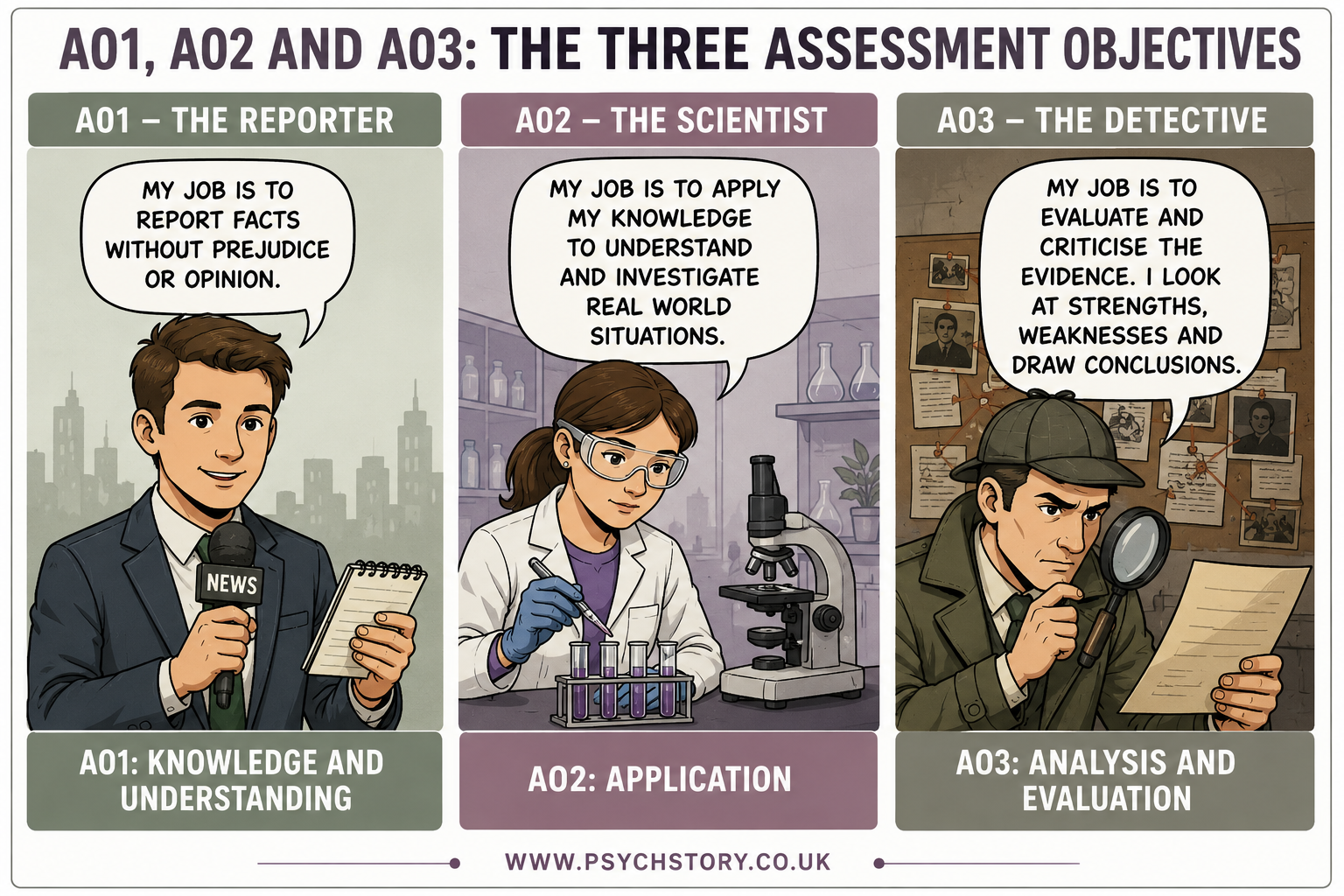
UNDERSTAND THE ASSESSMENT OBJECTIVES: Understanding AOs 1 (knowledge and understanding), 2 (application), and 3 (analysis, interpretation, and evaluation) helps students identify exactly what a question requires and how marks are awarded.
UNDERSTAND THE COMMAND WORDS ASSOCIATED WITH AO1/AO2/AO3
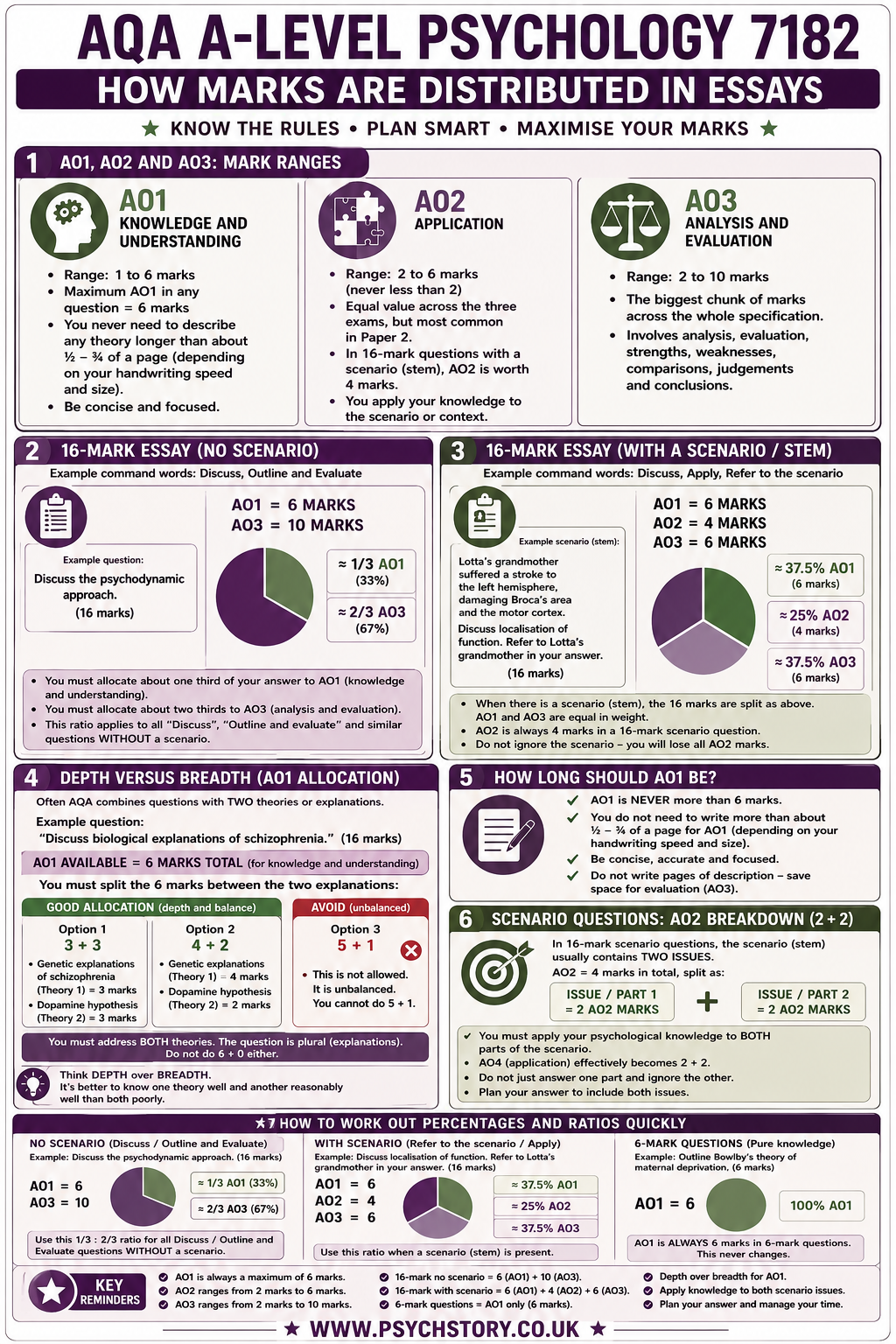
UNDERSTANDING THE ASSESSMENT OBJECTIVES ARE DISTRIBUTED IN MARKS: Knowing how marks are allocated across the assessment objectives helps students allocate their time and focus appropriately. Essays that focus solely on describing theories (AO1) without evaluating (AO3) or applying knowledge (AO2) will lose marks. A clear understanding of all assessment objectives is key to meeting examiner expectations. For example, if only a minority of the marks are awarded for AO1, an essay that mainly describes theories and studies cannot achieve the highest marks.
KEEP THE CORRECT BALANCE
For a 16-mark question, marks are distributed as follows:30% (6 marks): AO1 (knowledge)
70% (10 marks): AO3 (evaluation)
If the essay includes a quote and scenario, AO2 (application) is required. The breakdown changes:
30% (6 marks): AO1 (knowledge)
40% (6 marks): AO3 (evaluation)
30% (4 marks): AO2 (application)
USE PE, PEEL, OR PEC TYPED STRUCTURES FOR AO1/AO2/AO3 .These frameworks help students construct clear, logical and fully developed paragraphs. They ensure that each A03 points are explained, supported with appropriate evidence and connected directly to the question.Students must explain why a point matters and consider what it means for the validity, usefulness or credibility of a theory, explanation or research study.
USE A BROAD RANGE OF EVALUATION SKILLS: Strong AO3 involves more than listing strengths and weaknesses. There are other A03 points (see the mnemonics section below).
KNOW HOW TO STRUCTURE AN EVALUATION: Effective evaluation requires students to develop a coherent argument rather than present a disconnected list of criticisms. This may involve examining supporting and contradictory evidence, methodological limitations, ethical issues, alternative explanations, practical applications and broader debates within psychology.
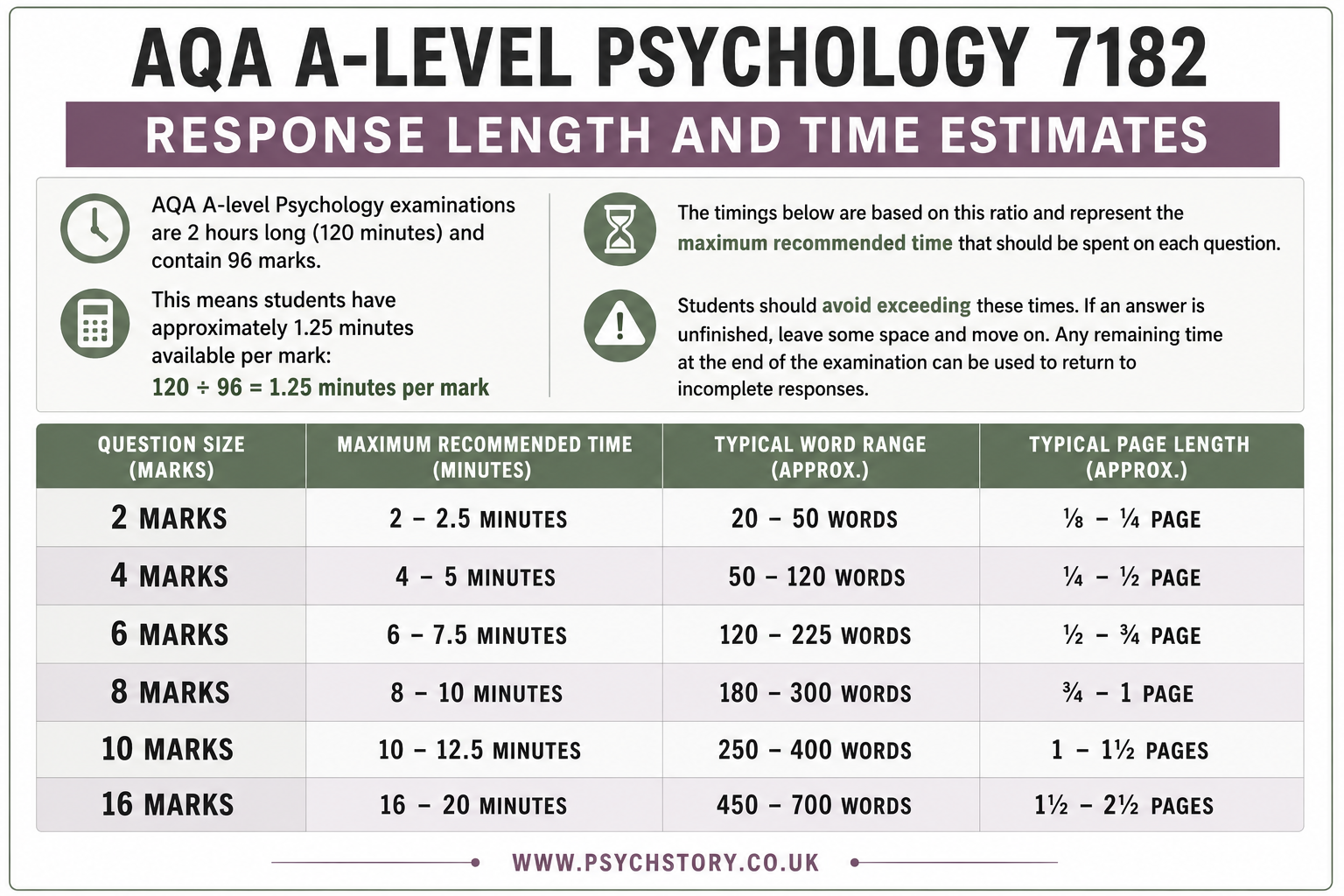
UNDERSTAND QUESTION TIMINGS AND WORD COUNTS: Look at the image below.
HOW TO WRITE EFFECTIVE AO1
FOCUS ON WHAT THE QUESTION ASKS
Every part of an essay must answer the question directly. Do not include information merely because it is related to the general topic. Examiners award marks for relevant material, not for everything a student knows about schizophrenia.
DO NOT WASTE TIME SETTING THE SCENE
A common mistake is to begin an essay with general background information that the question does not require. For example, consider the question:
“DISCUSS PSYCHOLOGICAL THERAPIES FOR SCHIZOPHRENIA”
A student might begin: “Schizophrenia is a serious mental disorder characterised by positive symptoms, such as hallucinations and delusions, and negative symptoms, such as avolition and speech poverty.”
Although this information is accurate, it does not answer the question. The question asks about psychological therapies, not the meaning or symptoms of schizophrenia. It is assumed that the student knows what schizophrenia is, so this material will not be credited. Students have limited time and only a limited number of AO1 marks are available. Wasting time describing the disorder leaves less time to outline the psychological therapies and, more importantly, to evaluate them. Instead, cut to the chase: “One psychological therapy used to treat schizophrenia is cognitive behavioural therapy. CBT helps patients identify and challenge irrational or maladaptive beliefs, including beliefs associated with delusions and hallucinations.” This immediately addresses the question and begins earning relevant AO1 marks. The essay can then explain other psychological therapies, such as family therapy, before evaluating their effectiveness, limitations and supporting evidence. The same principle applies to every essay: identify precisely what the question asks and begin answering it immediately. Do not define the general topic, describe symptoms or provide historical background unless that information is necessary to answer the question
READ AND ANALYSE THE QUESTION
A common mistake is confusing explanations, research studies and research . For example, describing a related study instead of explaining the theory /explanation that the research study For example, when asked to outline Milgram's Agency Theory, a student might write about the electric shock procedure — but the experiment and the theory are different. The study investigated obedience and the theory explaining why people obey. Describing the procedure earns no AO1 marks here.
Instead:
"Milgram's Agency Theory proposes that people operate in either an autonomous state, where they see themselves as responsible for their actions, or an agentic state, where they see themselves as acting on behalf of an authority figure and therefore not responsible for the outcome."
The experiment can later serve as evidence when evaluating the theory — but it isn't a substitute for explaining it. Before writing, underline the command word (outline, explain, discuss) and identify the exact concept required.
KNOW THE MARK LIMITS OF AO1
In a 16-mark AQA essay, AO1 is capped at 6 marks — roughly a third to three-quarters of a page. This isn't a cue to rush, but a ceiling: once you've explained enough to earn all 6 marks, further description adds nothing. Accurately explaining all four components of the Working Memory Model earns full AO1 marks; a further page of detail cannot earn a 7th or 8th mark. This matters because the other 10 marks come from AO2/AO3. Overwriting AO1 eats into the time needed for evaluation, where the bulk of the marks sit.
AO1 = knowledge and understanding only. Applying it to a scenario is AO2. Evaluating evidence, strengths, limitations, or alternatives is AO3
PLAN YOUR RESPONSE
Create a brief plan to organise your ideas logically. Identify the main components of the theory or study and note down the key terms or concepts you need to include. Consider the examiner’s expectations and highlight the key elements for answering the question. For example, when planning a response about the Working Memory Model (WMM), consider its central components: the central executive, which directs attention and coordinates subsystems; the phonological loop, which processes verbal and auditory information; the visuospatial sketchpad, which handles visual and spatial data; and the episodic buffer, which integrates information from the subsystems and long-term memory. You may also mention why the model was proposed (as an improvement on the Multi-Store Model) and its practical applications.
USE A SYSTEM SUCH AS PE OR PEC FOR AO1
When describing a theory or study, students should use a system such as Point-Explain-Consequence(PEC) or Point Explain (PE).
WHY PEC/PE IS NEEDED
Without a system, students can write explanations in an unorganised, vague or haphazd way. , They might list the components without explaining what they actually mean when taken as a whole. why the theory is relevant. Both systems sound like they're "about" the topic without proving the student understands it.
PEC forces three separate things to happen in sequence, each doing a job the others can't:
POINT Where a the to introduce — its category and purpose — before diving into detail. Skip this and an examiner has to infer what you're describing from a list of parts, which costs marks even if every part is accurate.
EXPLAIN forces you to say what a component does or how it works, not just that it exists. This is where understanding gets demonstrated — naming a component shows memory, explaining its function shows comprehension.
COMPONANT forces you to ground the explanation in something specific and named, rather than staying abstract. Vague description ("the brain has areas that do things") can't be marked highly because there's nothing concrete to credit
PEC helps students present their knowledge in a logical order. They first identify the theory or model, then explain its central claim, and finally introduce the specific components or processes by which it works. Consider the following exam question:
“OUTLINE THE WORKING MEMORY MODEL.”
A student who has not organised the AO1 material might write:
“The Working Memory Model has a central executive, a phonological loop, a visuospatial sketchpad and an episodic buffer. The central executive controls the other components. The phonological loop has a phonological store and an articulatory process.”
Although some of this information is accurate, the response immediately shifts to a list. It does not first explain what the Working Memory Model is, why it was developed or what it proposes about short-term memory. The student is naming parts of the model without establishing the central idea that connects them.
Using PEC produces a more systematic explanation:
“The Working Memory Model is a model of short-term memory developed by Baddeley and Hitch. It was proposed in response to evidence that challenged the Multi-Store Model’s view of short-term memory as a single, unitary and relatively passive store. In contrast, the Working Memory Model presents short-term memory as an active processing system made up of several separate but interacting components. These are the central executive, the phonological loop, the visuospatial sketchpad and the episodic buffer, although the episodic buffer was added to the model later.”
The opening sentence provides the Point by identifying the Working Memory Model as a model of short-term memory. The next two sentences explain why the model was proposed and how its view of short-term memory differs from that of the Multi-Store Model. The final sentence identifies the Components that make up the model. Each stage develops the same account rather than introducing a loosely connected fact.
PEC can then be used again to explain each component. For example:
“The central executive is the main supervisory component of working memory. It directs attention towards relevant information and allocates tasks to the appropriate subsidiary system. For example, verbal and auditory information is sent to the phonological loop, whereas visual and spatial information is sent to the visuospatial sketchpad.”
Here, the first sentence identifies the component. The second explains its function, and the third connects that function to the specific subsystems it coordinates.
The phonological loop can then be developed in the same way:
“The phonological loop is the component responsible for processing verbal and auditory information. It temporarily stores this information and maintains it through rehearsal. It contains two components: the phonological store, known as the ‘inner ear’, which holds words that have been heard, and the articulatory process, known as the ‘inner voice’, which silently repeats verbal information to prevent it from fading.”
The student is not simply listing the phonological store and articulatory process. The paragraph first identifies the phonological loop, explains what it does and then describes the specific components that allow it to perform this function.
PEC therefore creates a connected explanation. The Point identifies what is being described, the Explanation establishes what it means or how it works, and the Component/consequence provides the specific psychological detail needed to demonstrate accurate knowledge and understanding
FINAL CHECK
Review your AO1 response to ensure that it directly addresses the question. Ensure all relevant components are included and described systematically, avoiding unnecessary repetition. Ensure your writing is concise, logically structured, and free from evaluation or application.
By following this approach, your AO1 section will effectively summarise a theory's or study's key elements, providing a strong foundation for the rest of your essay.
HOW TO WRITE EFFECTIVE AO3
USE A SYSTEM SUCH AS PEEL OR PEC FOR AO3
START WITH EVALUATING RESEARCH
WHY BEGIN WITH RESEARCH?
A theory is only as credible as the evidence supporting it. A theory makes predictions about behaviour, while research tests whether those predictions are correct. Research evidence is therefore the logical place to begin an evaluation because it establishes whether the theory has a sound foundation.
For example, the Working Memory Model predicts that verbal and visual information are processed by separate components of short-term memory. Research can test this prediction, but finding an apparently supportive result is not enough. The quality of the research must also be considered. A controlled study involving a suitable sample and replicated findings generally provides more convincing evidence than a single case study.
An effective evaluation must therefore answer two questions: Does the research support the theory, and how much confidence should be placed in that research?
ORDER EVIDENCE FROM WEAKER TO STRONGER
The order in which research is presented matters. If the strongest evidence is presented first and followed by a weaker case study, the discussion can appear to move backwards. Criticising the case study for its poor generalisability may also seem to weaken the conclusion already established by the stronger evidence.
It is more logical to begin with limited evidence and progress towards evidence that tests the theory more rigorously.
For example, the KF case provides some support for the Working Memory Model. Following brain damage, KF experienced serious problems with verbal short-term memory while retaining a relatively intact ability to process visual information. This supports the model’s claim that verbal and visual information are processed by separate components. However, KF was one individual with a unique brain injury, so his pattern of memory impairment cannot be confidently generalised to everyone.
Controlled dual-task studies provide stronger support. Baddeley and Hitch found that performance was worse when participants completed two tasks requiring the same component of working memory than when they completed tasks using different components. This directly supports the prediction that working memory contains separate systems with limited capacities. It is more convincing than the KF case because the prediction was tested under controlled conditions with a sample of participants.
Neuroimaging research may provide further support by showing that different brain regions become active during verbal and visual working-memory tasks. However, brain-imaging evidence should not automatically be described as experimental or causal. Unless researchers manipulate an independent variable under controlled conditions, the scan shows an association between a task and brain activity rather than proving that the activity caused the behaviour.
The evidence should therefore be ordered according to its actual methodological strength, not simply according to the research method used. Case studies, animal research and correlational findings often provide useful initial evidence, but may be limited by poor generalisability, species differences or the inability to establish causation. Controlled and replicated research may provide stronger support because it tests the theory’s predictions more directly.
BUILD TOWARDS A DECISIVE CONCLUSION
Moving from weaker to stronger evidence is not simply a method of arranging studies. It allows the evaluation to build towards a judgement. Ideally, each new study should address a limitation of the evidence discussed before it.
In the Working Memory Model example, KF suggests that verbal and visual short-term memory can be affected separately, but a single case cannot show that this organisation applies to everyone. Dual-task experiments then test the same proposed separation under controlled conditions across a larger sample. The later evidence therefore addresses an important limitation of the earlier evidence.
The discussion must eventually reach a conclusion. If a paragraph repeatedly states that evidence supports the theory, then questions that support, then introduces stronger evidence without deciding what it all means, the examiner may be left unsure whether the theory is considered credible.
A clear conclusion might state:
“Overall, the Working Memory Model is supported by converging evidence from case studies, controlled dual-task experiments and brain-imaging research. The controlled evidence is particularly convincing because it directly tests the model’s predictions, although the artificial nature of some laboratory tasks may limit their relevance to everyday memory.”
This does not ignore the limitations. It weighs them against the strengths and reaches a defensible conclusion.
That judgement must also remain consistent throughout the essay. For example, if the Authoritarian Personality explanation has already been judged weak because it relies heavily on correlational evidence, a potentially unrepresentative sample, a potentially biased measure and assumptions that are difficult to falsify, it should not later be presented as a convincing alternative to Milgram’s situational explanation. It may be discussed as an alternative explanation, but its established weaknesses must be acknowledged. Otherwise, the essay contradicts its own argument.
KEEP SUPPORTING AND CONTRADICTORY EVIDENCE DISTINCT
Supporting and contradictory evidence perform different functions. Supporting evidence shows that the theory’s predictions are consistent with research findings. Contradictory evidence identifies findings that the theory cannot explain or predictions that have not been supported.
Begin by presenting the supporting evidence, assessing its quality and reaching a provisional conclusion about the strength of that support. Then introduce contradictory evidence as a separate and clearly signposted challenge. This allows the student to judge whether the contradictory findings merely limit the theory or fundamentally undermine it.
The reader should always understand what role a study plays in the argument. A study should not simply be added because it is related to the topic: it should be clear whether it supports the theory, challenges it or changes the extent to which the theory can be accepted.
EVALUATION BEYOND RESEARCH
After discussing the research evidence, move on to broader evaluative points that address the theory’s practical relevance and implications.
DISCUSSING PRACTICAL APPLICATIONS IN AO3: HOW TO DO IT EFFECTIVELY
When evaluating a theory in AO3, incorporating its practical applications can significantly enhance the quality of your argument. Demonstrating how a theory informs real-world practices or interventions shows a deeper understanding of its relevance and utility. However, students must use this strategy thoughtfully, ensuring their examples align with the theory’s credibility.
WHAT DOES DISCUSSING PRACTICAL APPLICATIONS MEAN?
When you discuss a theory's practical applications, you explain how its insights address real-world issues, such as improving mental health, education, or workplace productivity. This demonstrates that the theory is conceptually valid and useful in practice, strengthening your evaluation.
EXAMPLES OF PRACTICAL APPLICATIONS
1. The Working Memory Model (WMM)
The WMM’s robust empirical foundation and widespread acceptance strengthen its practical applications.
Example of Application: In ADHD management, interventions have been developed based on the WMM’s components, such as the phonological loop and central executive. For instance, breaking tasks into smaller, manageable steps to reduce cognitive overload is rooted in the model’s framework. Similarly, rehearsal techniques targeting the phonological loop are employed to enhance working memory skills in children with ADHD.
Why It’s Relevant: These applications underline the WMM’s scientific validity and ability to address real-world cognitive challenges effectively.
2. Bowlby’s Attachment Theory
Bowlby’s attachment theory has real-world implications, particularly in childcare and parenting practices.
Example of Application: The critical period concept has informed hospital policies to allow parents to stay with their children during long-term care, minimising separation anxiety. Furthermore, developing programs such as early-intervention parenting schemes has drawn directly on Bowlby’s emphasis on secure attachments, promoting better emotional and social outcomes for children.
Why It’s Relevant: These applications highlight the theory’s utility in shaping evidence-based practices and demonstrate its enduring impact on developmental psychology and societal policies.
BUT NOT ALL THEORIES CAN BE APPLIED
While discussing real-world applications can enhance AO3, this strategy is only effective for theories that are methodologically sound and widely accepted within the scientific community. Applying a debunked or weak theory risks undermining your evaluation.
Freud’s Psychosexual Theory as an Example
Freud’s theory is often criticised for lacking falsifiability, reliance on anecdotal evidence, and limited empirical support.
Why Applications Don’t Work: Suggesting that Freud’s theories justify psychoanalytic therapy can appear contradictory if you’ve already criticised the theory’s foundations. For instance, if the theory lacks empirical validity, discussing its application to therapeutic practices becomes redundant or implies a failure to recognise its limitations.
What to Do Instead: Highlight the theory’s historical significance but note that its lack of scientific rigour makes it unsuitable for practical use today, contrasting it with evidence-based approaches like CBT.
USING ALTERNATIVE EXPLANATIONS IN AO3
WHY ALTERNATIVE EXPLANATIONS ENHANCE EVALUATION
Incorporating alternative explanations into AO3 strengthens your critical evaluation by highlighting the limitations of the original theory and offering more robust or nuanced perspectives. This demonstrates higher-order thinking, a key requirement at A-level. However, it is essential to use these critiques strategically to maintain focus and clarity.
HOW TO INTRODUCE ALTERNATIVE EXPLANATIONS
When using an alternative explanation, briefly explain its key points and why it provides a better account of the phenomenon under discussion. Then, it will be linked back to the original theory to critique its shortcomings. Avoid letting the alternative explanation dominate the essay, as the focus should remain on the primary theory.
EXAMPLES OF ALTERNATIVE EXPLANATIONS
MILGRAM’S OBEDIENCE STUDY VS SOCIAL IDENTITY THEORY
Milgram explained obedience through situational factors such as the agentic state and proximity. However, social identity theory (SIT) offers a compelling alternative. SIT suggests that participants conformed due to group identification with the experimenter and their perceived social role rather than blind obedience. Reicher and Haslam’s BBC Prison Study supports this, showing that group identification can lead individuals to resist or conform depending on their perceived group identity. This critique highlights that Milgram’s theory may oversimplify obedience by ignoring social dynamics.
BOWLBY’S MATERNAL DEPRIVATION HYPOTHESIS: EARLY ATTACHMENT AND LONG-TERM IMPACTS
Bowlby’s hypothesis attributes emotional and social difficulties to early separation from a primary caregiver. Rutter challenged this by distinguishing between deprivation (loss of attachment) and privation (failure to form any attachment), arguing that privation has more severe long-term effects. His findings from Romanian orphan studies indicate that the quality of caregiving, not separation alone, determines outcomes. This critique suggests that Bowlby’s hypothesis lacks nuance and oversimplifies the impact of early separation.
PRIORITISE CLARITY AND FOCUS
Essays should prioritise clarity and avoid tangents. If alternative explanations are introduced, state briefly why they are better or worse without making them the essay’s primary focus. For example:
STAY ON TOPIC: Use alternative explanations to critique the original theory and then return to the essay's primary focus. Do not over-explain the alternative. A concise critique is sufficient to enhance your AO3 and demonstrate higher-order thinking.
FINAL NOTE
Using alternative explanations effectively demonstrates critical evaluation and a sophisticated understanding of the topic. However, the key is balance: critique the original theory and integrate the alternative explanation, but ensure the essay remains focused on answering the question.
MNEMONICS FOR A03 EVALUATION
WHY USE A MNEMONIC?
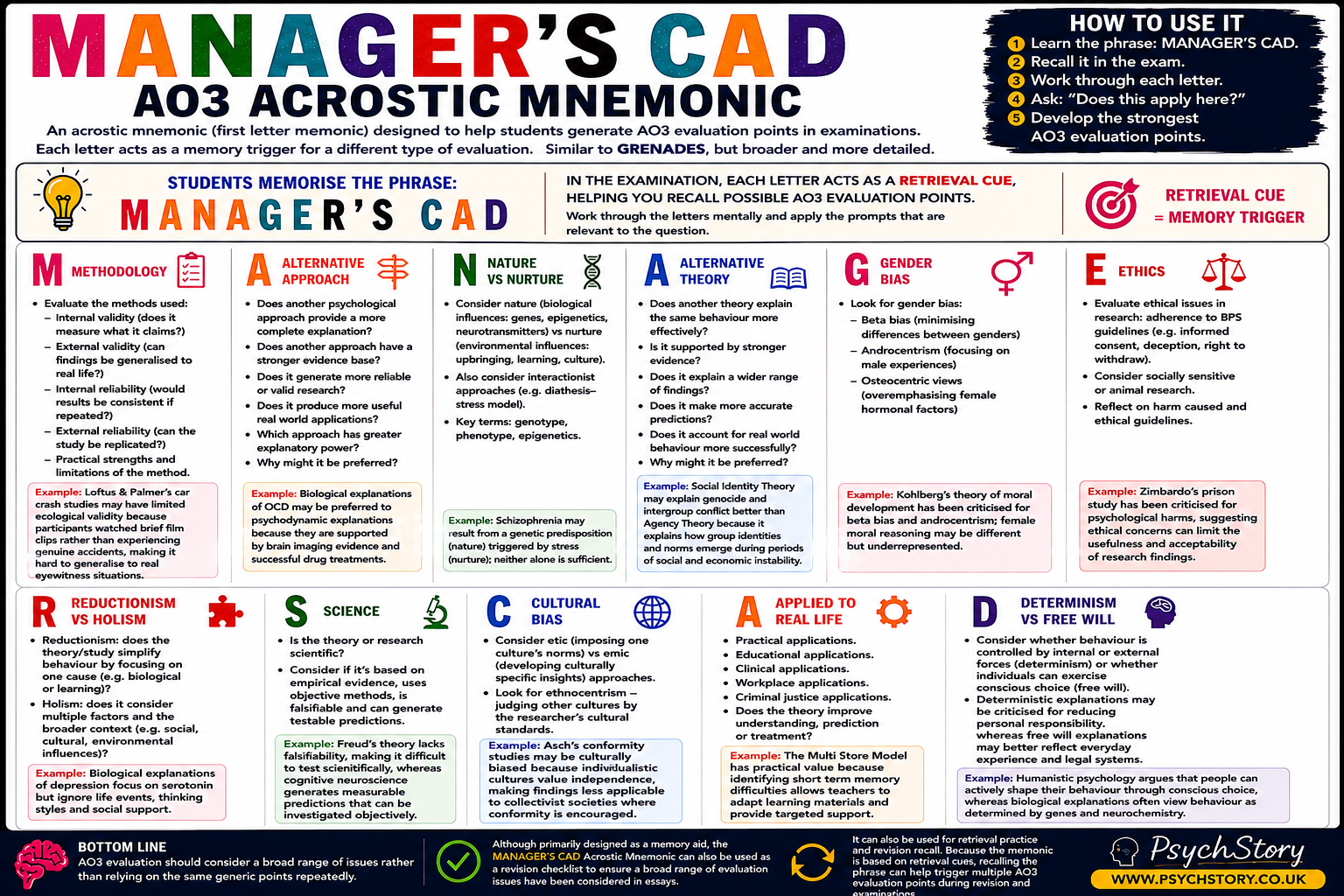
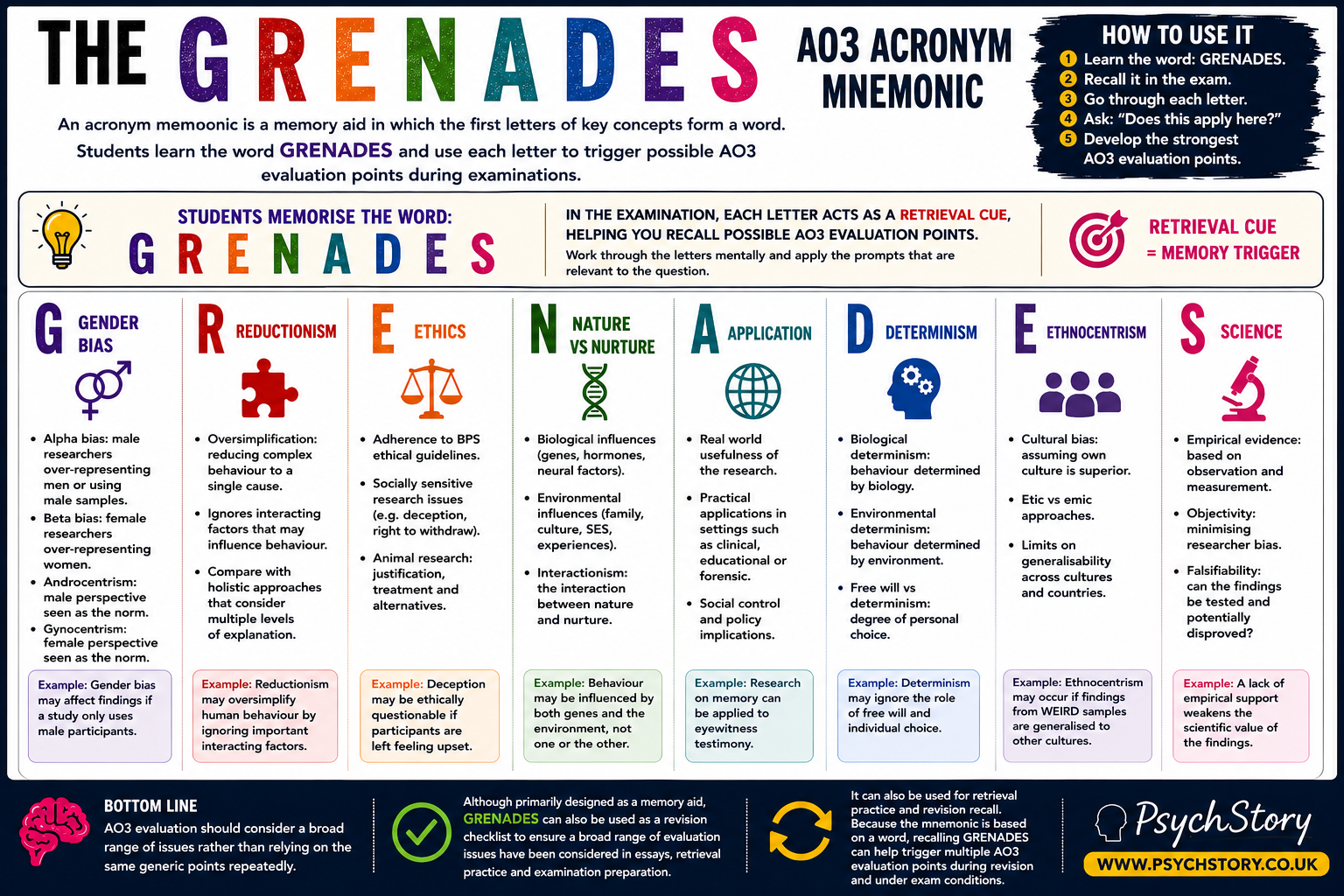
A mnemonic is simply a memory aid. The two examples in the diagrams below, GRENADES and MANAGER'S CAD, are acrostic mnemonics, where each letter serves as a retrieval cue for a different AO3 evaluation point.
When students cannot immediately think of one or more evaluative points for an essay, they often assume they do not know the material. Sometimes this is true, but not always. It may simply mean they do not yet have the right retrieval cues. This is where mnemonics such as GRENADES and MANAGER'S CAD can be useful. By working through each letter, students can trigger evaluation points that they may not have recalled independently.
It is also a good way of testing knowledge without notes. Can a student spontaneously think of a range of evaluative points and apply them to any theory, explanation, study or approach without looking anything up? If they can, this demonstrates genuine understanding, as AO3 requires students to select, apply and develop relevant criticisms rather than simply recognise them on the page.
However, if a student works through GRENADES or MANAGER'S CAD and still cannot produce a meaningful evaluation, they probably need to return to the theory, explanation, or study and strengthen their understanding.
The real value of these mnemonics is not simply remembering information. They help students perform under examination conditions when nerves can interfere with recall, and they help strengthen existing memories by repeatedly retrieving and applying knowledge. Most importantly, they help students generate an AO3 evaluation by identifying possible strengths, weaknesses, criticisms and debates that can then be applied to the question.
.EXAMPLE APPLICATION: MILGRAM’S STUDY
E – ETHICS: Deceptive and caused psychological distress, but Milgram argued the findings justified this.
R – REDUCTIONISM: Focuses on authority but ignores cultural or social factors.
M – METHODOLOGY: High reliability due to controlled conditions, but lacks ecological validity.
S – SCIENCE: Scientific with experimental methods, but challenging to falsify broader obedience theories.
C – CULTURAL BIAS: Ethnocentric—findings from the USA may not apply to collectivist cultures.
D – DETERMINISM: Suggests obedience is driven solely by authority, ignoring free will.
G – GENDER BIAS: Participants were mainly male.
N – NATURE VS NURTURE: Focuses more on situational factors (nurture) and neglects individual differences (nature).
A – ALTERNATIVE APPROACH: An evolutionary approach might explain this phenomenon better.
A – ALTERNATIVE THEORY: Social identity theory may explain group behaviour better.
A – APPLIED TO REAL LIFE: Helps understand atrocities like the Holocaust or improve whistleblowing systems.
Make it stand out
Whatever it is, the way you tell your story online can make all the difference.
HOW TO WRITE EFFECTIVE AO2
ESSAYS WITH AO2 APPLICATION
A question that includes AO2 will begin with a quote or scenario and require students to link theories or research to the specific example provided.
For instance, LOTTA’S GRANDMOTHER
SCENARIO: Lotta’s grandmother suffered a stroke in the left hemisphere, damaging Broca’s area and the motor cortex.
QUESTION: Discuss the localisation of function in the cerebral cortex. (16 marks)
MARKS BREAKDOWN:
AO1 (6 marks): Describe the localisation of function, including Broca’s area and the motor cortex.
AO3 (6 marks): Evaluate evidence for and against localisation of function.
AO2 (4 marks): Apply knowledge to Lotta’s grandmother (2 marks per applied point).
EXAMPLE AO2 APPLICATION (4 MARKS):
Damage to Broca’s area likely caused Broca’s aphasia, impairing Lotta’s grandmother’s ability to form coherent sentences. (2 marks)
Damage to the motor cortex would have resulted in paralysis or weakness on the right side of her body, as motor control is contralateral. (2 marks)
AO1, AO2, AND AO3
When a 16-mark essay includes AO2 (application), a quote or scenario will always precede the essay question. This requires students to apply their knowledge to a specific case. For example:
SCENARIO: “Lotta’s grandmother suffered a stroke to the left hemisphere, damaging Broca’s area and the motor cortex.”
ESSAY QUESTION: “Discuss localisation of function in the cerebral cortex; refer to Lotta’s grandmother in your answer.”
MARK ALLOCATION FOR A01, A02, AND A03
AO1 = six marks: Description of localisation of function (limited to six marks).
AO2 = four marks: Application to Lotta’s grandmother (address Broca’s area and the motor cortex, using a 2 + 2 structure).
AO3 = eight marks: Evaluation and critical discussion of localisation of function.
MARK BREAKDOWN
AO1 = six marks
This is limited to 6 marks in all essay questions, meaning you only need to describe the theory or research relevant to the question.
In this case, describe localisation of function, including:
The role of Broca’s area in speech production.
The role of the motor cortex in voluntary movement.
How functions are lateralised in the left and right hemispheres.
Use concise, focused descriptions to score these marks, as no more than six marks can be awarded for AO1.
AO2 = FOUR MARKS
These marks are awarded for applying your knowledge to the scenario. You must refer directly to Lotta’s grandmother’s stroke in this example.
AQA requires you to address both aspects of the damage (Broca’s area and the motor cortex) for full marks. Use a 2 + 2 structure:
2 marks for Broca’s area: Lotta’s grandmother is likely to struggle with speech production, such as forming words or sentences. She may retain comprehension, as this involves Wernicke’s area.
2 marks for the motor cortex: Lotta’s grandmother may experience paralysis or weakness on the right side of her body, as the motor cortex controls contralateral movement.
Ensure that both points are tied to the scenario to earn full AO2 marks.
AO3 = EIGHT MARKS
The most significant portion of marks (8) is for evaluation and analysis.
In this case, critically evaluate the localisation of function:
SUPPORTING EVIDENCE:
Petersen et al. used brain imaging to show that Broca’s area is active during speech production, supporting localisation.
Case studies such as that of Phineas Gage demonstrate how damage to specific brain areas affects behaviour.
CRITIQUES:
Lashley’s equipotentiality theory suggests that cognitive functions like learning are distributed rather than strictly localised.
Brain plasticity shows that other areas can take over functions when damage occurs, challenging strict localisation.
Use balanced arguments with evidence and counterpoints to achieve high AO3 marks.
CONCLUDING THE ESSAY
Most specifications do not require a conclusion. Check your exam board requirements. If a conclusion is necessary, summarise your main evaluative points and directly answer the essay question. The conclusion should integrate your analysis, providing a final judgement on the theory’s validity or usefulness. For example, when concluding an evaluation of the MSM, you might write: "In conclusion, the Multi-Store Model provides a strong framework for understanding memory, supported by evidence from case studies and neuroimaging. However, its oversimplification of memory processes and lack of attention to interactions between STM and LTM highlight its limitations. Despite this, its real-world applications, particularly in dementia care, underscore its relevance and practical value."
FINAL CHECK
Ensure your AO3 section addresses the essay question, flows logically, and is well-balanced. Avoid superficial points or shopping list evaluations. Fully develop each argument using structured frameworks like PEC or PEEL and integrate broader considerations to provide a well-rounded critical analysis. By following this approach, you will craft a substantial AO3 section that meets A-level psychology essay requirements and