
SITUATIONAL VARIABLES AFFECTING OBEDIENCE
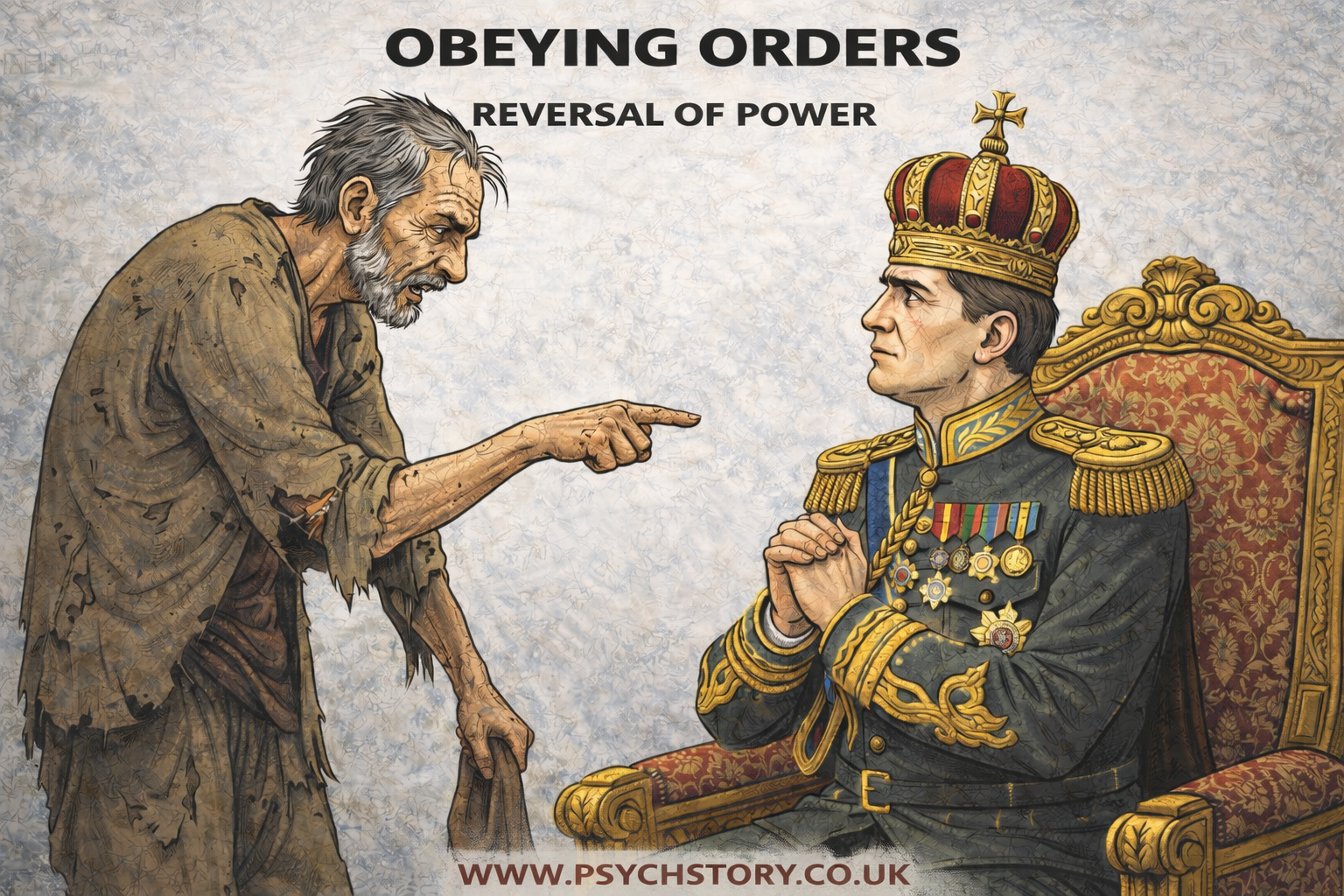
SPECIFICATION WARNING: MILGRAM AND OBEDIENCE (AQA)
The specification states: “Explanations for obedience: agentic state and legitimacy of authority, and situational variables affecting obedience, including proximity and location, as investigated by Milgram, and uniform.”
This is not one demand. It is two separate questions, and students consistently fail to separate them.
Firstly, “Explanations for obedience: agentic state and legitimacy of authority” refers to Milgram’s theory. This is AO1, focused on explanation. The task is to explain how obedience occurs, which means outlining the agentic state, the agentic shift, and legitimate authority. It does not mean describing Milgram’s original study. Students repeatedly default to outlining the procedure because it is familiar, but this does not answer the question. The theory explains obedience; the study does not replace the theory. The original study can be used, but only as AO3, for example, to support whether the theory is valid.
Secondly, “situational variables affecting obedience, including proximity and location, as investigated by Milgram, and uniform” refers to the variations. This is also AO1, but of a different type. The focus is on how obedience changes when specific situational factors are manipulated. You must describe the variations and, crucially, what each one demonstrates about obedience. The emphasis is on identifying which factors increase or decrease obedience. Again, students make the same error and describe the original study instead of the variations, which does not meet the question's demand.
The specification also creates confusion in how it separates concepts. “Uniform” is presented as a distinct factor, but it is simply one way of signalling legitimate authority. It is not a separate mechanism. Likewise, proximity and buffering are treated as different ideas, but both operate through empathy. Reduced proximity, or increased buffering, lowers empathic engagement and makes obedience easier. Increased proximity does the opposite.
Please note that many of the evaluative points fromMilgram’s original study apply to his variations. For example, his variations were gender and culturally biased and lacked validity.
MILGRAM’S OBEDIENCE STUDY: EXPERIMENT OR CONTROLLED OBSERVATION?
Milgram’s obedience study is commonly referred to as a laboratory experiment in textbooks. However, it is not a true experiment. In a genuine experiment, the researcher manipulates an independent variable so that participants in different conditions perform different tasks. In Milgram’s study, every real participant performed exactly the same task throughout — acting as the teacher, asking questions, and administering what they believed were electric shocks when instructed to continue. There was no independent variable in the experimental sense.
Instead, Milgram’s study is best classified as a structured, controlled observation, just like Ainsworth’s Strange Situation and Asch’s conformity study. It was conducted under highly controlled laboratory conditions with a standardised procedure and scripted prods from the authority figure. This tight control over extraneous variables meant that any changes in participants’ behaviour were likely due to the pressure from the authority figure rather than other uncontrolled factors.
The fact that Milgram conducted several variations (such as varying levels of proximity between the teacher and the learner) does not make it a true experiment. These variations simply represent different levels of the same observed situation, exactly as the different variations in Asch’s study and the different episodes in the Strange Situation did not create independent variables

EVERYDAY OBEDIENCE OR OBEYING PATHOLOGICAL REQUESTS?
Finally, Milgram was not investigating everyday, low-level obedience such as following routine instructions from teachers or authority figures in benign contexts. His work was explicitly concerned with destructive obedience: the conditions under which ordinary individuals are prepared to carry out actions that violate their moral code and cause harm to others. The historical context is critical. Milgram was attempting to understand how seemingly normal people participated in the atrocities of the Holocaust, not why people comply with harmless requests in daily life.
Without this context, the theory is stripped of its meaning and reduced to a superficial account of obedience. The central issue is not whether people obey, but why they obey unjust and harmful orders, even when those orders conflict with their conscience. This is why concepts such as moral strain, the agentic shift, and binding factors are necessary. They explain how individuals resolve the conflict between personal morality and authority, and how responsibility is displaced. Ignoring this focus leads to a fundamental misinterpretation of both Milgram’s theory and the purpose of his research.
MILGRAM’S ORIGINAL STUDY
AIM: Milgram (1963) was interested in researching how far people would go in following an unjust order, such as harming another person. Stanley Milgram hypothesised that ordinary people could be influenced into committing atrocities, for example, Germans in WWII, because of situational factors like obedience as described in his “Agency Theory”.
PROCEDURE: 1961, Milgram placed an advertisement in the New Haven Register asking for volunteers: “We will pay you $4 for one hour of your time.” “We need 500 New Haven men to help us complete a scientific study of memory and learning.” Thus, participants were recruited by a volunteer sample. There were 40 males, aged between 20 and 50, whose jobs ranged from unskilled to professional, from the New Haven area. They were paid $4 for just turning up.
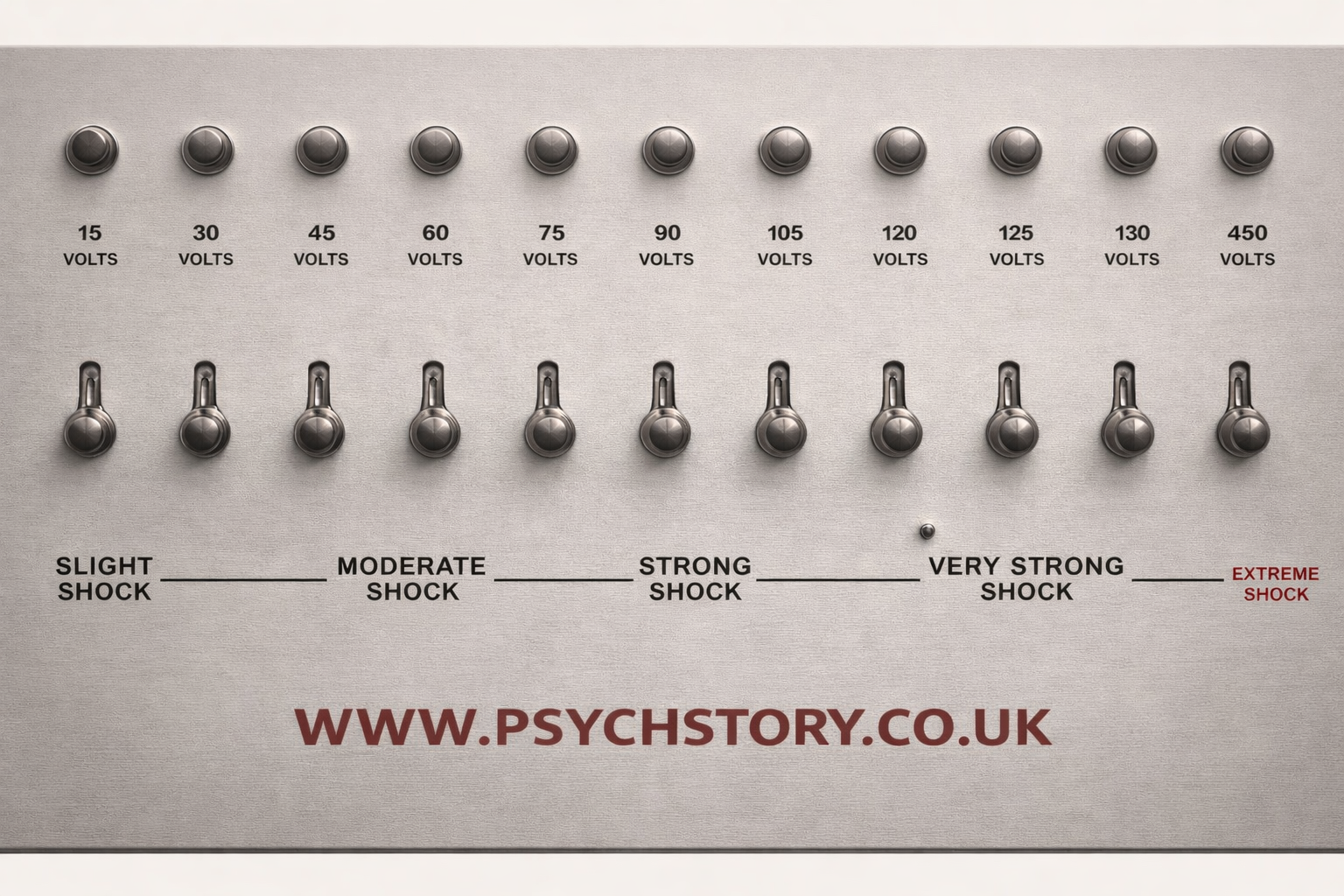
MILGRAM’S SHOCK GENERATOR. At the beginning of the observation, they were introduced to another participant, who was a confederate of the experimenter (Milgram). They drew straws to determine their roles – learner or teacher – although this was fixed and the confederate was always the learner. There was also an “experimenter” dressed in a grey lab coat, played by an actor (not Milgram).
Two rooms in the Yale Interaction Laboratory were used - one for the learner (with an electric chair) and another for the teacher and experimenter with an electric shock generator.
The “learner” (Mr Wallace) was strapped to a chair with electrodes. After he has learned a list of word pairs given him to learn, the "teacher" tests him by naming a word and asking the learner to recall its partner/pair from a list of four possible choices.
The teacher is instructed to administer an electric shock every time the learner makes a mistake, increasing the shock level each time. There were 30 switches on the shock generator marked from 15 volts (slight shock) to 450 volts (danger – severe shock).
The learner gave mainly wrong answers (on purpose), and for each of these, the teacher gave him an electric shock. When the teacher refused to administer a shock, the experimenter was to give a series of orders/prods to ensure they continued.
There were four prods, and if one was not obeyed, then the experimenter (Mr Williams) read out the next prod, and so on.
Prod 1: Please continue
Prod 2: The experiment requires you to continue.
Prod 3: It is absolutely essential that you continue.
Prod 4: You have no other choice but to continue.
RESULTS: 65% (two-thirds) of participants (i.e., teachers) continued to the highest level of 450 volts. All the participants continued to 300 volts.
CONCLUSIONS: Ordinary people are likely to follow orders given by an authority figure, even to the extent of killing an innocent human being. Obedience to authority is ingrained in us all from the way we are brought up. People tend to obey orders if they recognise the authority behind them as morally right and/or legally valid. This response to legitimate authority is learned in a variety of situations, for example, in the family, school, and workplace.
REAL EFFECTS OF ELECTRIC SHOCKS
Real physical effects for each voltage (15V–450V, dry skin contact, brief 60Hz AC shock). Current (not voltage alone) decides harm.
• 15V: Faint tingle or nothing. Not painful. No harm.
• 30V: Mild tingling/prick. Not painful. Safe.
• 45V: Noticeable tingle. Mild prick at most. Harmless.
• 60V: Clear tingling. Unpleasant but not painful.
• 75V–90V: Strong tingle turning to mild sting. Unpleasant.
• 105V–120V: Painful shock. Sharp sting, muscle twitch.
• 135V–180V: Very painful. Strong jolt, possible muscle lock.
• 195V–240V: Severe pain. Hard to let go, burning at contacts.
• 255V–300V: Excruciating pain. Muscle spasms, breathing risk.
• 315V–360V: Extreme pain. Likely unconsciousness, heart risk.
• 375V–420V: Life-threatening. Severe burns, high chance of cardiac arrest.
• 435V–450V: Potentially lethal. Can cause ventricular fibrillation, burns, death (especially if wet skin or longer contact)

OUTLINE VARIATIONS ON MILGRAM’S ORIGINAL STUDY
Milgram’s variations were designed to test and refine his explanation of obedience, rather than simply repeat the original procedure. While Agency Theory explains why individuals obey through concepts such as the agentic shift and moral strain, the variations examine when obedience increases or decreases by manipulating situational conditions. There is, therefore, a clear overlap: the variations provide empirical support for the theoretical claims, but they are not the theory itself. Milgram conducted a series of systematic variations, altering one key factor at a time in order to isolate its effect on obedience. These included changes in proximity between the teacher and learner, proximity to the authority figure, the status and legitimacy of that authority, and the setting in which the study took place. By doing this, Milgram was not attempting to demonstrate obedience again, but to identify the specific conditions that make obedience more or less likely.
The original study established that high levels of obedience occur. The variations then showed that obedience is not fixed, but highly sensitive to situational factors. For example, reducing proximity increases psychological distance and lowers empathy, making obedience easier, while reducing the legitimacy of authority decreases compliance. Similarly, moving the study away from a prestigious institution reduces perceived authority and lowers obedience.
Taken together, the variations operationalise the mechanisms proposed in Agency Theory. They demonstrate that obedience is not simply a dispositional trait, but a situationally driven response shaped by authority, context, and distance from the consequences of one’s actions
MILGRAM’S VARIATIONS
Proximity of authority figure: Instructions by telephone
Physical closeness of the learner: The Learner is placed in the same room as the teacher
Prestige of the institution: Conducted in a run-down office building
Role of a rebel: Two other confederates refuse to continue the experiment
Ordinary person as authority: The ordinary individual replaces the experimenter
Voice-feedback condition: Teacher hears the learner's protests
The teacher forces the learner’s hand on the electric plate
WHICH VARIATIONS TIE TO SPECIFIC BINDING FACTORS?
ANSWERS
PROXIMITY OF AUTHORITY FIGURE – Instructions by telephone → LEGITIMACY OF AUTHORITY (authority figure and institution)
PHYSICAL CLOSENESS OF THE LEARNER – The Learner is placed in the same room as the teacher → THE PRESENCE OF ‘BUFFERS’: factors that induce empathy
PRESTIGE OF THE INSTITUTION – Conducted in a run-down office building → LEGITIMACY OF AUTHORITY (authority figure and institution)
ROLE OF A REBEL – Confederates refuse to continue the experiment → LEGITIMACY OF AUTHORITY (authority figure and institution)
ORDINARY PERSON AS AUTHORITY – Ordinary individual replaces the experimenter → LEGITIMACY OF AUTHORITY (authority figure and institution)
VOICE-FEEDBACK CONDITION – Teacher hears the learner's protests → THE PRESENCE OF ‘BUFFERS’: factors that induce empathy
THE TEACHER FORCES THE LEARNER’S HAND ON THE ELECTRIC PLATE → THE PRESENCE OF ‘BUFFERS’: factors that induce empathy
QUESTIONS ON THE MILGRAM’S VARIATIONS
Based on Milgram’s theory, did obedience go up or down in the following variations?
Estimate a percentage
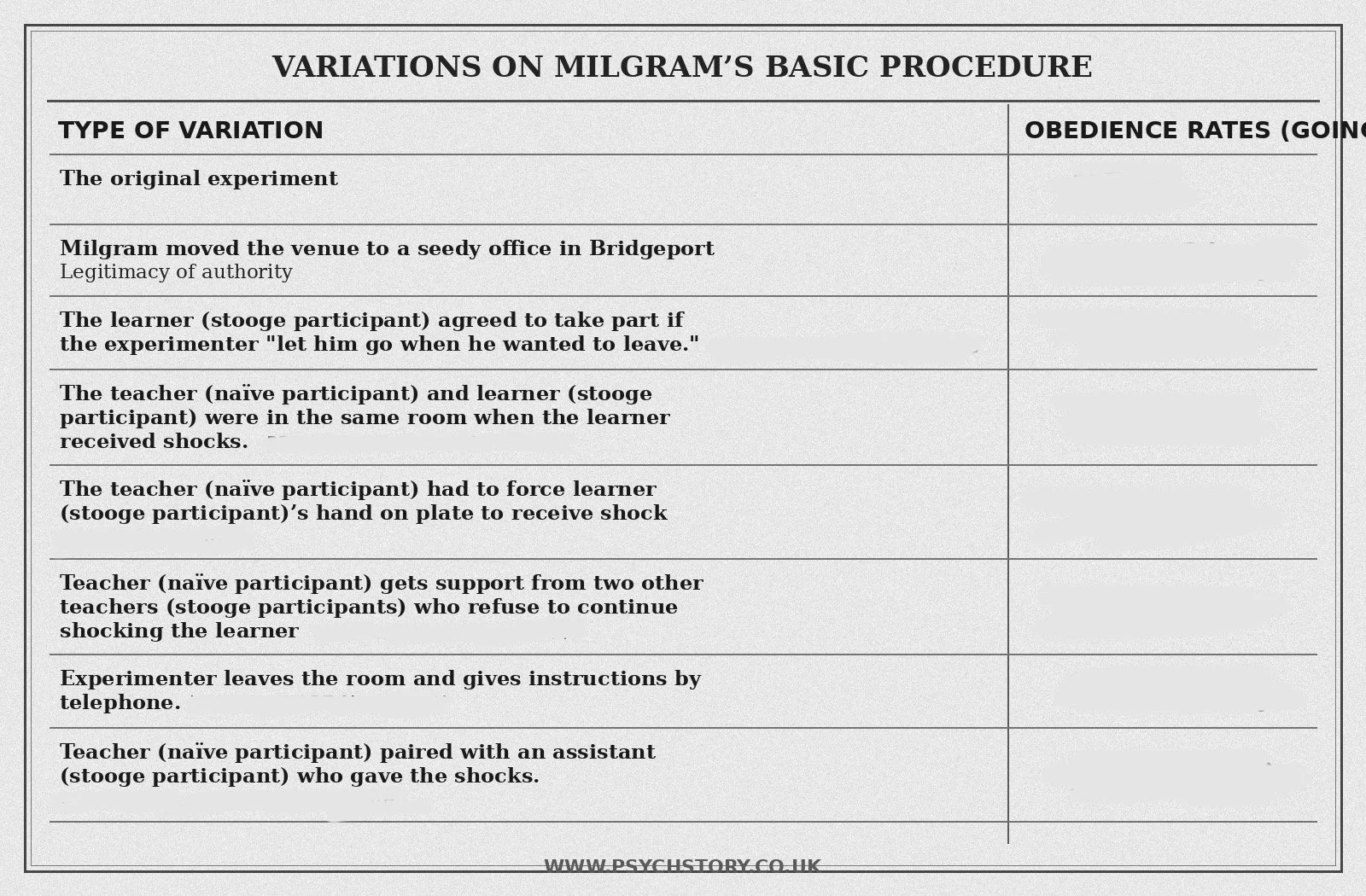
Provide exact percentages for each variation's impact on obedience levels.
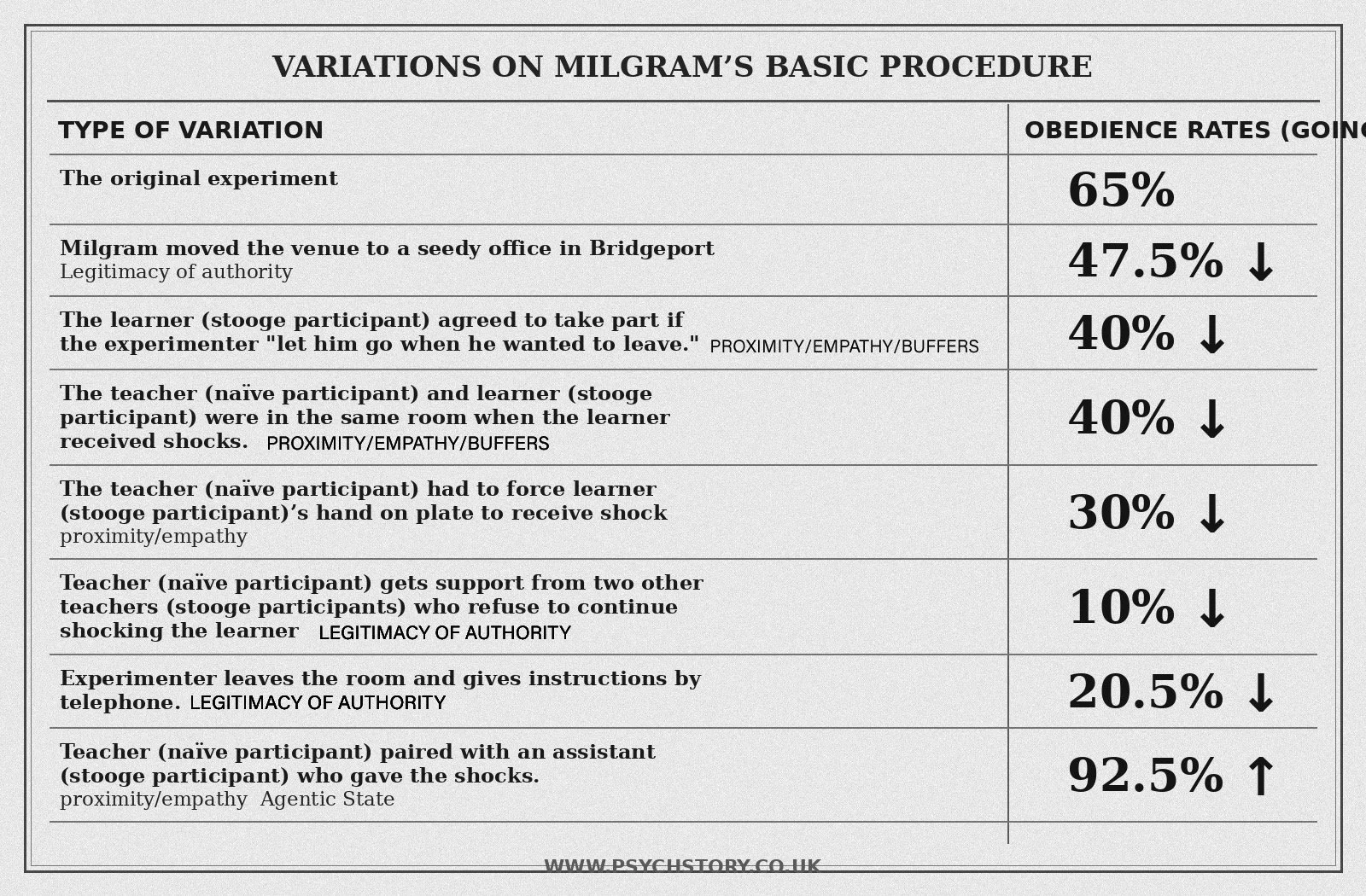
Proximity of Authority Figure: Decreased from 65% to 20.5%.
Physical Closeness of the Learner: Decreased to 40%.
Prestige of the Institution: Dropped to 47.5%.
Role of a Rebel: Decreased to 10%.
Ordinary Person as Authority: Dropped to 20%.
Voice-Feedback Condition: Dropped to 13.5%.
PERCENTAGE OF PARTICIPANTS GOING TO 450 VOLTS
THE PRESENCE OF BUFFERS/THE PROXIMITY OF THE VICTIM
The presence of buffers or moral strain is basically an argument that empathy can win the day, as the closer people get to each other the more they should individualise each other and feel empathy.
In Milgram’s study, some participants tried to lessen the learner’s pain by giving the lowest shock, or they helped the learner by stressing the correct answer on the memory test and/or by flicking the shock generator switches lightly, as if this would somehow lessen the pain. Also, when Milgram removed a buffer by making the ‘teacher’ place the ‘learner's hand on the electric plate, and/or the learner was in the same room, levels of disobedience dropped as participants could not ignore the suffering. Zimbardo also found that adding in more buffers, such as by making the ‘learner’ wear a hood and be only referred to by a number rather than their name, caused increased levels of obedience, although this finding could as easily be attributed to deindividuation.
According to Mandel, the same cannot be applied to the holocaust as the proximity and legitimacy of the authority figure in Milgram’s variations had no ecological validity in Nazi Germany. SS soldiers were often alone with their victims and not in the physical presence of their superiors. Moreover, SS soldiers always ensured that all Jews were dead when they were gassed or shot, and they displayed severe brutality on those whom they ‘caught.’ These actions do not indicate that those involved tried to lessen their victims’ suffering, even when they had a chance to do so.
PRESENCE OF ALLIES IN MILGRAM’S VARIATIONS
The presence of allies should have reduced the authority's legitimacy. According to Milgram’s findings, as participants used defiance toward allies as an opportunity to avoid harming the learner and felt able to do so, there was reduced legitimacy of authority.
David Mandel argued that men were aware that several of their peers had removed themselves from the killing, but only a small minority of men took up the offer to be assigned to other duties. The vast majority continued to kill. Moreover, some Nazis went on killing sprees of their own volition or were cruel without a specific order. The presence of allies in Milgram's experiments, particularly when confederates (participants pretending to be fellow subjects) refused to continue, served as a form of social support and solidarity. This reduced the perceived legitimacy of the authority figure and the binding factor of the authority figure's commands. Participants may have felt less isolated and more empowered to resist the authority figure's orders when they observed others doing the same. This social dynamic challenged the authority's influence and contributed to a decrease in participants' willingness to administer shocks.
AN EXPERIMENT IS A SNAPSHOT IN TIME
Moreover, the findings do not tell the whole tale. Milgram’s study took place in a single hour, with very little time either to deliberate or talk things over with someone. In most situations, like the Holocaust, the perpetrators had ample time (years) to reflect on their actions, and yet, they still chose to turn up every day. Milgram perhaps highlights only how far we'll go in the heat of the moment.
Not all of Milgram’s variations were unsuccessful.
THE PROXIMITY AND LEGITIMACY OF THE AUTHORITY FIGURE
This was supported by Milgram’s research, in which he showed that levels of obedience decreased when he removed the legitimate authority figure by dressing the experimenter more casually and removing his white coat. In another variation, the observation was moved from the prestigious Ivy League university to a seedy office in a run-down city. The results showed that the participants in the Bridgeport study were less likely to obey because they did not see the researchers as qualified. Moreover, in another variation of Milgram’s experiment, teachers were given orders by telephone, thereby reducing the perceived presence of the authority figure and lowering levels of obedience. Bickman also showed that uniform acts as a symbol of authority, as participants were more likely to obey a guard than ordinary civilians. This supports the idea that legitimate authority affects obedience, as there were drops in obedience levels.
Please note: The specification asks for a discussion of uniforms, but the uniform is really just “LEGITIMACY OF AUTHORITY.”
So you can use the L. Bickman (1974) study on the power of uniforms, or any of Milgram’s variations above in which the legitimacy of authority has been removed, e.g., moving the offices to Bridport or removing the experimenter from the room and giving instructions by phone.
Counter-arguments use real-life examples of how the power of a situation and the influence of an authority figure can shape a person’s behaviour by removing personal responsibility and morals, e.g. conscience and compassion. For example, the Abu Ghraib prison abuse showed many similarities with Milgram’s obedience research.
OTHER RESEARCH MILGRAM
A partial replication of the observation was staged by British illusionist Derren Brown and broadcast on the UK's Channel 4 in The Heist(2006).
In 2009, Burger received approval from the institutional review board after modifying several of the observation protocols. Burger found obedience rates virtually identical to those reported by Milgram in 1961–62, even while meeting current ethical regulations requiring informed consent. In addition, half the replication participants were female, and their rate of obedience was virtually identical to that of the male participants. Burger also included a condition in which participants first saw another participant refuse to continue. However, participants in this condition obeyed at the same rate as participants in the base condition.
In the 2010 French documentary Le Jeu de la Mort (The Game of Death), researchers recreated the Milgram observation with an added critique of reality television by presenting the scenario as a game show pilot. Volunteers were given €40 and told that they would not win any money from the game, as this was only a trial. Only 16 of 80 "contestants" (teachers) chose to end the game before delivering the highest-voltage punishment.
The Discovery Channel aired the "How Evil Are You?" segment of Curiosity on October 30, 2011. The episode was hosted by Eli Roth, who produced results similar to the original Milgram observation, though the highest-voltage punishment used was 165 volts, rather than 450 volts. Roth added a segment in which a second person (an actor) in the room would defy the authority ordering the shocks, finding more often than not, the subjects would stand up to the authority figure, in this case.
CULTURAL BIAS MILGRAM
There have been cross-cultural variations of the Milgram study. These are important because a tendency to obey authority figures might be something they get from their surrounding culture rather than an innate human impulse (found in everyone, everywhere).
Meeus & Raaijmakers (1986) found results similar to Milgram's in 1960s America in liberal Holland. However, this study used a less distressing punishment (insults rather than electric shocks).
Shanab & Yahya (1978) found similar results to Milgram in a non-Western society - Jordan, in the Middle East
Thomas Blass (2012) reviewed all these studies and found that, on average, American obedience was 5% lower than in non-American studies. This certainly suggests that genocide could happen anywhere. This makes it very important that countries develop democratic institutions in which authority figures are questioned and challenged.
POPULATIONS BIAS: The participants were all white, male working-class. Are the findings generalisable to non-white females from different social classes?
In observation 8, Milgram used an all-female contingent; previously, all participants had been men. Obedience did not differ significantly, though the women reported experiencing higher levels of stress.
Around the time of the release of “Obedience to Authority in 1973–1974”, a version of the observation was conducted at La Trobe University in Australia. As reported by Perry in her 2012 book Behind the Shock Machine, some of the participants experienced long-lasting psychological effects, possibly due to the lack of proper debriefing by the experimenter.
EVALUATION OF SITUATIONAL VARIABLES AFFECTING OBEDIENCE
INTERNAL VALIDITY ISSUES
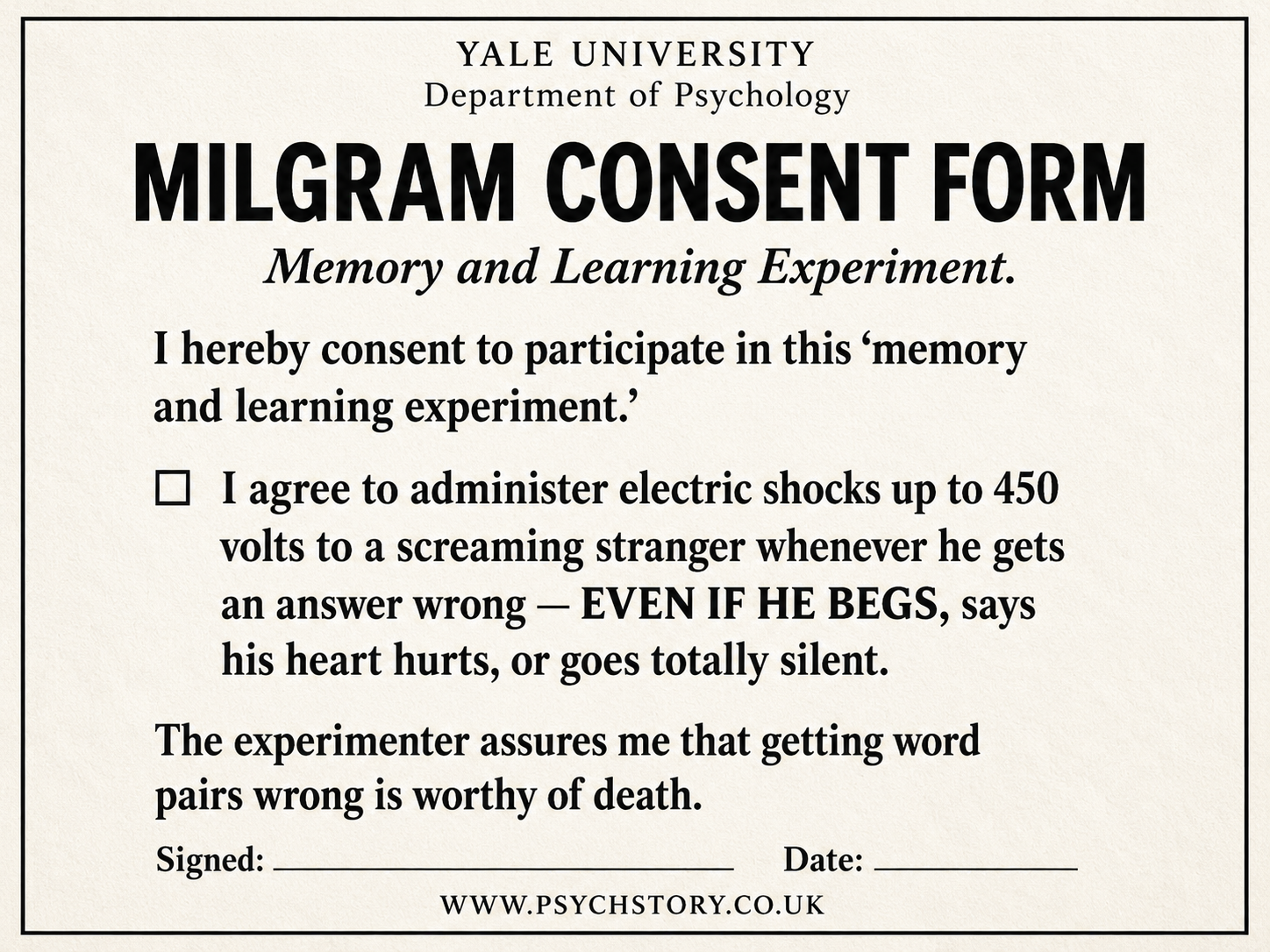
Orne and Holland found the notion that Milgram’s participants believed they could legally execute a member of the public for no apparent, meaningful reason ridiculous. Whichever way you view it (manslaughter, murder, grievous bodily harm), participants were being asked to commit, arguably, the worst social taboo for a crass learning theory that had little social benefit – and “to top it off”, they were in one of the world’s most prestigious universities where being inconspicuous was out of the question.
Moreover, the participants’ disbelief would have been further confounded by the presence of the “experimenter”. Why didn’t he throw the switches himself? The logical conclusion formed by many of the participants would have been that the role of the teacher was unnecessary, and they may have then wondered why they were there, say many critics of Milgram.
Orne and Holland believed that you couldn’t defy the logic of the ordinary man in this way. Moreover, many participants are quite aware of the research restraints imposed by law, e.g., no physical harm. They concluded that the participants must have played along with Milgram to please him (demand characteristics). Therefore, they didn’t obey an unjust command, and the results are meaningless and lack internal validity. The authors also cite hypnosis research showing that people can't be compelled to actually harm others if it's really clear that the victims will be injured.
Critics of Orne and Holland counter-argued that Milgram’s participants were displaying actual behaviour as they had shown real, visible signs of stress and disturbance. (sweating, trembling, hesitance, etc). Also, all participants questioned the authority figure, tried to leave the observation at some stage, and 35% even actually quit. Critics say these factors show that participants did believe the experiment was causing harm to the learner, so why bother with the histrionics and just go through the motions?
However, in a replication of Milgram’s study, Orne and Holland found that 75% of participants reported believing the victim was hurt on follow-up. More importantly, in a study in which subjects were told beforehand that something “fishy” was in the test, they performed the same as the control group and had a similar stress reaction. "Thus, in the final post-observation inquiry, it became clear that much of the subject's disturbed behaviour occurred because the individual felt that such behaviour was demanded by the situation in the experiment." "That the subject will, in an observation, carry out behaviours that appear destructive either to himself or others, reflects more upon his willingness to trust the experimenter and the experimental context than on what he would do outside of the experimental situation. Orne and Holland
Charles Sheridan and Richard King (at the University of Missouri and the University of California, Berkeley, respectively) hypothesised that some of Milgram's subjects may have suspected that the victim was faking, so they repeated the observation with a real victim: a "cute, fluffy puppy" who was given real, albeit apparently harmless, electric shocks. Their findings were similar to Milgram's: 7 of 13 male subjects and all 13 female subjects obeyed throughout. Many subjects showed high levels of distress during the experiment, and some openly wept. In addition, Sheridan and King found that the duration of shock button press decreased as shock levels increased, indicating that subjects were more hesitant at higher shock levels.
Indeed, records of Milgram’s research came to light after his death and revealed that many of his participants were aware of the aims of his study. This means that if the study lacked validity, it cannot be used to support Milgram’s theory. One silver lining of Milgram is that it can inoculate people against such drone-like behaviour. It can help people to resist. Simply knowing how far we can be manipulated helps allow individuals to say, "No”. The counterargument is that the ability to resist obedience to unjust authority also depends on the severity of the sanction for disobeying an order. In Nazi Germany, for instance, protecting Jewish people could have devastating consequences for a person, whereas people constantly park on single yellow lanes because the punishment is trivial. It may be, therefore, that agency theory is only relevant to understanding why people obey “just orders” or “unjust orders” with catastrophic consequences.
EXTERNAL VALIDITY IN MILGRAMM’S OBEDIENCE STUDIES
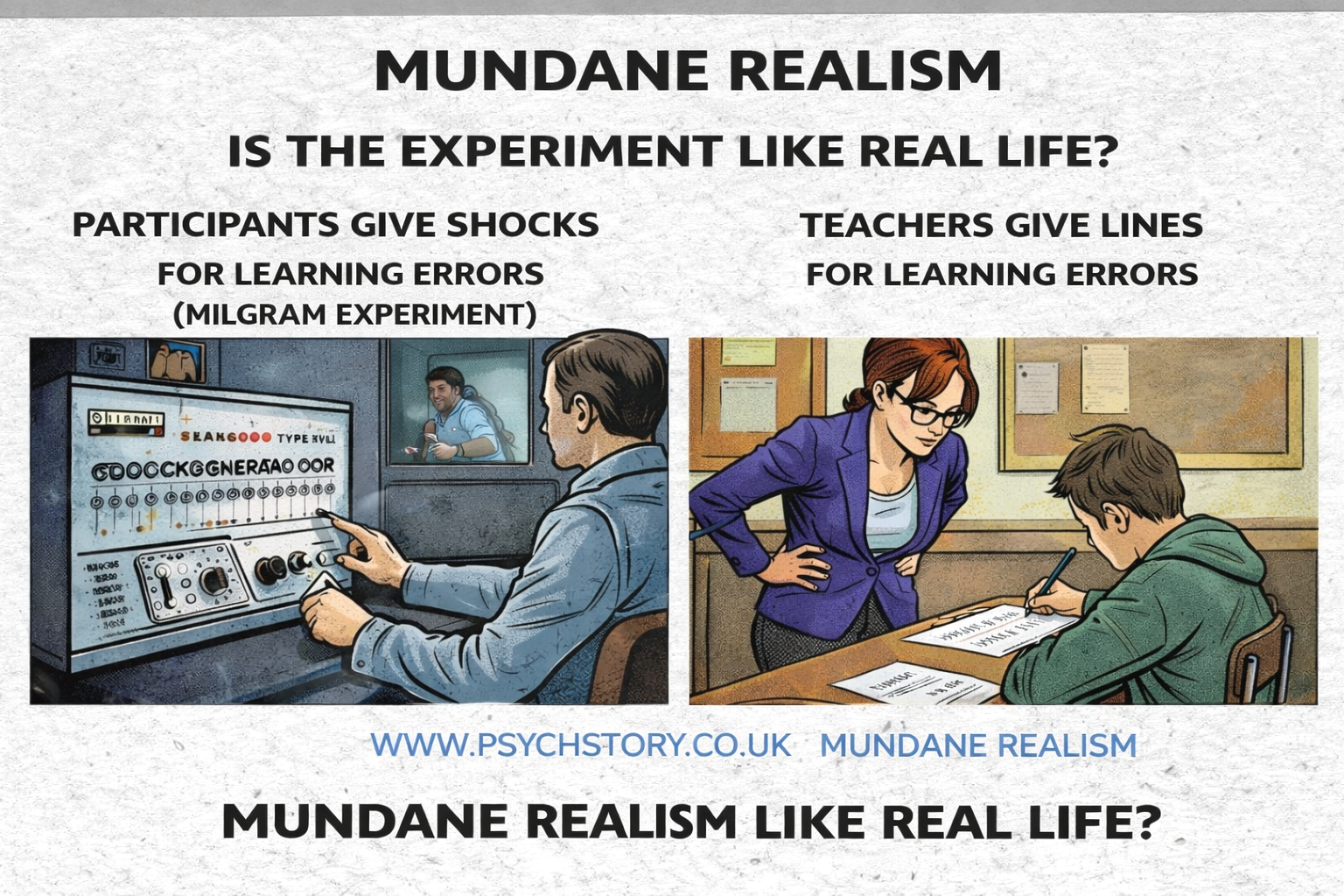
Many other criticisms of Milgram focus on the study’s lack of mundane realism; for example, no one in real life would ever “electric shock” a student for trivial learning errors, so how does the research apply to everyday situations?
Milgram’s counterargument was that it does not matter whether the study has mundane realism if it has ecological validity, i.e., whether the results can be applied to real-life situations people face daily. Milgram is convinced his results could be applied to events in the Holocaust.
Many defenders of Milgram use the Hofling “obedient Nurses” study as an example of how Milgram’s study did have ecological validity because, in real life, the nurses in the Hofling study obeyed telephone instructions from an unknown doctor to over-prescribe an unknown tablet; thus, breaking many cardinal sins of the medical profession.
There are two things wrong with using the Hofling study as evidence for Milgram having ecological validity.
Firstly, when the Hofling study was replicated with a known medicine, the nurses did not over-prescribe the tablets. This shows that previous results were due more to ignorance than blind obedience. If this is the case, then the Hofling study cannot support ecological validity as its internal validity is seriously flawed.
Secondly and more importantly, Milgram was not investigating obedience per se. He didn’t want to know about everyday obedience and/or why people obeyed reasonable orders. He wanted to know if the obedience alibi was true, for example, if ordinary people could obey unjust/evil commands - like the orders that SS soldiers claimed were given to them during the Holocaust. The Hofling study, however, does not, in any way, investigate unjust obedience; it is perplexing that it is so often used to support Milgram’s study.

METHODOLOGICAL ISSUES IN MILGRAM’S RESEARCH
Milgram’s widow donated all of Milgram’s materials (papers, videos, and audio recordings) after his death in 1984. They remained largely untouched for years until Yale’s library staff began to digitise all the materials in the early 2000s. Researchers found some glaring issues with Milgram’s data. Among the accusations were that the supervisors went off script in their prods to the teachers, that some of the volunteers were aware that the setup was a hoax, and that others weren’t debriefed on the whole thing until months later.
In 2012, Australian psychologist Gina Perry investigated Milgram's data and writings and concluded that Milgram had manipulated the results and that there was a "troubling mismatch between (published) descriptions of the experiment and evidence of what actually transpired." She wrote that "only half of the people who undertook the observation fully believed it was real and of those, 66% disobeyed the experimenter" She described her findings as "an unexpected outcome" that "leaves social psychology in a difficult situation as methodologically, there have been many problems with Milgram’s research some psychologists feel that the textbook descriptions of his research need to be re-examined.”
However, in a book review critical of Gina Perry's findings, Russell and Picard take issue with Perry for not mentioning that "there have been well over a score, not just several, replications or slight variations on Milgram’s basic observational procedure, and these have been performed in many different countries, several different settings and using different types of victims. And most, although certainly not all of these experiments have tended to lend weight to Milgram’s original findings, the participants were American.

QUESTIONS ON MILGRAM
Describe how situational variables have been found to affect obedience. Discuss what box these situational variables tell us about why we obey. [16 marks]
It is the end of the school day, and Freddie is pushing other students in the bus queue. “Stop it, will you?” protests one of Freddie’s classmates. “You can’t tell me what to do!” laughs Freddie. At that moment, Freddie turns to see the deputy head, wearing a high-visibility jacket, staring angrily at him. Without thinking, Freddie stops pushing the other boys and waits quietly in line.
Discuss the legitimacy of authority and agentic state explanations of obedience. Refer to Freddie’s behaviour in your answer.
Charlie has just started at a new school. He has become friendly with a group of boys in his year group. Charlie thinks they are ‘cool’. One day, one of the more popular boys in the group suggests they all wear their school jumpers inside-out for a week, ‘just to see what will happen’. Charlie worries about this all night, but still goes to school the following day wearing his jumper inside-out.
Use your knowledge of conformity to explain Charlie’s behaviour. [6 marks]
Later that day, the headteacher called each of the boys in the group to his office one by one, including Charlie. He explains that the school jumper should not be worn inside-out, and that a detention will be given to any boy who disobeys. From then on, each boy wears their jumper correctly.
Use your knowledge of obedience to explain the boys’ behaviour. [6 marks]
Students Natasha and Tanya are buying food in the supermarket on their way home from school. As they are paying, they notice their psychology teacher, Mr Boat, at the far end of the queue. They both smile and wave. Mr Boat shouts, “Hey, you two! I think you owe me homework. Wait there so we can have a quick chat.” Natasha and Tanya finish paying, glance at each other, giggling and hurry out of the supermarket.
Using your knowledge of obedience research, explain possible reasons why the students failed to obey their teacher. [6 marks]