
LABORATORY EXPERIMENTS
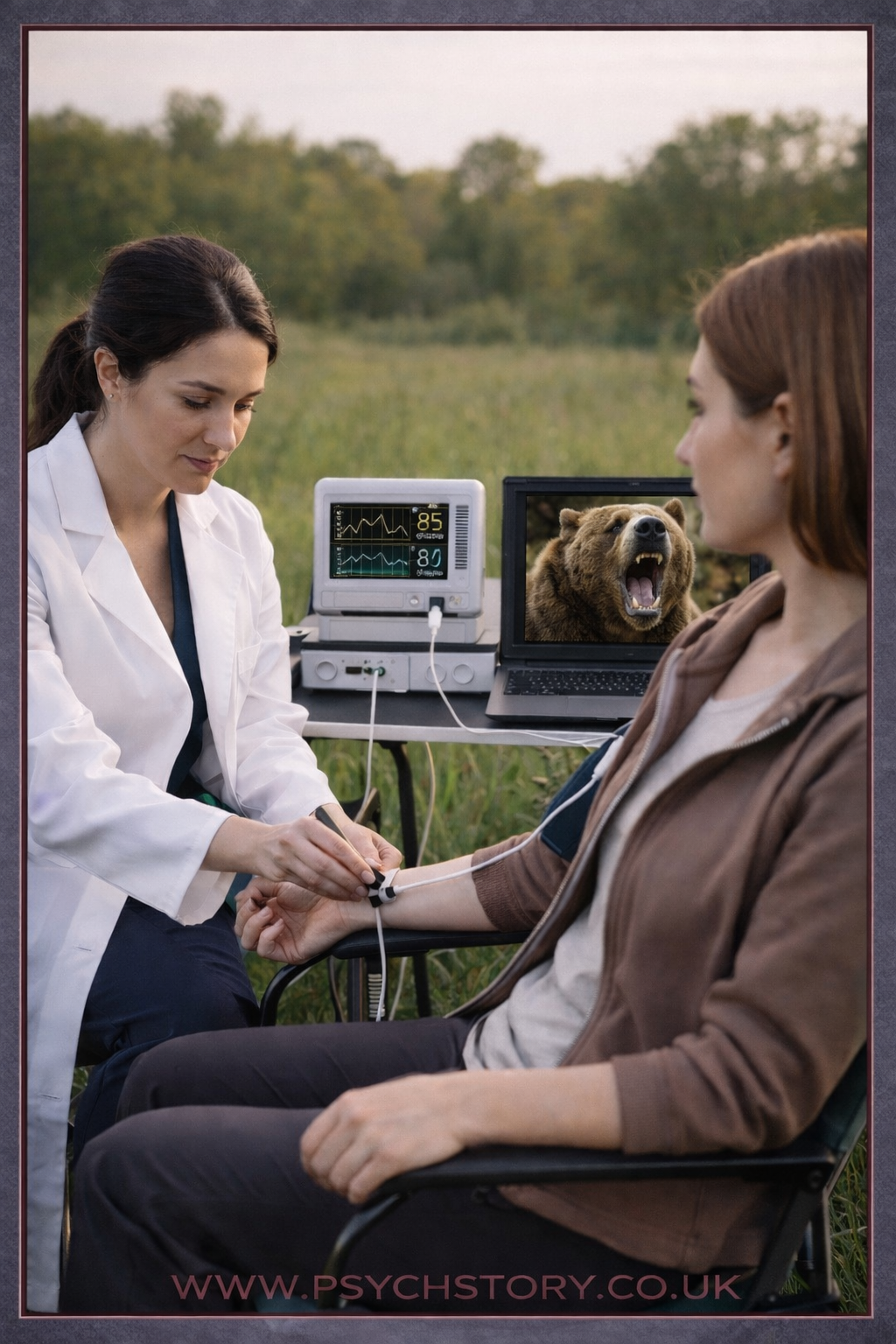
DEFINITION: "A lab experiment is the 'classic' experiment with all four features of a true experiment. Its strength comes from its "lab setting" ‘ which is a controlled environment. A laboratory setting doesn't have to be a laboratory with test tubes and scientific gizmos; it could be conducted in a field. However, any experiment in a special, tightly controlled environment is a laboratory. A laboratory setting is an environment where the researcher controls everything that happens. So if you close your classroom door with a sign outside saying "DO NOT ENTER: EXPERIMENT IN PROGRESS", you've turned your classroom into a psychology lab. Of course, there might still be a fire alarm or another interruption. However, many extraneous variables are ruled out in a lab setting. The hallmark of a lab experiment is that participants are aware of their involvement.
In summary, the Solomon Asch study exemplifies a laboratory experiment in which participants are aware that they are part of an experiment. In contrast, the weapon focus study is a field experiment in which participants' behaviour is observed in a more naturalistic setting without their explicit awareness of being studied.

Laboratory experiments can include animals, as they offer greater opportunities for experimental control than research with humans.
ADVANTAGES OF LABORATORY EXPERIMENTS
Lab experiments offer precise control over variables, minimising extraneous influences and facilitating the establishment of cause-and-effect relationships, which is particularly advantageous in psychology research. For example, in a lab experiment investigating the effects of sleep deprivation on cognitive function, researchers can carefully manipulate the duration and quality of sleep participants receive, allowing for a clear understanding of how sleep affects various aspects of cognition without confounding variables from the external environment, facilitating the establishment of causal relationships. Researchers can meticulously manage all variables, enhancing the ease of replication and bolstering the reliability of study findings. Replication allows researchers to verify the results of a study. When multiple independent studies produce similar results, it increases confidence in the reliability and validity of the findings.
DISADVANTAGES OF LABORATORY EXPERIMENTS
THREATS TO THE EXTERNAL VALIDITY OF LABORATORY EXPERIMENTS
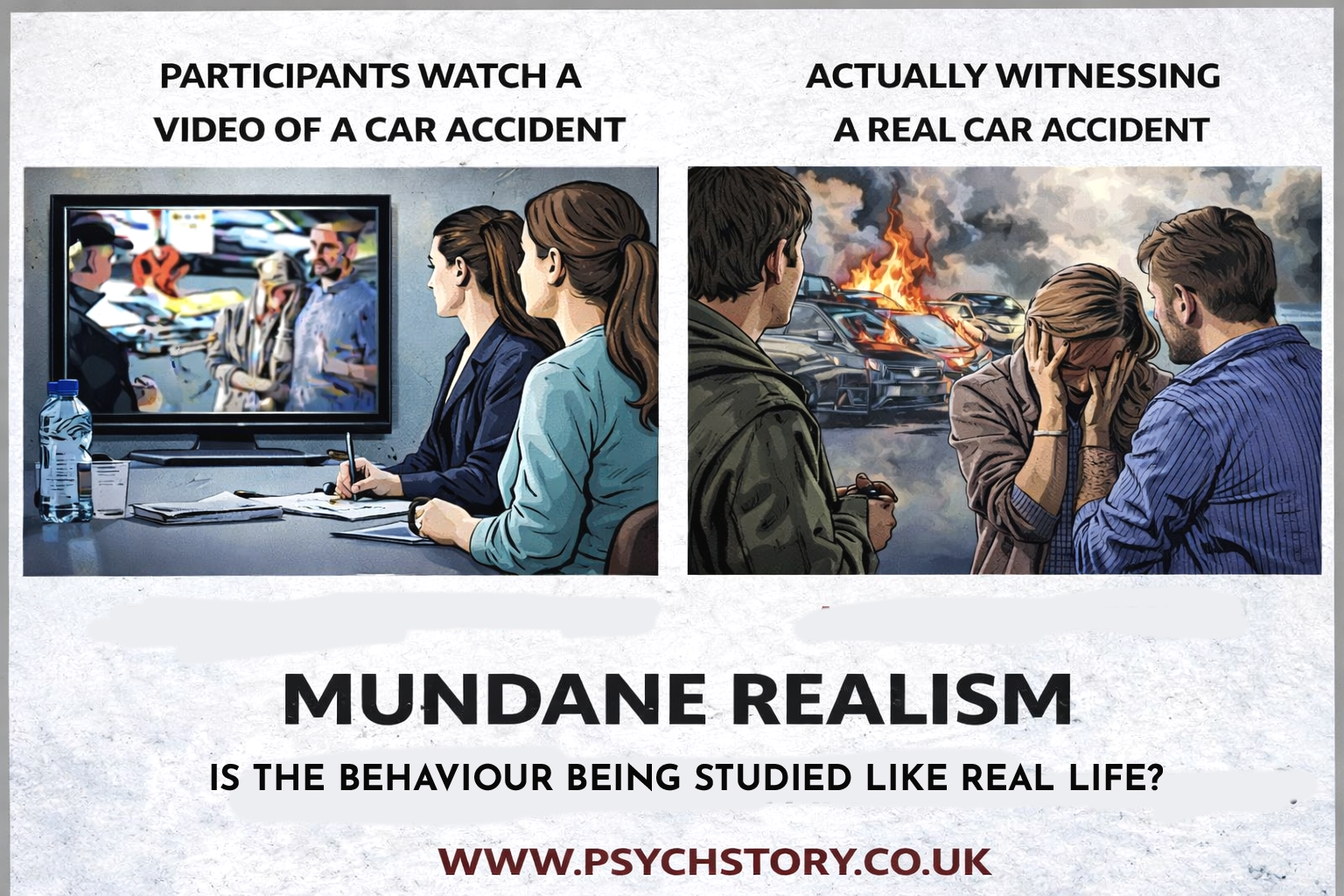
Lab experiments may lack mundane realism, as the controlled environment may not faithfully replicate real-world conditions, potentially compromising ecological validity.
It's essential to recognise the difference between mundane realism and ecological validity in psychological research:
MUNDANE REALSIM
This term refers to the extent to which the conditions in a study resemble real-life situations. An example of mundane realism being questioned is Stanley Milgram's obedience study, in which a teacher would never be asked to administer electric shocks to a student in real life, especially for minor errors. Another example is memory research, such as studies on digit span. Remembering random, nonsensical sequences of digits isn't a common real-life task.

ECOLOGICAL VALIDITY
This concept involves the applicability of a study's results across different environments and settings. Just because a study lacks mundane realism does not mean it can't be applied to real life; it might still have ecological validity. In the digit span example, most people struggle to remember long cell phone numbers, typically exceeding the 7±2-digit span limit identified in the research. This demonstrates the ecological validity of the findings despite the lack of mundane realism in the experimental task.
Ecological validity can be challenging in lab experiments when researchers cannot manipulate the variables they want to investigate. For instance, Stanley Milgram initially sought to explore the dynamics of atrocities like those seen in the Holocaust. However, he couldn't ethically manipulate participants to engage in actual violence. Consequently, he devised the electric shock experiment as a substitute, aiming for its findings to reflect real-world behaviour. Despite the controlled lab environment, Milgram believed his study could provide insights applicable to real-life situations, showcasing ecological validity.
However, Milgram's study lacked both mundane realism and ecological validity. While one of Milgram's variations showed that obedience levels dropped when the learner and the teacher were in the same room, Milgram's study lacked both mundane realism and ecological validity. While one of Milgram's variations showed how obedience levels dropped when the learner and the teacher were in the same room, it did not accurately reflect real-life dynamics. Additionally, the study's applicability to events like the Holocaust was questioned. In real-life scenarios, SS soldiers often shot their victims even when they were nearby, and their obedience to authority persisted even in dire circumstances, which was not adequately captured in Milgram's study.
In conclusion, while a study may lack mundane realism, it can still possess ecological validity and vice versa. Both concepts are integral to understanding the external validity of research, allowing us to apply findings to broader contexts, such as different cultures, locations, populations, and settings.
THREATS TO THE INTERNAL VALIDITY OF LABORATORY EXPERIMENTS
Participant awareness of being in an experiment can trigger demand characteristics, social desirability bias, and the Hawthorne effect, influencing participant behaviour and threatening internal validity.
DEMAND CHARACTERISTICS: These are cues or hints within the experimental context that suggest to participants how they are expected to behave. When participants become aware of these cues, they may alter their behaviour to align with what they believe the experimenter wants or expects rather than behaving naturally. For example, in a lab study investigating the effects of caffeine on cognitive performance, participants who know they are receiving caffeine might consciously try to perform better to confirm the hypothesis.
Demand characteristics might include the following behaviour:
Acting nervously or out of character because they feel they are being evaluated in some way, because they are in an experiment.
Sometimes, if participants are in both conditions, they can guess what the experiment is about and, as a result, behave differently.
Or it could be that they guess what the researcher wants to happen in the experiment and try to please the experimenter, or vice versa!
SOCIAL DESIRABILITY BIAS occurs when participants respond in a way they perceive as socially acceptable or desirable rather than providing honest responses. In lab experiments, participants may modify their behaviour or responses to avoid judgment or to present themselves in a favourable light. For instance, in a lab study examining attitudes towards recycling, participants might overstate their commitment to recycling if they believe it is socially desirable, even if their behaviour differs.
THE HAWTHORNE EFFECT: This phenomenon refers to changes in behaviour that occur simply because of being observed or participating in an experiment rather than the experimental manipulation itself. When participants are aware of being studied, they may alter their behaviour, consciously or unconsciously, to conform to what they believe the experimenter expects. For example, workers in a factory may increase their productivity during a lab study simply because they know they are being observed, regardless of any changes in their working conditions.
INVESTIGATOR EFFECTS refer to the unintentional influence that experimenters or researchers may have on the behaviour or responses of participants in a study. This influence can occur through various means, such as subtle cues, body language, or unintentional biases conveyed by the experimenter during the experiment. For example, suppose an experimenter inadvertently expresses enthusiasm or approval when participants provide certain responses or behaviours. In that case, it may subtly encourage participants to continue or repeat those behaviours, basing the study's results. In a lab experiment investigating the effects of praise on task performance, an investigator effect may occur if the experimenter's tone of voice or facial expressions unintentionally convey approval or encouragement to participants who receive praise, leading them to perform better on the task. Similarly, if an experimenter shows disinterest or scepticism when participants provide certain responses, this may inadvertently discourage those responses, affecting the study's overall outcomes.
EXPERIMENTER BIAS
When the researcher’s expectations about the study affect the results, they may indirectly or unconsciously indicate how they want the results to be.
They may give leading behaviour or questions.
They may also be biased in assessing someone’s behaviour—seeing what they want to see, as it supports their hypothesis.
ETHICS: Ethical considerations in lab experiments encompass standard principles such as participant confidentiality, informed consent, and minimising psychological or physical harm. Unlike field experiments, ethical concerns are typically less pronounced in lab settings since participants are aware of their participation, making obtaining informed consent and managing deception less problematic.
EXAMPLES:
Milgram's Obedience Study: The experiment took place in a Yale University laboratory. The controlled environment allowed Milgram to systematically manipulate variables, such as the proximity of the authority figure and the presence of peers, to observe their effects on participants' behaviour. The tightly controlled conditions facilitated the replication of the study, enhancing its reliability.
Asch Conformity Experiment: Asch conducted the experiment in a laboratory setting where participants were seated around a table, with the experimenter and confederates present. The controlled setting of the lab enabled Asch to manipulate the independent variable (social pressure) precisely and to measure participants' responses to it. This controlled environment allowed for the systematic investigation of conformity under varying conditions.
Zimbardo's Stanford Prison Experiment: Although Zimbardo's study is often called a "field experiment," it occurred in a simulated prison environment within the confines of Stanford University's psychology department. The laboratory-like setting allowed Zimbardo to control various aspects of the experiment, such as selecting and assigning participants to roles, establishing rules and procedures within the simulated prison, and monitoring participant behaviour. While the setting resembled a real-world scenario, the experiment retained the characteristics of a controlled laboratory study, albeit with ethical concerns about participants' well-being.