
CASE STUDIES
SPECIFICATION: Case Studies
NON-EXPERIMENTAL METHODS IN PSYCHOLOGY
CASE STUDY IN PSYCHOLOGY
DEFINITION
A case study is a research method in psychology that investigates a particular individual, group, or situation in depth. It involves a detailed analysis of the subject, gathering information from various sources such as interviews, observations, and documents. Researchers aim to understand the complexities and nuances of the subject, exploring thoughts, feelings, behaviours, and experiences to gain insights into specific psychological phenomena.
Case studies are particularly valuable for examining rare or unique situations that may not be easily replicated in a laboratory setting. For example, the case study of Genie Wiley focused on her development following extreme social isolation, offering insights into the effects of neglect on language acquisition and cognitive growth. By analysing individual cases, researchers can generate hypotheses, develop theories, and contribute to the existing body of knowledge in psychology. This type of research provides a holistic view of the subject by considering various factors influencing behaviour or mental processes. For instance, Goffman’s study of asylums examined not only patients' experiences but also institutional culture and its psychological impact. Case studies are often utilised in clinical psychology, where they can provide valuable insights into the diagnosis, treatment, and outcomes of specific psychological disorders.
Case studies are not limited to single observations; they often involve longitudinal tracking, allowing researchers to observe changes over time. For example, HM (Henry Molaison) was studied for decades to understand the role of the hippocampus in memory formation. These studies can also involve cross-case research, comparing multiple cases to identify patterns, or within-case research, focusing exclusively on a single case.
A strength of case studies is their ability to provide detailed, in-depth information, enabling researchers to examine psychological phenomena in real-world contexts. This approach is particularly useful for exploring complex, multifaceted issues. For instance, John Money’s study of David Reimer, though controversial, explored the psychological impact of gender reassignment in infancy, highlighting the interplay between biology, identity, and upbringing.
However, case studies are not limited to clinical contexts; they can explore organisational settings, belief systems, or specific events. Yin’s comparative organisational case studies, for example, identified patterns in successful management practices across businesses.
By examining individual cases, researchers can inform theory, practice, and future research. The information gathered can serve as a foundation for more extensive investigations or inspire novel approaches to psychological questions. While case studies often focus on rare or exceptional phenomena, they can also contribute to understanding broader psychological principles.
BULLET SUMMARY OF CASE STUDIES
Definition and scope: Case studies analyse an individual, group, or situation in depth, using data from multiple sources like interviews, observations, and documents.
Example: Genie Wiley's case provided insights into language and cognitive development following social isolation.
Purpose: To understand the complexities and nuances of thoughts, feelings, behaviours, and experiences, often focusing on unique or rare phenomena.
Example: HM’s case revealed the hippocampus's role in memory formation.
Holistic view: Case studies consider multiple factors that influence behaviour or mental processes, thereby offering a comprehensive understanding.
Example: Goffman’s study of asylums examined the psychological impact of institutional culture.
Value in clinical psychology: Case studies provide insights into diagnosis, treatment, and outcomes for specific psychological disorders.
Example: Studies on PTSD treatment outcomes in unique trauma cases.
Longitudinal and cross-case research: Case studies often track changes over time (longitudinal) or compare multiple cases to identify patterns (cross-case).
Example: Yin’s organisational research compared management practices across companies.
Theory and hypothesis generation: Case studies serve as a foundation for developing theories or hypotheses and inspire future research.
Example: John Money’s study of David Reimer contributed to understanding gender identity development
EXAMPLES: Clive Wearing, HM, KF, S, Genie Wiley, Czech twins, Anna O, Little Albert, Little Hans, Phineas Gage, Louis Leborgne, Charles Whitman.
ADVANTAGES OF CASE STUDIES IN PSYCHOLOGY
They provide a wide variety of in-depth, detailed information that would be impossible to obtain under tightly controlled conditions, such as experiments (idiographic). They can provide a realistic sense of suffering from a particular disorder or of being involved in a certain situation.
Allows detailed investigation into situations. They often provide the only feasible way to study a particular condition or event. It would not be possible to re-create situations such as the Genie or HM experimentally artificially, so our only access to information about privation or severe amnesia is through case studies.
A strength of the case study approach is that it provides an opportunity to uncover rich, detailed information about a situation. These unique insights are often overlooked when only one variable is manipulated to assess its effect on another. Further, case studies can be used in circumstances that would not be ethical to examine experimentally.
DISADVANTAGES OF CASE STUDIES IN PSYCHOLOGY
Often, case studies require retrospective data collection, with parents, friends, and other informants asked to recall participants’ earlier years. Retrospective data collection is not reliable.
Objectivity and researcher bias can be difficult, with psychologists getting too close to patients, as in the case of David Rigler and Jean Butler and their research/fostering of Genie.
Confidentiality may be an issue; however, this can be addressed by using pseudonyms or initials.
There are methodological issues associated with case studies. By studying only one individual, an isolated event, or a small group of people, it isn't easy to generalise findings to the broader population, as results are likely unique. Therefore, this creates issues with external validity, as psychologists cannot confidently conclude that anyone beyond the ‘case’ will behave in the same way under similar circumstances, thereby reducing population validity. Case studies, by their very nature, are one-offs or unusual and often involve people who are not themselves representative of the general population. The cases of Genie and the Czech twins illustrate this clearly. Both suffered severe deprivation over a prolonged period, but their outcomes are very different; the Czech twins seemed to make a full recovery, whereas, as far as we know, Genie never recovered from her early problems.
An issue in case studies, particularly where qualitative methods are used, is that the researcher’s subjectivity may pose a problem. For example, in the case study of Little Hans, Freud developed a comprehensive theory based on his observations. No scientific or experimental evidence from his case study supported his suggestions. A significant problem with his research is that we cannot be certain that he reported his findings objectively. Consequently, a significant limitation of case studies is that research bias and subjectivity can interfere with the validity of the findings/conclusions.
CASE STUDIES DON’T SHOW CAUSE-AND-EFFECT RELATIONSHIPS
Phineas Gage: We can’t assume that all individuals will suffer the same cognitive deficits after frontal lobe injury as Phineas Gage did.
Genie - We can’t assume all privated babies will behave like Genie.
David Reimer Twins - We can’t assume that all individuals will reject the gender they were not assigned at birth.
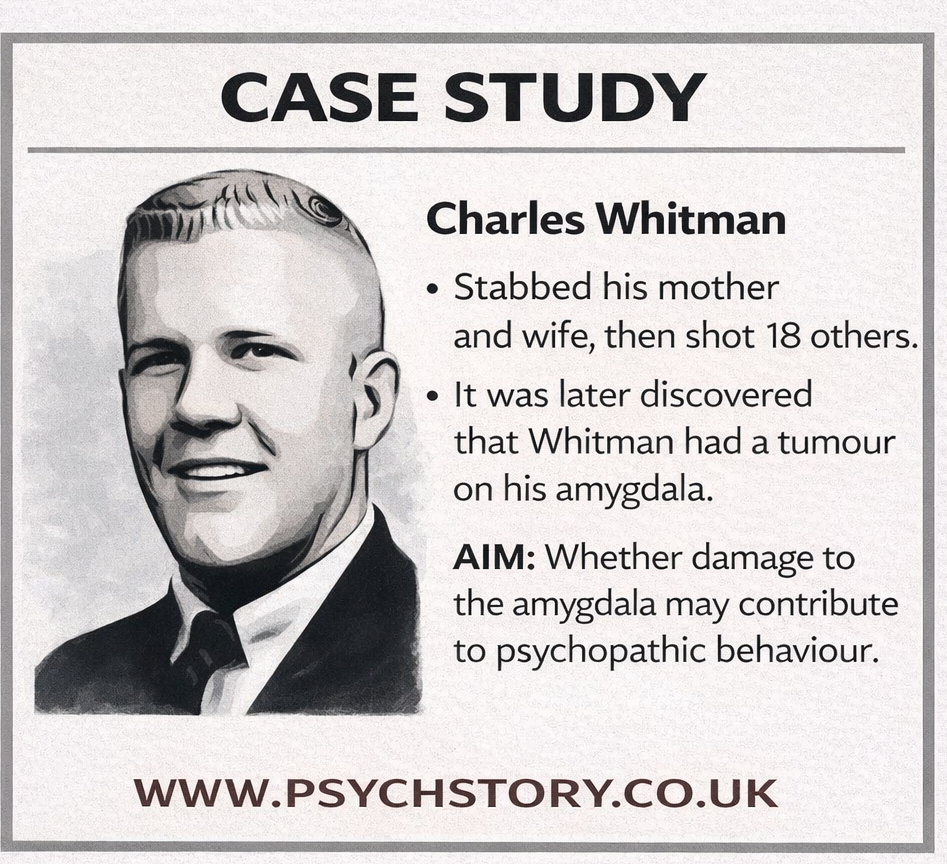
Charles Witman - We can’t assume that all individuals with tumours on the amygdala will go on a psychopathic killing spree.
Paul Leborgne - We can’t assume all individuals will lose speech if they damage the left frontal lobe.
CASE STUDY QUESTIONS
1. Researchers often use various techniques to gather information in case studies of individuals, institutions or events. Suggest one technique which the psychologist could use in a case study. (1 mark) Exam Hint: Referring to the use of meta‐analysis here would not be appropriate: be specific and name an
experimental or non‐experimental research method (e.g. interview).
2. Define the key term ‘case study’. (2 marks)
Exam Hint: Better answers will note that a case study is an in-depth investigation of a single person, typically over time, using various methods to collect data. Students can also illustrate their answers with relevant examples, such as Freud’s case study of Little Hans.
3. Explain one limitation of using a case study as a method of investigation. (2 marks)
Exam Hint: Most students will explain a lack of population validity here: since a case study concerns a single person, it is difficult to generalise the results to the broader population, as they may not behave in the same way.
Explain one strength of using a case study methodology in psychology. (3 marks)
Scarlett has an incredible memory. She can see a pack of playing cards only once and then recall the order correctly. A psychologist sought to investigate this phenomenon further by examining Scarlett's remarkable memory across different situations and contexts.
The scenario illustrated above exemplifies a case study methodology. Explain one strength and
one weakness of this research method. (4 marks)
Exam Hint: For this question, there is one mark each for identifying one appropriate strength and one appropriate weakness, and the third and fourth marks come from suitable elaboration of these points. For example, a strength of using a case study to examine memory is that the data gathered will be rich in detail, providing unique insight into Scarlett's case and her memory.
6. Evaluate the use of case studies in psychological research. Refer to the evidence in your answer. (6 marks)
QUESTIONS ON CLIVE WEARING, H.M., and K.F.
Instructions: For each of the three case studies (Clive Wearing, H.M., and K.F.), answer the following ten questions. Research the terms anterograde amnesia and retrograde amnesia to help you answer some of the questions.
Background Information
What caused the memory impairment in each case study (e.g., illness, injury, surgery)?
What were the main symptoms experienced by each individual?
Memory Processes
How was short-term memory (STM) affected in each case?
How was long-term memory (LTM) affected in each case?
Which types of LTM (e.g., episodic, semantic, procedural) were preserved or impaired?
Types of Amnesia
Define anterograde amnesia and retrograde amnesia.
For each case study, identify whether the individual experienced anterograde amnesia, retrograde amnesia, or both. Provide examples to support your answer.
Impact on Daily Life
How did the memory impairments affect the daily lives of Clive Wearing, H.M., and K.F.?
Insights into Memory
What does each case study reveal about the different types of memory (e.g., STM vs. LTM, or different types of LTM such as procedural memory)?
Advantages of Case Studies
What unique insights did each case study provide about memory that could not have been gained from laboratory experiments or other research methods?
Limitations of Case Studies
What are the main limitations of using case studies like these for understanding memory?
Ethical Considerations
What ethical issues might arise when working with individuals like Clive Wearing, H.M., and K.F. in psychological research?
Comparing Cases
Compare and contrast the memory impairments in the three case studies. How are they similar, and how are they different?
Applications of Findings
How might the findings from these case studies be applied to help individuals with memory impairments today?
This set of questions will guide students in exploring the key aspects of each case while also developing an understanding of broader concepts, such as types of amnesia, memory systems, and the strengths and limitations of case studies in psychological research.