
THE SOCIAL CONSTRUCTION OF MADNESS
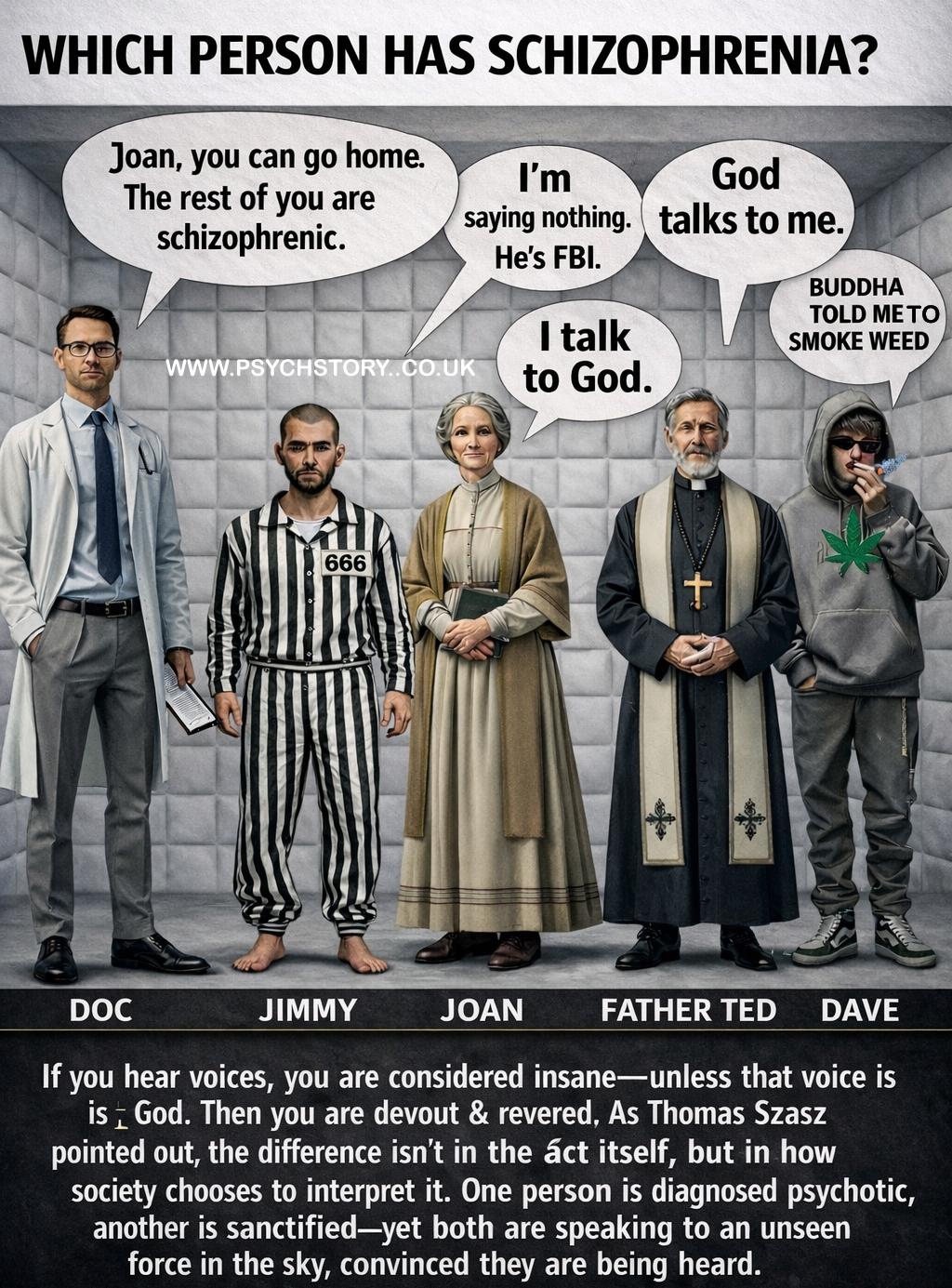
If you observed me sitting alone, quietly muttering to myself, you would probably conclude that I was unwell. But if you then noticed my hands were clasped and my eyes closed, you would just as readily decide I was praying.
Should I confess to hearing voices, the diagnosis might be schizophrenia—unless I describe that voice as God. In that case, the response is likely to be one of respect, even reverence.
As Thomas Szasz observed, the difference lies not in the experience itself, but in the social interpretation placed upon it. One individual is labelled psychotic; another is regarded as devout. Both are addressing an unseen presence, convinced of being heard.
Szasz maintained that the boundary is not clinical but cultural. Society determines which convictions are to be deemed sacred and which are to be treated as symptoms of mental disorder. One set of beliefs is institutionalised as illness; another is consecrated as faith—not on the basis of evidence, but according to prevailing norms and social convention.
What, then, separates the prophet from the patient? Is it the content of the belief, the state of the mind, or merely the degree of collective sanction?
#ThomasSzasz #Schizophrenia #SocialConstructionism #SanityAndMadness #Hallucinations