COLLECTIVE LEARNING, MAGIC AND RELIGION
If I have seen further, it is by standing on the shoulders of giants.”
Early humans had no knowledge about the world because none of it existed at the start of humanity. What is known today took hundreds of thousands of years to accumulate. “Standing on the shoulders of giants” simply means using ideas developed by earlier thinkers to move understanding further.
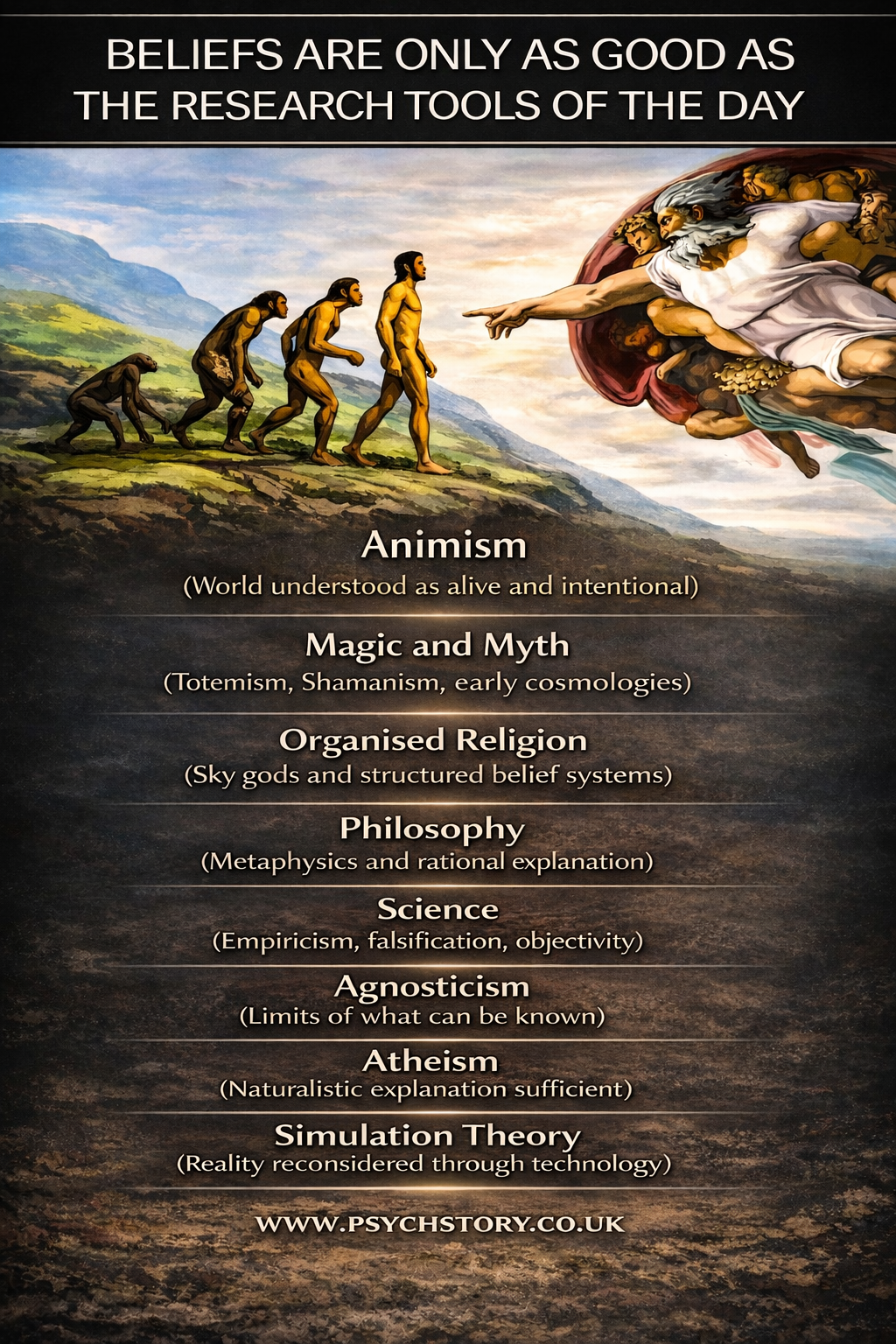
Collective learning is the uniquely human ability to share, preserve and build knowledge across generations. Every book read, lesson taught, or documentary watched depends on this accumulated inheritance. The history of science is not a series of sudden breakthroughs but a gradual stacking of ideas over time. At the beginning of human existence there were no shared explanations about reality or existence. So early theories about existence were based on magic and superstition.
As societies grew and knowledge increased, organised religions and sky gods emerged, providing structure and large scale explanations about life and death.
Religion therefore represents a stage in collective learning rather than a break from it. It was an attempt to systemise understanding using the best knowledge available at the time. As shared knowledge continued to grow, new ways of explaining reality appeared, each shaped by the intellectual tools humanity had accumulated up to that point.
Alongside religion , philosophy shifted attention toward reasoning itself, questioning how previous ideas withstood logic.
As tools and knowledge progressed, science introduced hypothesis testing and falsification. Ideas now survived only if they matched observation.
As scientific knowledge expanded, explanations increasingly relied on natural causes rather than supernatural ones. For some, this led to agnosticism, the position that certain ultimate questions may be unknowable. For others, atheism followed as the universe appeared explainable without reference to gods.
oday, explanations continue to reflect the tools of the age. In a world shaped by computers and artificial systems, some theories now imagine reality itself as a simulation. The framework changes, but the pattern remains the same: humans interpret the unknown using the most advanced concepts available to them at the time.