
DEMALE STEREOTYPES THOUGH TIME
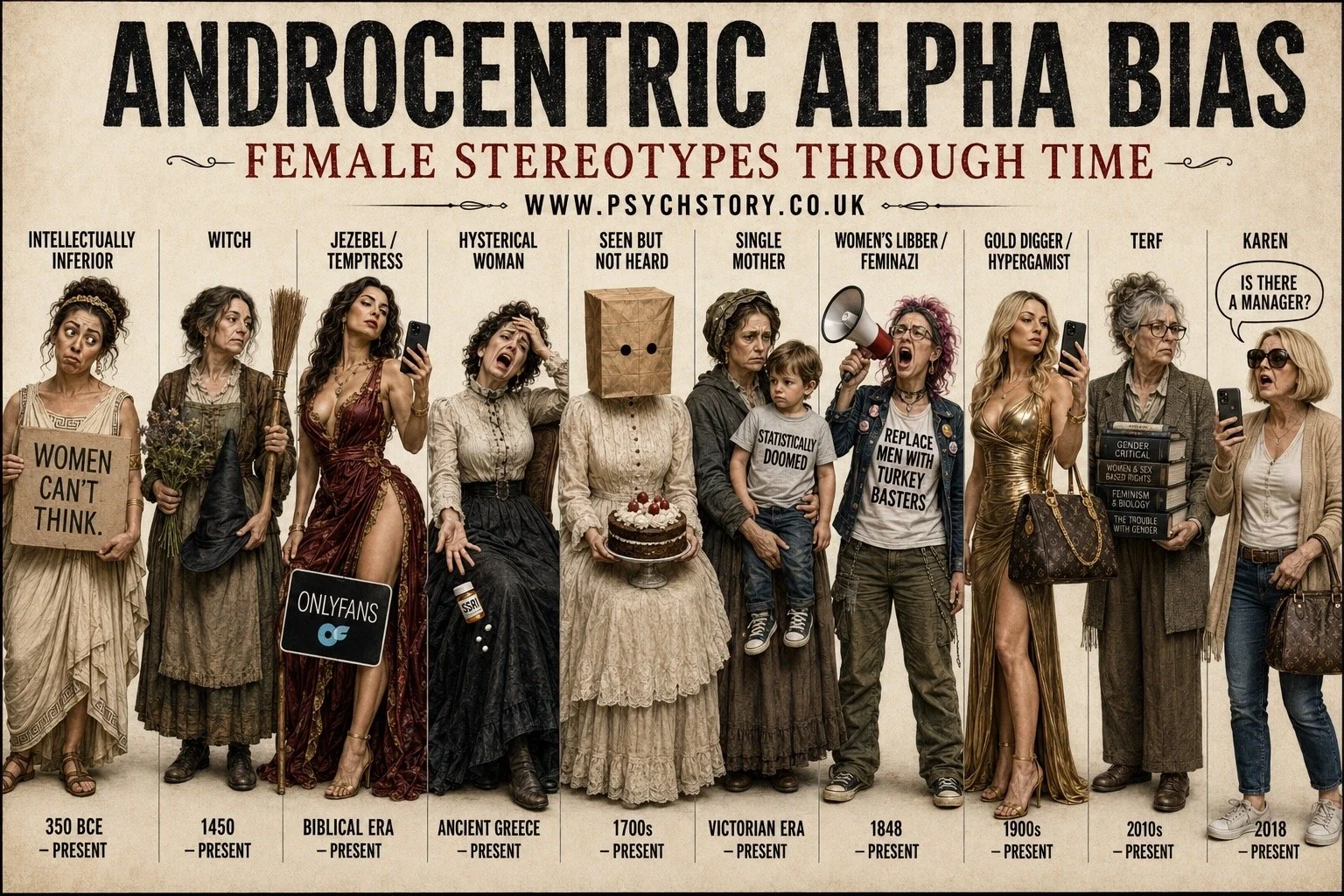
ANDROCENTRIC ALPHA BIAS THROUGH THE AGES
Androcentric alpha bias occurs when men are treated as the standard against which women are judged, whilst differences between the sexes are exaggerated.
Historically, this often led to a peculiar form of reasoning. Once women were assumed to be fundamentally different from men, it became possible to attribute to them uniquely female strengths, weaknesses, virtues and vices.
This way of thinking has appeared repeatedly throughout history. Aristotle regarded women as less rational than men. Nineteenth century scientists measured skulls in an attempt to demonstrate female intellectual inferiority. Physicians attributed women's distress to hysteria. Religious authorities associated female sexuality with temptation, impurity and moral danger.
The psychological significance is that once a biological sex is viewed as fundamentally different, it can begin to be viewed as a monolith. There are more similarities between the biological sexes than differences. These differences can be influenced by early environment and developmental plasticity, for example girls using spears in the Amazon, or by hormone exposure, such as males with unusually low testosterone or females with unusually high testosterone. Biological sex therefore contains enormous variation, even if recognisable clusters of behaviour do exist. Yet alpha bias encourages us to overlook that variation and treat individuals as representatives of a category before judging them as individuals. Behaviour is interpreted through assumptions about what men and women are supposedly like, rather than through the circumstances in which that behaviour occurs.
This matters because behaviour shaped by social conditions can be mistaken for evidence of innate sex differences. For much of history, women had limited access to education, wealth, political power and professional achievement. Success could often only be expressed indirectly through marriage and family. Under such conditions, seeking a wealthy husband may have been a rational route to security, status and influence. Yet this behaviour was frequently interpreted as evidence that all women were naturally hypergamous, materialistic or dependent. The social constraint disappeared from the explanation and only the stereotype remained.
The result is not merely a collection of stereotypes, but a framework through which behaviour itself is interpreted.