THE RUSSIAN REVOLUTION
The Russian Revolution Explained: World History Review - YouTube
The Bolsheviks KS3 | Y9 History Lesson Resources | Oak National Academy
Tsarist methods of control - state infrastructure - Imperial Russia - Government and people - National 5 History Revision - BBC Bitesize
What was the Russian revolution? - BBC Newsround
Russian Revolution - Kids | Britannica Kids | Homework Help
8606926086CE65F25294960E79ACA132.pdf
KEY WORDS
ABDICATE
To abdicate means to give up the throne or step down from power voluntarily. In 1917, Tsar Nicholas II abdicated after protests, riots, and unrest spread across Russia.
AUTOCRACY
An autocracy is a system of government where one ruler has almost complete power. In Tsarist Russia, the Tsar could make major decisions without needing the approval of ordinary people or parliament.
BOLSHEVIKS
The Bolsheviks were a revolutionary political group led by Vladimir Lenin. They believed Russia needed a revolution to remove the Tsar and replace the old system with a socialist government that claimed to represent workers and peasants.
BOURGEOISIE
The bourgeoisie were the wealthy people in society who owned factories, businesses, land, and industry. Because they owned the means of production, they made profits from the labour of workers. Karl Marx believed the bourgeoisie had too much wealth and power while ordinary workers remained poor.
CAPITALISM
Capitalism is an economic system where businesses, factories, and trade are privately owned in order to make profit. Marx believed capitalism created inequality because wealthy owners became richer while workers often remained poor and exploited.
CIVIL WAR
A civil war is a war fought between groups within the same country. After the Russian Revolution, a civil war broke out between the Bolsheviks and their opponents.
CLASS STRUGGLE
Class struggle means conflict between social classes, especially between wealthy owners and workers. Marx believed society was full of tension because workers wanted better pay and conditions, while owners wanted larger profits.
COMMUNISM
Communism is a political and economic system where factories, land, and businesses are shared collectively rather than privately owned. Marx believed communism would create a fairer society without huge differences between rich and poor.
DICTATORSHIP
A dictatorship is a system where one person or political group holds power and limits opposition, freedom, or democracy.
EXPLOITATION
Exploitation means treating workers unfairly by paying them less than the value of the work they produce. Marx believed capitalism depended on the exploitation of workers.
IDEOLOGY
An ideology is a set of political beliefs and ideas about how society should be organised and governed.
INDUSTRIALISATION
Industrialisation is the process of developing factories, machinery, and large scale manufacturing industries. During industrialisation, more people move to towns and cities to work in factories.
INEQUALITY
Inequality means unfair differences in wealth, power, rights, or opportunities between groups in society.
LABOUR
Labour means the physical or mental work people do in exchange for wages or payment.
LENIN
Lenin was the leader of the Bolsheviks and one of the most important figures in the Russian Revolution. He adapted Marx’s ideas to Russia and helped the Bolsheviks seize power in 1917.
MARXISM
Marxism refers to the political and economic ideas developed by Karl Marx. Marxism focuses on class struggle, inequality, capitalism, and the belief that workers would eventually overthrow the ruling classes.
MEANS OF PRODUCTION
The means of production are the factories, land, railways, farms, machinery, and businesses used to produce goods and wealth. Marx believed whoever owned the means of production held the real power in society.
PEASANTS
Peasants were poor farmers who worked on land owned by others. Most people in Russia at the beginning of the twentieth century were peasants and lived in poverty.
PROPAGANDA
Propaganda is information, posters, speeches, newspapers, or media designed to persuade people to support a political idea, leader, or government.
PROLETARIAT / WORKING CLASS
The proletariat, also called the working class, were ordinary workers who did not own factories, businesses, or large amounts of land. They had to work for wages in order to survive. Marx believed the proletariat were exploited because they produced wealth through their labour but remained poor themselves.
PROVISIONAL GOVERNMENT
The Provisional Government was the temporary government that ruled Russia after the Tsar abdicated in 1917 but before the Bolsheviks seized power later that year.
RED ARMY
The Red Army was the Bolshevik army led by Leon Trotsky during the Russian Civil War.
REFORM
A reform is a change made to improve a political or social system without completely overthrowing it.
REVOLUTION
A revolution is when people overthrow a government or political system and replace it with a new one. Revolutions often involve protests, violence, and major social change.
RULING CLASS
The ruling class are the people in society who hold the most wealth, political power, and influence.
SOCIALISM
Socialism is a system where the government or the people have greater control over industry, wealth, and resources in order to reduce inequality and create a fairer society.
SOVIET
Originally, a soviet was a council of workers or soldiers in Russia. Later, the word became strongly connected with communist government in the Soviet Union.
STRIKE
A strike is when workers refuse to work until demands for better pay, conditions, or treatment are met.
TSAR
The Tsar was the ruler of Russia before 1917. The Tsar had enormous political power and ruled like an emperor.
TSARIST RUSSIA
Tsarist Russia refers to Russia under the rule of the Tsars before the Russian Revolution of 1917.
THE SCENARIO
You’re a 16–17-year-old factory worker living and working in Thamesmead, London 2026.
You live in a cramped, tiny bedsit room with your entire family – think mouldy walls, no heating or hot water, sharing one stinky toilet bathroom with the 35+ people who live in other rooms in the house. You, and your father are the sole breadwinners for the entire family. In total there are niner family members.
You and your other family members, sleep on a few mattress on the floor. There is no Wi-Fi, o0r television, no computers or play station, and no stereo. . The kitchen is a cupboard and a kettle in the corner. In winter, it’s freezing; in summer, boiling. Bugs, damp smells, zero privacy, from your Mum, Dad, and six siblings. There are constant arguments over noise and bathroom usage with the other people who live in the building. Sometimes the disputes have ended violently because everybody is stressed.
Everyday, you drag yourself out of bed and walk four miles to a dilapidated building known as the “glue factory”. You work 17-hour shifts with no real breaks, usually 6–7 days a week because you desperately need the money). The boss is a psychopath, your colleagues are hostile, and you endure heavy lifting and standing all day. At the end of the day your feet are blistered and bleeding.
As you are only 16, your pay is a pathetic £2 an hour after tax (well below minimum wage ) – that’s £34 per day for a 17 hour day and £204 for a full brutal 6 day week. This does not cover your contribution for food, bus fare, heating and electricity, never mind luxuries like mobile phones or clothes . You have no savings, no fun, you are always stressed about the next bill.
YOUR FAMILY’S OUTGOING COSTS
Room Rent £600
Electricity and gas £300
Council tax £200
Food £150 ( you cant afford proper food and live off bread and potatoes, rice and milk).
Meanwhile, your boss, the super-rich owner/CEO of the chain of glue factories, chills in a massive luxury mansion: infinity pool, home cinema with massive TV, speedboat docked outside, private gym, helicopter pad, endless parties with influencers, designer everything, He never worries about money or the cold. Him and his family post yacht selfies while you’re exhausted on the night bus home.
QUESTIONS
1) What would YOU do in this situation right now? Circle one (or write your own):
A) Take it quietly – keep grinding, hope for a better job one day. (Scared of losing what little you have.)
B) Go on strike – stop working with your co-workers to demand fair pay (£15+ min wage), shorter shifts, and breaks. (Risky – could get sacked, but might force change.)
C) Join a peaceful protest/march to the company HQ or government – hold signs, post on TikTok, ask nicely for help. (Like Father Gapon’s march.)
D) Revolt fully – try to change the whole system, maybe push for big reforms or even overthrow unfair bosses/rich elites. (Super dangerous, but ends the inequality?)
E) Something else?
2) Write about the answer you chose and why. (6 marks)
3) How does your answer compare to the events of the Russian revolution
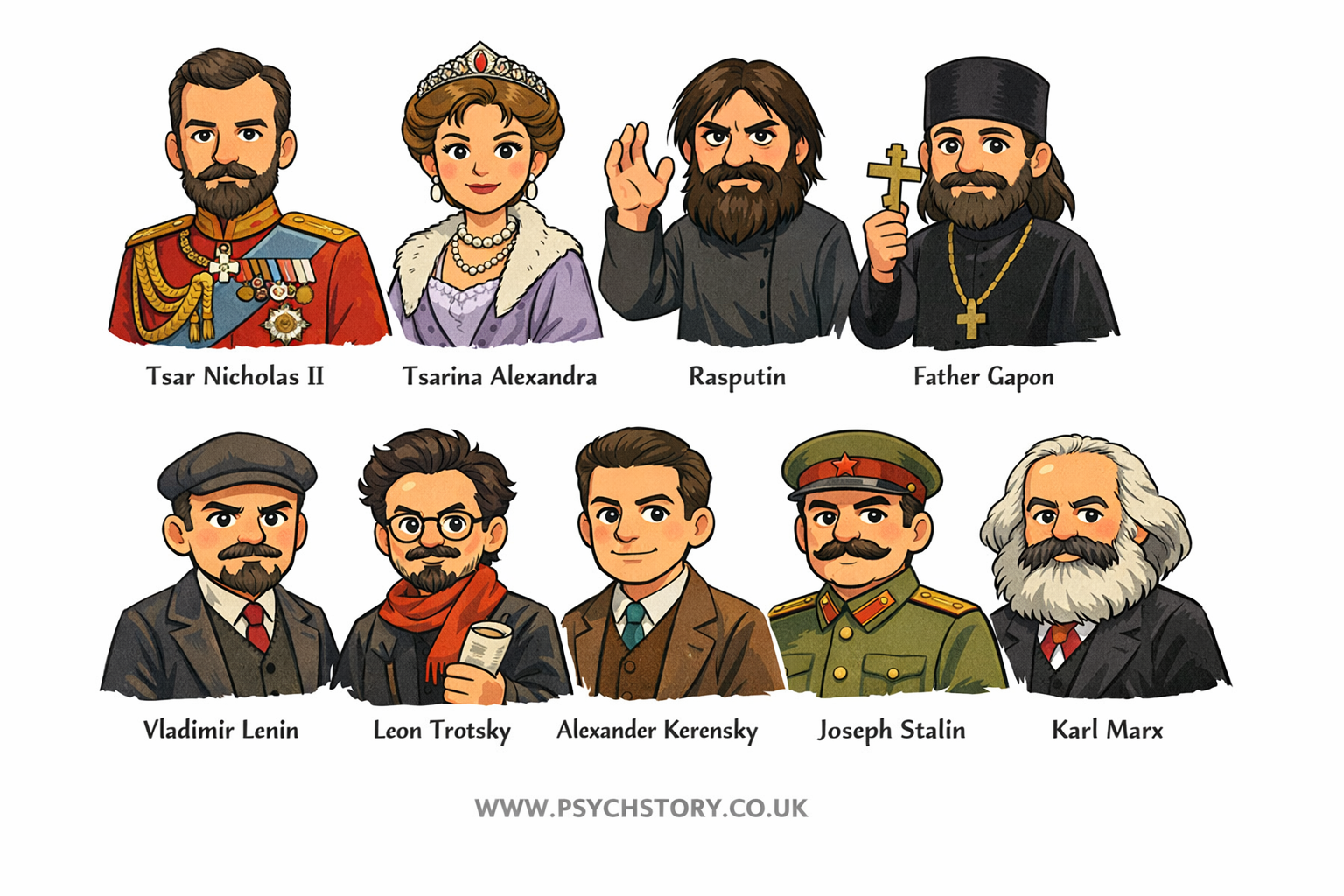
MAIN CHARACTERS IN DETAIL
FATHER GEORGY GAPON (1870 to 1906)
Position: Russian Orthodox priest
Father Gapon organised a peaceful march of workers to the Winter Palace in January 1905. The workers wanted better wages, shorter working hours, and political reform.
They carried religious icons and portraits of the Tsar because they believed he would help them.
Soldiers fired on the crowd. Hundreds were killed or injured. This event became known as Bloody Sunday.
Why he matters:
Bloody Sunday destroyed many people’s trust in the Tsar and triggered the 1905 Revolution.
GRIGORI RASPUTIN (1869 to 1916)
Position: Religious mystic
Rasputin was a Siberian peasant who became close to the royal family. He appeared able to ease the symptoms of haemophilia suffered by the Tsar’s son, Alexei.
Because of this, Tsarina Alexandra trusted him deeply. Rasputin influenced ministerial appointments during the First World War.
He was widely disliked by nobles and politicians. In 1916, aristocrats murdered him.
Why he matters:
His influence made the monarchy look corrupt and weakened public confidence in the government.
VLADIMIR LENIN (1870 to 1924)
Full name: Vladimir Ilyich Ulyanov
Position: Leader of the Bolsheviks
Lenin was a revolutionary who followed the ideas of Karl Marx. He believed workers should overthrow the existing system and create a socialist state.
He spent many years in exile. He returned to Russia in April 1917.
He promised “Peace, Bread, Land.”
Peace meant leaving the war.
Bread meant solving food shortages.
Land meant giving peasants land from wealthy landowners.
In October 1917, the Bolsheviks seized power in Petrograd.
Why he matters:
He led the October Revolution and became the first leader of the Soviet state.
LEON TROTSKY (1879 to 1940)
Position: Revolutionary leader and military organiser
Trotsky joined the Bolsheviks in 1917. He helped organise the October takeover.
During the Russian Civil War, he created and led the Red Army. He introduced strict discipline and used experienced officers to train soldiers.
Why he matters:
Without Trotsky’s military leadership, the Bolsheviks might have lost the Civil War.
ALEXANDER KERENSKY (1881 to 1970)
Position: Leader in the Provisional Government
Kerensky became a leading figure after the Tsar abdicated in February 1917.
He supported democracy and civil rights. However, he continued Russia’s involvement in the First World War and delayed land reform.
His government struggled with strikes, food shortages, and competition from workers’ councils called soviets.
Why he matters:
His weak position made it easier for the Bolsheviks to take power in October 1917.
JOSEPH STALIN (1878 to 1953)
Full name: Joseph Vissarionovich Stalin
Position: Bolshevik leader, later ruler of the Soviet Union
Stalin was a Bolshevik organiser during the revolution. He was not the main public speaker, but he worked behind the scenes.
After Lenin died in 1924, Stalin gradually removed rivals and became leader of the Soviet Union.
Why he matters:
He transformed the Soviet Union into a powerful and highly controlled state.
KARL MARX (1818 to 1883)
Position: Political thinker and writer
Marx was not Russian. He lived in the nineteenth century.
He argued that history is shaped by conflict between the bourgeoisie, who own wealth and industry, and the proletariat, who work for wages.
His ideas influenced Lenin and the Bolsheviks.
Why he matters:
His theory provided the ideological foundation for the revolution.
RUSSIAN REVOLUTION
PART 1 LIFE IN RUSSIA BEFORE THE REVOLUTION – THE PLIGHT OF THE PEOPLE
Picture this. Russia in the early 1900s was like a giant frozen puzzle where most pieces did not fit. Over 80 percent of the population were peasants, struggling to survive on the land, while a tiny elite controlled wealth, power, and politics. Life was harsh, and the outbreak of World War I in 1914 made conditions far worse. Below is a breakdown of everyday life for ordinary Russians.
THE TSAR’S IRON GRIP
Tsar Nicholas II ruled as an autocrat. There were no democratic elections and no meaningful political voice for ordinary people. He made all major decisions himself, including entering wars that Russia was unprepared to fight. Opposition was suppressed by secret police, censorship, and imprisonment. Many people felt trapped and powerless. The Tsar believed he had a God given right to rule and rejected any suggestion that ordinary people should have a say in how Russia was governed. Political parties were banned or tightly controlled, newspapers were censored, and critics were arrested or exiled to labour camps in Siberia. Peaceful protests were often met with violence, most famously on Bloody Sunday in 1905 when soldiers fired on unarmed protesters. This created fear but also deep resentment, as many Russians came to see the Tsar as cruel, out of touch, and indifferent to their suffering.
PEASANTS’ DAILY STRUGGLE
Most peasants lived in small wooden huts, often housing large extended families of up to ten people. Homes usually had dirt floors, no running water, and poor ventilation. Hygiene was extremely poor, and diseases spread easily due to the lack of clean water and sanitation. Although serfdom had been abolished in 1861, peasants were still forced to make heavy redemption payments to the government to buy land, leaving many permanently in debt. Landowners kept the best land, forcing peasants to rent poor quality soil at high prices. Peasants worked from dawn until dusk. A bad harvest often meant starvation. In the 1890s, famines killed hundreds of thousands, with some people surviving on grass or tree bark. Diets were basic and repetitive, usually consisting of watery cabbage soup, millet porridge, and stale bread. Meat, fruit, and vegetables were rare. Children worked from a young age, and most did not attend school. Literacy levels were very low, around 20 to 30 percent. Life expectancy was only around 36 years, with high infant mortality. Many peasants felt dehumanised and deeply resentful toward the Tsar and the nobility.
CITY WORKERS’ NIGHTMARE
Industrialisation led many peasants to migrate to cities such as St Petersburg in search of work. Factory conditions were brutal. Workers laboured for 12 to 14 hours a day, six days a week, in dark, noisy, and dangerous environments. There was no safety equipment, and serious injuries were common. Wages were extremely low, often not enough to afford food. Housing was overcrowded, with entire families sharing single rooms in poorly heated barracks. Trade unions were banned until 1905, and strikes were illegal. Women and children were employed on night shifts, despite laws attempting to ban this. World War I intensified these problems. Millions of soldiers were killed, food shortages increased, prices rose sharply, and cities faced hunger and unrest.
WHY THIS MATTERS
This widespread misery created intense anger and frustration. People increasingly demanded land, food, fair wages, and an end to Tsarist rule.
PART 3 WHAT HAPPENED IN THE RUSSIAN REVOLUTION
By 1917, Russia was under extreme stress because of World War I. The war placed unbearable pressure on the country, the government, and ordinary people. Russia was not prepared to fight a modern industrial war. Soldiers were sent to the front without proper weapons, boots, or food. Some were issued rifles without bullets and told to pick up weapons from fallen soldiers. Millions of Russian soldiers were killed, wounded, or captured, and morale collapsed. The war caused chaos at home. Huge numbers of men were taken from farms and factories to fight, leading to food shortages and falling production. The railway system was overwhelmed by military demands, meaning grain could not be transported to cities. As a result, cities such as Petrograd faced severe bread shortages. People queued for hours in freezing temperatures, often to find there was no food left. Prices rose rapidly, while wages failed to keep up, leaving families unable to afford necessities. Living conditions worsened dramatically. Workers were forced to work longer hours under stricter discipline to support the war effort. Peasants faced requisition, where the state seized grain for the army, leaving villages hungry. Soldiers’ families struggled to survive with little support. Anger grew as people saw the Tsar, nobility, and government officials remain protected while ordinary Russians suffered. Confidence in Tsar Nicholas II collapsed during the war. His decision to personally lead the army removed him from the capital and left the government under the control of the Tsarina and her advisers, including Rasputin, who was widely distrusted. The government appeared weak, corrupt, and incapable of managing the crisis. By early 1917, many Russians no longer believed the Tsar could rule effectively. World War I therefore acted as the final trigger. It intensified poverty, hunger, military failure, and political mistrust. Without the pressure of the war, revolution may not have happened in 1917. With it, the existing problems in Russian society exploded into open revolt.
PART 3 WHAT HAPPENED IN THE RUSSIAN REVOLUTION
The Russian Revolution did not happen all at once. It happened in stages as problems built up and different groups reacted to events. By 1917, Russia was under extreme pressure from war, food shortages, and anger toward the Tsar.
BACKGROUND TO 1917
By the start of 1917, Russia had been fighting in World War I for nearly three years. The army was badly equipped, millions of soldiers had been killed or wounded, and morale was extremely low. At home, food shortages were severe. The railway system was failing, meaning grain could not be transported to cities. Prices rose quickly, wages did not keep up, and many families faced hunger. Trust in Tsar Nicholas II collapsed, especially after he left the capital to lead the army and left the government in the hands of the Tsarina and the unpopular Rasputin.
The Russian RevolutionTimeline (KS3)
Before 1905 – Russia before the Revolution
Russia was ruled by the Tsar.
The Tsar had total power.
Most people were poor peasants.
Working conditions were very hard. 👉 People were unhappy because…
1905 – Bloody Sunday
Workers marched to the Tsar’s Winter Palace.
They wanted better living and working conditions.
Soldiers fired on the crowd. 👉 This event made people feel…
1905 – The Tsar’s Reaction
The Tsar promised change.
He set up the Duma (a parliament).
The Tsar still kept most power. 👉 These changes did not solve problems because…
1914 – Russia Enters World War One
Russia joined the war.
The army lacked weapons and training.
Many soldiers were killed. 👉 The war caused problems such as…
1916 – Conditions Worsen
Food shortages increased.
Prices rose quickly.
Many people were starving. 👉 People blamed the government because…
February 1917 – February Revolution
Workers went on strike.
Soldiers refused to stop the protests.
The Tsar abdicated. 👉 This event was important because…
1917 – The Provisional Government
A new government took control.
They promised change.
They continued fighting the war. 👉 People lost support for this government because…
October 1917 – October Revolution
The Bolsheviks, led by Lenin, took power.
They promised Peace, Bread and Land.
The Provisional Government was removed. 👉 The Bolsheviks gained support because…
1918–1921 – Russian Civil War
The Reds fought the Whites.
The Reds won the war.
Lenin became leader of Russia. 👉 The Reds were successful because…
Summary Sentence
“Life was hard, war made it worse, the Tsar fell, the new government failed, and the Bolsheviks took power.
QUESTIONS
Events Before the Russian Revolution (Pre‑1917)
Activity 1: Mixed‑Up Timeline
Task: Put the events in the correct order (1 = earliest).
Mixed‑up Events
⬜ Russia enters World War One
⬜ Bloody Sunday
⬜ Tsar Nicholas II rules Russia
⬜ Food shortages and strikes increase
⬜ The 1905 Revolution
⬜ The Tsar creates the Duma
👉 Write numbers 1–6 next to each event.
Help Box (optional for support)
The Tsar ruled before any revolutions.
World War One starts after 1905.
Food shortages happen close to 1917.
Activity 2: Event Meaning Match (Optional Pre‑Teach)
Draw a line to match each event to what it means.
EventMeaningTsar⬜ Soldiers shot peaceful protestersBloody Sunday⬜ Russia joined a major warDuma⬜ The ruler of RussiaWorld War One⬜ A parliament to advise the Tsar
Activity 3: Multiple‑Choice Questions
Circle the correct answer.
1. Who ruled Russia before 1917?
A. Lenin
B. Stalin
C. Tsar Nicholas II
D. The Duma
2. What happened on Bloody Sunday (1905)?
A. The Tsar gave more power to people
B. Soldiers fired on protesters
C. Russia left World War One
D. Lenin took power
3. Why did many people protest in Russia?
A. Life was easy
B. There was plenty of food
C. Poor living and working conditions
D. Russia was winning wars
4. What was the Duma?
A. The Russian army
B. A new religion
C. A parliament to advise the Tsar
D. A group led by Lenin
5. How did World War One affect Russia?
A. It made people happier
B. It caused fewer problems
C. It made shortages and anger worse
D. It ended protests
Activity 4: Short Answer Questions
Answer in one sentence. Sentence starters are provided.
1. Why were people unhappy with the Tsar?
People were unhappy because ____________________________.
2. What was Bloody Sunday?
Bloody Sunday was when ________________________________.
3. Why did the Tsar create the Duma?
The Tsar created the Duma to ____________________________.
4. How did World War One increase problems in Russia?
The war made life worse because _________________________.
5. What problems existed in Russia by 1917?
By 1917, Russia had problems such as ____________________.
Activity 5: One‑Sentence Summary (Highly Supported)
Choose one and complete it:
Before 1917, Russia was ruled by ____________________.
People protested because ____________________________.
World War One made problems _________________________
Russia After the Revolution: Scaffolded Timeline (KS3)
1918 – Russia Leaves World War One
Lenin became leader.
Russia signed the Treaty of Brest‑Litovsk.
Russia left World War One. 👉 This helped Russia because…
1918–1921 – Russian Civil War
The Reds (Bolsheviks) fought the Whites (their enemies).
Other countries helped the Whites.
There was fighting, hunger, and death. 👉 Life during the Civil War was hard because…
1921 – The Reds Win the Civil War
The Bolsheviks won.
Lenin stayed in power.
Russia became a one‑party state. 👉 This changed Russia because…
1921 – The New Economic Policy (NEP)
Lenin introduced the NEP.
Some businesses could make profit.
Farming improved and food supplies increased. 👉 The NEP was successful because…
1922 – The USSR Is Created
Russia became the Union of Soviet Socialist Republics (USSR).
The Communist Party controlled the country. 👉 The USSR was controlled by…
1924 – Death of Lenin
Lenin died in 1924.
There was a power struggle.
Stalin and Trotsky wanted control. 👉 After Lenin’s death, the problem was…
1928 – Stalin Takes Power
Stalin became leader.
Trotsky was removed and sent away.
Stalin became a dictator. 👉 Stalin stayed in power by…
1928–1937 – Stalin’s Control of Russia
Stalin introduced Five‑Year Plans.
Heavy industry grew.
Farmers were forced into collective farms. 👉 These changes helped Russia by…
1936–1938 – The Great Terror
Stalin used fear to control people.
Many were arrested or killed.
No one could speak out. 👉 People were afraid because…
Simple Summary Sentence
“After the revolution, Russia left the war, fought a civil war, created the USSR, and became a dictatorship under Stalin.”
QUESTIONS
What similarities exist between the opening scenario and life for Russian workers in 1905?
Why might workers begin to blame the government rather than just their employers?
Which event most damaged trust in Tsar Nicholas II? Explain your answer.
Why did industrialisation create anger even though it created jobs?
How did the war with Japan weaken the Tsar’s authority?
Why did Bloody Sunday change how people viewed the Tsar permanently?
Which groups became involved in revolutionary unrest and what did they want?
Why did the October Manifesto calm some people but not others?
Give one reason the 1905 Revolution failed.
Based on everything above, do you think revolution in Russia was becoming unavoidable by 1906? Explain.
BOLSHEVIKS
The Bolsheviks were a Marxist party led by Vladimir Lenin. This meant that the Bolsheviks believed that the industrial workers of Russia, the proletariat, would one day stage a revolution in Russia and take power away from the Tsar, aristocracy and bourgeoisie.
Although there were other parties who supported the idea of a proletarian revolution in Russia, the Bolsheviks were more extreme. Lenin argued that a revolution should be organised as soon as possible. To ensure this happened, Lenin argued that the Bolsheviks should not rely on cooperating with other parties. Lenin also argued against the idea of gradually preparing the Russian proletariat for a revolution. Instead, the Bolsheviks focussed on preparing a smaller number of committed revolutionaries who could take power for themselves and then rule on behalf of the proletariat to create a socialist state.
The extreme views of the Bolsheviks meant they were closely monitored by the Tsar’s secret police. When World War I broke out, which the Bolsheviks refused to support, leading members of the party were forced into exile. This meant that when the February Revolution broke out in 1917, many leading Bolsheviks were not in Russia and had little influence on events.
SEIZING POWER
After Tsar Nicholas II abdicated during the February Revolution, Russia was led by a Provisional Government. The Provisional Government promised to hold elections which were eventually scheduled for November in order to create a new, permanent government.
In the meantime, the Provisional Government continued to support Russia’s participation in WWI whilst introducing some reforms to try and correct some of the problems of tsarist rule. These reforms included granting freedom of speech and abolishing the tsarist secret police which made it easier for people to oppose the government. The Provisional Government also introduced a shorter, eight hour working day to help industrial workers in Russia.
Unlike many other parties who wanted to see a proletarian revolution happen in future, Lenin refused to support the Provisional Government when he returned to Russia in April 1917. Lenin disagreed with the Provisional Government’s decision to continue fighting the war against Germany and promised peace, something many protestors had demanded during the February Revolution. Lenin also argued that the Provisional Government was not going far enough to help peasants and the proletariat.
Elections were scheduled for November 1917 to help form a new government for Russia. However, Lenin was concerned that other parties would be more successful than his. Instead, the Bolsheviks planned for another revolution which would bring themselves to power by force. In October 1917, less than a month before elections were scheduled to take place, the Bolsheviks began their revolution. The Bolsheviks were able to arm their supporters, including groups of soldiers and sailors, and created a detailed military plan to overthrow the Provisional Government. During the night of 24 October, the Bolsheviks took over key locations in Russia’s capital, Petrograd. There was little involvement of ordinary Russians in these events; the Bolsheviks did not involve large crowds in their revolution and crowds did not form to protect the Provisional Government either. The Bolsheviks therefore seized control and Lenin became the new leader of Russia.
BOLSHEVIKS IN POWER
As soon as the Bolsheviks came to power, they began limiting the ability of others to oppose them. New laws were passed banning all non Bolshevik newspapers and also banning some other political parties. Furthermore, the Bolsheviks set up their own secret police force, the Cheka. In July 1918, the Cheka executed the former tsar, Nicholas II, and his family. By this time, a civil war had already begun in Russia as opponents of the Bolsheviks began to fight against them. Lenin and his party were worried that the royal family could inspire their opponents in the civil war. It was for this reason that they approved the secret murder of the entire royal family.
The Bolsheviks also used their power to bring an end to Russia’s war with Germany. In March 1918, the two countries signed the Treaty of Brest Litovsk. Lenin had continually promised that the Bolsheviks would deliver peace to Russia after three years of war under both the Tsar and Provisional Government. However, peace came at a high price. As part of the Treaty of Brest Litovsk, Russia had to pay Germany 3,000,000,000 rubles and transfer large amounts of land to Germany, including more than a quarter of the farmland the Russian Empire had controlled.
QUESTIONS
ESTIONS: THE RUSSIAN REVOLUTION
PART A: KEY WORDS
What does the word autocracy mean?
Who were the Bolsheviks?
What was the proletariat?
What is capitalism?
What does exploitation mean?
What are the means of production?
What is a revolution?
What was Tsarist Russia?
What is propaganda?
What is class struggle?
What does abdicate mean?
What is a civil war?
Who were the bourgeoisie?
What is communism?
What is socialism?
PART B: MAIN CHARACTERS
Who was Father Gapon and why is he important?
What happened on Bloody Sunday?
Why did many Russians begin to lose trust in the Tsar after Bloody Sunday?
Why was Rasputin unpopular with many people?
Why did Tsarina Alexandra trust Rasputin?
What did Lenin promise when he returned to Russia in 1917?
Why did Lenin gain support from workers and peasants?
What was Leon Trotsky’s role during the Civil War?
Why was Kerensky unpopular by 1917?
Why is Karl Marx important to the Russian Revolution?
What happened after Lenin died in 1924?
PART C: LIFE IN RUSSIA BEFORE THE REVOLUTION
Describe life for peasants in Tsarist Russia.
Give two problems faced by factory workers.
Why were many Russians angry with Tsar Nicholas II?
What happened to people who criticised the government?
Why did industrialisation cause problems in cities?
How did World War I make life worse for ordinary Russians?
Why were food shortages a major problem?
What was Bloody Sunday?
Why did many people feel the Tsar did not care about ordinary Russians?
PART D: THE REVOLUTION
Why was Russia unprepared for World War I?
What problems did soldiers face during the war?
Why did people blame the government for Russia’s problems?
What happened during the February Revolution?
Why did the Tsar abdicate?
What was the Provisional Government?
Why did the Provisional Government lose support?
Why did Lenin oppose the Provisional Government?
What did the Bolsheviks do in October 1917?
Why did the Bolsheviks gain support from workers and soldiers?
What happened after the Bolsheviks seized power?
Why did the Bolsheviks create the Cheka?
What was the Treaty of Brest Litovsk?
Why did the Bolsheviks agree to end the war with Germany?
Why did a Civil War break out after the revolution?
PART E: THINKING QUESTIONS
Why do you think many peasants supported revolution?
Which group in Russia do you think suffered the most before 1917? Explain your answer.
Do you think World War I was the main cause of the Russian Revolution? Explain your answer.
Why might some people have supported the Bolsheviks while others opposed them?
Was the Provisional Government successful? Explain your answer using evidence.
Why are ideas sometimes powerful enough to change governments?
Why do revolutions often happen during times of war or economic crisis?
Do you think Lenin improved life in Russia or created new problems? Explain your answer.
Why might some Russians have feared communism?
What lessons can governments learn from the Russian Revolution?
PART A: BASIC UNDERSTANDING
Who led the Bolsheviks?
What type of political group were the Bolsheviks?
What did the Bolsheviks believe about the proletariat?
What did the Bolsheviks want to happen in Russia?
Why were the Bolsheviks considered more extreme than other political groups?
What did Lenin believe about revolution?
Why did Lenin think workers needed leadership?
What did the Bolsheviks promise ordinary people?
Why did many workers and peasants support the Bolsheviks?
Why did the Tsar’s secret police monitor the Bolsheviks?
PART B: WORLD WAR I AND THE BOLSHEVIKS
Why did the Bolsheviks oppose World War I?
What happened to many Bolshevik leaders during the war?
Why did the Bolsheviks gain support during World War I?
What problems were people facing in Russia during the war?
Why were soldiers becoming unhappy with the government?
PART C: THE PROVISIONAL GOVERNMENT
What happened to Tsar Nicholas II during the February Revolution?
What was the Provisional Government?
What reforms did the Provisional Government introduce?
Why did some workers support the Provisional Government at first?
Why did Lenin refuse to support the Provisional Government?
Why did the decision to continue the war damage the Provisional Government?
Why did Lenin believe the Provisional Government was not helping peasants enough?
Why did support for the Provisional Government begin to weaken?
PART D: THE OCTOBER REVOLUTION
Why was Lenin worried about the elections planned for November 1917?
What did the Bolsheviks decide to do instead of waiting for elections?
When did the Bolsheviks begin their revolution?
How did the Bolsheviks prepare for the revolution?
What important places did the Bolsheviks take control of in Petrograd?
Why was the October Revolution successful?
Why did the Provisional Government fail to stop the Bolsheviks?
What happened after the Bolsheviks seized power?
PART E: THE BOLSHEVIKS IN POWER
What did the Bolsheviks do to stop opposition after taking power?
What was the Cheka?
Why did the Bolsheviks execute Tsar Nicholas II and his family?
What was the Russian Civil War?
Who fought against the Bolsheviks during the Civil War?
What was the Red Army?
Why was Leon Trotsky important during the Civil War?
What was the Treaty of Brest Litovsk?
Why did Lenin agree to peace with Germany?
What did Russia lose as part of the Treaty of Brest Litovsk?
Why do some historians believe the Bolsheviks became a dictatorship?
PART F: EXTENDED QUESTIONS
Why did the Bolsheviks become popular by 1917?
Was World War I the main reason the Bolsheviks gained power? Explain your answer.
Why did Lenin believe revolution was necessary?
Why was the October Revolution important in world history?
How far did the Bolsheviks improve life for ordinary people?
Why might some Russians have feared the Bolsheviks?
Do you think the Bolsheviks truly represented workers and peasants? Explain your answer.
Was the Bolshevik takeover a revolution supported by the people or a seizure of power by a small group? Explain your answer.