
SOCIOLOGY
SCHOOLING HAS BEEN AT ONCE SOMETHING DONE TO THE POOR AND FOR THE POOR
Samuel Bowles (1939–) and Herbert Gintis (1940–)
IN CONTEXT
FOCUS
The hidden curriculum
KEY DATES
1968 In Life in Classrooms, US sociologist Philip W Jackson claims that children are socialised in the classroom via a “hidden curriculum”.
1973 According to Pierre Bourdieu, the reproduction of “cultural capital” (the ability to recognise cultural references, to know how to act appropriately in different social situations, and so on) explains middle class success.
1978 Kathleen Clarricoates’ British study indicates that gender inequality, to the detriment of girls, forms part of the implicit curriculum.
1983 Henry Giroux, US cultural critic, suggests that hidden curriculums are plural, operating along lines of gender and ethnicity as well as social class.
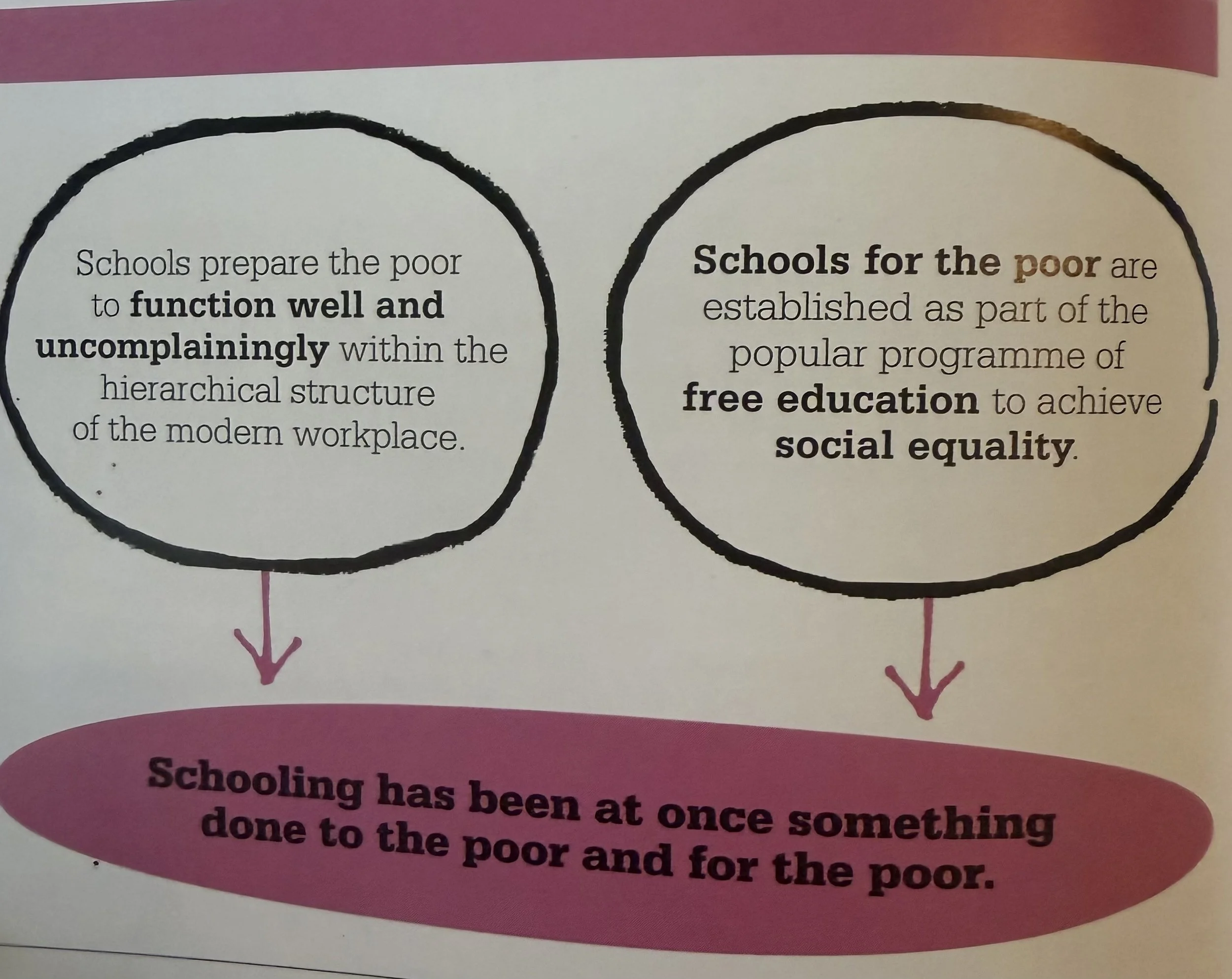
Schools prepare the poor to function well and uncomplainingly within the hierarchical structure of the modern workplace.
Schools for the poor are established as part of the popular programme of free education to achieve social equality.
Schooling has been at once something done to the poor and for the poor.
Schools exist to prepare children for adulthood and society, but in the 1960s the benign consensus about this fact of modern life began to fragment. At the end of that decade the term “hidden curriculum” was coined by Philip W Jackson, who claimed that elements of socialisation take place in school that are not part of the formal educational curriculum. Although Émile Durkheim had observed this imparting of values decades earlier, it was now given a less favourable interpretation and since then several sociological approaches have developed.
The most radical perspectives come from US economists Samuel Bowles and Herbert Gintis, who argue in Schooling in Capitalist America (1976) that education is not a neutral sphere but one where the needs of capitalism are reproduced by implicitly creating attitudes among young people that prepare them for work that alienates them in their future lives.
CLASS MATTERS
In France, Pierre Bourdieu took a different view and suggested that hidden curriculum is achieved through the cultural reproduction of knowledge.
“The structure of social relations in education… inures the student to the discipline of the workplace.”
Samuel Bowles & Herbert Gintis
The dominant class is able to define its culture and values as superior and this shapes what is taught, thus people learn to respect things perceived as upper class and deride those considered working class. For example, working class children might be taught that classical music is superior to popular music, and that it is too difficult for them to understand, whereas middle class children are taught how to appreciate it. In a similar way, middle class children are taught the qualities that will enable them to become leaders. So, lower class children face systematic bias against them in the system.
Many sociologists, such as British academic Diane Reay, contend that schools have not become vehicles for economic opportunity. The work of Bowles and Gintis still has much resonance because there has been little progress for the working classes over the last century. The poor are simply better educated than in the past. Throughout Western society, “real” incomes for the poorest have been falling, inequality has been increasing, and it is common to find graduates in low paid work.
Samuel Bowles and Herbert Gintis
Both Samuel Bowles, born in New Haven, Connecticut, USA, and Herbert Gintis, born in Philadelphia, Pennsylvania, received doctoral degrees from Harvard University and they have since worked extensively with one another. They were invited by the US civil rights leader Martin Luther King Jr to write educational background papers for the Poor People’s March of 1968. Much of their work, which has been described as Marxist, argues that many social institutions, such as schools, are characterised by the disciplinary exercise of power.
They were both hired in 1973 to join the economics department at the University of Massachusetts. Gintis still works there, but Bowles left in 2001 to join the Santa Fe Institute as research professor and director of behavioural sciences, and he is also a professor of economics at the University of Siena. Recent collaborations have focused on cultural and genetic evolution, asking why large groups of unrelated individuals gather together cooperatively.
KEY WORKS
1976 Schooling in Capitalist America: Educational Reform and the Contradictions of Economic Life
1986 Democracy and Capitalism: Property, Community, and the Contradictions of Modern Social Thought
2005 Unequal Chances: Family Background and Economic Success (eds)
According to Bowles and Gintis, schools exist to reproduce social inequalities. Therefore, the best predictor for a child’s future is the economic status of parents, rather than academic achievement or intelligence. Although the explicit curriculum is about equality of opportunity, education’s prime role is not to teach the skills needed in the world of work, but to instil into children a “hidden curriculum”. Working class children are taught their place in society and learn that qualities such as working hard, deference, punctuality, and following orders are prized. These traits are rewarded, while creativity and independent thought are not valued. This maintains the economic status quo, which needs industrious, uncritical employees.
Bowles and Gintis claim that early 19th century schools in the USA were set up to assimilate immigrants into the “American” work ethic. Crucially, there is a “correspondence” between the hierarchical social relations within the school system and those found in the economic system. The nature of school work also has similarities: pupils have little control over what they study and neither do they study for the inherent value of knowledge; like workers, they are “alienated”. Schools teach children that social inequalities are just and inevitable, and therefore education can be seen as a form of social control.
QUESTIONS ON THE ABOVE TEXT
AQA STYLE EXAM QUESTIONS USING THE STEM
EDUCATION: SOCIAL CLASS INEQUALITY
Using material from the item and your knowledge, evaluate the view that education mainly serves the interests of capitalism.
(30 marks)
Applying material from the item, analyse two ways schools reproduce class inequality.
(10 marks)
Applying material from the item, analyse two functions of the hidden curriculum.
(10 marks)
Outline and explain two ways education may act as an ideological state apparatus.
(10 marks)
Outline and explain two criticisms Marxists make of the education system.
(10 marks)
Using material from the item, analyse two ways schools socialise pupils into workplace norms.
(10 marks)
Applying material from the item, analyse two ways middle class culture may be privileged in schools.
(10 marks)
Using material from the item, analyse two consequences of cultural capital for educational achievement.
(10 marks)
Outline and explain two ways schools may contribute to social control.
(10 marks)
Using material from the item, analyse two ways schools legitimise inequality.
(10 marks)
THEORY AND METHODS LINKS
Using material from the item and your knowledge, evaluate the contribution of Marxism to our understanding of the role of education.
(20 marks)
Outline and explain two differences between Marxist and functionalist views of education.
(10 marks)
Using material from the item, analyse two criticisms interactionists might make of Marxist views of education.
(10 marks)
Evaluate the view that educational achievement is mainly shaped by external factors.
(30 marks)
Applying material from the item, analyse two internal school factors affecting educational achievement.
(10 marks)
RESEARCH METHODS QUESTIONS FROM THE STEM
The extract refers to studies by Bowles and Gintis, Diane Reay, Kathleen Clarricoates and Pierre Bourdieu.
Suggest two reasons why sociologists studying social class inequality in education may use qualitative methods.
(4 marks)
Outline two practical problems of researching working class pupils in schools.
(4 marks)
Outline and explain two strengths of using participant observation to study school culture.
(10 marks)
Outline and explain two limitations of using interviews to investigate hidden curriculum.
(10 marks)
A sociologist wants to investigate whether schools reward middle class behaviour more positively than working class behaviour.
Suggest one observational method they could use.
(2 marks)
Explain one limitation of this method.
(2 marks)
Using material from the item, evaluate the usefulness of ethnographic research for studying education.
(20 marks)
Outline and explain two ethical problems sociologists may face when researching inequality in schools.
(10 marks)
Applying material from the item, analyse two reasons why official statistics on educational achievement may be misleading.
(10 marks)
METHODS IN CONTEXT STYLE QUESTIONS
A sociologist wants to study how teachers reward obedience and conformity in schools.
Using your knowledge of sociological research methods, explain the strengths and limitations of using covert observation to investigate this issue.
(20 marks)
A sociologist wants to investigate whether schools reproduce class inequality.
Using your knowledge of research methods, explain the strengths and limitations of using unstructured interviews for this investigation.
(20 marks)
A researcher wants to study the hidden curriculum experienced by working class pupils.
Using your knowledge of methods in context, evaluate the strengths and limitations of participant observation for studying this issue.
(20 marks)
SHORT RETRIEVAL QUESTIONS
Define the term “hidden curriculum”.
(2 marks)
Define the term “cultural capital”.
(2 marks)
What is meant by the “correspondence principle”?
(2 marks)
Identify two characteristics schools reward according to Bowles and Gintis.
(2 marks)
Suggest two ways schools may reproduce inequality.
(4 marks)
Explain one way education may benefit capitalism.
(4 marks)
HOW WORKING CLASS KIDS GET WORKING CLASS JOBS
Paul Willis (1950–)
IN CONTEXT
FOCUS
Cultural reproduction and education
KEY DATES
1971 Influential research by British sociologist Basil Bernstein suggests that working class children are disadvantaged in the education system.
1976 US academics Samuel Bowles and Herbert Gintis suggest that schools are institutions that teach people their place in society.
1979 British journalist Paul Corrigan’s Schooling the Smash Street Kids argues that working class boys reject middle class understandings of success through hard work.
1994 A study by British sociologist Máirtín Mac an Ghaill, The Making of Men, reflects some of Paul Willis’s findings, showing how “macho lads” react against school.
Working class counter school culture rejects middle class values.
↓
Formal academic knowledge is derided as feminine.
Practical jobs are believed to be masculine.
↓
These beliefs are useful on the factory floor and in other low paid work.
↓
Working class kids get working class jobs.
A repeated claim is that society is meritocratic: people can achieve to the level of their ability. But Paul Willis, in his study of working class youths in an industrial town in England in the 1970s, asks why it is, then, that working class boys end up in working class jobs.
Following 12 boys, or “lads” as he refers to them, in their final two years of school and first year of employment, Willis claims it is the culture and values surrounding these young men that inform their life choices. They develop a counterculture that resists the philosophy of school, namely that academic hard work will lead to progress. Through language, dress, and practices such as smoking and drinking, they make clear their rejection of middle class ideals, and instead emphasise their belief in practical skills and life experience, developing what Willis sees as a chauvinistic or patriarchal attitude.
See also: Michel Foucault 52–55 • Friedrich Engels 66–67 • Pierre Bourdieu 76–79 • R W Connell 88–89 • Stuart Hall 200–01 • Samuel Bowles and Herbert Gintis 288–89
SCHOOL’S OUT
The boys see academic knowledge as “feminine”, and pupils who aspire to achieve — the “ear’oles” (“conformists”) — as “sissies” and inferior. Factory work and similar employment is viewed, says Willis, as suitably masculine. Many of the boys work part time, for example as shelf stackers or key cutters, and learn the value of and culture connected to such work.
Their attitudes to girls are exploitative and hypocritical (“sexy” girls are desired but also become figures of contempt), and are based, Willis claims, on a belief in the gendered division of labour. Another challenging aspect of their culture is racism, which serves to distinguish their white, working class group identity. The factory or shop floor culture mirrors the boys’ experiences in school — with a stress in both places on having a laugh and resisting too much work.
FACTORY FODDER?
Willis argues that, in effect, the boys’ “performance” of working class masculinity supports both patriarchy and — crucially, from a Marxist perspective — capitalism by providing the low paid (male) workforce. The lads, however, experience their employment as a matter of their own free choice rather than as exploitation.
Willis says that this is not simply an example of Friedrich Engels’ “false consciousness”, whereby the dominant ideology is imposed from above. Instead, ideas about class, gender, and ethnicity also emerge from within their culture; they are very aware that they would have to sacrifice their class identity to move up the social ladder. Their teachers often have low expectations of the boys, leading them to gradually give up on the idea of teaching them. Schools thus play a crucial role in reproducing cultural values, economic divisions, and working class trajectories.
NEW QUESTIONS
Willis’s work has been criticised, for example by British sociologists David Blackledge and Barry Hunt, for being based on insufficient sampling. But in the 1990s British sociologist Inge Bates reframed Willis’s question to ask why working class girls end up with working class and gender stereotyped jobs. One of her studies showed that girls who wanted to work in childcare ended up on training schemes for care of the elderly. Another study focused on girls who were keen to enter the gender stereotyped world of fashion. These aspirations confirm, says Bates, that working class girls have limited horizons. Overall, Bates suggests that a constrained labour market, few qualifications, and socialisation into “choosing” gendered jobs means there is little evidence of social mobility.
“The fierce opposition to school exhibited by working class boys in the UK is evident, according to Willis, in their ‘struggle to win symbolic and physical space from its rules’.”
PAUL WILLIS
A cultural theorist, sociologist, and ethnographer, Paul Willis was born in Wolverhampton, UK. After graduating from the University of Cambridge with a degree in literary criticism, he studied for his PhD at the Centre for Contemporary Cultural Studies at the University of Birmingham. From 1989 to 1990, Willis was a member of the Youth Policy Working Group for the Labour Party. Much of his recent work has focused on ethnographical studies of culture; in 2000 he co founded the journal Ethnography. Having been a professor of social and cultural ethnography at Keele University, he is now a professor in the sociology department of Princeton University, USA.
KEY WORKS
1977 Learning to Labour: How Working Class Kids Get Working Class Jobs
AQA STYLE EXAM QUESTIONS USING THE PAUL WILLIS STEM
EDUCATION: CLASS, GENDER AND CULTURE
Using material from the item and your knowledge, evaluate the view that working class underachievement is mainly caused by school subcultures.
(30 marks)
Applying material from the item, analyse two ways schools may reproduce working class identities.
(10 marks)
Using material from the item, analyse two features of anti school subcultures.
(10 marks)
Applying material from the item, analyse two ways masculinity may influence educational achievement.
(10 marks)
Using material from the item, analyse two ways schools contribute to social reproduction.
(10 marks)
Outline and explain two criticisms interactionists might make of Willis’s study.
(10 marks)
Outline and explain two ways gender identities are shaped within schools.
(10 marks)
Applying material from the item, analyse two reasons why working class boys may reject school values.
(10 marks)
Using material from the item, analyse two ways education may contribute to patriarchy.
(10 marks)
Outline and explain two ways peer groups may affect educational achievement.
(10 marks)
Using material from the item, analyse two internal factors affecting working class achievement.
(10 marks)
30 MARK ESSAYS
Evaluate the view that schools mainly reproduce class inequality.
(30 marks)
Evaluate sociological explanations of working class underachievement.
(30 marks)
Evaluate the contribution of Marxist theories to our understanding of education.
(30 marks)
Evaluate the view that anti school subcultures are the main cause of educational failure among working class boys.
(30 marks)
Evaluate the view that educational achievement is shaped more by gender than social class.
(30 marks)
THEORY AND METHODS QUESTIONS
Using material from the item and your knowledge, evaluate the usefulness of ethnography for researching school subcultures.
(20 marks)
Outline and explain two strengths of participant observation in schools.
(10 marks)
Outline and explain two ethical problems sociologists may face when studying pupils in schools.
(10 marks)
A sociologist wants to investigate anti school subcultures among working class boys.
Suggest one suitable research method.
(2 marks)
Explain one limitation of this method.
(2 marks)
Using material from the item, analyse two practical problems of researching pupils in schools.
(10 marks)
Outline and explain two reasons why participant observation may produce valid data when researching school culture.
(10 marks)
Using material from the item, evaluate the strengths and limitations of unstructured interviews for studying educational achievement.
(20 marks)
METHODS IN CONTEXT STYLE QUESTIONS
A sociologist wants to investigate how working class boys experience school discipline.
Using your knowledge of research methods, evaluate the strengths and limitations of covert participant observation for studying this issue.
(20 marks)
A researcher wants to study anti school subcultures in a secondary school.
Using your knowledge of methods in context, evaluate the strengths and limitations of using group interviews for this research.
(20 marks)
A sociologist wants to investigate how gender identities are constructed within school peer groups.
Using your knowledge of methods in context, evaluate the strengths and limitations of ethnographic research for this investigation.
(20 marks)
SHORT EXAM STYLE QUESTIONS
Define the term “counter school culture”.
(2 marks)
Define the term “cultural reproduction”.
(2 marks)
Identify two characteristics of the “lads” described by Willis.
(2 marks)
Suggest two ways peer groups may influence educational achievement.
(4 marks)
Explain one way masculinity may influence educational achievement.
(4 marks)
Explain one criticism of Willis’s research.
(4 marks)
ITEM BASED APPLICATION QUESTIONS
ITEM
Some sociologists argue that working class boys reject school values because they see academic success as feminine and manual labour as masculine. These attitudes may lead them to form anti school subcultures.
Using material from the item, analyse two reasons why working class boys may underachieve in education.
(10 marks)
ITEM
Some sociologists argue that schools reproduce both class and gender inequalities through peer group cultures and teacher expectations.
Using material from the item, analyse two ways schools may reinforce gender identities.
(10 marks)
ITEM
Some sociologists argue that anti school behaviour may actually prepare pupils for low paid employment rather than helping them resist inequality.
Using material from the item and your knowledge, evaluate the view that resistance to schooling still reproduces capitalism.
(30 marks)
Model Stem Material (Education Context)
Sociologists are interested in understanding how pupils experience life in school. One area of interest is how teacher–pupil interactions may affect pupils’ behaviour and achievement. Some sociologists have attempted to study this by collecting data from pupils and teachers within schools. However, researching education can present a number of practical and ethical issues, particularly as most pupils are under the age of 16 and schools are formal organisations with strict rules and routines.
This stem is strong because it:
Clearly places the research in education
Mentions pupils and teachers
Hints at ethical issues (children, power, consent)
Hints at practical issues (school rules, routines)
Can be applied to any method (interviews, questionnaires, observations, etc.)
Alternative Stem (if you want something more specific)
Observation-focused stem
Some sociologists believe that observing pupils in classrooms is the best way to understand how behaviour is managed in schools. They argue that this allows researchers to see how teachers enforce discipline and how pupils respond to school rules. However, conducting research inside classrooms may be difficult due to lesson disruption and the presence of authority figures.
Questionnaire-focused stem
Sociologists sometimes use questionnaires to investigate pupils’ attitudes towards school, such as their views on homework, discipline and relationships with teachers. This method allows data to be collected from a large number of pupils across different schools, but responses may not always reflect pupils’ true feelings.
How students should use the stem (examiner expectation)
Top-band students will:
Refer directly to the stem (“As the stem suggests…”, “This is important when researching pupils…”)
Link the stem to research characteristics, for example:
Ethics → pupils under 16
Validity → true feelings vs socially desirable answers
Practical issues → lesson disruption
Representativeness → different schools
If you want, next I can:
Build a full Band 5 model 20-mark answer using this exact stem
Annotate the model answer to show where marks come from
Adjust the stem to match your department’s preferred method
Tell me which method you want the model answer on (e.g. interviews, questionnaires, observations, official statistics).
20 mark question on Paper 1 where pupils have to apply research methods to the context of education. The most crucial thing they need to know is the research characteristics
Got it — this is AQA A-level Sociology (Year 12), Paper 1, the 20-mark “research methods in education” question. I’ll be very clear and exam-focused here.
What the head of sociology means by “research characteristics”
In this question, students are not just describing methods. They must apply the strengths and limitations (characteristics) of research methods to education.
Think of research characteristics as the features of a method that affect how good the research is.
The CORE research characteristics AQA expects
Students should be able to apply these every time, to any method, in an education context.
1. Validity
Does the method produce truthful, in-depth data?
High validity = real meanings, experiences, feelings
Low validity = artificial, superficial data
Education application example:
Interviews with pupils → high validity (pupils explain experiences of school)
Questionnaires → lower validity (students may lie or misunderstand questions)
2. Reliability
Can the research be repeated and get the same results?
High reliability = standardised, structured methods
Low reliability = flexible, interpretive methods
Education example:
Structured questionnaires on homework habits → reliable
Unstructured interviews with teachers → not reliable (different answers each time)
3. Representativeness
Does the sample reflect the wider population?
This is HUGE for education studies.
Education example:
Studying one private school → not representative of all UK schools
Using official statistics on exam results → highly representative
4. Generalisability
Can findings be applied to all schools or students?
Closely linked to representativeness.
Education example:
In-depth study of one classroom → low generalisability
National surveys of pupils → high generalisability
5. Practical issues
Is the method realistic to use in schools?
Includes:
Time
Cost
Access to schools
Disruption to lessons
Education example:
Observations in classrooms → difficult due to lesson disruption
Questionnaires → quick and cheap during tutor time
6. Ethical issues
Does the research protect pupils and teachers?
Education research often involves children, which examiners LOVE.
Key issues:
Consent (especially with under-16s)
Confidentiality
Harm or stress
Power imbalance (teachers vs pupils)
Education example:
Observing pupils without consent → unethical
Anonymous questionnaires → more ethical
How this fits the 20-mark question
The question usually looks like:
“Evaluate the use of [method] in researching education.”
Top-band answers:
Apply research characteristics throughout
Constantly link to schools, pupils, teachers
Weigh strengths vs limitations
Reach a balanced judgement
Simple structure students can use (very exam-safe)
Introduction
Define the method
Say it will be evaluated using research characteristics
Paragraphs (PEEL):
One characteristic per paragraph
e.g. validity, reliability, representativeness, ethicsAlways link back to education
Conclusion
Overall judgement
Which method is better for education and why
Examiner tip (important)
If students only describe the method, they will be capped.
If they apply research characteristics to education, they hit Band 4–5
TOPIC 2: SOCIOLOGICAL RESEARCH METHODS
FOCUS ON RESEARCH: GANG LEADER FOR THE DAY
The ‘projects’ in Chicago where the research was conducted.
Sudhir Venkatesh (2009) was a young researcher who started trying to do questionnaire research into Black gangs in the housing blocks (or ‘projects’) of Chicago. He ventured into the Projects armed with a questionnaire, but was soon surrounded and himself questioned by the leader of a gang, the Black Kings, who called their leader J.T.
Fortunately for the researcher, J.T. decided that he would allow Sudhir Venkatesh to study his gang, and the two men became close friends during the research. However, Venkatesh rapidly abandoned the idea of using questionnaires and instead carried out a participant observation study. It allowed him to get something of an insider’s view into one of the most deprived and crime prone African American housing projects on the Southside of Chicago.
The Black Kings was a major gang that received most of its income from dealing in crack cocaine and other drugs. Venkatesh was not fully open with J.T. about the purpose of the research, letting him believe that he would write his biography. However he sometimes shared information with J.T., who occasionally used it to demand money from people who had told the researcher about their earnings.
Venkatesh did not report the many illegal activities he witnessed, including drug dealing, violence and police corruption, believing that it was more important to protect his sources than to report law breaking.
Venkatesh got involved in the activities of the gang to some extent, on one occasion even kicking somebody during a fight. He also took up J.T.’s offer to be ‘gang leader for a day’ as J.T. wanted him to appreciate that decision making wasn’t always easy for a gang leader.
Venkatesh ended up sympathising with the residents, not only those who were the victims of the drug gangs, but also those who were members of the gangs. As well as showing the violence, he reveals a complex economic system and close knit community, and he found that in some respects the Black Kings made a positive contribution to the community. He also found evidence of corruption in the police force.
Venkatesh is dismissive of the research of sociologists who rely more on quantitative data, arguing that they simply cannot get close to understanding life in poor neighbourhoods.
QUESTIONS
Demonstrate an understanding of the evidence which shows that Venkatesh may have ‘gone native’ during his research.
Interpret and describe the practical problems faced by the researcher in carrying out his study.
Analyse the ethical issues involved in the conduct of this research.
For each ethical issue identified, evaluate the choices and justifications made by the researcher.
Venkatesh was only allowed by J.T. to study some aspects of life in the Projects. Evaluate whether this makes his research invalid.
Answers
1. DEMONSTRATE AN UNDERSTANDING OF THE EVIDENCE WHICH SHOWS THAT VENKATESH MAY HAVE ‘GONE NATIVE’ DURING HIS RESEARCH
‘Going native’ refers to a situation in participant observation where the researcher becomes so emotionally involved with the group being studied that they lose objectivity and begin to identify with the participants. There is considerable evidence that Venkatesh may have gone native during his research with the Black Kings gang.
First, he developed a close friendship with J.T., the gang leader. This suggests he moved beyond the detached role of researcher and became personally involved with members of the gang.
Second, he became involved in gang activities himself. The text states that he even kicked somebody during a fight. This is strong evidence of participation rather than detached observation, indicating blurred boundaries between researcher and participant.
Third, he accepted the role of ‘gang leader for a day’. This implies not only participation but temporary immersion in the gang’s authority structure and worldview. J.T. wanted him to understand the pressures of gang leadership, and Venkatesh appeared willing to empathise with this role.
Fourth, he chose not to report serious criminal activity, including drug dealing, violence, and corruption. This suggests his loyalty to participants may have become stronger than his commitment to legal or professional obligations.
Finally, Venkatesh became sympathetic towards gang members and argued that gangs sometimes made positive contributions to the community. While this may reflect deeper sociological understanding, critics may argue that he became emotionally aligned with participants and lost critical distance.
Together, these examples suggest that Venkatesh’s deep immersion in the social world of the gang may have compromised his neutrality and led him to ‘go native’.
2. INTERPRET AND DESCRIBE THE PRACTICAL PROBLEMS FACED BY THE RESEARCHER IN CARRYING OUT HIS STUDY
Venkatesh faced several major practical problems during the research.
One practical problem was gaining access to the group. Gangs are difficult to study because they are suspicious of outsiders, particularly researchers. Initially, Venkatesh entered the Projects with questionnaires, but this immediately created hostility and suspicion. Access was only achieved because J.T. allowed him to stay and study the gang.
A second problem involved personal safety. The Projects were described as deprived and crime prone areas involving drug dealing and violence. Venkatesh risked intimidation, assault, or even death while conducting the research. The fact that he became surrounded and questioned by gang members at the beginning illustrates these dangers.
Another practical issue was maintaining trust and rapport. To continue observing the gang, Venkatesh had to build relationships and avoid appearing threatening or judgmental. This required significant emotional labour and likely influenced how he behaved around participants.
A further problem involved collecting valid data. Criminal groups may hide information, exaggerate stories, or manipulate the researcher. Since J.T. controlled access to aspects of gang life, Venkatesh’s observations may have been selective and incomplete.
The researcher also faced the problem of role conflict. He had to balance being a sociologist with maintaining acceptance by the gang. Reporting crimes or criticising participants could have ended the study and endangered him.
Another issue was reliability. Participant observation is difficult to replicate because it depends heavily on unique relationships and situations. Another researcher may not have gained the same access or findings.
Finally, covert aspects of the research created difficulties in recording data openly. Taking notes openly may have aroused suspicion, so Venkatesh may have had to rely on memory, reducing accuracy.
3. ANALYSE THE ETHICAL ISSUES INVOLVED IN THE CONDUCT OF THIS RESEARCH
Several major ethical issues emerged during Venkatesh’s study.
One ethical issue was deception. Venkatesh was not fully honest about the purpose of the research and allowed J.T. to believe he was writing a biography. Participants therefore may not have given fully informed consent.
A second ethical issue involved informed consent itself. Although J.T. permitted the study, not everyone in the Projects necessarily agreed to participate. Some residents may not even have known they were being studied.
Another issue was confidentiality and harm. Venkatesh shared some information with J.T., who then used it to demand money from people. This potentially placed participants at risk and breached confidentiality.
A further ethical problem was the researcher’s involvement in illegal and violent activities. Venkatesh witnessed drug dealing, violence, and corruption without reporting them. Critics may argue this indirectly enabled criminal behaviour and failed to protect victims.
The fact that he physically participated in violence by kicking someone during a fight raises additional ethical concerns. Sociologists are generally expected to avoid causing harm or becoming involved in criminal acts.
There was also the issue of researcher safety. Ethical guidelines stress that researchers should not place themselves at serious risk. Conducting immersive research in violent gang environments clearly created dangers.
Finally, the research raised issues about exploitation and power. Some critics may argue that the researcher benefited academically and professionally from studying disadvantaged communities experiencing poverty and violence.
4. FOR EACH ETHICAL ISSUE IDENTIFIED, EVALUATE THE CHOICES AND JUSTIFICATIONS MADE BY THE RESEARCHER
Venkatesh justified deception by arguing that full openness would have prevented access to the gang. From an interpretivist perspective, covert methods may sometimes be necessary to study hidden or deviant groups authentically. However, positivists and ethical critics would argue that deception undermines informed consent and participant autonomy.
Regarding confidentiality, Venkatesh may have believed that sharing information with J.T. was necessary to maintain trust and personal safety. However, because this information was later used against residents, critics would argue he failed to adequately protect participants from harm.
His decision not to report criminal behaviour can also be evaluated from different perspectives. Venkatesh argued that protecting sources and understanding social reality were more important than informing authorities. Interpretivists may support this position because reporting crimes would destroy rapport and end the research. However, others would argue that sociologists have a moral responsibility not to ignore serious violence, exploitation, and drug crime.
His participation in violence by kicking someone during a fight may have been motivated by fear, pressure, or a need to preserve his cover. In dangerous situations, refusing participation might have exposed him to suspicion or violence. Nevertheless, becoming physically involved in aggression clearly crossed ethical boundaries and compromised professional neutrality.
Supporters of the study may argue that the research produced valuable sociological insights into poverty, gang structures, informal economies, and community life that would otherwise remain hidden. It challenged simplistic stereotypes and revealed complexity within deprived neighbourhoods.
However, critics may argue that ethical standards exist precisely to prevent researchers becoming too involved, exploitative, or complicit in harm. Therefore, although the study produced valuable data, many sociologists would consider some of the ethical compromises unacceptable.
5. VENKATESH WAS ONLY ALLOWED BY J.T. TO STUDY SOME ASPECTS OF LIFE IN THE PROJECTS. EVALUATE WHETHER THIS MAKES HIS RESEARCH INVALID
The fact that J.T. controlled access to information may reduce the validity of the research to some extent, because the researcher may only have seen selected aspects of gang life. Gatekeepers can influence what researchers observe, potentially hiding activities or presenting the group in a more favourable way.
For example, J.T. may have restricted access to the most serious crimes or manipulated Venkatesh’s understanding of gang operations. This means the data could be partial, selective, or biased.
In addition, Venkatesh’s close relationship with J.T. may have influenced how he interpreted events. If the researcher sympathised too strongly with participants, this could reduce objectivity and critical analysis.
However, it does not necessarily make the research invalid. Interpretivist sociologists argue that validity comes from achieving deep understanding and insight into social meanings. Through participant observation, Venkatesh gained rich qualitative data about daily life, community relationships, informal economies, and gang culture that would have been impossible through questionnaires or official statistics.
All sociological research has limitations. Even quantitative methods may suffer from dishonesty, low response rates, or superficial data. While Venkatesh’s study may not provide a complete picture of life in the Projects, it still offers valuable and detailed insights.
Furthermore, the existence of gatekeepers is common in sociological research involving closed groups such as gangs, prisons, or religious sects. Researchers often have to negotiate access through powerful individuals. This does not automatically invalidate findings, although it requires caution when interpreting them.
Overall, the study may have limited representativeness and objectivity, but many sociologists would still regard it as highly valid in terms of depth, realism, and insider understanding.
BUILD CONNECTIONS
Experimental and comparative methods are both found in scientific research. Scientists cannot always use laboratory experiments to study large scale or long term phenomena (for example, evolution or the birth of the universe). This means that scientists need to adopt more varied methods so that science is perhaps closer to social science than it might immediately appear to be. These issues will be revisited in the later parts of the A level course (Book 2) when we look at whether sociology can be considered a science.
Discuss the view that because comparative research is commonly used in sociology, sociology can be considered to be a scientific subject.
FOCUS ON SKILLS: COMPARATIVE RESEARCH ON ACADEMY CHAINS
Manchester Academy
Becky Francis, Merryn Hutching and Robert De Vries (2014) conducted research comparing different academy chains (where a single body ran three or more academy schools) and comparing academy chains with schools in general. Their findings were published in a report entitled Chain Effects. To make the comparisons they examined existing data on:
• GCSE exam results in terms of the grades obtained by disadvantaged pupils (those getting free school meals) in their five best GCSEs
• the proportion obtaining five or more GCSEs including English and Maths
• the amount of progress made in English and Maths
• the proportion obtaining the English Baccalaureate.
They also compared the different types of chain to see whether any particular type tended to have more success than other types in raising the achievement of pupils from poor households. They found that academy chains did less well than the average for all schools in raising achievement for poor pupils, but some were very successful and these were likely to be chains that had not expanded too quickly, and that had staff with lots of experience of managing school improvement.
For more on this study visit the Sutton Trust website.
QUESTIONS
Explain. Demonstrate your understanding of the comparative method by explaining why this study is an example of comparative research.
Analyse some of the different independent variables that were used in this study.
Analyse the main dependent variables used in this study.
Analyse reasons why this research could not have been carried out as a field experiment.
Evaluate the possible weaknesses and limitations of this research.
Evaluate the strengths of this research.
EXPERIMENTAL RESEARCH IN THE CONTEXT OF EDUCATION
Experimental research has been used to investigate a range of topics in the education system. However, the most common type of research is to do with labelling theories of education and the effects of teacher expectations upon pupil performance. Some examples are discussed below (see Topic 1, Chapter 2 for further details of the studies).
Rosenthal and Jacobson (1968) gave false information to primary school teachers in the USA about the IQ of pupils. They found that pupils who were believed to have
ANSWERS
1. EXPLAIN. DEMONSTRATE YOUR UNDERSTANDING OF THE COMPARATIVE METHOD BY EXPLAINING WHY THIS STUDY IS AN EXAMPLE OF COMPARATIVE RESEARCH
This study is an example of comparative research because the researchers compared different groups in order to identify similarities, differences, and patterns in educational achievement. Comparative research involves examining existing social groups or institutions rather than manipulating variables experimentally.
Francis, Hutching, and De Vries compared different academy chains with one another and also compared academy chains with schools generally. They examined whether certain types of academy chains were more successful at improving educational outcomes for disadvantaged pupils.
The study compared educational performance using existing statistical data, such as GCSE outcomes, English and Maths progress, and English Baccalaureate achievement. Because the researchers were analysing differences between naturally occurring groups rather than creating experimental conditions, this is comparative rather than experimental research.
The research also attempted to identify possible relationships between organisational features, such as rapid expansion or management experience, and school performance. This reflects the comparative method’s aim of identifying social patterns and possible causal relationships through comparison.
2. ANALYSE SOME OF THE DIFFERENT INDEPENDENT VARIABLES THAT WERE USED IN THIS STUDY
Independent variables are the factors believed to influence outcomes or differences in the research.
One independent variable was the type of school organisation. The researchers compared academy chains with schools in general to see whether academy structures affected pupil achievement.
Another independent variable was the type of academy chain. Different chains may have had different management styles, funding priorities, leadership structures, or educational approaches.
The rate of expansion of academy chains also appeared to function as an independent variable. The study suggested that chains which expanded too quickly performed less successfully than those that developed more gradually.
Management experience was another independent variable. Chains with staff experienced in school improvement appeared more effective at raising achievement among disadvantaged pupils.
Social background was also indirectly involved as an independent variable because the study specifically focused on disadvantaged pupils receiving free school meals. Poverty and social class are significant variables influencing educational achievement.
These variables were not manipulated experimentally by the researchers but existed naturally within the education system, which is typical of comparative sociological research.
3. ANALYSE THE MAIN DEPENDENT VARIABLES USED IN THIS STUDY
Dependent variables are the outcomes measured by researchers to assess the effect of independent variables.
One major dependent variable was GCSE achievement among disadvantaged pupils, particularly grades achieved in their five best GCSE subjects. This measured academic performance.
Another dependent variable was the proportion of pupils obtaining five or more GCSEs including English and Maths. This is an important national benchmark used to assess school effectiveness.
The amount of progress made in English and Maths was also used as a dependent variable. This measured improvement over time rather than simple final attainment.
A further dependent variable was the proportion of pupils obtaining the English Baccalaureate. This indicated success in achieving a recognised academic qualification combination.
All these dependent variables measured educational outcomes and allowed researchers to compare the effectiveness of different academy chains and school structures.
4. ANALYSE REASONS WHY THIS RESEARCH COULD NOT HAVE BEEN CARRIED OUT AS A FIELD EXPERIMENT
This research could not realistically be conducted as a field experiment for several reasons.
First, researchers cannot ethically or practically manipulate which pupils attend different academy chains. School structures already exist naturally, and pupils cannot simply be randomly assigned to schools for experimental purposes.
Second, many of the variables involved are large scale social factors that cannot easily be controlled experimentally. Factors such as poverty, teacher quality, leadership experience, school funding, parental support, and neighbourhood conditions all affect achievement simultaneously.
Third, field experiments require control over independent variables, but the researchers had no direct control over how academy chains were managed, expanded, or staffed.
Another reason is practicality. The study involved large numbers of schools and pupils across the education system. Conducting an experiment on this scale would be extremely time consuming, expensive, and difficult to manage.
There are also ethical issues. Manipulating educational opportunities or school structures could disadvantage pupils and potentially damage educational outcomes.
Finally, the research relied on existing national educational data collected over time. Comparative analysis of official statistics was therefore a more practical and realistic method than experimentation.
5. EVALUATE THE POSSIBLE WEAKNESSES AND LIMITATIONS OF THIS RESEARCH
One weakness is that comparative research cannot prove clear cause and effect relationships. Although differences were found between academy chains, the study cannot conclusively show that academy structures caused the differences in achievement.
Another limitation is the presence of extraneous variables. Many factors influence educational success, including family background, school funding, teacher quality, parental involvement, ethnicity, and local deprivation. These variables may distort findings.
The study also relied heavily on official statistics and existing data. Official statistics may lack depth and fail to explain why certain academy chains performed better than others.
A further limitation is that educational achievement was mainly measured quantitatively through exam results. This may ignore wider educational experiences such as wellbeing, creativity, student relationships, or school culture.
The research may also suffer from issues of comparability. Different schools may operate in very different social contexts, making direct comparisons difficult.
In addition, league table pressures and school policies may encourage teaching to the test, meaning exam results may not fully reflect genuine educational quality.
Finally, because the study focuses mainly on measurable outcomes, interpretivist sociologists may argue that it lacks insight into the lived experiences of pupils and teachers.
6. EVALUATE THE STRENGTHS OF THIS RESEARCH
One major strength is that the research used large scale data. This increases representativeness and allows broader patterns across the education system to be identified.
Another strength is reliability. The study relied on standardised educational statistics such as GCSE results, which can be consistently measured and compared across schools.
The comparative method also allows sociologists to study real world educational systems without artificial laboratory conditions. This increases ecological validity because the research reflects actual educational settings.
A further strength is practicality. Using existing official statistics is less expensive and time consuming than collecting entirely new data through interviews or observation.
The study is also useful for policy making. Governments and educational organisations can use findings to identify which academy structures appear more successful and why.
In addition, comparative research can identify trends and correlations that may guide future sociological or educational research.
Finally, the research highlighted important inequalities affecting disadvantaged pupils, making it socially significant and relevant to debates about class and educational opportunity.
FOCUS ON RESEARCH: SURVEY RESEARCH ON PARENTS AND EDUCATIONAL ADVANTAGE
In Parent Power?, a study of how parents use money and skills to help children succeed in education, Becky Francis and Merryn Hutchings (2013) used survey data. The study was based on an online survey of 1,173 parents of children aged 5–16 years who attended school. It was carried out for the Sutton Trust by the polling organisation, YouGov.
The sample was taken from members of the public who are on YouGov’s panel of people willing to take part in polling on various subjects for a small fee. YouGov selected parents who lived with their children to take part; they took account of the proportions who were male and female and invited people from different social classes (or as they call them, social grades), taking account of how many people in the general population are in those classes.
However, those in the highest group (social grade A, consisting of higher managers, administrators and professionals) were over sampled because the study was particularly interested in parents from this class. (Over sampling involves asking a higher proportion than you would in a representative sample from one group of particular interest, and then adjusting the results to take account of this at the end. It allows you to make more reliable statements about groups who would otherwise make up only a small proportion of the sample).
Respondents were sent an email asking them to participate and those who responded positively were included. YouGov ensured that 50 per cent of the sample was male and 50 per cent was female.
Although this sampling method got a spread of people from different classes, the sample did not closely match the proportions in the population as a whole (because it depended on who agreed to participate), with some classes over represented in the sample and some under represented. Furthermore, they found that Black and minority ethnic groups made up only about 12 per cent of their sample, while about 24 per cent of school pupils come from these backgrounds.
For more information on this study visit the Sutton Trust website.
QUESTIONS
What was the sampling frame used in this research?
Suggest ways in which the sampling frame may not have been representative of the population as a whole. (Think about the sort of people likely to be on the YouGov panel.)
What type (or types) of sampling was used in this study? (You may find more than one type was used.)
Evaluate the overall strengths and weaknesses of the sampling procedures. (Think about how representative the sample was, and whether it could have been more or less representative.)
Suggest ways in which the sampling could have been improved.
1. WHAT WAS THE SAMPLING FRAME USED IN THIS RESEARCH?
The sampling frame was YouGov’s existing panel of members of the public who had already volunteered to participate in surveys and polling research. From this panel, parents of children aged 5 to 16 who lived with their children were selected.
2. SUGGEST WAYS IN WHICH THE SAMPLING FRAME MAY NOT HAVE BEEN REPRESENTATIVE OF THE POPULATION AS A WHOLE
The sampling frame may not have been fully representative because people on the YouGov panel are volunteers who choose to participate in surveys, often for small financial rewards. This may attract particular types of people.
For example, people who regularly use the internet are more likely to join online panels, meaning older individuals, poorer households, or those with limited internet access may be under represented.
People interested in politics, education, or social issues may also be more likely to participate, creating volunteer bias.
The sample may also over represent individuals with more free time, higher literacy levels, or stronger opinions.
In addition, Black and minority ethnic groups were under represented in the sample compared with the wider school population. The study itself noted that only around 12 per cent of participants came from these backgrounds, despite approximately 24 per cent of pupils nationally being from minority ethnic groups.
Higher social classes may also have been over represented because the researchers deliberately over sampled social grade A participants.
3. WHAT TYPE (OR TYPES) OF SAMPLING WAS USED IN THIS STUDY?
Several sampling methods were used.
One method was volunteer sampling because the original YouGov panel consisted of people who had volunteered to participate in surveys.
A second method was stratified sampling. Researchers attempted to include participants from different genders and social classes in proportions related to the wider population.
There was also over sampling of social grade A participants. This was a deliberate form of disproportionate stratified sampling because researchers intentionally included a higher proportion of this group than existed in the general population.
Finally, self selected sampling was involved because only those who responded positively to the email invitation actually participated.
4. EVALUATE THE OVERALL STRENGTHS AND WEAKNESSES OF THE SAMPLING PROCEDURES
One strength is that the sample was relatively large, with 1,173 parents participating. Larger samples tend to increase representativeness and reduce the influence of unusual individual responses.
Another strength is that the researchers attempted to include people from different genders and social classes. This improves representativeness compared with a purely random volunteer sample.
The use of stratified procedures also allowed researchers to examine differences between social groups more effectively.
Over sampling social grade A participants was useful because it allowed more reliable conclusions to be drawn about an important subgroup that may otherwise have been too small for detailed analysis.
However, there were also important weaknesses.
The sample depended heavily on volunteers from the YouGov panel, creating volunteer bias. People willing to complete online surveys may differ significantly from the general population.
The research was also limited to people with internet access and sufficient digital literacy to participate in online surveys.
Another weakness is that some groups were under represented, particularly Black and minority ethnic participants. This reduces the representativeness of the findings.
The use of self selected responses means non response bias may also have occurred because those who ignored the invitation may systematically differ from those who agreed to participate.
Finally, because the sample was not fully representative of the wider population, generalising the findings to all parents may be problematic.
5. SUGGEST WAYS IN WHICH THE SAMPLING COULD HAVE BEEN IMPROVED
One improvement would be to use a truly random sample taken from a wider national database rather than relying solely on the YouGov panel.
Researchers could also increase representativeness by including offline methods such as telephone surveys, postal questionnaires, or face to face interviews to include participants without internet access.
Another improvement would be to ensure ethnic groups were represented in proportions matching the national population.
The researchers could also use proportionate stratified sampling more carefully so that all social classes matched national distributions more accurately.
Increasing response rates through follow up reminders or incentives might also reduce non response bias.
Finally, combining several sampling methods and recruiting participants through schools, local authorities, or community organisations could improve coverage of harder to reach groups.