
SPECIFICATION: Holism and reductionism: levels of explanation in Psychology. Biological reductionism and environmental (stimulus-response) reductionism.
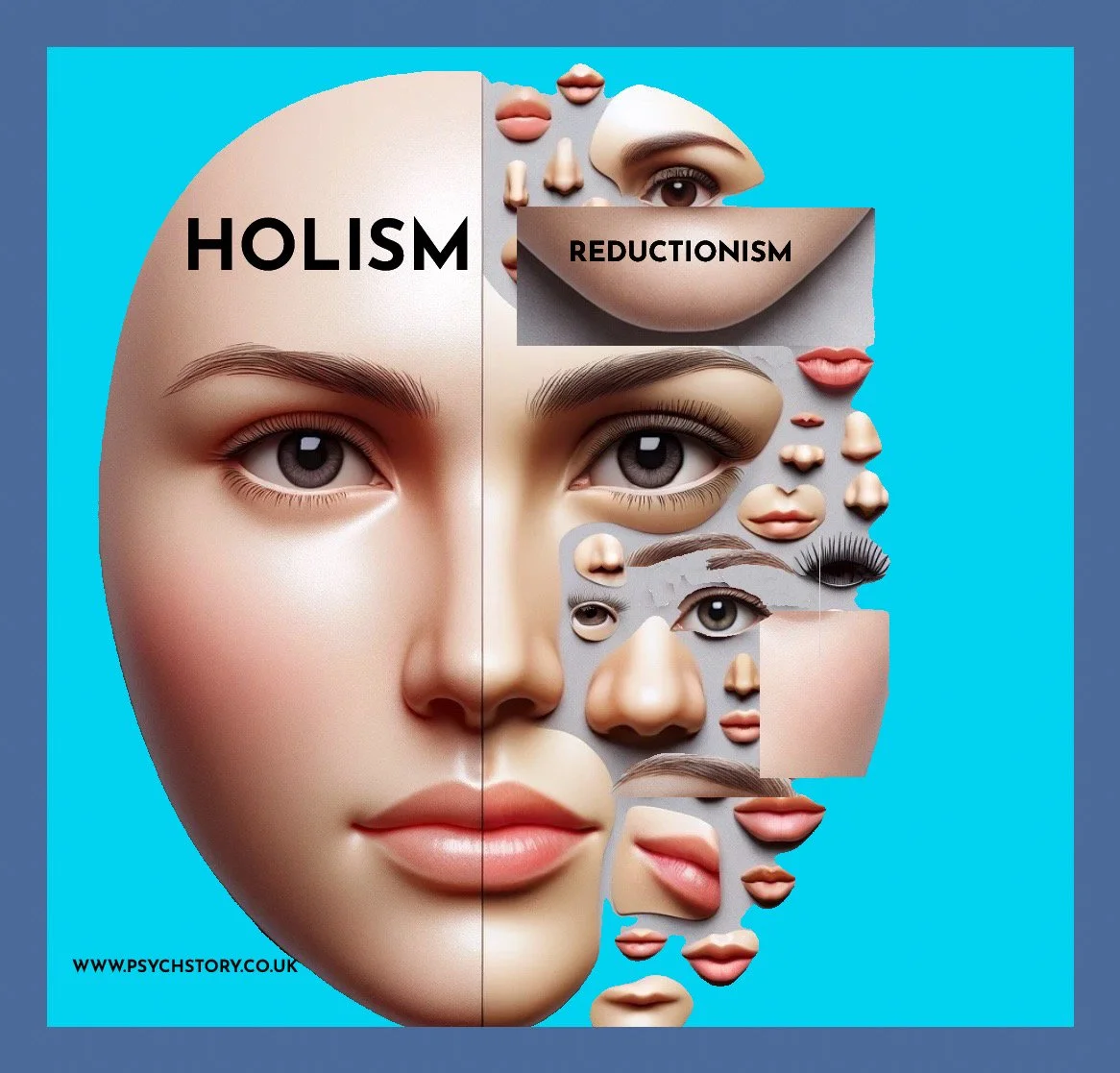
Specification: Levels of Explanation in Psychology. Biological Reductionism and Environmental (Stimulus-Response) Reductionism.
LEVELS OF EXPLANATION IN PSYCHOLOGY
Psychological behaviour can be explained at different levels. Some explanations focus on the smallest biological mechanisms, while others consider broader environmental or social influences. This debate is often framed as reductionism versus holism.
These levels of explanation reflect that human behaviour is complex and can be approached from several perspectives. At one level, explanations may focus on biological processes such as genes, neurotransmitters, hormones, or brain structures. At another level, psychologists may examine cognitive processes such as perception, thinking, memory, and decision-making. Beyond this, behaviour can also be studied in relation to social environments, cultural influences, and interpersonal relationships.
Different psychological approaches tend to emphasise different levels. Biological psychology often focuses on neural mechanisms and genetic influences. Cognitive psychology examines internal mental processes. Behaviourist explanations emphasise learning through interaction with the environment, while social psychology considers how behaviour is shaped by group dynamics, social norms, and situational pressures.
The idea of levels of explanation recognises that psychological phenomena can often be interpreted in more than one way. For example, aggression might be analysed in terms of genetic predisposition, hormonal influences, learned behaviours, or social context. Each explanation highlights a different level of analysis.
At the extreme ends of this spectrum lie two contrasting perspectives. Reductionist explanations focus on smaller and more fundamental components of behaviour, while holistic explanations emphasise broader systems and interactions. Most psychological research, however, operates somewhere between these two positions, selecting the level of explanation most appropriate to the research question being investigated
REDUCTIONISM:: Reductionism explains behaviour by breaking complex phenomena into simpler components. The assumption is that if the underlying parts are understood, the behaviour itself can be explained.
Two common forms appear in psychology.
BIOLOGICAL REDUCTIONISM: Biological reductionism explains behaviour in terms of physiological processes such as genes, brain structures, neurotransmitters, and hormones. For example, schizophrenia may be explained through dopamine dysregulation, genetic vulnerability, or abnormalities in brain structure.
ENVIRONMENTAL REDUCTIONISM” Environmental reductionism explains behaviour in terms of learned stimulus–response associations. Behaviourist approaches reduce behaviour to conditioning processes. For example, phobias can be explained through classical conditioning, where a neutral stimulus becomes associated with fear after repeated pairings with a traumatic event. In both cases, complex behaviour is reduced to a smaller set of underlying mechanisms.
HOLISM: Holism takes the opposite view. It argues that behaviour cannot be fully understood by examining isolated components. Instead, behaviour emerges from the interaction among biological, cognitive, and social processes. For example, depression may involve biological factors such as neurotransmitters, psychological factors such as cognitive biases, and environmental influences such as stress or social isolation. A holistic explanation attempts to integrate these interacting influences rather than reduce the behaviour to a single cause
THE LEVELS OF EXPLANATION ISSUE
The debate is not simply about which approach is correct. Different psychological questions require different levels of explanation. Biological explanations may be useful when studying neurological disorders, while environmental explanations may be more informative when analysing learned behaviours. Modern psychology, therefore, often combines multiple levels of explanation rather than relying exclusively on either reductionism or holism
HOLISM
Holism argues that behaviour and mental processes cannot be fully understood by examining isolated components. Instead, psychological phenomena emerge from the interaction among multiple systems. The mind, therefore, needs to be studied as an integrated whole rather than as a collection of separate parts.
The core idea of holism is often summarised by the phrase “the whole is greater than the sum of its parts.” Individual biological, psychological, and social influences may contribute to behaviour, but none of these factors alone provides a complete explanation. Understanding human cognition, therefore, requires examining how these influences interact.
A key concept supporting holism is emergent properties. These are characteristics that arise from the organisation of a system but are not visible when examining individual components in isolation. The human brain provides a clear example. It consists of billions of neurons, yet studying a single neuron reveals very little about how thought, memory, or decision-making occur. These processes only become meaningful when the activity of large neural networks is considered together.
Holistic approaches are common in several areas of psychology. Humanistic psychology, for example, focuses on the individual as a whole person rather than reducing behaviour to biological mechanisms or learned responses. Similarly, many modern explanations of mental disorders combine biological, cognitive, and social influences to produce a more complete account of behaviour.
This approach therefore emphasises interaction, complexity, and integration, rather than simple one-cause explanations
HOLISM IN DIFFERENT PSYCHOLOGICAL FIELDS
GESTALT PSYCHOLOGY: Rooted in holism, Gestalt psychology emphasises perceiving psychological phenomena as organised wholes rather than collections of isolated elements. Gestalt theorists argued that the mind actively organises sensory information into meaningful patterns. Principles such as the law of similarity, proximity, and closure illustrate how perception emerges from the structured organisation of stimuli rather than from individual sensory components alone.
HUMANISTIC PSYCHOLOGY: In contrast to reductionist approaches, humanistic psychology examines the individual as a complete person. This perspective emphasises the interaction of emotional, social, and psychological influences in shaping behaviour. Rather than reducing behaviour to biological mechanisms or conditioned responses, humanistic psychologists focus on personal growth, meaning, and self-actualisation. Concepts such as Abraham Maslow’s hierarchy of needs illustrate this holistic attempt to understand human motivation and well-being.
SOCIAL PSYCHOLOGY: Social psychology also reflects a holistic perspective by examining behaviour within its social context. Individuals are influenced by social norms, group dynamics, and situational pressures, meaning behaviour cannot always be understood by analysing individuals in isolation. Group behaviour often differs from individual behaviour, demonstrating emergent properties that arise from interaction between people
MEMORY AND HOLISM
Memory illustrates the tension between reductionist and holistic explanations in neuroscience. Early research attempted to identify specific brain regions responsible for memory. For example, studies of patient H.M. demonstrated that damage to the hippocampus severely impaired the formation of new memories, suggesting that particular structures play specialised roles.
However, modern neuroscience also shows that memory is not produced by a single brain structure. Instead, it emerges from the interaction of several systems. The hippocampus, prefrontal cortex, amygdala, and sensory cortices all contribute to different aspects of memory, such as encoding, emotional tagging, consolidation, and retrieval. This network perspective reflects a more holistic understanding of memory.
Historically, neurologists debated whether functions were strictly localised in particular brain areas or distributed across the brain. Karl Lashley’s equipotentiality theory, for example, proposed that memories were stored across the cortex rather than in a single location. Although this view was later refined, it contributed to the idea that complex psychological processes often involve coordinated activity across multiple brain regions
CRITICISMS OF HOLISM
LACK OF PRECISION
One criticism of holism is that explanations can become overly broad and imprecise. Because holistic approaches attempt to consider many interacting influences simultaneously—biological, cognitive, social, and environmental—it can be difficult to identify exactly which factor is responsible for a particular behaviour.
For example, consider explanations of depression. A holistic explanation might argue that depression results from an interaction between genetic vulnerability, negative thinking patterns, stressful life events, poor social support, and cultural expectations. While this account may capture the complexity of the disorder, critics argue that it does not clearly specify which factor is the primary cause. Without identifying a specific mechanism, the explanation risks becoming descriptive rather than explanatory.
DIFFICULTY IN SCIENTIFIC TESTING
Holistic explanations can also be difficult to test empirically. Scientific research typically attempts to isolate variables so that cause-and-effect relationships can be examined. When a theory proposes that behaviour results from many interacting factors, designing controlled experiments becomes more challenging.
For example, if a psychologist proposes that aggression arises from a combination of hormonal influences, childhood experiences, peer group norms, cultural expectations, and situational stress, testing this claim experimentally would require controlling and measuring all of these variables simultaneously. In practice, this is extremely difficult. As a result, many psychological experiments focus on isolating individual variables, which reflects a more reductionist research strategy.
NON-SPECIFIC INTERVENTIONS
Another criticism is that holistic explanations can lead to vague or non-specific interventions. If behaviour is explained as the product of many interacting influences, it may be unclear which factor should be targeted in treatment.
For example, a holistic explanation of anxiety might emphasise biological predisposition, cognitive biases, lifestyle factors, social stressors, and environmental pressures. While this provides a broad understanding of the condition, it does not clearly indicate which factor should be addressed first in treatment. By contrast, more reductionist approaches often target specific mechanisms, such as altering neurotransmitter activity with medication or modifying maladaptive thinking patterns through cognitive behavioural therapy.
LIMITED PREDICTIVE POWER
A further criticism concerns predictive power. Scientific explanations aim not only to describe behaviour but also to predict when it is likely to occur. Because holistic accounts involve numerous interacting influences, predicting behaviour precisely can be difficult.
For instance, if criminal behaviour is explained through a combination of biological predispositions, childhood environment, socioeconomic factors, peer influences, and situational pressures, predicting which individuals will actually commit crimes becomes highly uncertain. Reductionist explanations that focus on specific mechanisms—such as impulsivity linked to frontal lobe dysfunction or reinforcement histories associated with antisocial behaviour—may allow clearer predictions under certain conditions.
RISK OF REDUCED SCIENTIFIC CLARITY
Finally, critics argue that holistic explanations can sometimes reduce scientific clarity. When explanations become too inclusive, they may incorporate many possible influences without clearly distinguishing their relative importance. This can make theories harder to falsify or refine.
For this reason, many psychologists argue that reductionist approaches remain necessary for scientific progress. By isolating specific processes—such as neurotransmitter activity, conditioning mechanisms, or cognitive biases—researchers can build precise explanations that can later be integrated into broader, more holistic accounts of behaviour
REDUCTIONISM
Reductionism in psychology is the approach of explaining complex behaviour by analysing the smaller components that produce it. Rather than studying behaviour as a whole system, reductionist explanations seek to identify the fundamental mechanisms underlying psychological processes. The assumption is that complex behaviour can be understood by examining the simpler processes that generate it.
This approach reflects a common strategy in science. Complex systems are often investigated by breaking them into smaller parts that can be studied more precisely. In psychology, this means examining the biological mechanisms, learning processes, or cognitive components that contribute to behaviour. By identifying these underlying processes, researchers aim to construct explanations of behaviour that are measurable, testable, and scientifically precise.
Reductionist explanations, therefore, attempt to locate the primary mechanism responsible for a behaviour. Once this mechanism is identified, it can be studied experimentally and used to explain similar behaviours in other contexts.
BIOLOGICAL REDUCTIONISM
Biological reductionism explains behaviour in terms of physiological processes such as genes, neurotransmitters, hormones, and brain structures. According to this perspective, psychological phenomena ultimately arise from biological activity within the nervous system.
A well-known example comes from early biological explanations of depression. Researchers proposed that depression could be explained by low levels of serotonin, a neurotransmitter involved in mood regulation. This hypothesis led to the development of SSRIs (selective serotonin reuptake inhibitors), drugs designed to increase the availability of serotonin at synapses. In this explanation, a complex psychological condition—depression—is reduced to a specific biological mechanism involving neurotransmitter activity.
Although modern research recognises that depression involves many interacting influences, the serotonin hypothesis illustrates how biological reductionism attempts to identify a specific physiological cause underlying behaviour.
ENVIRONMENTAL (STIMULUS–RESPONSE) REDUCTIONISM
Environmental reductionism is most closely associated with behaviourism. Behaviourists argued that behaviour can be explained without reference to internal mental processes, by focusing instead on the relationship between environmental stimuli and observable responses.
From this perspective, complex behaviours are viewed as the result of learning through conditioning. Behaviour is shaped by reinforcement, punishment, and repeated associations between stimuli and responses.
A classic example is the behaviourist explanation of phobias. According to classical conditioning, a neutral stimulus can become associated with fear if it is repeatedly paired with a frightening event. For instance, a person who experiences a frightening dog attack may later develop a fear of dogs. In this explanation, the complex emotional response of a phobia is reduced to a learned stimulus–response association formed through conditioning.
Environmental reductionism, therefore, attempts to explain behaviour by identifying the specific environmental conditions and reinforcement histories that produce it
PSYCHODYNAMIC REDUCTIONISM
Another form of reductionism appears in the psychodynamic approach developed by Sigmund Freud. Freud argued that much of human behaviour can be explained by unconscious psychological processes, particularly those rooted in early childhood experiences and unresolved conflicts.
According to Freud, behaviours, emotions, and personality traits often arise from unconscious drives and internal conflicts among the id, ego, and superego. Complex behaviours are therefore reduced to underlying psychological forces such as instinctual drives, repression, and unresolved childhood tensions.
For example, Freud suggested that adult anxiety disorders or phobias may originate from unresolved childhood conflicts that have been repressed into the unconscious mind. A person who experiences unexplained anxiety in adulthood might, from a psychodynamic perspective, be expressing unresolved conflicts formed during early developmental stages.
In this sense, psychodynamic explanations reduce complex adult behaviour to unconscious processes formed during early childhood. Freud believed that by uncovering these underlying psychological mechanisms through techniques such as psychoanalysis and free association, the deeper causes of behaviour could be understood.
This approach, therefore, represents a form of psychological reductionism, where behaviour is explained in terms of unconscious motives, internal conflicts, and early developmental experiences
WHY COGNITIVE AND SOCIAL LEARNING THEORIES ARE LESS REDUCTIONIST
COGNITIVE APPROACH
The cognitive approach is considered less reductionist because it explains behaviour at the psychological level of analysis rather than reducing behaviour to biological mechanisms such as genes, neurotransmitters, or neural activity.
Cognitive theories focus on the proximal mental processes that directly produce behaviour. These include mechanisms such as schemas, beliefs, attention, memory, and expectations. In this sense, behaviour is explained through how information is processed and interpreted by the mind rather than through the biological structures that ultimately support those processes.
A proximal explanation, therefore, focuses on the immediate psychological mechanisms that generate behaviour, rather than tracing them further down to their biological substrates. The explanation stops at the level of mental processing rather than reducing behaviour to the lowest biological level.
Cognitive explanations also recognise that behaviour often emerges from the interaction between environmental experiences and internal mental processes. For example, cognitive theories of depression propose that stressful life events interact with negative schemas and maladaptive patterns of thinking to produce depressive symptoms. While biological factors may contribute, the explanation does not reduce the disorder solely to neural mechanisms.
SOCIAL LEARNING THEORY
Social learning theory is also less reductionist because it integrates both environmental influences and cognitive processes. Bandura argued that behaviour cannot be explained purely through stimulus–response associations, as proposed by strict behaviourism.
Instead, social learning theory proposes that behaviour is shaped through the interaction of environmental factors, cognitive processes, and behavioural outcomes. This is described as reciprocal determinism. For example, individuals may observe a model performing a behaviour, but whether they imitate that behaviour depends on internal processes such as attention, memory, reward expectations, and perceived self-efficacy. Self-efficacy refers to an individual’s belief in their ability to perform a behaviour successfully.
Because social learning theory incorporates both environmental learning processes and internal cognitive factors, it does not reduce behaviour solely to conditioning. Instead, behaviour emerges from the interaction between social experience and internal psychological processes.
For this reason, both the cognitive approach and social learning theory occupy an intermediate position between reductionism and holism, explaining behaviour at the psychological level while acknowledging the influence of biological and environmental factors
CRITICISMS OF REDUCTIONISM
OVER-SIMPLIFICATION
A central criticism of reductionism is that it can oversimplify complex psychological phenomena. By breaking behaviour down into isolated components, reductionist explanations may ignore the richness and complexity of human experience.
For example, strict behaviourist explanations reduce behaviour to stimulus–response associations formed through conditioning. While this approach can successfully explain simple learned behaviours, it struggles to account for more complex processes such as decision-making, language, or moral reasoning. Human behaviour is rarely a direct response to stimuli; it is shaped by interpretation, memory, emotion, and context. Reducing behaviour to simple associations can therefore produce incomplete explanations.
IGNORING EMERGENT PROPERTIES
Reductionism is also criticised for failing to account for emergent properties. These are characteristics that arise from the interaction of multiple components but cannot be understood by examining those components in isolation.
For instance, individual neurons can be studied with respect to electrical activity and synaptic transmission. However, processes such as consciousness, self-awareness, or complex reasoning cannot be explained by examining single neurons. These phenomena emerge from the coordinated activity of large neural networks. Critics argue that reductionist approaches struggle to explain how these higher-level properties arise from lower-level components.
LIMITATIONS IN UNDERSTANDING BRAIN FUNCTION
In neuroscience, reductionism is often associated with the localisation of function, where specific brain regions are linked to particular behaviours. While there is strong evidence for localisation, critics argue that this approach can oversimplify how the brain actually operates.
For example, although Broca’s area is associated with speech production, language is not produced solely by this area. It involves coordinated activity across multiple regions, including the temporal, parietal, and motor cortices. In addition, evidence from neuroplasticity shows that the brain can reorganise itself following damage, with other areas taking over lost functions. This suggests that functions are not always rigidly fixed to single locations, challenging a strictly reductionist interpretation.
LOSS OF CONTEXT
Reductionist explanations often isolate variables in order to study them under controlled conditions. While this increases scientific precision, it can remove behaviour from the context in which it naturally occurs.
For example, explaining aggression solely in terms of testosterone levels ignores the influence of social norms, cultural expectations, past experiences, and situational factors. A biological explanation may identify a contributing factor, but without considering the wider context, the explanation remains incomplete. Critics argue that understanding behaviour requires considering the environment in which it occurs, not just the internal mechanisms.
DETERMINISM AND ETHICAL IMPLICATIONS
Reductionist explanations, particularly biological ones, can lead to deterministic interpretations of behaviour. If behaviour is explained entirely in terms of genes, brain chemistry, or neural activity, it may suggest that individuals have limited control over their actions.
For example, if criminal behaviour is attributed to genetic predisposition or abnormalities in brain structure, this raises questions about personal responsibility and free will. Critics argue that such explanations may have ethical and legal implications, particularly in areas such as criminal justice. While biological factors may influence behaviour, reducing behaviour entirely to these factors risks overlooking the role of choice, agency, and social context.
SUMMARY OF REDUCTIONISM VERSUS HOLISM
Holism and reductionism represent different levels of explanation rather than opposing theories. Reductionism focuses on identifying specific mechanisms and components, such as brain regions or neurotransmitters, while holism focuses on how these components interact within larger systems to produce behaviour. Evidence from neuroscience supports both positions. Localisation of function demonstrates that certain cognitive processes are linked to specific cortical areas, supporting reductionist explanations. At the same time, research using brain imaging and studies of neuroplasticity show that most complex functions depend on distributed networks, supporting a more holistic interpretation.
OVERALL EVALUATION
Neither approach alone provides a complete account of behaviour. Reductionism offers precision, testability, and clear causal mechanisms, but risks oversimplifying complex processes. Holism captures the complexity and interaction of systems, but can lack specificity and be more difficult to test scientifically. As a result, contemporary psychology adopts a multi-level approach. Behaviour is explained at different levels depending on the research question, with biological, cognitive, and social explanations often used together. In the context of the cerebral cortex, this means recognising both functional specialisation and network interaction. Holism and reductionism are therefore best understood as complementary perspectives, each providing part of the explanation rather than competing to provide a single correct account.
HOLISM AND REDUCTIONISM APPLIED TO LOCALISATION OF FUNCTION IN THE CEREBRAL CORTEX
INTRODUCTION
The debate between holism and reductionism is often illustrated through research on localisation of function in the cerebral cortex. The cerebral cortex is responsible for higher cognitive processes such as perception, language, memory, and decision-making. Psychologists and neuroscientists have long debated whether these functions are carried out by specific, specialised brain regions or whether they emerge from the integrated activity of many areas working together.
HOLISM IN THE STUDY OF CORTICAL FUNCTION
Holistic interpretations of brain function emphasise that cognitive processes arise from the coordinated activity of multiple brain regions rather than isolated centres. According to this view, although some areas may play dominant roles, most psychological functions depend on networks of interacting cortical systems.
Many cognitive tasks clearly require distributed processing. For example, language involves several cortical regions working together. The temporal cortex contributes to the processing of speech sounds and meaning, frontal areas are involved in speech production, and parietal regions support aspects of language integration and attention. Language, therefore, emerges from the interaction of a network of regions, not from a single isolated area.
Holistic perspectives are also supported by evidence from neuroplasticity. After a brain injury, some patients regain lost abilities as other regions of the brain begin to compensate for damaged areas. This suggests that functions are not always rigidly fixed to a single cortical location and that the brain can reorganise its activity when necessary. Early neurological theories also reflected holistic thinking. Karl Lashley, for example, proposed the principle of equipotentiality, arguing that memory was distributed across the cortex rather than stored in a specific location. Although later research showed that some areas play specialised roles, Lashley’s work highlighted the importance of considering the brain as an integrated system.
REDUCTIONISM IN THE STUDY OF CORTICAL FUNCTION
Reductionist approaches attempt to identify specific cortical areas responsible for particular functions. This perspective assumes that complex cognitive processes can be understood by examining the specialised roles of individual brain regions.
Classic neurological discoveries strongly supported localisation. In the nineteenth century, Paul Broca identified a region in the left frontal lobe that is crucial for speech production. Patients with damage to this area could understand language but struggled to produce fluent speech. Similarly, Carl Wernicke identified a region in the temporal lobe associated with language comprehension. Damage to this area results in fluent but meaningless speech and impaired understanding.
Reductionist approaches are also supported by modern neuroscience methods. Techniques such as brain imaging, electrical stimulation, and lesion studies allow researchers to examine the functions of specific cortical areas. For example, damage to the occipital lobe typically produces visual deficits, while damage to the motor cortex can impair voluntary movement. At a deeper level, reductionist neuroscience investigates the neural mechanisms within these regions, examining how neurons, synapses, and neurotransmitters contribute to cognitive processes.
INTEGRATION OF BOTH PERSPECTIVES
Modern neuroscience generally recognises that both perspectives contribute to understanding brain function. Some brain regions show clear functional specialisation, supporting reductionist accounts of localisation. At the same time, complex psychological processes typically involve distributed neural networks, reflecting a more holistic view of cortical organisation.
As a result, contemporary explanations of brain function often combine elements of both holism and reductionism when studying the cerebral cortex