
GENDER BIAS
SPECIFICATION: Gender and culture in Psychology: universality and bias. Gender bias includes androcentrism and alpha and beta bias; cultural bias includes ethnocentrism and cultural relativism.

WHAT IS THE GENDER BIAS DEBATE ABOUT?
Are males & females different, or are the differences exaggerated by stereotypes & culture? How do you conduct research in? this area?
At its core, the gender bias debate concerns how psychology should understand and represent the relationship between the sexes. Are men and women psychologically so different that separate theories and explanations are sometimes required? Are they so similar that emphasising differences creates a distorted picture of human behaviour? Or is the truth somewhere in between, with meaningful differences existing alongside substantial similarities? The challenge for psychologists is not simply identifying differences or similarities, but deciding how much weight to give to each. Throughout its history, psychology has been criticised both for exaggerating sex differences and for ignoring them. The gender bias debate, therefore, asks how researchers can study males and females accurately without overestimating or underestimating the extent to which they differ
NOTES ON THE SPECIFICATION FOR GENDER AND CULTURAL BIAS AS ONE TOPIC
AQA includes both gender bias and cultural bias within Issues and Debates because gender itself is partly shaped by culture. Ideas about what is considered “masculine,” “feminine,” acceptable, attractive, dominant, emotional, rational or nurturing vary across societies and historical periods rather than existing as completely fixed biological truths. As a result, gender bias is often viewed as a specific form of cultural bias. Psychology has historically reflected the assumptions and values of dominant social groups whilst presenting those assumptions as universal facts about human behaviour. Most early psychological research was produced within Western, white, male-dominated societies, meaning that male experiences and Western cultural norms were often treated as the standard against which everyone else was judged. .
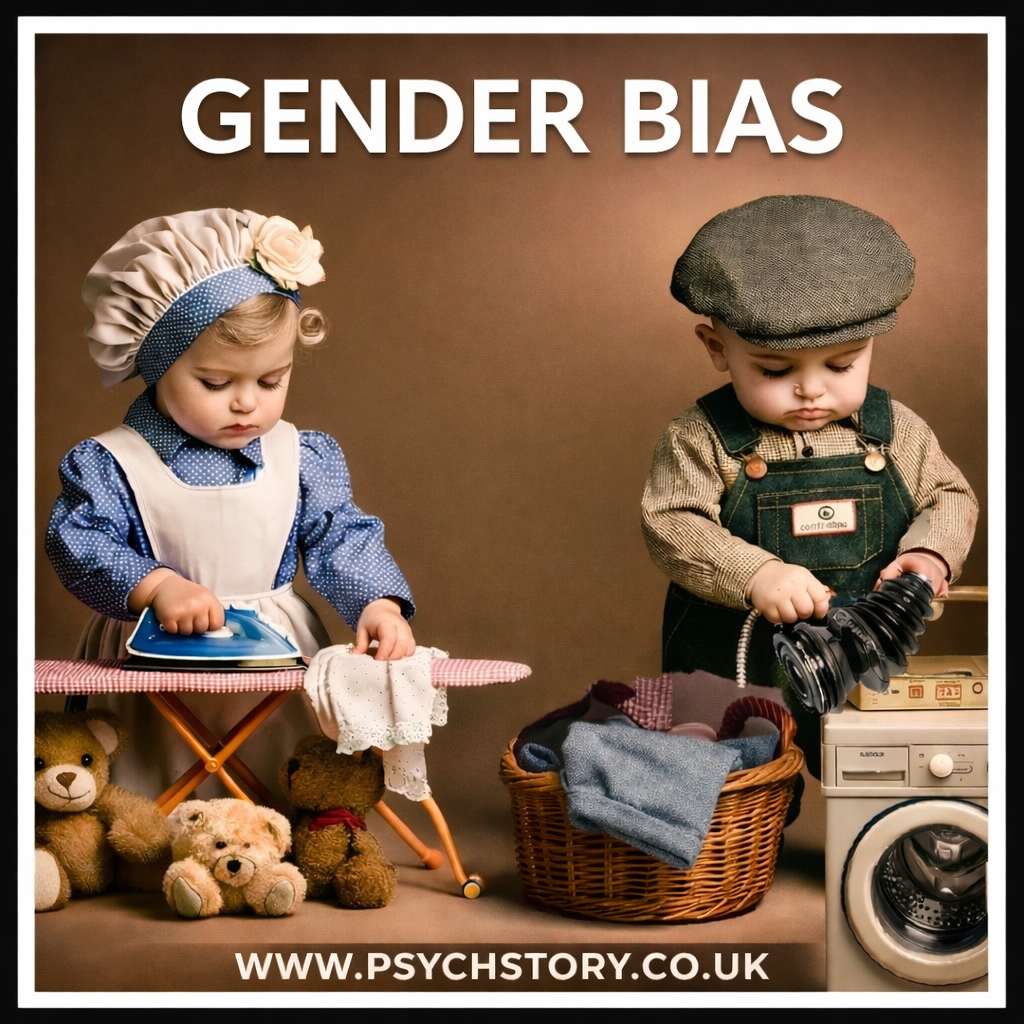
BIOLOGICAL SEX VERSUS GENDER
BIOLOGICAL SEX: Biological sex is the classification of individuals as male or female, based primarily on biological and physiological characteristics. These include:
chromosomes (e.g. XX, XY)
reproductive anatomy
hormones
secondary sexual characteristics
GENDER: Gender refers to the psychological, social and cultural meanings associated with masculinity and femininity. It includes:
gender roles
identity
social expectations
behaviour
cultural norms surrounding what societies define as “male” or “female”
ACTIVITY: MALE AND FEMALE STEREOTYPES
Make two lists — one headed ‘Examples of male stereotypes’ and the other ‘Examples of female stereotypes’. Think of as many examples as you can in each category (e.g. dizzy blonde or knight in shining armour).
Are your lists of similar length? Did you find it equally easy to compile both lists?
If you found it easier to prepare one list than the other, why do you think that was?
Now subdivide each list into two: (a) positive stereotypes and (b) negative stereotypes. How do the male and female lists compare now?
How might your lists differ if you belonged to a different culture?
To what extent do you think that gender stereotypes held by researchers might affect the way that research is carried out?
GENDER BIAS IN PSYCHOLOGY
"Intelligent women are so rare that they are exceptional as a monstrosity, such as a gorilla with two heads; consequently, we may neglect them entirely." — Gustave Le Bon (1879)
Le Bon's claim was widely accepted as legitimate science in 1879. How did men of his generation and cultural background come to believe such claims with such conviction, and what does this tell us about the nature of science itself, and the extent to which it can be shaped by the assumptions of the society producing it?
Psychology likes to present itself as objective, scientific, and detached from culture. Yet for much of its history, many of its theories reflected the values and assumptions of the societies that produced them. Men were often treated as the psychological “norm”, while women were described as emotional, irrational, unstable, dependent, or biologically limited. These ideas were not usually presented as opinion or prejudice. They were presented as science. Gender bias refers to the ways psychological research and theory may distort, simplify, ignore, or misrepresent the behaviour and experiences of men and women. Sometimes this occurs because research is based mainly on male participants. Sometimes it appears in the interpretation of behaviour itself, where identical behaviour may be judged differently depending on whether it is shown by a man or a woman. In other cases, stereotypical assumptions become embedded into theories about intelligence, aggression, attachment, leadership, mental illness, sexuality, or personality. This matters because psychology does not simply describe human behaviour. Psychological theories influence education, parenting, employment, relationships, therapy, criminal justice, and wider cultural attitudes. Once a biased idea becomes accepted within psychology, it can begin to shape how entire societies define what is considered normal, healthy, masculine, feminine, desirable, intelligent, or even mentally stable.
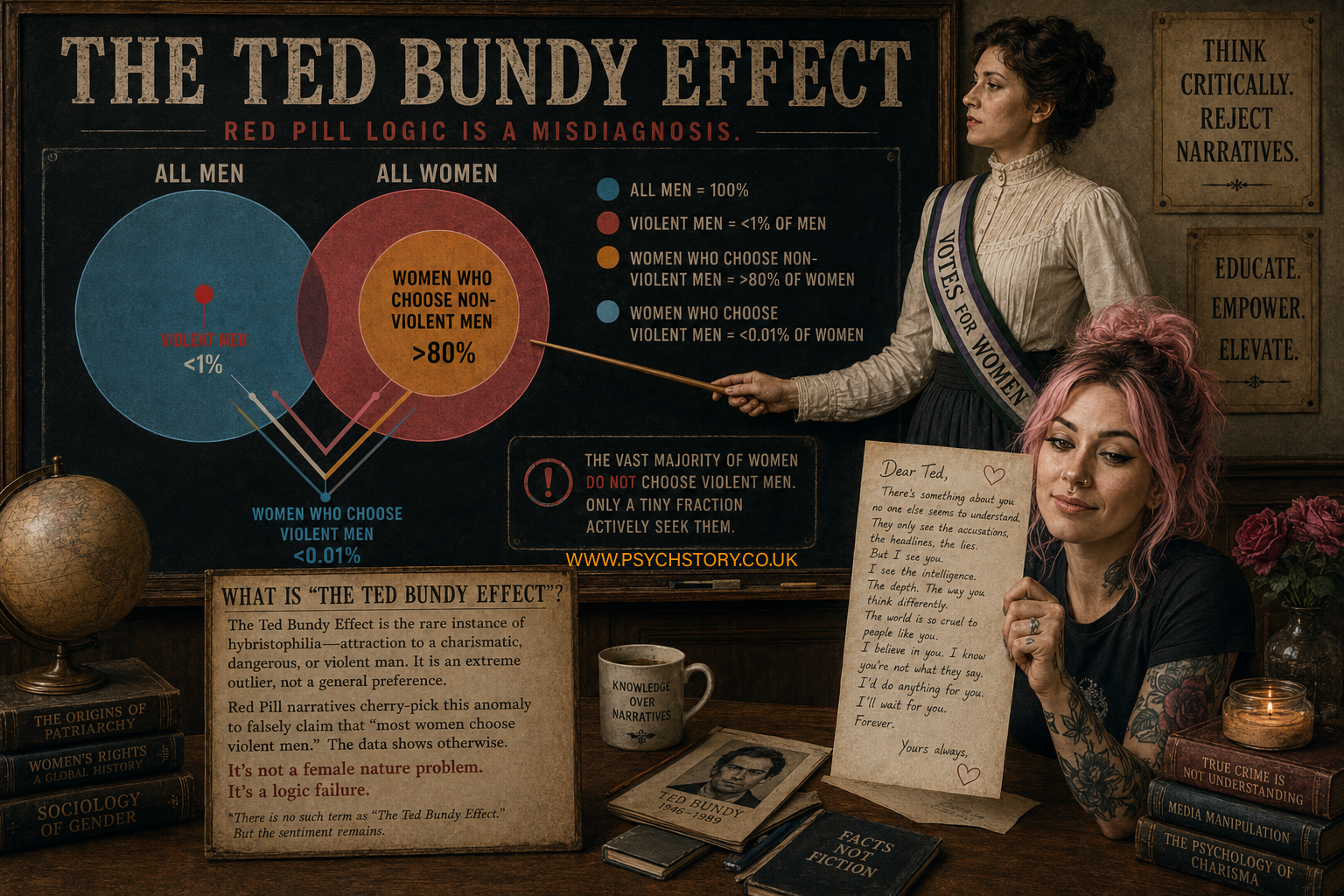
ACTIVITY: NATURE OR NURTURE?
INSTRUCTIONS
Read some of the categories below and decide whether the difference in biological sex is more strongly explained by:
NATURE: Natural explanations focus on biology, genetics, hormones, evolution and inherited characteristics.
NURTURE: Nurture explanations focus on upbringing, culture, learning, reinforcement, social expectations, education and environment.
BOTH NATURE AND NURTURE
For each example, you must:
IDENTIFY whether you think the difference is mainly nature, mainly nurture or both
EXPLAIN why you reached that conclusion
SUPPORT your reasoning with evidence, examples or psychological knowledge where possible
AGGRESSION, VIOLENCE AND CRIME: Men commit approximately 88% of homicides worldwide and are responsible for the majority of violent assaults, armed robberies and serious violent offences across cultures and historical periods. Men are also far more likely to be both perpetrators and victims of serious violence. In most countries, the majority of homicide victims are male, and most are killed by other males. Female homicide victims are more likely than male victims to be killed by an intimate partner or family member. Women commit substantially fewer violent crimes than men and are less likely to engage in direct physical aggression. However, some researchers argue that women are more likely to employ indirect or relational forms of aggression, including gossip, social exclusion and reputational manipulation. Refs: Archer (2004), Daly and Wilson (1988), Maccoby and Jacklin (1974), UN Crime Statistics.
SEXUAL OFFENDING: Sexual offending shows one of the largest and most consistent sex differences in psychology and criminology. Approximately 95% to 99% of convicted rape offenders are male, and men commit the overwhelming majority of sexual assaults, child sexual abuse offences and other serious sexual crimes across cultures and historical periods. Whilst women can and do commit sexual offences, they represent a small minority of convicted offenders. Refs: Ministry of Justice, Crime Survey for England and Wales, Archer (2004).
INCARCERATION: Men are vastly overrepresented in prison populations worldwide. In most countries, males account for more than 90% of prisoners and the majority of repeat offenders. In England and Wales, approximately 96% of the prison population is male. Similar figures are found across Europe, North America, South America, Africa and Asia. Refs: World Prison Brief, Ministry of Justice, UN Crime Statistics.
SUBSTANCE USE AND ADDICTION: Men historically show higher rates of alcohol abuse, illicit drug use, gambling addiction, substance misuse disorders and drug-related mortality. Men are also more likely to die from alcohol related diseases, liver disease, overdoses and accidents linked to substance use. Women, however, are prescribed significantly more psychotropic medication. Antidepressant use is approximately twice as high in women, with US data showing around 17.7% of women taking antidepressants compared with 8.4% of men. Women are also more likely to be prescribed anti-anxiety medications, sedatives and sleeping tablets. Antipsychotic use is more mixed. Men are more likely to be diagnosed with disorders such as schizophrenia and often show slightly higher use of some antipsychotic medications, whereas women are more likely to receive multiple psychotropic prescriptions overall. Refs: WHO Substance Use Reports, NIDA Statistics, CDC Antidepressant Use Data, Boyd et al. (2015), Seifert et al. (2021).
HOMELESSNESS: Men account for approximately 70% to 80% of homeless populations and rough sleepers in many Western countries. Long-term street homelessness is also predominantly male. Refs: Crisis UK, Shelter, US Department of Housing and Urban Development.
RISK TAKING AND DANGEROUS BEHAVIOUR: Men are more likely to engage in dangerous driving, gambling, reckless behaviour, and physical risk-taking. Men account for approximately 75% of road traffic fatalities worldwide and receive substantially more convictions for dangerous driving offences. Refs: WHO Road Safety Data, UK Department for Transport Statistics.
WORKPLACE DEATHS: Men account for approximately 95% of workplace fatalities in the UK and most industrialised nations, particularly in construction, mining, heavy industry, fishing and transport. Refs: UK Health and Safety Executive, International Labour Organisation.
SEXUAL AND ROMANTIC OUTSOURCING: Men are substantially more likely to purchase sexual services, consume visual pornography and pay for sexually explicit online content. Across countries where data are available, between 10% and 20% of men report having paid for sex at least once compared with fewer than 1% of women. Surveys typically find that approximately 70% to 90% of men report pornography consumption compared with approximately 30% to 60% of women. Men are also considerably more likely to be daily pornography users. Sex differences are also found in the type of sexual content consumed. Men show greater interest in visual pornography, sexual novelty, anonymous sexual encounters and a wider variety of sexual categories. Female pornography consumption tends to be lower overall but is more likely to involve relationship-based, narrative-driven or female-focused content. Women also account for the majority of consumers of romance fiction and erotic fiction. Romance publishing generates billions annually, and women account for approximately 80% of romance novel purchasers. Erotic fiction readership is also overwhelmingly female. OnlyFans shows a similar pattern. The majority of content creators are female, whilst the majority of paying subscribers are male. Estimates typically suggest that around 70% to 80% of creators are women, and over 80% of paying customers are men. Refs: Hald (2006), Regnerus et al. (2016), Weitzer (2005), Pornhub Insights, OnlyFans Industry Data, Nielsen BookScan.
SEXUAL BEHAVIOUR AND MATE PREFERENCES: Men consistently report greater interest in casual sex, short-term mating and sexual variety than women. Clark and Hatfield (1989) found that approximately 75% of men agreed to a casual sexual encounter with a stranger compared with 0% of women. Schmitt's (2005) study of more than 16,000 participants across 52 nations found that men reported a greater desire for uncommitted sexual relationships in every culture examined. Refs: Clark and Hatfield (1989), Schmitt (2005).
NUMBER OF SEXUAL PARTNERS: Men generally report higher desired numbers of sexual partners than women. Buss and Schmitt (1993) found that men expressed a desire for significantly more sexual partners across one month, one year, five years and a lifetime. However, actual lifetime partner counts are often substantially closer than stated preferences suggest. Refs: Buss and Schmitt (1993), Schmitt (2005).
EXTRAMARITAL AFFAIRS: Men report higher rates of infidelity than women, although the gap appears to have narrowed in younger generations. Data from the US General Social Survey typically finds that approximately 20% of married men report having had an extramarital affair compared with approximately 13% to 15% of married women. Refs: General Social Survey.
DIVORCE INITIATION: Approximately 65% to 70% of divorces are initiated by women. Among university-educated couples, some studies report figures approaching 90%. Refs: Rosenfeld (2015).
CHILDCARE, CUSTODY AND PARENTAL INVOLVEMENT: Women perform approximately 60% to 70% of unpaid childcare and domestic labour across most Western countries. In the United Kingdom, approximately 85% of lone parent households are headed by mothers and approximately 15% by fathers. Following parental separation, children reside primarily with their mother in approximately 65% of cases, with their father in approximately 12% of cases, and in shared care arrangements in approximately 20% to 25% of cases, depending on the country and definition used. In England and Wales, the proportion of children in shared care arrangements increased from approximately 9% in 2007 to around 30% by the early 2020s. Around 4% of fathers apply for sole custody through the courts. Estimates suggest that approximately 50% of non-resident fathers see their children at least once per week, whilst around 10% to 20% report little or no contact. Refs: ONS, OECD Family Database, Family Resources Survey, Department for Work and Pensions, Pew Research Centre, US Census Bureau.
HOUSEHOLD PURCHASING DECISIONS: Women influence or directly control approximately 70% to 80% of consumer purchasing decisions in many Western economies, particularly in relation to food, clothing, childcare and household spending. Refs: Nielsen, Forbes.
MENTAL HEALTH, PERSONALITY AND PSYCHOLOGICAL DISORDERS: Sex differences are observed across many psychological disorders, although the size of these differences varies considerably. Males are diagnosed more frequently with autism spectrum conditions (approximately 3–4:1), ADHD (approximately 2–3:1 in childhood), conduct disorder, oppositional defiant disorder, antisocial personality disorder (approximately 3–5:1), substance use disorders, gambling disorder and several externalising disorders characterised by impulsivity, aggression and behavioural disinhibition. Males are also overrepresented amongst school exclusions, youth offending populations and prison populations.
Females are diagnosed more frequently with anxiety disorders, major depression, social anxiety disorder, panic disorder, post-traumatic stress disorder and eating disorders. Women are approximately twice as likely as men to receive a diagnosis of major depressive disorder and most anxiety disorders. Borderline personality disorder is diagnosed more frequently in women, although some researchers argue that diagnostic practices may contribute to this difference. Females also report higher levels of rumination, body dissatisfaction and self-harm.
Some disorders show smaller or more complex sex differences. Obsessive-compulsive disorder occurs at broadly similar rates overall, although symptom patterns may differ (HOW ). Schizophrenia occurs in both sexes, but males typically show an earlier age of onset, poorer premorbid functioning and more severe negative symptoms. Narcissistic personality disorder is diagnosed more frequently in males, with some studies reporting approximately 50% to 75% of diagnosed cases being male. Bipolar disorder shows relatively similar prevalence rates across sexes, although women are more likely to experience rapid cycling and mixed episodes.
Interpretation of these findings is complicated by potential diagnostic and referral biases. Boys are more likely to display externalising symptoms such as hyperactivity, impulsivity, aggression and disruptive behaviour, making conditions such as ADHD and autism more visible to parents, teachers and clinicians. Girls often present differently, with greater social masking and fewer overt behavioural difficulties, leading some researchers to argue that female autism and ADHD are underdiagnosed. Conversely, women are more likely to seek medical and psychological help and therefore receive formal diagnoses of depression and anxiety, whereas men are less likely to access mental health services and are more likely to self-medicate through alcohol, illicit drug use, risk-taking or antisocial behaviour. Consequently, some observed sex differences may reflect patterns of diagnosis and help-seeking behaviour as well as genuine differences in prevalence. Refs: APA, DSM-5, WHO, Nolen-Hoeksema (2001), Loomes et al. (2017), Torgersen et al. (2001), Quinn and Madhoo (2014), Lai et al. (2015).
COGNITIVE, SOCIAL AND COMMUNICATION DIFFERENCES: Women generally score higher on measures of empathy, emotional recognition, interpersonal sensitivity and facial expression recognition. Female infants also tend to show greater eye contact and social attentiveness in some developmental studies. Girls typically develop language slightly earlier than boys and often outperform boys on verbal fluency, reading and communication tasks during childhood. Girls also consistently outperform boys on reading and literacy assessments across most developed countries. Men often outperform women on certain visuospatial tasks. These include mental rotation, which involves imagining how an object would appear after rotation in space, three-dimensional visualisation, large-scale navigation, route-finding, map reading, and some forms of target-acquisition accuracy. Men also tend to score higher on measures of systemising, which involves identifying patterns, rules and relationships within systems. Refs: Simon Baron-Cohen (2002, 2003), Hoffman (1977), Herlitz and Lovén (2013), Hyde and Linn (1988), Halpern (2012), Voyer et al. (1995), Linn and Petersen (1985), PISA Studies. The greater male variability hypothesis, however, remains controversial. The hypothesis proposes that males are overrepresented at both the highest and lowest ends of intelligence distributions. Unlike theories suggesting higher average intelligence, most modern research finds little or no meaningful difference in average IQ between males and females. Instead, the claim is that males are more likely to appear at the extremes. For example, studies of mathematically precocious youth have reported male ratios ranging from approximately 2:1 to more than 10:1 amongst the very highest scorers, depending on the score threshold used. Males are also overrepresented amongst those with intellectual disabilities, learning difficulties and several neurodevelopmental disorders. Supporters argue that this pattern has been reported repeatedly across intelligence testing, educational attainment and mathematical performance and helps explain why males are disproportionately represented amongst both elite intellectual achievers and those experiencing significant cognitive difficulties. Critics argue that the evidence is more complex than such explanations suggest. The size of the effect varies substantially depending on the ability being measured. Male ’ advantages are reported most consistently for certain spatial and mathematical tasks, whereas females typically outperform males on reading achievement, verbal fluency, spelling accuracy and language development. International PISA assessments, for example, consistently find female advantages in reading literacy of approximately 25 to 40 points across OECD countries. Mathematical differences are generally much smaller and less consistent. Some countries report negligible differences in average mathematical performance, whilst others report modest male advantages. Critics, therefore, argue that if cognitive sex differences were primarily biological, greater consistency across cultures might be expected. They also note that the proportion of females in higher education, advanced mathematics, and scientific careers has increased dramatically over the past century, suggesting that educational opportunity and social factors may influence outcomes previously attributed solely to cognitive differences. Refs: Benbow and Stanley (1980), Hyde (2005), Halpern (2012), Ceci and Williams (2010), PISA Studies.
INTELLIGENCE, ACHIEVEMENT AND COGNITIVE DIFFERENCES: Most research finds little or no difference in average IQ between males and females. However, some researchers have argued that males are more likely to be found at both extremes of intelligence distributions. In other words, males appear more frequently amongst both exceptionally gifted individuals and those with intellectual disabilities or severe learning difficulties. This pattern has been used to explain why men are disproportionately represented amongst Nobel Prize winners, elite mathematicians, inventors and scientific innovators, whilst also being overrepresented amongst school exclusions, learning disabilities and some developmental disorders. The greater male variability hypothesis, however, remains controversial. The hypothesis proposes that males are overrepresented at both the highest and lowest ends of intelligence distributions. Unlike theories suggesting higher average intelligence, most modern research finds little or no meaningful difference in average IQ between males and females. Instead, the claim is that males are more likely to appear at the extremes. For example, studies of mathematically precocious youth have reported male ratios ranging from approximately 2:1 to more than 10:1 amongst the very highest scorers, depending on the score threshold used. Males are also overrepresented amongst those with intellectual disabilities, learning difficulties and several neurodevelopmental disorders. Supporters argue that this pattern has been reported repeatedly across intelligence testing, educational attainment and mathematical performance and helps explain why males are disproportionately represented amongst both elite intellectual achievers and those experiencing significant cognitive difficulties. Critics argue that the evidence is more complex than such explanations suggest. The size of the effect varies substantially depending on the ability being measured. Males' advantages are reported most consistently for certain spatial and mathematical tasks, whereas females typically outperform males on reading achievement, verbal fluency, spelling accuracy and language development. International PISA assessments, for example, consistently find female advantages in reading literacy of approximately 25 to 40 points across OECD countries. Mathematical differences are generally much smaller and less consistent. Some countries report negligible differences in average mathematical performance, whilst others report modest male advantages. Critics, therefore, argue that if cognitive sex differences were primarily biological, greater consistency across cultures might be expected. They also note that the proportion of females in higher education, advanced mathematics, and scientific careers has increased dramatically over the past century, suggesting that educational opportunity and social factors may influence outcomes previously attributed solely to cognitive differences. Refs: Benbow and Stanley (1980), Hyde (2005), Halpern (2012), Ceci and Williams (2010), PISA Studies.
STEM AND ACADEMIC SUBJECT CHOICES: Men are overrepresented in engineering, physics and computer science, whereas women are overrepresented in psychology, education, nursing and biological sciences. These patterns are observed across many countries. Refs: Su et al. (2009), Lippa (1998), Ceci and Williams (2010).
UNIVERSITY ATTENDANCE: Women now outnumber men in higher education across most Western countries. Refs: UNESCO, Higher Education Statistics Agency.
PHYSICAL STRENGTH AND SPORTS PERFORMANCE: Men possess approximately 40% to 60% greater upper body strength on average and approximately 30% greater lower body strength. Men outperform women in most speed, strength and power-based sports categories after puberty. Refs: Miller et al. (1993), Handelsman et al. (2018).
LIFE EXPECTANCY: Women live approximately 4 to 5 years longer than men, on average, in most developed countries. Men show higher mortality rates from violence, accidents, suicide, cardiovascular disease and risk-related behaviour. Refs: WHO Life Expectancy Data, Office for National Statistics.
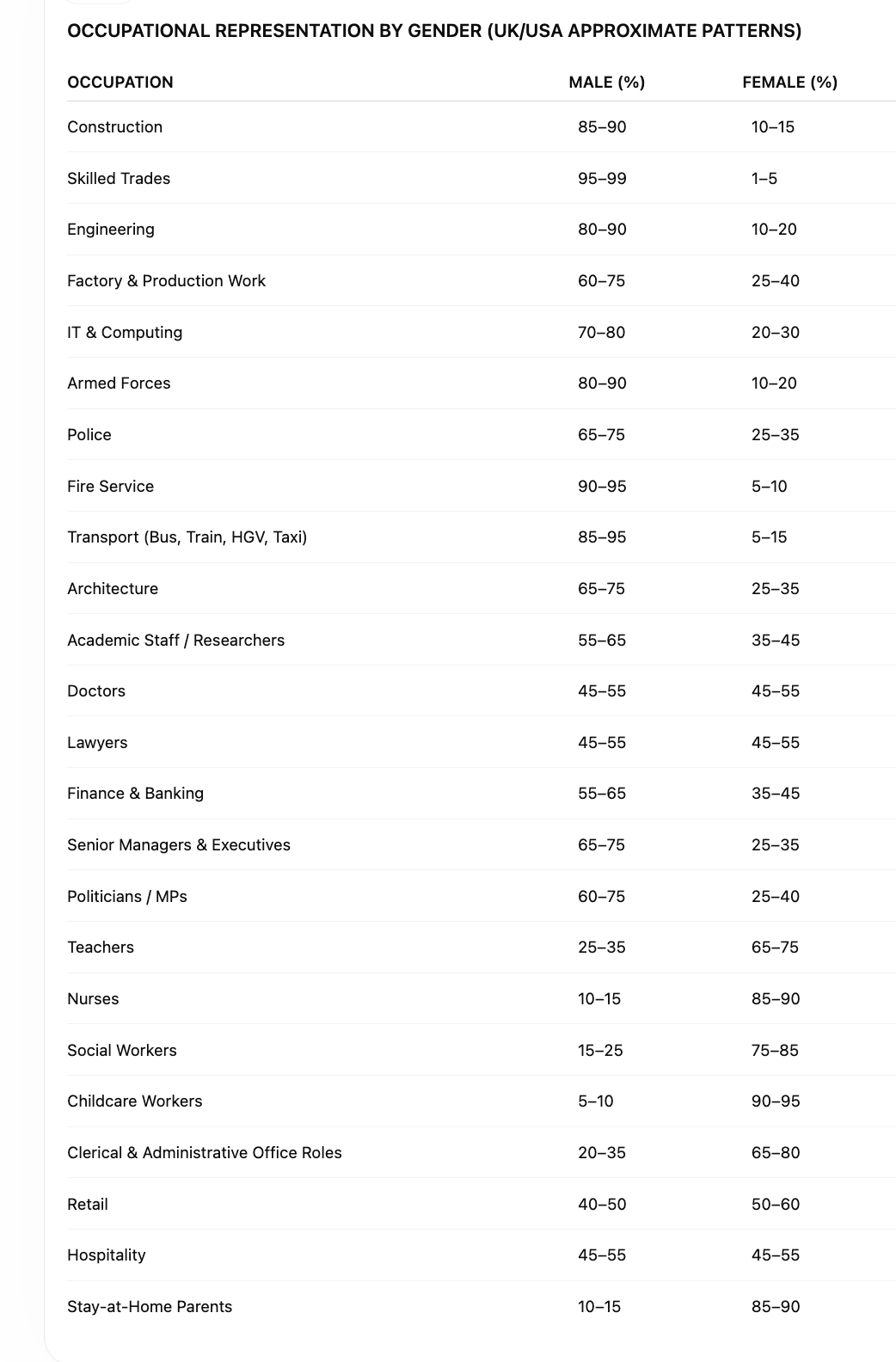
CAREER CHOICE AND OCCUPATIONAL DIFFERENCES:
A HISTORICAL LOOK AT GENDER BIAS
Gender bias did not originate within psychology. It reflects a much longer history of cultural, religious, philosophical and scientific beliefs about the nature of men and women. For most of recorded history, societies were patriarchal, meaning that political power, economic resources and social authority were concentrated largely in the hands of men. Women were often excluded from education, voting, property ownership, professional careers and positions of leadership. Such inequalities were not usually viewed as discrimination but as the natural consequence of presumed differences between the sexes.
Many early cultures viewed men and women as fundamentally different in intellect, temperament and social function. Men were associated with reason, authority, independence, and leadership, whilst women were associated with emotion, dependence, caregiving, and domestic responsibilities. These assumptions became deeply embedded within religion, philosophy, medicine and law, shaping how women were viewed for centuries. When science emerged as a dominant way of understanding human behaviour during the nineteenth century, many of these assumptions were incorporated into supposedly objective scientific theories. Scientists attempted to explain female inferiority through measurements of skull size, brain weight and anatomy. Biological differences between men and women were often interpreted as evidence of intellectual, moral or psychological differences. Rather than questioning whether women were inferior, researchers frequently assumed it to be true and sought evidence to support it.
Early psychology inherited many of these beliefs. Sex differences were often treated as innate, fixed and biologically determined. Psychological theories commonly assumed that men and women possessed fundamentally different natures and that these differences explained social roles and inequalities. This reflected what would later be known as alpha bias, in which differences between the sexes are exaggerated and viewed as psychologically significant. During the twentieth century, major social changes began to challenge these assumptions. Women gained greater access to education, employment and political rights. As women entered universities and professional careers in larger numbers, traditional claims about female intellectual inferiority became increasingly difficult to defend. The rise of feminism encouraged psychologists to question whether many apparent sex differences reflected biology or socialisation.
Researchers began to recognise that psychology itself might be biased. Many studies have been conducted primarily on men and then generalised to women. Behaviours associated with men were often treated as normal or standard, whilst behaviours associated with women were viewed as deviations from that norm. Feminist psychologists argued that psychological theories frequently reflected the values and assumptions of the societies in which they were developed. As a result, psychology gradually shifted away from strong alpha bias and towards greater emphasis on similarities between men and women. Researchers have increasingly highlighted the substantial overlap between the sexes in intelligence, personality, and cognitive abilities. Socialisation, culture and gender roles became more prominent explanations for behavioural differences.
Today, gender bias remains an important issue, although the nature of the debate has changed. Earlier psychologists were criticised for exaggerating biological differences and using them to justify inequality. Contemporary debates focus more on how biological factors, socialisation, identity and culture interact to shape behaviour. Modern psychology, therefore, faces the challenge of recognising genuine sex differences where they exist whilst avoiding stereotypes, discrimination and overly simplistic explanations.
ACTIVITY: NATURE OR NURTURE?
WHICH OF THE FOLLOWING BEST REFLECTS YOUR VIEW?
A. MEN AND WOMEN ARE FUNDAMENTALLY DIFFERENT
Biological sex creates substantial psychological and behavioural differences across most areas of life.
B. MEN AND WOMEN ARE MOSTLY DIFFERENT, BUT WITH SOME SIMILARITIES
Biological sex influences many traits and behaviours, although there is overlap between the sexes.
C. MEN AND WOMEN ARE EQUALLY DIFFERENT AND SIMILAR
Some characteristics show meaningful sex differences, whilst others show little or no difference.
D. MEN AND WOMEN ARE MOSTLY SIMILAR, BUT WITH SOME DIFFERENCES
Most psychological characteristics are shared, although a number of sex differences exist.
E. MEN AND WOMEN ARE FUNDAMENTALLY SIMILAR
Psychological and behavioural differences are generally small, with most observed differences reflecting social and cultural influences
DIFFERENT TYPES OF GENDER BIAS

ALPHA BIAS
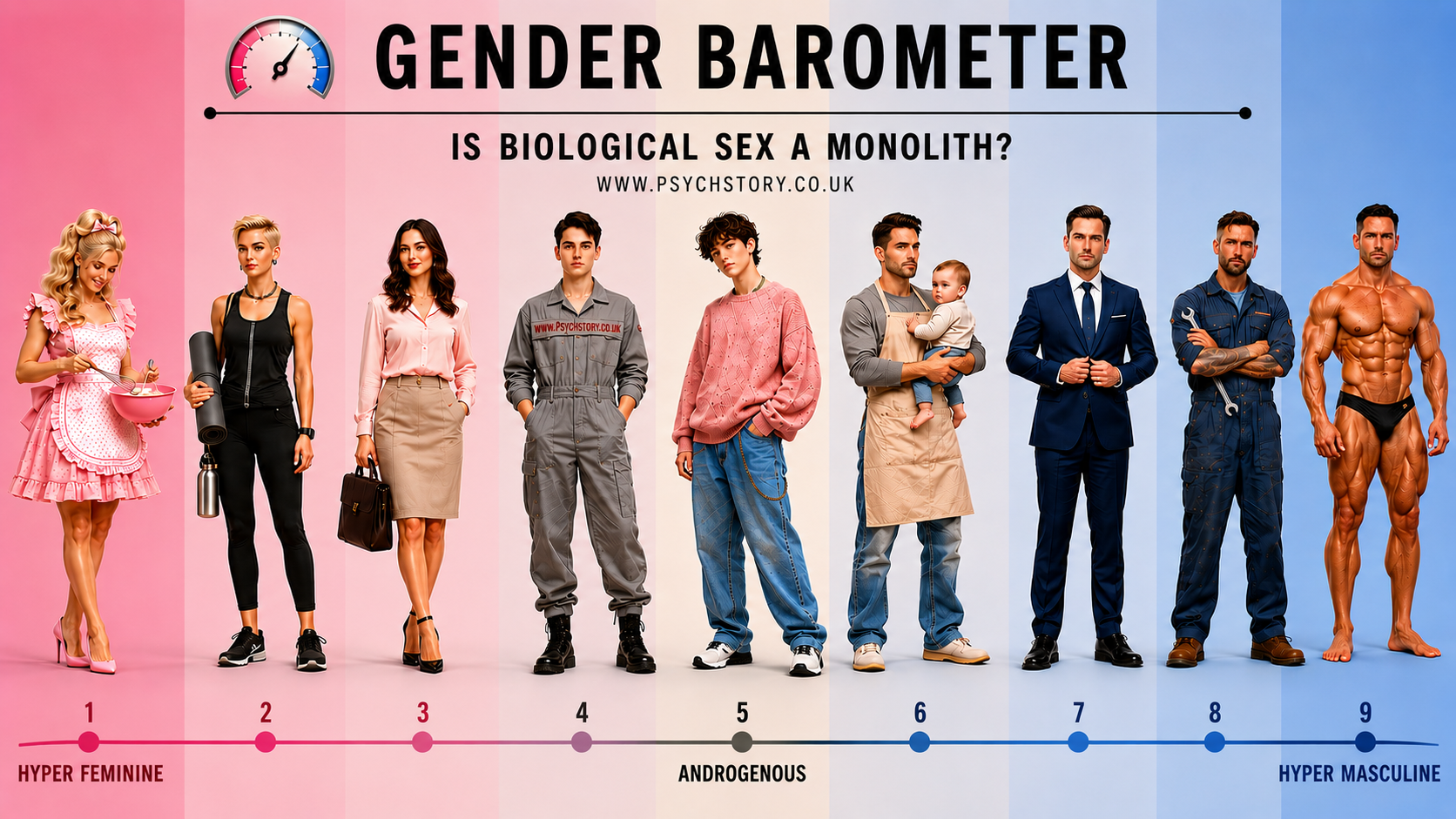
Alpha bias exaggerates differences between males and females. It assumes that men and women differ in important psychological, behavioural or biological ways and that these differences are meaningful for understanding human behaviour. Alpha-biased theories emphasise distinction over similarity and focus on characteristics that separate males and females into distinct categories.
Some alpha-biased explanations view these differences as biologically based, innate, universal and deterministic. In Biological Psychology and Neuroscience, alpha bias can occur when sex differences in chromosomes, hormones, brain structure or neurochemistry are used to explain behavioural differences between men and women. For example, differences in testosterone levels have been linked to aggression, dominance, competitiveness and risk-taking. Similarly, sex differences in brain organisation have been used to explain differences in emotional processing, spatial ability and language.
Evolutionary psychology also provides examples of alpha bias, as it assumes that males and females evolved distinct psychological adaptations in response to distinct reproductive challenges. Sexual selection theory proposes that males evolved to maximise reproductive success through competition and multiple mating opportunities, whilst females evolved to be more selective in mate choice because of the greater biological costs associated with reproduction. Consequently, males are often described as more aggressive, competitive, risk-taking and sexually motivated, whereas females are described as more nurturing, relationship-focused and selective.
Other alpha-biased explanations view sex differences as the product of socialisation, culture and gender roles rather than biology. For example, Social Learning Theory argues that boys and girls learn different behaviours through observation, imitation and reinforcement. Children are rewarded for behaviours that conform to gender expectations and discouraged from behaviours that violate them. As a result, males and females may develop different patterns of behaviour, interests and personality traits. Although Social Learning Theory attributes these differences to environmental influences rather than biology, it still assumes that meaningful psychological differences exist between the sexes.
The psychodynamic approach also provides a clear example of alpha bias because Freud argued that male and female development follow different psychological pathways. Freud’s theory suggested that boys resolve the Oedipus complex through identification with the father, leading to stronger superego development. Girls, however, were said to experience penis envy and to resolve the Electra complex less completely. As a result, Freud claimed that women developed weaker morality and a less fully developed superego than men. This is an alpha bias because male and female development are presented as fundamentally different, with separate explanations given for male and female psychological development
Regardless of the explanation, alpha bias assumes that sex differences are substantial enough to require separate explanations for male and female behaviour.
LIMITATIONS OF ALPHA BIAS
Alpha bias can lead to an overestimation of the magnitude and importance of sex differences. Although males and females differ on a number of biological and psychological characteristics, these differences are usually statistical averages rather than absolute categories. For most traits, the distributions overlap considerably. This means that many females score higher than the average male, and many males score lower than the average female.
For example, males generally have higher testosterone levels than females, and testosterone is associated with aggression, competitiveness and risk-taking. However, testosterone levels vary enormously within each sex. Some women have higher testosterone levels than some men, and individual behaviour is influenced by many biological and environmental factors in addition to hormones. Consequently, average sex differences do not allow accurate predictions about any particular individual.
Alpha bias can also encourage essentialist thinking by treating average tendencies as defining characteristics of males and females. A statistical tendency may therefore become interpreted as a fixed rule. Men may be viewed as naturally aggressive, dominant or emotionally detached, whilst women may be viewed as naturally nurturing, empathic or risk-averse, even though substantial variation exists within both groups.
A further limitation is that alpha-biased theories can exaggerate the extent to which behaviour is determined by sex alone. Most psychological characteristics are influenced by multiple interacting factors, including genetics, hormones, personality, upbringing, culture and life experience. As a result, sex differences are often matters of probability rather than certainty. Alpha bias may therefore oversimplify complex patterns of human behaviour by presenting average group differences as more consistent, universal or psychologically important than they actually are.
STRENGTHS OF ALPHA BIAS
Despite criticism, alpha bias can make an important contribution to psychological science because it prevents researchers from overlooking genuine sex differences. If males and females differ in meaningful ways, theories that assume they are psychologically interchangeable may produce incomplete or inaccurate explanations of behaviour.
One strength of alpha bias is that it encourages psychologists to investigate sex as a potentially important variable. Research has identified consistent sex differences in areas such as violent offending, aggression, suicide completion, autism spectrum conditions, ADHD, occupational preferences, sexual behaviour and some aspects of cognition. These findings suggest that biological sex can influence behaviour and that studying males and females separately may sometimes improve the accuracy of psychological explanations.
Alpha bias has also contributed to advances in medicine, neuroscience and mental health. Historically, many studies used predominantly male samples and generalised findings to females. Recognition of genuine sex differences has improved understanding of conditions that present differently in males and females, including autism, ADHD, cardiovascular disease, depression and schizophrenia. This has led to more targeted assessment, diagnosis and treatment strategies.
A further strength is that alpha bias can challenge overly simplistic assumptions that all behavioural differences are socially constructed. Some sex differences appear repeatedly across cultures, historical periods and, in some cases, across species. Such findings suggest that biology may contribute to at least some behavioural differences and that explanations based entirely on socialisation may be incomplete.
However, the value of alpha bias depends upon recognising that group differences are statistical averages rather than fixed categories. Most psychological traits show substantial overlap between males and females. Consequently, alpha bias is most scientifically useful when it identifies genuine population-level differences whilst avoiding stereotypes, biological determinism and assumptions about individual people
BETA BIAS IN PSYCHOLOGY
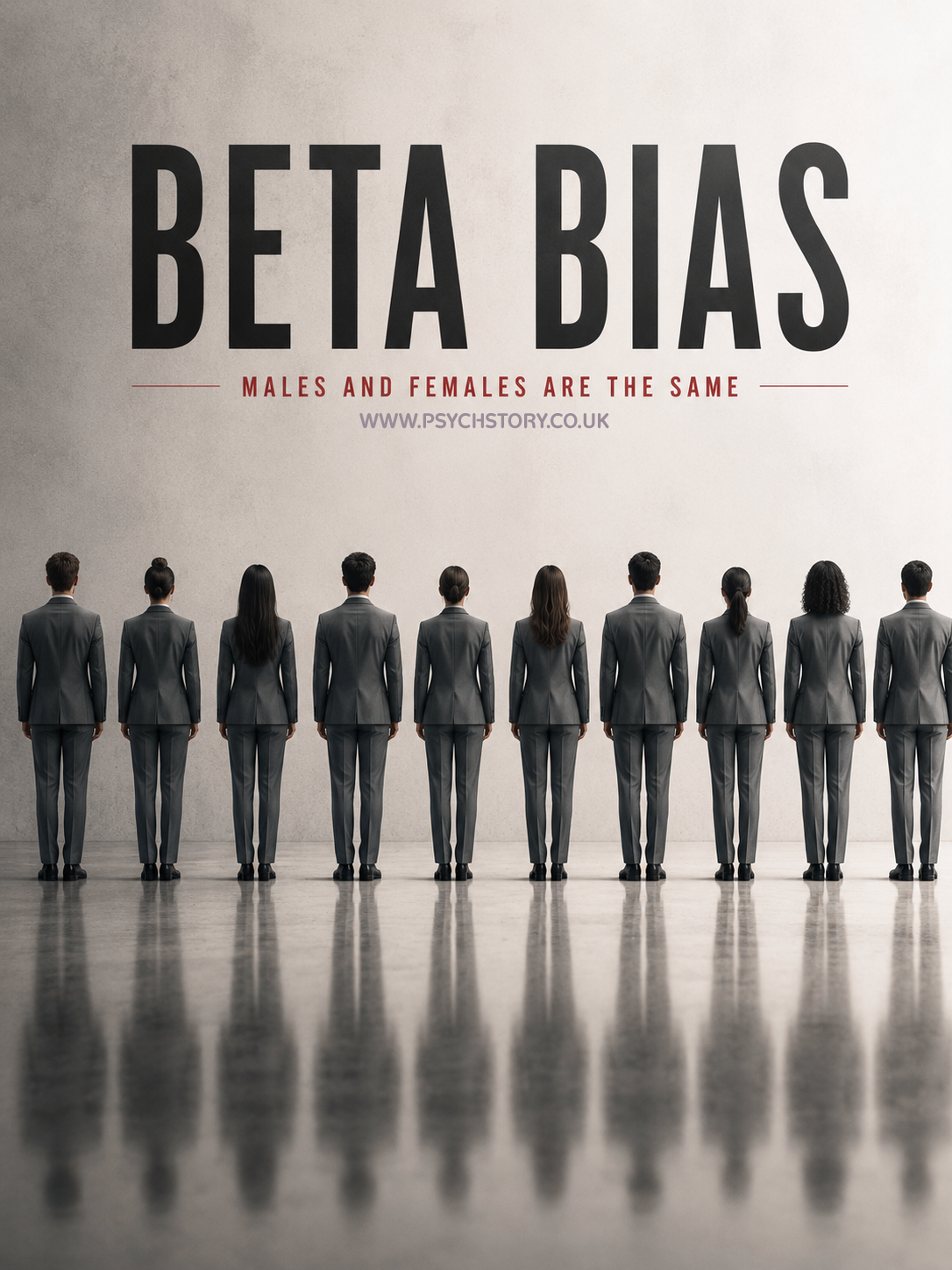
Beta bias occurs when psychologists assume that sex differences are minimal, irrelevant, or unimportant for understanding behaviour. As a result, findings based on one sex are treated as universally applicable to the other. In practice, this has often meant that research conducted primarily on males is used to form general psychological theories about all humans. A clear implication of beta bias is that male participants become the default representation of humanity in psychological science. Female experience is not necessarily denied, but it is not independently theorised; instead, it is assumed to fit within a model constructed from male samples. This can lead to important sex-related differences in cognition, emotion, or behaviour being overlooked entirely. This pattern is particularly visible in early Cognitive Psychology, where foundational studies on memory, perception, and problem-solving frequently used male-only samples but were still presented as universal explanations of human cognition. The assumption underlying this approach is that cognitive processes are essentially sex-neutral, meaning that results from males can be generalised to females without modification. Beta bias, therefore, reflects a form of false universality: it assumes sameness where meaningful differences may exist, and it constructs psychological knowledge from one group while presenting it as representative of all people.
Stress research initially centred on male occupational stress and the fight or flight response, neglecting relational stress patterns more commonly reported by women. Subsequent work suggested a “tend and befriend” pattern in females, linked to oxytocin, that challenges the assumed universality of the fight-or-flight response. Attachment research also reflected beta bias. Early models prioritised the mother-infant dyad and neglected fathers. The assumption was that caregiving was inherently maternal. Contemporary research shows that paternal hormones change in response to infant care and that fathers form secure attachments comparable to mothers. Beta bias can disadvantage women by ignoring gender specific experiences. For example, medical research historically tested drugs primarily on men, leading to dosage miscalculations for women. It can also disadvantage men. Male depression may present differently from female depression. If diagnostic criteria are shaped around female presentation, male distress may be under-recognised.
PSYCHOLOGICAL CHARACTERISTICS SHOWING LITTLE OR NO CONSISTENT SEX DIFFERENCE
Research has found little or no meaningful difference between males and females in many psychological characteristics. Where differences are reported, they are often small and accompanied by substantial overlap between the sexes.
GENERAL INTELLIGENCE (IQ) Most modern research finds little or no difference in average IQ between males and females.
WORKING MEMORY: Males and females generally perform similarly on most working memory tasks.
LONG-TERM MEMORY: Overall memory performance is broadly similar, although males and females sometimes use different strategies.
GENERAL LEARNING ABILITY: Both sexes show comparable ability to acquire and retain new information.
CREATIVITY: Most studies find little difference in average levels of creativity, although males and females may express creativity in different domains.
HAPPINESS AND LIFE SATISFACTION: Average levels of reported happiness and life satisfaction are generally similar.
SELF ESTEEM: Differences are typically small and inconsistent across cultures and age groups.
LEADERSHIP EFFECTIVENESS: Men and women are generally equally effective leaders, although leadership styles may differ.
JOB PERFORMANCE: When performing the same role, men and women generally show similar levels of competence, productivity and effectiveness.
MORAL REASONING: Modern research suggests that males and females are similarly capable of complex moral reasoning, despite earlier claims of sex differences.
CONFORMITY: Large sex differences in conformity are not consistently found, with context often having a greater influence than sex.
OBEDIENCE TO AUTHORITY: Research generally finds little difference between males and females in obedience studies.
GENERAL PERSONALITY FUNCTIONING: Although some average personality differences exist, males and females overlap substantially across all major personality dimensions.
MATHEMATICAL ABILITY (AVERAGE PERFORMANCE): Average mathematical performance is very similar between males and females in most developed countries, although differences sometimes emerge at the extreme ends of distributions.
SCIENTIFIC ABILITY: There is little evidence that one sex possesses a greater innate capacity for scientific reasoning than the other.
PROBLEM SOLVING ABILITY: Overall problem-solving ability is broadly similar between males and females.
ACADEMIC POTENTIAL: Both sexes are equally capable of high academic achievement.
MANAGERIAL COMPETENCE: Research generally finds little difference in overall management effectiveness between male and female managers.
POLITICAL INTELLIGENCE AND POLITICAL COMPETENCE: There is no evidence that men and women differ in their ability to understand political issues, evaluate evidence, engage in political reasoning or participate effectively in democratic decision making. Whilst men and women often differ in political preferences and voting patterns, these differences do not reflect differences in political competence or intelligence.
ETHICAL BEHAVIOUR: No consistent evidence suggests that one sex is inherently more ethical, honest or moral than the other.
CAPACITY FOR NURTURING AND ATTACHMENT: Both sexes are capable of forming strong emotional bonds, attachment relationships and caring behaviours, despite differences in average caregiving roles.
CAPACITY FOR LEARNING LEADERSHIP SKILLS: Men and women appear equally capable of acquiring leadership, communication and organisational skills through education, training and experience.
GENERAL COGNITIVE CAPACITY: Across most areas of cognition, males and females show far more similarities than differences. Many reported sex differences are small in magnitude and are accompanied by substantial overlap between male and female distributions.
Refs: Hyde (2005), Hyde et al. (2019), Halpern (2012), Eagly and Johnson (1990), Costa and McCrae (1992), APA, PISA Studies
EXAMPLES OF BETA BIASED RESEARCH
Hazan and Shaver's attachment study used a mixed sample of men and women but presented the resulting attachment styles as a general theory of adult romantic relationships, without analysing whether the patterns held differently across the sexes.
Rosenthal's research on experimenter effects used both male and female participants and found a real difference in how they were treated, but this difference was minimised as a methodological artefact rather than addressed as a substantive finding.
Rutter's Romanian orphan studies used a mixed sample of boys and girls but presented the effects of institutional deprivation and the capacity for recovery as general conclusions, without analysing whether deprivation or recovery differed by sex.
STRENGTHS OF BETA BIAS :
• It promotes equality by rejecting differences.
• It avoids stereotyping.
LIMITATIONS OF BETA BIAS
• It can conceal genuine biological or social variation.
• It may produce inappropriate generalisation.
• It risks treating male patterns as universal human norms.

ANDROCENTRISM IN PSYCHOLOGY
Even when researchers believed they were being unbiased and just studying “human behaviour,” they were frequently studying only men. They were also assuming the findings applied equally to women. For example, early psychological research relied heavily on male university students as participants, largely because universities themselves were dominated by men. This meant that theories of intelligence, morality, personality, aggression, and even mental illness were often based almost entirely on male samples. Women were either excluded from research altogether or judged against standards based on male behaviour. This does not mean that women made no contribution to psychology.
ANDROCENTRISM IN PSYCHOLOGY:
Androcentrism refers to a male-centred framework in which male behaviour, experiences and values are treated as the default standard for understanding human psychology. Male experience becomes positioned as “normal” human behaviour, whilst female experience is ignored, compared against male standards, or treated as secondary. Androcentrism underlies both alpha bias and beta bias.
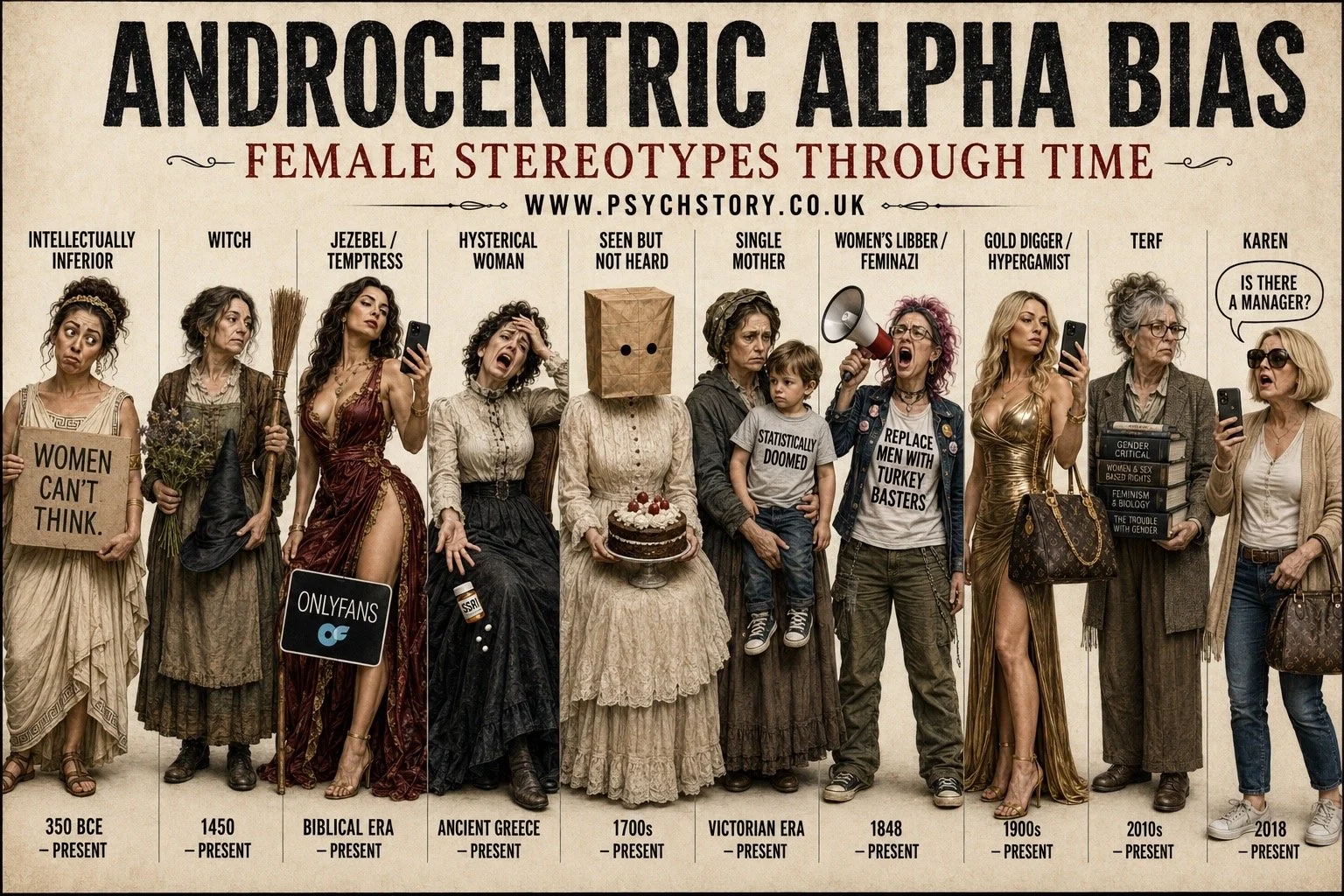
ANDROCENTRIC ALPHA BIAS
Androcentric alpha bias occurs when psychological theories exaggerate differences between males and females whilst simultaneously presenting male characteristics as more desirable, rational, mature, evolved or psychologically superior.
IN THIS FORM OF BIAS:
Males and females are viewed as fundamentally different
Masculine traits are valued more positively
Female behaviour may be portrayed as weaker, deficient or less developed
EXAMPLES INCLUDE:
Freud’s portrayal of women through “penis envy”
Victorian beliefs that women were too emotional or irrational for higher education
Theories presenting aggression, dominance and rationality as superior masculine traits
ANDROCENTRIC BETA BIAS:
Androcentric beta bias occurs when male behaviour is treated as universally representative of human behaviour. Sex differences are minimised or ignored, and findings based on male samples are generalised to females. Male experience is therefore treated as neutral and universal rather than sex-specific. This is most evident in early experimental psychology, where male-only samples were frequently used, but findings were still presented as general principles of cognition and behaviour. The underlying assumption is that psychological processes operate similarly across sexes, making a separate investigation of female experience unnecessary.
IN THIS FORM OF BIAS:
Males dominate research samples
Male experiences shape theories
Female differences are ignored or minimised
Male norms become treated as “human norms”
EXAMPLES INCLUDE:
Milgram, Asch and Zimbardo used predominantly male participants whilst generalising findings to all humans
Early fight or flight research was conducted mainly on male animals and was assumed to apply equally to females
diagnostic criteria built largely around male symptom presentation
Kohlberg’s stages of moral development are being treated as universal despite male-centred samples
KEY DIFFERENCES BETWEEN THE TWO FORMS OF ALPHA BIAS
Androcentric alpha bias exaggerates differences between males and females, whilst valuing the male side more highly.
Androcentric beta bias ignores differences because male behaviour is treated as representative of all humans.
In both cases, male experience remains the reference point around which psychological theory is constructed
KOHLBERG AS AN EXAMPLE OF ANDROCENTRIC BETA AND ALPHA BIAS
Lawrence Kohlberg’s theory of moral development demonstrates both androcentric beta and alpha biases in a particularly clear way. The theory shows androcentric beta bias because it was developed primarily using male participants and based on responses to male-oriented moral dilemmas, such as the Heinz dilemma, which focuses on justice, law, and property rights. Despite this male-based foundation, Kohlberg presented his stage theory as a universal model of moral development applicable to all humans. This involves assuming that a male-derived structure of moral reasoning can be generalised across sexes without requiring a fundamentally different model for females. Carol Gilligan argued that this reflects a masculine orientation toward morality, privileging justice-based reasoning more commonly associated with male participants, while care-based moral reasoning, more commonly found in female participants, is placed lower within the hierarchy. As a result, female moral reasoning appears less advanced within the model, not because it is inherently inferior, but because the theory defines moral maturity in a way that aligns with a male-centred conception of morality. At the same time, the theory shows androcentric alpha bias. Kohlberg defined the highest stage of moral reasoning as Stage 6: Universal Ethical Principles, which is based on abstract justice reasoning. Because women and girls more often use moral reasoning that is based on relationships, contextual understanding, and an ethic of care when responding to moral dilemmas, their reasoning is more likely to be scored at lower stages within Kohlberg’s framework. However, this difference does not necessarily reflect a genuine lack of moral development. Instead, it reflects the fact that Kohlberg’s definition of the highest level of moral reasoning is based on a justice-oriented model of morality that is more closely associated with male participants. The bias, therefore, lies in the structure of the theory itself, which treats one style of moral reasoning as the standard for moral maturity, making other forms of reasoning appear less advanced

.
OESTROCENTRIC BIAS
Also known as estrocentic bias
Oestrocentric bias refers to a female-centred form of gender bias in which female behaviour, values or psychological characteristics are treated as psychologically healthier, morally superior or more socially desirable than male characteristics. In theory, oestrocentrism is the opposite of androcentrism. However, genuinely oestrocentric psychology is relatively rare because psychology historically developed within overwhelmingly male-dominated academic, medical and scientific institutions. Most mainstream theories were therefore constructed around male norms long before women entered psychology in substantial numbers. Ironically, many theories labelled “oestrocentric” were not originally attempts to centre women, but attempts to challenge earlier androcentric alpha bias. In other words, they emerged reactively rather than independently. Karen Horney, for example, rejected Freud’s portrayal of women as biologically and psychologically inferior. Freud argued that women suffered from penis envy and weaker moral development, whereas Horney countered that men may experience “womb envy” because they cannot reproduce or nurture life biologically. However, Horney’s work was fundamentally a rebuttal to psychoanalytic misogyny rather than a fully female-centred system replacing male psychology.
Similarly, Carol Gilligan criticised Kohlberg’s theory of moral development for defining higher morality in terms of male-associated justice reasoning. Gilligan argued that women often reason morally through empathy, care and interpersonal responsibility rather than abstract legal principles. Again, this was not simply “women are superior,” but a challenge to the assumption that male morality represented the universal standard. Some feminist approaches have also been accused of oestrocentric alpha bias when they portray women as naturally more empathic, cooperative, emotionally intelligent or morally advanced than men. Likewise, some contemporary social narratives can portray masculinity itself as inherently toxic, aggressive or emotionally deficient whilst idealising feminine traits as socially healthier or more ethical. However, critics argue that even these examples remain relatively marginal compared with the scale of historical androcentrism within psychology. Most so-called oestrocentric theories are therefore better understood as corrective reactions that attempt to rebalance centuries of male-centred assumptions rather than as genuine female-dominated frameworks that replace them.
This creates an important evaluative issue. If psychology historically exaggerated male superiority through androcentric alpha bias, simply reversing the hierarchy and idealising women may still remain a form of alpha bias because both approaches exaggerate categorical differences between the sexes rather than recognising substantial overlap and individual variation
.ALPHA BIAS: THEORIES THAT EXAGGERATE DIFFERENCES BETWEEN MEN AND WOMEN
Freud's psychosexual theory exaggerated differences between men and women by claiming girls develop weaker superegos than boys due to a less powerful identification process.
Horney's concept of womb envy reversed the direction of Freud's bias but kept the same structure, exaggerating a difference by claiming men are driven by an unconscious envy of women's reproductive capacity.
ANDROCENTRIC BETA BIAS: AN ALL-MALE SAMPLE GENERALISED TO EVERYONE
Kohlberg's theory of moral development was built on an all-male sample but presented as a universal account of moral reasoning for both sexes.
GYNOCENTRIC BETA BIAS: AN ALL-FEMALE SAMPLE OR FEMALE-CENTRED METHOD GENERALISED TO EVERYONE
Jacobs' digit span study used an all-female sample but generalised the findings on short-term memory capacity to everyone, including men.
Moscovici's research into minority influence used an all-female sample but generalised the findings on social influence to both sexes.
Ainsworth's Strange Situation tested infants of both sexes but built the entire methodology around assessing attachment to the mother specifically, thereby generalising conclusions about attachment from a procedure that only ever tested one type of caregiving relationship.
RETALIATORY OR CORRECTIVE RESEARCH: WORK THAT DIRECTLY ANSWERS AN EARLIER ANDROCENTRIC BETA BIAS
Gilligan's ethic of care directly addressed the androcentric bias in Kohlberg's theory by testing both sexes and proposing that women's moral reasoning follows a different but equally valid logic of care rather than justice.
Taylor's tend-and-befriend model directly addressed the androcentric beta bias in early fight-or-flight research, which had been built on male-only samples, by proposing that female stress responses evolved along a different pathway centred on protecting offspring and forming alliances.
Eagly and Johnson's meta-analysis of leadership style directly challenged assumptions built into earlier, largely male-centred leadership research by testing both sexes and finding that male and female leaders differed little in organisational settings, contrary to gender-stereotypic expectations.
ACTIVITY: HOW DO THE FOLLOWING PSYCHOLOGICAL APPROACHES CONTRIBUTE TO GENDER BIAS?
• Psychodynamic approach
• Evolutionary approach
• Biological approach
• Social psychology
• Humanistic psychology
• Cognitive psychology
• Behaviourism
• Neuroscience
EVALUATION OF GENDER BIAS IN PSYCHOLOGY
EXAMPLES OF GENDER BIAS IN PSYCHOLOGY The following theories, studies, and research areas are commonly cited as examples of gender-biased research in psychology. Some demonstrate alpha bias, where differences between males and females are exaggerated, whilst others demonstrate beta bias, where male behaviour is treated as the universal human standard and generalised to females. Together, they illustrate how psychological research has historically reflected wider cultural assumptions surrounding gender, masculinity and femininity.
QUICK SUMMARY OF GENDER BIAS RESEARCH AREAS IN PSYCHOLOGY
Aristotle — women described as biologically inferior and lacking full rationality
Freud’s psychoanalytic theory — women portrayed through “penis envy,” female development framed as deficient compared to males
Freud’s concept of female morality and sexuality — women were viewed as weaker in superego development
Kohlberg’s theory of moral development is based primarily on boys and male-centred concepts of justice
Milgram’s obedience studies — initially used only male participants, but generalised findings to all humans
Asch’s conformity studies — male-only samples generalised to both sexes
Zimbardo’s Stanford Prison Experiment — an entirely male sample, generalised broadly
Early IQ testing and craniometry — used skull size and brain weight to argue that women were intellectually inferior
Victorian medical theories — women portrayed as biologically unsuited for higher education
Diagnosis of hysteria — female emotionality pathologised as illness
DSM historical diagnostic patterns — women disproportionately diagnosed with borderline personality disorder and hysteria-related conditions
Broverman et al. (1970) — clinicians associated psychological health with stereotypically masculine traits
Evolutionary psychology (some early forms) — portrayed males as naturally dominant, sexually competitive, and females as naturally passive or nurturing
Bowlby’s maternal deprivation theory strongly emphasised women’s role as primary caregivers
Parsons’ functional role theory — men viewed as instrumental providers, women as expressive caregivers
Sociobiology often interprets male aggression and promiscuity as biologically inevitable
Research on leadership traits — leadership is historically associated with masculine characteristics such as dominance and assertiveness
Research on aggression — male aggression is often treated as natural or biologically driven, while female aggression is minimised
Traditional intelligence research — rationality and logic are associated more strongly with men than women
Research on emotion — women stereotyped as more emotional and less rational
Research on mental illness — male depression is historically underdiagnosed because distress was expected to appear as aggression or substance abuse rather than sadness
Research on eating disorders — often framed as female disorders, leading to under-recognition in males
Studies of domestic violence — early frameworks sometimes portrayed men primarily as perpetrators and women as victims, overlooking bidirectional violence
Bem’s androgyny theory — criticised for implicitly valuing masculine traits more highly than feminine ones
Humanistic psychology — largely developed from male perspectives and male experiences
Early neuroscience — male brains often treated as the biological norm, with female variation framed as deviation
Medical drug trials until the late twentieth century — women were excluded due to hormonal variability, despite findings later applied to women
Autism research — diagnostic criteria historically based on male presentations, leading to underdiagnosis in females.
A STRENGTH OF FEMINIST PSYCHOLOGY IS THAT IT CHALLENGES HOW PSYCHOLOGICAL KNOWLEDGE IS PRODUCED
Feminist psychology emerged during the 1960s and 1970s as a critique of traditional psychological theories that often treated male experiences and perspectives as universal. Rather than simply studying women, feminist psychologists questioned how psychological knowledge itself is produced, interpreted and validated.
Its major contribution was encouraging psychologists to examine the assumptions embedded within theories, research methods and diagnostic systems. Feminist psychologists argued that researchers are not completely detached observers and that scientific theories can be influenced by the social values, historical context and cultural assumptions of the societies in which they are developed. This made psychology more reflexive by encouraging researchers to examine their own biases and assumptions rather than treating them as objective facts.
Feminist psychology also challenged the tendency to interpret sex differences through purely biological or deterministic explanations. Rather than assuming that observed differences between males and females reflected fixed biological realities, feminist psychologists argued that socialisation, culture, power relationships and gender expectations may also influence behaviour. This helped promote more interactionist explanations that consider both biological and environmental influences.
A further contribution was highlighting the distinction between description and evaluation. Historically, some psychological theories implicitly treated traditionally masculine traits as desirable and traditionally feminine traits as deficient. Gilligan's critique of Kohlberg is a classic example. She argued that differences in moral reasoning should not automatically be interpreted as evidence that one sex is more morally advanced than the other. In doing so, feminist psychology encouraged psychologists to distinguish between being different and being inferior.
Feminist psychology also broadened the range of questions psychologists asked. Topics such as caregiving, reproductive health, sexual violence, objectification, gender roles, domestic labour and power relationships became legitimate areas of scientific investigation. This did not simply add new topics to psychology; it changed what psychologists considered worthy of study.
Consequently, the greatest contribution of feminist psychology may not have been changing the conclusions of psychological research, but changing the questions psychologists ask, the assumptions they scrutinise and the methods they use to generate knowledge. In this sense, feminist psychology contributed to a more critical, self-aware and methodologically sophisticated discipline.
Although feminist psychology helped expose alpha bias and androcentrism within psychology, some critics argue that it occasionally replaced one bias with another. In attempting to challenge exaggerated sex differences, certain feminist approaches may have underestimated genuine biological differences between males and females, thereby creating a form of beta bias. Consequently, whilst feminist psychology undoubtedly made psychology more self critical, critics argue that some versions may have shifted the discipline from exaggerating differences to minimising them.

CONSEQUENCES OF ALPHA & BETA BIAS
Both alpha bias and beta bias can distort psychological understanding, but they do so in opposite ways. Alpha bias exaggerates or overemphasises sex differences, whereas beta bias minimises or ignores them. The challenge for psychology is that both errors can produce misleading theories, poor research and harmful real-world consequences. One consequence of beta bias is that genuine sex differences may be overlooked. Historically, many medical and psychological studies were conducted primarily on male participants and then generalised to females. This contributed to poorer recognition of female symptoms in areas such as cardiovascular disease and may have delayed understanding of sex differences in conditions such as autism, ADHD, depression and schizophrenia. If researchers assume males and females are essentially identical, important biological, psychological and behavioural differences may be missed. Beta bias may also reduce the effectiveness of interventions. Men account for approximately 75% of suicides in the UK and commit the overwhelming majority of serious violent offences, whilst women are diagnosed more frequently with anxiety disorders and depression. If males and females are assumed to experience identical risks, vulnerabilities, and developmental pathways, prevention and treatment programmes may fail to adequately address the needs of either group.
However, alpha bias creates different problems. Throughout history, exaggerated claims about sex differences have often been used to justify inequality. Women were frequently excluded from education, politics, science and leadership roles because they were assumed to be less rational, less intelligent or less capable than men. Likewise, some interpretations of evolutionary theory have been criticised for portraying male promiscuity, competitiveness and dominance as natural and inevitable, whilst presenting women as naturally suited to domestic and caregiving roles. Critics argue that such interpretations can blur the distinction between explaining behaviour and justifying it. Alpha bias can also encourage stereotyping. Men commit the overwhelming majority of violent crime, homicide and sexual offences, yet the overwhelming majority of men never commit these crimes. The danger is that genuine group-level differences become transformed into assumptions about individuals. This is sometimes illustrated by the "Maltesers analogy." If one Malteser in a box contained dog faeces, many people would avoid the entire box despite knowing that most Maltesers were perfectly safe. Applied to sex differences, the argument is that statistically rare but highly consequential behaviours can lead people to become cautious of an entire group. The original statistic may be accurate, but the conclusion drawn from it may extend far beyond what the data support.
Similarly, a finding that women are diagnosed more frequently with anxiety disorders does not mean all women are anxious. A finding that men score higher on average on some spatial tasks does not mean all men outperform all women. Average differences describe populations, not individuals. When statistical tendencies are treated as fixed characteristics, alpha bias can transform scientific findings into stereotypes. Ultimately, both biases can distort psychological understanding. Beta bias risks treating males and females as identical when meaningful differences exist. Alpha bias risks treating males and females as fundamentally different categories when substantial overlap exists. Modern psychology increasingly attempts to avoid both errors by examining the size, consistency, and practical significance of sex differences whilst recognising the considerable variation within each sex.
WHICH IS BETTER: ALPHA OR BETA BIAS?
One major difficulty in evaluating alpha and beta biases is that males and females simultaneously exhibit both similarities and differences. Neither sex is a monolithic category, meaning not all men or all women conform to the same psychological traits, behaviours or identities. However, broad statistical patterns repeatedly emerge across cultures, suggesting that at least some average sex differences are genuine rather than entirely socially invented.
Critics of beta bias argue that psychology sometimes ignores or downplays genuine sex differences in an attempt to appear egalitarian. Research consistently finds average differences between males and females in areas such as aggression, violent crime, risk-taking, suicide completion, autism diagnoses, sexual behaviour, empathy, occupational preferences and some cognitive abilities. Many of these differences appear cross-culturally and, in some cases, even across species, suggesting at least partial biological influence. For example, males commit the overwhelming majority of violent crime globally and show substantially higher average testosterone levels linked to aggression and dominance behaviour. Females consistently score higher on many measures of empathy and emotional recognition, whilst sex differences in toy preference have even been observed in non-human primates. Cross-cultural studies also consistently find similar patterns in mate preferences, with females, on average, tending to prioritise security and resources slightly more, whilst males prioritise youth and physical attractiveness more strongly.
Despite the risk of exaggerating sex differences, alpha bias can be scientifically valuable because it draws attention to genuine biological and psychological differences that might otherwise be overlooked. Whilst many psychological traits show substantial overlap between males and females, this does not mean that sex differences are unimportant or non-existent. Rather, it suggests that sex differences are often statistical tendencies that occur at the group level, even though individual variation remains considerable. Research has identified a number of relatively consistent sex differences across cultures, including rates of violent offending, risk taking, suicide completion, autism diagnoses, empathy, spatial ability and some psychiatric disorders. Men commit the overwhelming majority of homicides and serious violent crimes, whilst women are diagnosed more frequently with anxiety disorders and depression. Such findings suggest that sex can be an important variable in understanding human behaviour, even if it is not the only variable.
Furthermore, an exclusive focus on similarities can itself create problems. Hyde's (2005) Gender Similarities Hypothesis correctly demonstrated that males and females are more alike than different on most psychological variables. However, emphasising similarity alone may obscure important differences that have practical consequences. For example, sex differences in responses to stress, vulnerability to particular mental health conditions, patterns of aggression and experiences of violence may require different explanations and interventions. Ignoring these differences in the pursuit of equality may reduce the accuracy of psychological theories and treatments. Steven Pinker similarly criticised what he termed the "gender similarities dogma," arguing that some areas of psychology became reluctant to acknowledge average biological sex differences because of ideological concerns surrounding equality and stereotyping. Critics, therefore, argue that attempts to explain all behavioural differences entirely through socialisation or culture may underestimate genuine biological influences on behaviour.
However, critics of alpha bias argue that psychology has often exaggerated sex differences and interpreted them through rigid stereotypes or biologically deterministic frameworks. Average differences between groups do not imply that all individuals within those groups conform to the same behavioural patterns, and substantial overlap remains between males and females across many psychological traits. For example, although males, on average, perform slightly better on some visuospatial tasks, many females outperform many males, particularly when females show greater prenatal testosterone exposure, environmental experience or occupational training. Likewise, although females on average score higher on many empathy measures, there are highly empathic males and comparatively unempathic females. Many men are emotionally sensitive, nurturing and non-aggressive, whilst many women are highly competitive, assertive and risk-taking.
This suggests psychology may be dealing less with two entirely separate categories and more with overlapping statistical distributions. In other words, males and females may cluster differently on certain traits at the population level, meaning that broad stereotypes may reflect measurable statistical patterns whilst still showing enormous variation within each sex. The distributions overlap heavily rather than forming two completely distinct groups. Consequently, alpha bias is most useful when it identifies genuine population-level differences whilst avoiding deterministic conclusions about individual men and women. The problem arises when statistical averages become stereotypes. A finding that one group scores higher on average does not mean that every individual possesses that characteristic.
At the same time, modern psychology increasingly focuses on gender as culturally shaped and socially influenced, which introduces another layer of complexity. The distinction between biological sex and gender means psychologists must separate biologically influenced differences, socially constructed gender roles, individual variation, and cultural expectations surrounding masculinity and femininity without oversimplifying any of them. Contemporary debates surrounding gender identity and transgender theory have complicated this issue further by raising questions about how sex and gender should be defined, measured and interpreted within psychological research.
The challenge for psychology is therefore avoiding two opposite errors: assuming males and females are completely identical, or assuming they are fundamentally different "types" of humans. Modern research methods such as mixed-sex sampling, quasi-experiments, and statistical comparisons between groups allow psychologists to analyse both similarities and differences more accurately. Rather than assuming males and females are either completely identical or completely separate categories, contemporary psychology increasingly attempts to examine the extent, size and meaning of differences without reducing individuals to simplistic stereotypes or denying average group patterns altogether.
Ultimately, neither alpha bias nor beta bias is inherently superior. Alpha bias can improve psychological understanding when genuine sex differences exist and have practical consequences. Beta bias can prevent stereotyping and inappropriate generalisation when similarities are more important than differences. The challenge is determining when differences matter, when similarities matter, and how psychologists can recognise both without distorting the evidence
GENDER BIAS AS A FORM OF SOCIALLY SENSITIVE RESEARCH
Research into sex differences is often highly socially sensitive because findings can influence public attitudes, educational policy, employment practices, healthcare provision and perceptions of entire groups. Unlike many areas of psychology, research on gender differences frequently extends beyond the laboratory into political, legal and cultural debates.
Historically, socially sensitive research was often criticised for portraying women as intellectually, morally or biologically inferior to men. Findings from intelligence testing, evolutionary psychology and theories such as Kohlberg's moral development theory were sometimes used to justify unequal treatment, exclusion from education and restricted social roles. In this context, concerns about alpha bias helped protect against discrimination based on exaggerated sex differences.
However, some critics argue that modern gender research faces the opposite problem. Findings showing higher rates of violent offending, imprisonment, substance abuse, suicide completion, educational underachievement and certain behavioural disorders amongst males can create negative perceptions of men as a group. Male Rights Advocates (MRAs) argue that research highlighting male offending or privilege is often widely publicised, whilst research concerning male victimisation, educational disadvantage, workplace deaths, homelessness, suicide and family court outcomes receives less attention.
From this perspective, socially sensitive research may create pressure on researchers to avoid findings that conflict with prevailing social or political narratives. Critics argue that researchers may become reluctant to investigate certain sex differences, particularly if findings could be interpreted as supporting biological influences on behaviour. Others argue that suppressing or ignoring uncomfortable findings is itself unscientific and may reduce the accuracy of psychological explanations.
Consequently, gender bias illustrates a central problem within socially sensitive research: psychological findings can have real-world consequences for entire groups. Researchers must therefore balance scientific accuracy with social responsibility, whilst avoiding both the exaggeration and suppression of genuine findings.
THE OPERATIONALISATION OF GENDER
One reason the topic of gender bias has become increasingly complex is that psychology is no longer simply debating whether men and women are different or similar. Contemporary debates increasingly focus on the nature of sex, gender and identity itself.
For example, Douglas Murray describes biological sex as "hardware" and gender as "software." In this analogy, sex refers to relatively fixed biological characteristics such as chromosomes, reproductive anatomy and sexual dimorphism, whilst gender refers to identity, roles, behaviours and cultural expectations. Traditional psychological research generally treated sex as a stable biological variable. However, transgender theory and some forms of gender theory challenge the assumption that biological sex alone should determine how individuals are categorised.
This creates important questions for psychological research. If biological sex and gender identity do not always align, should researchers classify participants according to their biological sex, their gender identity, or both? If sex differences are observed, are they best explained by biology, socialisation, identity, culture, or some interaction between these factors? As a result, the gender bias debate is no longer confined to whether psychology exaggerates sex differences (alpha bias) or minimises them (beta bias). It now also involves disagreement about the categories themselves and about how concepts such as sex, gender, and identity should be defined and measured in psychological research.
DOES THE TERM “GENDER BIAS” ITSELF CONTAIN ASSUMPTIONS?
Some critics argue that the phrase “gender bias” may itself contain implicit assumptions because the term gender is not identical to biological sex. Biological sex usually refers to relatively fixed male and female categories based on biology, whereas gender is more commonly associated with social roles, identity, culture and environmental influence.
Critics argue that using the term “gender bias” rather than “sex bias” may already imply that differences between males and females are socially constructed, culturally shaped and more fluid rather than fixed biological realities. In this sense, the language itself may lean slightly towards beta-biased assumptions because it foregrounds cultural and environmental explanations of difference. By contrast, approaches that focus strongly on biological sex differences may drift towards alpha bias because they emphasise stable, binary, and biologically rooted distinctions between males and females.
The debate, therefore, suggests that even the terminology used within psychology may subtly influence how differences between males and females are conceptualised and interpreted. Referring to “sex differences” foregrounds biology, anatomy, hormones and evolutionary explanations, encouraging psychologists to interpret male and female behaviour as relatively fixed and naturally differentiated categories. Referring instead to “gender differences” foregrounds culture, identity, socialisation, and environmental influences, encouraging psychologists to interpret behaviour as more fluid, variable, and socially constructed.
This creates a tension within modern psychology. If psychologists focus too heavily on biological sex differences, they may reinforce alpha bias and rigid stereotypes. However, if psychology focuses too heavily on gender as socially constructed and fluid, it may drift towards beta bias by minimising genuine biological influences on behaviour.
The debate, therefore, highlights a broader problem within gender psychology itself: psychology must attempt to distinguish between:
biological sex differences
culturally constructed gender roles
individual variation
and ideological interpretation
without oversimplifying any of them
The issue is therefore not simply semantic. The terms “sex” and “gender” may carry fundamentally different assumptions about the origins, stability and meaning of psychological differences between males and females
DETAILED ANALYSIS OF GENDER BIAS RESEARCH AREAS IN PSYCHOLOGY
THE PSYCHOLOGICAL APPROACHES ASSOCIATED WITH GENDER BIAS
Psychodynamic theory historically shows strong alpha bias, often misogynistic.
Early evolutionary accounts can display alpha bias when simplified.
Mid-century social psychology often reflects androcentric bias due to male sampling.
Biological psychology can fall into alpha bias when sex differences are exaggerated without acknowledging plasticity and overlap.
Humanistic psychology attempted to reduce gender bias but was developed primarily by male theorists.
Contemporary neuroscience increasingly corrects for both alpha and beta bias by explicitly analysing sex differences and overlap.
GENDER BIASED RESEARCH STUDIES
In relation to gender, the vast majority of historical bias within psychology has been androcentric. Male behaviour, male participants and male values were frequently treated as representative of all humans, whilst women were ignored, pathologised, stereotyped or judged against male standards. Many classic theories therefore reflected wider social assumptions about male rationality, leadership and dominance, alongside assumptions that women were more emotional, dependent or biologically limited.
MILGRAM’S OBEDIENCE STUDIES (1963)
TYPE OF BIAS: Androcentric bias
SAMPLE: 40 male participants aged 20–50 from the New Haven area were recruited through newspaper advertisements.
RESULTS: 65% of male participants continued administering shocks to the maximum 450 volts. All participants continued to at least 300 volts.
GENDER FINDINGS: Milgram’s original baseline study excluded women entirely. The findings were nevertheless generalised to “human obedience.”In a later replication involving female participants (Milgram, 1974), obedience levels remained extremely high, with approximately 65% of women also reaching 450 volts.
SIGNIFICANCE: The replication challenged stereotypes suggesting women would be less obedient or too emotionally distressed to continue. The original study is criticised not because women behaved differently, but because male behaviour was automatically treated as universally representative.
ASCH’S CONFORMITY STUDIES (1951)
TYPE OF BIAS: Androcentric bias
SAMPLE: 123 male American college students.
RESULTS: Participants conformed on 36.8% of critical trials. Approximately 75% conformed at least once.
GENDER FINDINGS: The original studies used only men. Later meta-analyses, such as Eagly and Carli (1981), suggested women showed slightly higher conformity rates than men in public situations, particularly when tasks were stereotypically masculine or when normative pressure was high. However, the effect sizes were relatively small and culturally dependent.
SIGNIFICANCE: Early conformity research often interpreted female conformity through stereotypes of dependency or submissiveness rather than analysing social power structures and gender role expectations.
MACCOBY AND JACKLIN (1974)
TYPE OF BIAS EXAMINED: Alpha bias
RESULTS:
After reviewing over 1400 studies, they concluded robust sex differences existed mainly in:
• verbal ability
• aggression
• visual spatial ability
• mathematical abilityHowever, many presumed sex differences lacked strong empirical support.
SIGNIFICANCE: Their work challenged exaggerated assumptions about innate psychological differences between men and women.
TAYLOR ET AL. (2000): “TEND AND BEFRIEND” THEORY
TYPE OF BIAS ADDRESSED: Beta bias in stress research
RESULTS: Taylor argued that traditional research on fight-or-flight was based primarily on male participants and male physiological models.
Women under stress often showed:
• affiliative behaviour
• social bonding
• caregiving responseslinked partly to oxytocin and social attachment systems.
SIGNIFICANCE:: The theory challenged the assumption that male stress responses represented universal human biology.
GENDER BIASED THEORIES
EVOLUTIONARY THEORY
TYPE OF BIAS: Androcentric alpha bias
THEORY: Evolutionary psychology proposes that behavioural differences between males and females evolved through sexual selection and reproductive pressures over evolutionary time.
Males are theorised to maximise reproductive success through:
• competition
• aggression
• dominance
• status seeking
• multiple mating opportunities
Females are theorised to maximise reproductive success through:
• nurturing behaviour
• parental investment
• mate selectivity
• preference for resources and protection
KEY RESEARCH: Buss (1989)
SAMPLE: More than 10,000 participants across 37 cultures.
RESULTS: Men consistently prioritised physical attractiveness and youth more highly than women, whereas women prioritised ambition, financial resources and status more highly than men.
GENDER FINDINGS: Evolutionary explanations frequently portray males as naturally aggressive, dominant, sexually competitive and promiscuous, whilst females are portrayed as nurturing, emotionally sensitive and biologically oriented towards caregiving and mate selection.
Critics argue that this exaggerates sex differences and can reinforce traditional gender stereotypes by presenting them as biologically fixed and universal.
In simplified or popularised forms, evolutionary theory has been used to justify:
• male promiscuity as “natural”
• male aggression as biologically inevitable
• female domestic roles as evolutionary adaptations
• women being valued primarily for fertility and attractiveness
SIGNIFICANCE: Critics argue that evolutionary psychology often reflects androcentric assumptions because traditionally masculine characteristics such as dominance, competitiveness and sexual variety are framed as adaptive and evolutionarily advantageous. Female behaviour is frequently interpreted in relation to male reproductive needs, whilst cultural and historical influences on behaviour may be underestimated.
KOHLBERG’S MORAL DEVELOPMENT THEORY (1958, 1981)
TYPE OF BIAS: Androcentric bias
SAMPLE: 75 American boys aged 10–16 followed longitudinally over approximately 12 years.
RESULTS: Kohlberg proposed six developmental stages of moral reasoning organised into three levels:
• preconventional
• conventional
• postconventionalFemales frequently scored lower within the hierarchy.
GENDER FINDINGS: Women were less likely to reach Stage 5 and Stage 6 abstract justice reasoning according to Kohlberg’s scoring criteria. Carol Gilligan criticised this in In a Different Voice (1982), arguing that women often prioritised relational ethics, empathy, and care-based morality over abstract legal reasoning.
SIGNIFICANCE: The criticism was not that women lacked morality, but that Kohlberg’s scoring system defined “higher morality” in terms of male-associated justice frameworks.
FREUD’S PSYCHOSEXUAL THEORY (1905–1923)
TYPE OF BIAS: Androcentric bias
CLAIMS ABOUT MALES: Boys supposedly resolve the Oedipus complex through identification with the father, thereby developing a superego and mature masculinity.
CLAIMS ABOUT FEMALES:: Girls supposedly experience “penis envy,” weaker superego development, and incomplete resolution of the Electra complex.
SIGNIFICANCE:: Freud explicitly argued that females were morally and psychologically less developed than males. Female development was conceptualised as derivative of male development rather than independent.
BOWLBY’S MATERNAL DEPRIVATION THEORY (1951)
TYPE OF BIAS: Gender role bias/androcentrism
RESULTS: Bowlby argued that prolonged maternal separation during the critical period increased the risk of affectionless psychopathy, delinquency, and emotional maladjustment.
GENDER FINDINGS: Attachment and childcare responsibilities were overwhelmingly assigned to mothers. Fathers were treated largely as economically supportive rather than emotionally central.
SIGNIFICANCE: The theory reinforced post-war domestic ideology in Britain, contributing to cultural expectations that women should remain primary caregivers.
MALE OVERREPRESENTATION IN RESEARCH PARTICIPANTS
For much of the twentieth century, women were routinely excluded from biomedical and psychological research. One major justification was that female hormonal cycles were considered “too variable” and therefore scientifically inconvenient. Researchers argued that menstruation, pregnancy and hormonal fluctuations might distort experimental findings, whereas male physiology was viewed as more stable and easier to measure. This became a major scientific and medical concern during the 1980s and early 1990s. In 1990, the United States General Accounting Office reported that women had been systematically underrepresented in clinical trials despite making up over half the population. In response, the National Institutes of Health Revitalisation Act (1993) legally required the inclusion of women in federally funded clinical research.
Evidence of male overrepresentation was substantial. Beery and Zucker (2011) reviewed biological research published between 2009 and 2010 and found strong male bias across many fields:
Neuroscience studies used male animals approximately 5.5 times more often than females
Pharmacology studies showed male bias ratios of around 5:1
Physiology studies also demonstrated substantial male overrepresentation
In psychology, Nielsen et al. (2017) analysed over 5,000 neuroscience papers and found persistent male bias in both animal and human studies despite policy efforts to increase female inclusion.
Historically, many classic psychological studies relied almost entirely on male participants:
Milgram’s obedience studies used only men in the original baseline study
Zimbardo’s Stanford Prison Experiment used an all-male sample
Asch’s conformity experiments predominantly used male college students
Kohlberg’s theory of moral development was based largely on American boys
Yet the conclusions from these studies were often presented as explanations of “human behaviour” rather than specifically male behaviour.
The consequences extended beyond psychology into medicine and psychiatry. Drug metabolism, cardiovascular functioning, hormonal interactions and symptom presentation often differ between males and females. For example, research later showed that women frequently experience different symptoms during heart attacks compared with men, yet diagnostic models were largely based on male presentations. This contributed to delayed diagnosis and poorer treatment outcomes for women. The problem became particularly visible in pharmacology. In 2001, the United States Government Accountability Office reported that 8 out of 10 prescription drugs withdrawn from the American market between 1997 and 2000 posed greater health risks to women than men, partly because sex differences had not been adequately tested during development. Feminist psychologists argued that this was not merely a sampling issue, but a deeper epistemological problem within science itself. If one group is repeatedly treated as the standard model of humanity, psychological theories may appear objective whilst still embedding cultural and gender bias into the foundations of scientific knowledge.
GENDER BIAS IN ANIMAL RESEARCH
TYPE OF BIAS: Androcentric beta bias
Historically, biomedical and neuroscience research relied heavily on male animals, particularly male rats and mice. Female animals were often deliberately excluded because researchers believed hormonal fluctuations linked to the oestrous cycle would introduce “unnecessary variability” into experimental results. As a result, male physiology became treated as the biological default standard, whilst female biology was viewed as scientifically inconvenient or overly complex.
Wald and Wu (2010) reported that many biomedical researchers avoided using female animals because:
• Oestrous cycles were viewed as confounding variables
• females were considered biologically “too variable”
• Researchers assumed male animals produced cleaner, more stable data
However, later evidence challenged this assumption. Researchers found that male animals also display substantial hormonal and behavioural variability due to fluctuations in testosterone, stress hormones, dominance hierarchies and environmental conditions. This undermined the claim that males represented a more stable biological baseline.
Beery and Zucker (2011) conducted a large review of biological research and found substantial male overrepresentation across multiple scientific fields.
Male animals outnumbered females approximately:
• 5.5: 1 in pharmacology
• 3.7: 1 in physiology
• 5: 1 in neuroscience
In some disciplines, female animals were almost entirely absent.
SIGNIFICANCE: These findings demonstrated that even preclinical biological research heavily favoured male subjects. Because many drugs, treatments and biological theories were developed primarily using male animals, findings were often generalised to females without adequately testing whether female physiology responded differently. Critics argue that this represents a classic example of androcentric beta bias because male biology was treated as the universal biological standard, whilst female differences were ignored, excluded or treated as problematic deviations from the norm
ANDROCENTRIC BIAS IN PSYCHOLOGY TEXTBOOKS
Psychology textbooks are not automatically androcentric simply because many early psychologists were male. Historically, women faced major institutional barriers within higher education, publishing and scientific research, meaning that psychology itself remained overwhelmingly male-dominated until the latter half of the twentieth century. Textbooks, therefore, partly reflected the composition of the discipline itself. However, some earlier psychology texts reproduced subtle androcentric assumptions by presenting findings from predominantly male samples as universal explanations of human behaviour without discussing their limitations. Crawford and Marecek (1989) argued that women were underrepresented within some introductory psychology texts both as researchers and as participants, whilst male behaviour was often treated implicitly as the default model of human functioning. Importantly, this did not mean female psychologists were entirely ignored. Influential researchers such as Mary Ainsworth, Elizabeth Loftus, and Charlan Nemeth were widely discussed for their major contributions to psychology. The criticism was therefore less about total exclusion and more about the broader framing of psychological knowledge around male norms and assumptions. Contemporary psychology education is now far more self-aware about these issues. Modern psychology textbooks commonly include explicit discussion of gender bias, cultural bias, androcentrism, alpha bias, beta bias and feminist psychology itself. In many cases, textbooks now actively critique the historical male centred assumptions that earlier generations of psychology often ignored
GENDER BIASED RESEARCH AREAS
FEMALE UNDERREPRESENTATION IN CLINICAL TRIALS
A 2001 US Government Accountability Office report found that:
• women remained underrepresented in many drug trials despite NIH reforms
• dosage recommendations were often based on male metabolism
• side effects affecting women were missed during testing
This later contributed to several drugs being withdrawn because women experienced disproportionately severe adverse effects. For example, the sleep medication Zolpidem was later found to remain in women’s bloodstreams significantly longer than in men, increasing risks of accidents and impairment.
DIAGNOSTIC GENDER BIAS IN PSYCHIATRY
Gender bias has historically shaped not only psychological theories, but also psychiatric diagnosis itself and wider definitions of what counts as “normal” psychological functioning. Diagnostic systems do not emerge in a cultural vacuum. They are shaped partly by social expectations surrounding masculinity and femininity, meaning that some behaviours are more likely to be interpreted as pathological depending on whether they are displayed by men or women. Women are diagnosed with depression at approximately twice the rate of men globally. According to the World Health Organisation, depression affects around 5–6% of women annually compared with approximately 3–4% of men. However, many psychologists argue that at least part of this disparity may reflect diagnostic bias and gendered expectations surrounding emotional expression rather than purely biological vulnerability.
Historically, women have received disproportionately high diagnoses of conditions associated with emotional instability, dependency and emotional dysregulation, including depression, hysteria, anxiety disorders and borderline personality disorder. Men, by contrast, have been diagnosed more frequently with antisocial personality disorder, conduct disorders, substance misuse disorders and other externalising disorders associated with aggression or behavioural disruption. One explanation for this pattern is that male psychological distress often manifests differently. Rather than displaying sadness, emotional disclosure or help-seeking behaviour, distressed men may show aggression, irritability, risk-taking, emotional withdrawal, impulsivity or substance abuse. As a result, conditions such as depression, anxiety disorders and eating disorders may be substantially underdiagnosed in males because many diagnostic frameworks were historically developed around more stereotypically female patterns of emotional presentation. At the same time, female emotionality has often been pathologised more readily than male emotionality. Women expressing distress, dependency, emotional sensitivity or interpersonal instability were historically more likely to be viewed as psychologically maladjusted, whereas comparable behaviour in men was often normalised, minimised or interpreted differently. Historical diagnoses such as hysteria illustrate this clearly, where ordinary female emotional behaviour was frequently medicalised and treated as evidence of instability or biological weakness.
This issue was demonstrated particularly clearly in the classic study by Broverman et al. (1970). Clinicians were asked to describe the characteristics of:
a psychologically healthy adult
a healthy man
a healthy woman
The results revealed a striking overlap between the traits associated with psychological health and stereotypically masculine characteristics. Healthy adults were described as independent, assertive, competitive, rational and objective, all traits traditionally associated with masculinity. By contrast, healthy women were expected to be more passive, emotional, dependent and submissive. Crucially, women displaying stereotypically masculine characteristics such as assertiveness or independence were often judged as less psychologically healthy or less feminine. The study therefore suggested that definitions of mental health were not entirely neutral scientific constructs, but were themselves shaped by cultural gender stereotypes. Psychological “normality” was implicitly organised around masculine standards, whilst women were expected to remain psychologically healthy within narrower social roles.
Feminist psychologists have argued more broadly that psychiatry has historically medicalised many aspects of female behaviour whilst simultaneously normalising problematic male behaviour. Female emotional instability was frequently pathologised, whereas male aggression, emotional suppression and risk-taking were more likely to be socially tolerated or dismissed as ordinary masculinity. At the same time, rigid stereotypes surrounding masculinity may also disadvantage men. Because men are expected to appear emotionally strong, stoical and self-controlled, male psychological suffering may be overlooked or misinterpreted. Depression in men may therefore appear through aggression, addiction, irritability or reckless behaviour rather than overt sadness, increasing the risk of underdiagnosis and delayed treatment. These findings suggest that psychiatric diagnosis cannot always be viewed as completely objective because cultural assumptions about gender may influence how symptoms are interpreted, which behaviours are considered abnormal, who receives particular diagnoses, and even how psychological distress itself is recognised and expressed.
ROSENHAN’S PSEUDOPATIENT STUDY (1973)
TYPE OF BIAS: Diagnostic gender bias
RESULTS: 8 pseudopatients gained admission to psychiatric hospitals after reporting hallucinations. Once admitted, all behaved normally but remained hospitalised for an average of 19 days.
BROVERMAN ET AL. (1970)
Broverman asked clinicians to describe:
• a healthy adult
• a healthy man
• a healthy woman
The characteristics associated with “healthy adults” closely matched those associated with men:
• independence
• rationality
• assertiveness
• emotional stability
Traits associated with women included:
• submissiveness
• emotionality
• dependence
This demonstrated that psychological definitions of “normality” were themselves gender biased.
AUTISM DIAGNOSTIC BIAS
Historically, autism diagnosis ratios were estimated at:
• 4: 1 male to female
However, newer research suggests girls are underdiagnosed because diagnostic criteria were based largely on male presentations.
Girls often display:
• better masking
• stronger social imitation
• different restricted interests
Loomes et al. (2017) suggested the “true” ratio may be closer to:
• 3: 1 or potentially lower.
ADHD GENDER BIAS
ADHD diagnoses have historically shown ratios of approximately:
• 2–3 boys diagnosed for every girl
However, girls more commonly display:
• inattentive symptoms
• internalised difficulties
• less disruptive behaviour
meaning they are less likely to be referred clinically.
This reflects how diagnostic systems often developed around stereotypical male behavioural patterns.
CARDIOVASCULAR RESEARCH BIAS
Historically, heart disease research focused heavily on male symptoms.
Women often present differently during myocardial infarction, including:
• nausea
• fatigue
• jaw pain
• breathlessness
Rather than the “classic” crushing chest pain, it is more common in men.
A study by Yentl Syndrome researchers Healy (1991) showed women were:
• less likely to receive cardiac investigations
• less likely to receive aggressive treatment
• more likely to have symptoms dismissed psychologically
This became known as the “Yentl Syndrome.”
GENDER BIAS ACTIVITIES
READ THE STUDIES BELOW (THERE ARE A LOT !) AND ANSWER THE FOLLOWING QUESTIONS
Is the study a gender biased theory or research study?
What kind of gender bias is demonstrated in this research?
• Alpha bias
• Beta biasIs the bias:
• Androcentric alpha bias
• Androcentric beta bias
• Oestrocentric alpha bias
• Oestrocentric beta biasIs the bias justified in your opinion? Explain your answer.
What is one possible solution to reduce the type of gender bias demonstrated?
MILGRAM’S OBEDIENCE STUDY (1963)
AIM: To investigate obedience to authority.
PROCEDURE: 40 male participants aged 20–50 were recruited from the New Haven area. Participants believed they were taking part in a study on learning and memory. They were instructed to administer electric shocks whenever incorrect answers were given.
FINDINGS: 65% continued to the maximum 450 volts. All participants continued to at least 300 volts.
ASCH’S CONFORMITY STUDY (1951)
AIM: To investigate conformity to majority influence.
PROCEDURE: 123 male American college students were placed in groups where confederates deliberately gave incorrect answers about line lengths.
FINDINGS: Participants conformed to approximately 36.8% of critical trials. Around 75% conformed at least once.
DABBS ET AL. (1995)
AIM: To investigate whether testosterone levels were linked to aggression, dominance and violent behaviour in male prison inmates.
PROCEDURE: Researchers collected saliva samples from 692 adult male prisoners in American prisons in order to measure testosterone levels. These levels were then compared with prison records, including disciplinary offences and the type of crimes committed.
RESULTS: Male inmates with higher testosterone levels were more likely to have committed violent crimes such as rape, murder and armed robbery. They were also more likely to break prison rules, show aggressive behaviour, and have disciplinary problems.
CONCLUSION: The study suggested a relationship between high testosterone levels and aggressive or dominant male behaviour
TAYLOR ET AL. (2000): “TEND AND BEFRIEND” THEORY
AIM: To investigate stress responses.
PROCEDURE: Taylor reviewed research on biological stress and examined behavioural responses to stress.
FINDINGS: Taylor proposed that stress responses may involve:
• affiliative behaviour
• social bonding
• caregiving responsesThese responses were linked partly to oxytocin and attachment systems.
BROVERMAN ET AL. (1970)
AIM: To investigate perceptions of psychological health.
PROCEDURE:
Clinicians were asked to describe:
• a psychologically healthy adult
• a psychologically healthy man
• a psychologically healthy womanFINDINGS:
Traits associated with psychologically healthy adults included:
• independence
• assertiveness
• rationality
• objectivityTraits associated with healthy women included:
• submissiveness
• emotionality
• dependence
• passivity
MACCOBY AND JACKLIN (1974)
AIM: To investigate psychological sex differences.
PROCEDURE: Maccoby and Jacklin reviewed over 1400 psychological studies investigating behavioural and cognitive sex differences.
FINDINGS:
They concluded robust sex differences existed mainly in:
• verbal ability
• aggression
• visual spatial ability
• mathematical abilityThey also concluded that many assumed sex differences lacked strong evidence.
KOHLBERG’S MORAL DEVELOPMENT THEORY
THEORY: Kohlberg proposed that moral reasoning develops through six stages organised into:
• preconventional morality
• conventional morality
• postconventional moralityThe highest stages focused on abstract justice, laws, rights, and universal ethical principles.
PROCEDURE:
75 American boys aged 10–16 were presented with moral dilemmas such as the Heinz dilemma and asked to explain their reasoning. Kohlberg’s dilemmas:
• were written by a male researcher
• focused heavily on justice, rules, laws, rights, and abstract principles
• rewarded detached logical reasoning in the scoring systemFor example, the Heinz dilemma focuses on:
• legality
• property rights
• abstract justice
• universal ethical principleFINDINGS: Males were more likely to reach the higher stages of moral reasoning involving abstract justice and universal ethical principles.
BOWLBY’S MATERNAL DEPRIVATION THEORY
THEORY: Bowlby argued that prolonged separation from the mother during a critical period of childhood increased the risk of:
• affectionless psychopathy
• delinquency
• emotional maladjustmentHe proposed that attachment to the mother was biologically important for healthy emotional development.
PROCEDURE: Bowlby studied 44 juvenile thieves and compared them with non-delinquent controls.
FINDINGS: Many affectionless thieves had experienced prolonged maternal separation during childhood.
Bowlby concluded that disruption of the mother-child bond could damage emotional development.
He placed strong emphasis on maternal care during early childhood development.
EVOLUTIONARY THEORY: SEXUAL SELECTION
THEORY: Sexual selection proposes that behaviours evolve because they increase reproductive success. Intersexual selection involves mate choice, whereas intrasexual selection involves competition within the same sex.
FINDINGS:
Research has often found:
• Males are more physically aggressive and competitive
• Males are more likely to take risks to gain status and mates
• Males place greater importance on physical attractiveness and fertility cues• Females show higher levels of empathy and emotional sensitivity
• Females invest more heavily in pregnancy, childcare, and infant care
• Females place greater importance on protection, commitment, and resources in mates
• Females generally show stronger verbal and language abilitiesResearch has also often found:
• Males perform better on some visual-spatial tasks
• Females perform better on some language-based tasks and emotional recognition tasks
EVOLUTIONARY THEORY: AGGRESSION
THEORY: Some evolutionary psychologists argued that aggression evolved because it increased access to:
• territory
• resources
• status
• reproductive opportunitiesFINDINGS: Males consistently show higher levels of physical aggression and violent offending across many cultures. Some evolutionary explanations proposed that male aggression was adaptive because successful competition increased reproductive success.
STRESS THEORY: FIGHT OR FLIGHT
THEORY: Cannon proposed that stress activates physiological responses that prepare organisms to confront or escape danger.
FINDINGS: Stress responses involve activation of the sympathetic nervous system and release of adrenaline and noradrenaline.
Traditional stress research focused heavily on:
• aggression
• confrontation
• escape behavioursTaylor later proposed that many individuals also respond to stress through:
• social bonding
• caregiving
• protection of offspring
• affiliative behaviourThese responses were linked partly to oxytocin and attachment systems
GENDER BIAS EXAM FOCUS
EXAM QUESTIONS
"A school finds boys are excluded four times more often than girls. Explain how an alpha-biased psychologist and a beta-biased psychologist might interpret this finding."
Most exam questions on gender bias are essentially asking the same core ideas in slightly different wording. Students mainly need to understand:
Alpha bias
Beta bias
Androcentrism
Consequences of gender bias
Examples of biased theories and research
Feminist psychology as a response
COMMON 2–6 MARK QUESTIONS
Define gender bias.
Outline alpha bias.
Outline beta bias.
Explain androcentrism.
Give one example of gender bias in psychology.
Explain one consequence of gender bias.
Discuss one example of androcentric research.
These questions usually recycle the same mark scheme points:
Alpha bias exaggerates differences
Beta bias minimises or ignores differences
Androcentrism treats male behaviour as the norm
Male-centred samples reduce population validity
Gender stereotypes may distort theory construction and interpretation
APPLICATION QUESTIONS
AQA sometimes applies gender bias to unfamiliar scenarios.
For example, A psychology researcher studies aggression using only male prisoners and then generalises the findings to all humans.
Students should identify:
Androcentric beta bias
Male-centred sampling
Reduced population validity
Possible lack of generalisability to females
Another example: A theory claims women are naturally more emotional and less rational than men because of biology.
Students should identify:
Alpha bias
Exaggeration of sex differences
Possible reinforcement of stereotypes
Biological determinism
COMMON EXAMPLES USED IN EXAMS
Freud:
Women viewed through penis envy
Weaker superego development
Female psychology is framed as deficient
Kohlberg:
Theory based mainly on boys
Justice-based morality is treated as superior
Gilligan argued that women use care-based morality
Evolutionary psychology:
Males are portrayed as naturally aggressive/promiscuous
Females are portrayed as nurturing/selective
May reinforce traditional stereotypes
Male-only samples:
Milgram
Asch
Zimbardo
fight or flight research
Diagnostic bias:
Women are diagnosed more with depression/hysteria
Men are underdiagnosed in depression/eating disorders
AO3 / 6–16 MARK ESSAYS
AO3 questions nearly always focus on:
Consequences of bias
Validity
Generalisability
Stereotype reinforcement
Feminist psychology
Biological versus social explanations
Strong AO3 points include:
Male-centred research lacks population validity
Alpha bias may reinforce stereotypes and inequality
Beta bias may ignore genuine sex differences
Diagnostic systems may reflect cultural stereotypes
Feminist psychology challenged androcentrism
Modern psychology increasingly uses representative sampling
Some sex differences may have biological support, making complete elimination of bias difficult
KEY EXAM POINT
AQA usually does not ask whether males and females are “actually different.”
The issue is whether psychology:
Exaggerates differences
Ignores differences
Interprets differences fairly
Or treats one sex as the universal standard