
ASCH: VARIABLES AFFECTING CONFORMITY
SPECIFICATION: Variables affecting conformity, including group size, unanimity and task difficulty, as investigated by Asch.
DISCLAIMER TO STUDENTS ABOUT THE ORIGINAL ASCH STUDY
Asch questions in the AQA specification are set in two distinct forms:
“Explanations for conformity: informational social influence and normative social influence”
Variables affecting conformity, including group size, unanimity and task difficulty, as investigated by Asch.”
Many students make the mistake of writing out the original Asch study for AO1 in the question Variables affecting conformity, including group size, unanimity and task difficulty, as investigated by Asch.”AO1 and then evaluating it. Do not do this. The original Asch study is not the focus of this question. It only needs to be understood so that the explanations and variations make sense.
If the question is about “Explanations for conformity: informational social influence and normative social influence”, the focus must be on normative social influence and informational social influence. The answer should explain what these are and can include how Asch designed his original study to test “normative social influence”. The original study may be used only as supporting evidence in AO3, for example, to show that participants conformed in order to be liked, accepted, or to avoid rejection. It must not be used as the main AO1 content, nor written out in APFC form, e.g., no aims, procedures, findings and conclusions as the question is primarily about explanations for conformity
If the question concerns variables affecting conformity, the focus must be on the variations in Asch’s original study. These include group size, unanimity, and task difficulty. The purpose of these variations was to isolate the specific mechanisms underlying conformity by systematically changing elements of the procedure. In this case, the original study should be mentioned only briefly in AO1 as background. If the original study is written out instead of the variations, the response will not access the relevant marks.
Please note that many of the evaluative points from Ash’s original study apply to the “Variables affecting conformity, including group size, unanimity and task difficulty, as investigated by Asch.” question. For example, his variations were gender and culturally biased and lacked validity.
ASCH’S CONFORMITY STUDY: EXPERIMENT OR CONTROLLED OBSERVATION?
Asch’s conformity study is commonly referred to as a laboratory experiment in textbooks. However, it is not a true experiment. In a genuine experiment, the researcher manipulates an independent variable so that participants in different conditions perform different tasks. In Asch’s study, every real participant performed exactly the same task throughout — judging the length of lines and stating their answers out loud. There was no independent variable in the experimental sense.
Instead, Asch’s study is best classified as a structured, controlled observation, just like Ainsworth’s Strange Situation. It was conducted under highly controlled laboratory conditions with a standardised procedure and scripted confederate behaviour. This tight control over extraneous variables meant that any changes in participants’ behaviour were likely due to the social pressure created by the confederates rather than other uncontrolled factors. The fact that Asch conducted several variations (such as different majority sizes or non-unanimous conditions) does not make it a true experiment. These variations simply represent different levels of the same observed situation, exactly as the different variations in Milgram’s study did not create independent variables
NORMATIVE SOCIAL INFLUENCE STUDY (NSI) KEY STUDY: SOLOMON ASCH (1955)
Solomon Asch investigated how far individuals would conform to a majority, even when the majority was clearly wrong. Male American college students were told they were taking part in a vision test. Each participant was placed in a group with several other individuals who were actually confederates. The real participant was unaware of this.
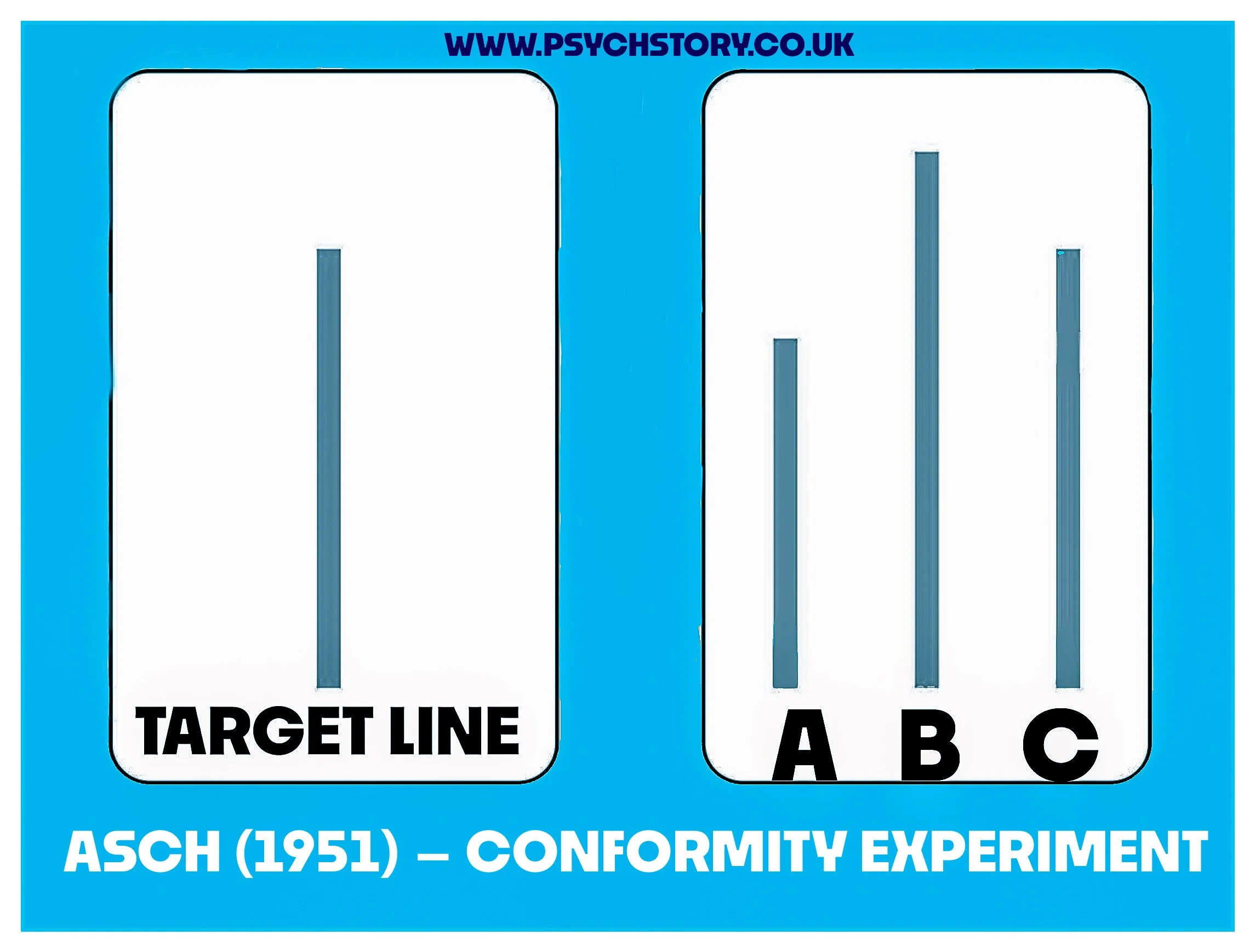
Participants were shown a stimulus line and three comparison lines labelled A, B, and C, and asked to state which comparison line matched the stimulus line in length. The correct answer was always obvious. The genuine participant answered last or near last after hearing the confederates' responses. On certain trials, known as critical trials, the confederates were instructed to all give the same incorrect answer.
In control conditions, with no confederates, participants made very few errors, around 0.7%. This confirmed that the task itself was simple and that mistakes were unlikely under normal circumstances. However, in the critical trials, approximately 37% of responses conformed to the incorrect majority answer. Furthermore, 75% of participants conformed at least once during the study, although a small minority never conformed.
When asked afterwards, many participants reported that they knew the group was wrong but went along with it to avoid standing out or being ridiculed. This indicates that their behaviour was driven by normative social influence, rather than a genuine belief that the group was correct.
EVALUATION OF ASCH’S CONFORMITY STUDY.
REPLICABILITY CONTROL AND CONSISTENCY
The study demonstrates a high level of control, as the procedure was standardised using identical line stimuli, a fixed group size, and scripted responses from the confederates. This ensured that extraneous variables were minimised and that the social pressure experienced by each participant was consistent. Such control makes the study highly replicable, as the same conditions can be reproduced by other researchers. The relatively large sample size of 123 participants further supports the reliability of the findings. Importantly, subsequent replications have produced broadly similar levels of conformity, demonstrating consistency in the results and strengthening the robustness and credibility of Asch’s conclusions

MUNDANE REALISM: NON CONTENTIOUS TASK IN ASCH’S CONFORMITY STUDY
The study presents a mixed picture regarding mundane realism. The physical setting, a classroom-style environment with other participants present, does resemble an everyday social context and therefore retains some degree of mundane realism. However, the task itself, judging line lengths, is highly artificial and lacks personal relevance. This creates a disconnect between the realistic social setting and the trivial nature of the decision being made.
A central limitation is the task's superficial nature. Participants are unlikely to care about being correct when judging line lengths, as there are no meaningful consequences attached to their responses. This low level of personal investment may increase conformity, as there is little motivation to resist group pressure. In contrast, real-world conformity often occurs in situations involving socially or morally significant issues, such as prejudice, discrimination, or ethical decision-making. In these contexts, individuals may be less willing to conform, particularly if doing so conflicts with personal values. Therefore, the findings may overestimate conformity in trivial situations while underestimating resistance in more consequential ones.
CULTURAL BIAS IN ASCH’S CONFORMITY STUDY
Asch’s participants were American male students, drawn from a Western, individualist society. This matters because conformity is not a fixed human response. It depends on cultural values, the group's role, and the consequences of nonconformity.
Cross-cultural evidence shows clear differences. Bond and Smith (1996) analysed 133 studies across 17 countries and found higher conformity in collectivist cultures such as Japan, Hong Kong, and Fiji, and lower conformity in individualist cultures such as the USA and Western Europe. Berry (1967) found a similar pattern, with higher conformity in societies where cooperation and group survival are emphasised than in more individualist groups.
One explanation is pressure and punishment. In collectivist societies, there is often stronger social pressure to conform and clearer consequences for deviation. These consequences are not trivial. They can involve loss of status, exclusion from the group, or, in more extreme political or religious systems, formal punishment. This is very different from Asch’s task, where the cost of dissent was minimal. However, conformity in collectivist cultures is not only about avoiding punishment. It is also about the collective's function. The group is prioritised over the individual, and conformity helps maintain shared systems such as family structure, work roles, and social obligations. For example, practices like arranged marriage or strong family duty rely on individuals aligning with group expectations. In this sense, conformity is part of how the system operates, not simply a response to pressure.
In contrast, individualist cultures place more value on independence and personal judgment. This reduces baseline conformity, but it does not remove it. Social pressure still exists, particularly in areas linked to identity, politics, and public opinion. The level of conformity also shifts over time. Perrin and Spencer (1980) found that conformity was much lower in a later UK replication, suggesting that Asch’s original findings reflected a more conservative period. This supports the idea that conformity depends on the broader social climate. In contemporary contexts shaped by political correctness and wokism, conformity may increase in certain domains, particularly where social or institutional consequences are perceived.
Overall, Asch’s findings are culturally limited. They show how people respond to group pressure in a low-stakes, Western context, but they do not capture how conformity operates when the group has real authority, real consequences, or a central role in organising social life.
DEMAND CHARACTERISTICS IN ASCH’S CONFORMITY STUDY
The use of confederates introduces the risk that participants will detect the situation's artificial nature. The confederates were not trained actors, which may have made their behaviour appear unnatural. If participants became suspicious, their responses may have been influenced by attempts to guess the study's aim rather than by genuine responses.
GENDER BIAS IN ASCH’S CONFORMITY STUDY
Asch’s original sample consisted entirely of male participants, making the study biased toward males. The findings are often generalised to all people, assuming that males and females would conform in the same way, despite the fact that only men were tested.
Subsequent research suggests this assumption may be incorrect. For example, Eagly and Carli (1981) reviewed a range of conformity studies and found that women tend to conform more than men, particularly in public situations with clear group pressure. However, this does not mean women are inherently more conformist. Interpreting these findings as a fixed, biological difference would be an alpha bias, exaggerating gender differences. A more plausible explanation is that conformity varies with social roles and expectations. Women are often socialised to be more cooperative and agreeable, and in some cultures may face stronger social penalties for dissent. In contexts characterised by greater gender inequality or misogyny, this pressure is likely to be amplified, leading to higher observed conformity.
Therefore, Asch’s study is limited by beta bias, as it assumes universality based on an all-male sample, whereas later research shows that conformity can differ by gender and social context.
HISTORICAL BIAS: THE INFLUENCE OF THE ZEITGEIST ON ASC’S CONFORMITY STUDIES
Impact of McCarthyism: Asch's conformity study, conducted during the 1950s, coincided with the era of McCarthyism in the United States. This period was marked by intense anti-communist sentiment and a culture of fear in which non-conformity could have serious social and political repercussions. The heightened pressure to conform during this era may have significantly influenced the participants' behaviour in the study. Participants might have been more inclined to conform to group pressure, reflecting the societal norms of the time.
Potential Differences in a Modern Context: If Asch's research were replicated today, the results could differ markedly. Modern society, with its increased emphasis on individualism and access to diverse perspectives (especially through digital media), might show lower rates of conformity. Today's social and cultural climate, which often encourages questioning and challenging the status quo, could lead to a reduction in the influence of group pressure observed in Asch's original study.
In summary, the historical context of Asch's study is a critical factor in interpreting its results. The specific societal conditions of the 1950s, particularly the influence of McCarthyism, may have created an environment more conducive to conformity. This historical bias suggests that the study's findings might not be as applicable or replicable in different historical periods or under varying cultural conditions
Nicholson's Study: Nicholson replicated Asch's study but found different results, indicating cultural and temporal variations in conformity.
Perrin and Spencer's Study: In a similar vein, Perrin and Spencer's replication of Asch's study with British participants in the 1980s found much lower rates of conformity. This difference suggested that conformity might vary with time and across cultures.
Crutchfield's Research: Crutchfield approached the study of conformity differently. Instead of the public-response method used by Asch, Crutchfield employed a more private, anonymous response format. His findings suggested that conformity rates might be lower when individuals are not under direct group pressure, highlighting the influence of response collection methods on conformity.
Refinement of Analysis Considering Informational vs. Normative Social Influence in Asch's research
In the context of Solomon Asch's conformity study, it's crucial to distinguish between informational and normative social influence, especially given that some participants genuinely believed they were misperceiving the lines.
Informational Social Influence at Play: Contrary to Asch's interpretation, which primarily focused on normative social influence, a closer examination reveals that informational social influence was also significant. Some participants, rather than just conforming to fit in or avoid social disapproval (normative influence), actually doubted their own perceptions in light of the group's unanimous disagreement. These participants conformed because they believed the group's judgment was more likely to be correct than their own, a classic example of informational social influence.
Reevaluation of Asch's Conclusions: This insight calls for a reevaluation of Asch's conclusions. While normative social influence (the desire to be liked and accepted by the group) undoubtedly played a role, the impact of informational social influence (the desire to be correct or to rely on others' judgments in ambiguous situations) was also significant. The presence of informational social influence indicates that some participants' conformity was not solely a matter of yielding to peer pressure but also involved a genuine change in their perceptions or beliefs in response to the group's input.
ETHICS OF ASCH’S CONFORMITY STUDY
The study raises ethical concerns due to deception; participants were unaware of the study's true purpose, believing it was a vision test. This deception, while arguably necessary for realistic behaviour, was addressed through a debriefing post-study.
EVOLUTIONARY BASIS FOR CONFORMITY
The evolutionary basis for conformity can be understood by considering how conforming to group norms and behaviours likely provided significant survival advantages in our ancestral past. This evolutionary perspective offers insights into why conformity is a widespread and deeply ingrained aspect of human behaviour:
Enhanced Group Cohesion and Survival: From an evolutionary standpoint, being part of a group has always been crucial for survival. Early humans living in groups could hunt more effectively, share resources, and provide mutual protection against predators and other threats. Conforming to the group's norms and behaviours would have been essential to remain part of the group, as non-conformity could lead to ostracisation or expulsion, which in prehistoric times could have been a death sentence.
Facilitated Learning and Knowledge Transfer: Conformity also played a key role in knowledge and skill transfer. In a time before written language and formal education, learning from others and adhering to established ways of doing things were vital. By conforming to the group's behaviours and techniques, individuals could acquire essential survival skills more efficiently.
Social Harmony and Conflict Avoidance: Conformity helps maintain social harmony. In small, interdependent groups, conflicts could be costly and dangerous. Conforming to group norms and expectations would have helped reduce friction and conflicts within the group, thereby promoting a more stable and cooperative living environment.
Reproductive Advantages: Conforming individuals may have had better reproductive success. By adhering to the group's norms, an individual would have been more likely to be viewed favourably by potential mates within that group, thus enhancing their reproductive opportunities.
Adaptive Flexibility: Conformity can be seen as a mechanism for adaptive flexibility. By aligning with group behaviours, individuals can quickly adapt to new environments or changes in circumstances, as the collective knowledge and experience of the group can guide appropriate responses to novel situations
An everyday example of ISI is when someone, unfamiliar with specific dining etiquette in a new restaurant, looks to others for cues on which cutlery to use for different dishes, adjusting their behaviour based on the group's actions.
VARIABLES AFFECTING CONFORMITY INCLUDING GROUP SIZE, UNANIMITY AND TASK DIFFICULTY AS INVESTIGATED BY ASCH
1. GROUP SIZE
Asch's Findings: In Asch's research, the influence of group size on conformity was evident. With just one confederate, conformity was a mere 3%. This figure rose to 13% with two confederates and significantly increased to 33% with three. However, adding more than three confederates (up to 15) did not substantially increase conformity rates, suggesting a plateau effect.
Further Research: A meta-analysis by Bond and Smith, examining 133 studies similar to Asch's, supported the finding that conformity peaks with a group size of 4-5. Campbell and Fairey further nuanced this understanding by distinguishing between tasks involving personal preference (in which larger groups increased conformity) and those with a correct answer (in which two confederates were sufficient for optimal conformity).
2. UNANIMITY:
Impact of a Dissenting Confederate: Asch found that conformity rates were high (33%) when all confederates unanimously gave the wrong answer. However, introducing a dissenting confederate who gave the correct answer dramatically reduced conformity to 5.5%. Even when the dissenting confederate gave a different wrong answer, conformity decreased to 9%. Asch concluded that breaking unanimity, regardless of whether the dissent supported the real participant's view, significantly reduced conformity.
3. TASK DIFFICULTY:
Increased Conformity with Difficult Tasks: As task difficulty rises, conformity increases, as individuals look to others for guidance in uncertain situations. This effect is a manifestation of informational social influence. Asch demonstrated this by making the line lengths very similar, thereby increasing the task's difficulty and observing an increase in conformity.
Moderating Role of Self-Efficacy: Lucas et al. found that the impact of task difficulty on conformity is moderated by individual self-efficacy. People with high self-efficacy, confident in their abilities, were less likely to conform, even in the face of challenging tasks. This finding underscores how individual differences, such as self-efficacy, interact with situational variables, such as task difficulty, to influence conformity.
In summary, these studies collectively highlight that conformity is influenced by multiple factors, including group size, unanimity, and task difficulty. They also underline the interplay between situational variables and individual differences in shaping conformity behaviour. Understanding these dynamics is essential for a comprehensive grasp of social influence processes.
EVALUATION OF ASCH’S VARIATIONS AFFECTING CONFORMITY
GROUP SIZE
Strengths: The consistency of findings across studies, including Asch's and the meta-analysis by Bond and Smith, provides robust evidence of the influence of group size on conformity. This finding is valuable for understanding group dynamics and peer pressure across settings, from social groups to organisational behaviour.
Limitations: However, the impact of group size may vary by context and cultural background. In some cultures or situations, larger groups might not necessarily exert more influence, especially where individualism is highly valued.
2. UNANIMITY:
Strengths: Asch's exploration of unanimity offers critical insights into the power of dissent to reduce conformity. This aspect is particularly relevant in understanding how minority viewpoints can influence majority opinions and foster independent thinking.
Limitations: The scenarios in Asch's study were highly controlled and artificial, raising questions about the ecological validity of these findings. Real-world situations often involve more complex dynamics and interactions, which may not be accurately captured in a laboratory setting.
3. TASK DIFFICULTY:
Strengths: The finding that task difficulty increases conformity, especially under conditions of uncertainty, is significant. It highlights the role of informational social influence and can be applied to understand decision-making processes in complex or ambiguous situations.
Limitations: The generalizability of this finding is constrained by individual differences. Factors such as self-efficacy, expertise, and confidence can significantly moderate the relationship between task difficulty and conformity, as shown in the research by Lucas et al. This variability indicates that conformity cannot be predicted solely based on task difficulty.
4. OVERALL EVALUATION
Contextual and Cultural Factors: The variables affecting conformity are not universal and can vary greatly depending on cultural, situational, and individual factors. What holds true in one context may not necessarily apply in another.
Ethical Considerations: Many of these studies, particularly those following Asch's methodology, involve some level of deception. While necessary for scientific integrity, this raises ethical concerns about participant consent and the potential psychological impact.
Application and Relevance: Despite their limitations, these studies offer valuable insights into human social behaviour. They have practical applications across psychology, marketing, education, and organisational management, helping to understand and predict how people are influenced by the groups they belong to.
Need for Further Research: Given the complexities and variations in conformity behaviour, there is a continuous need for further research, particularly studies that account for varying cultural contexts and real-world scenarios.
In conclusion, while the research on conformity, including Asch's research, has significantly advanced our understanding of social influence, it's crucial to approach these findings with an awareness of their limitations and the need for contextualization
INFORMATIONAL SOCIAL INFLUENCE CONFORMITY RESEARCH
ARTHUR JENNESS’S JELLYBEAN STUDY ON INFORMATIONAL SOCIAL INFLUENCE (1932)
Arthur Jenness investigated how group discussion influences judgment in ambiguous situations. Participants were first asked to make a private estimate of the number of jellybeans in a jar, a task with no clear or objectively correct answer. They then took part in a group discussion, during which they shared their estimates. After this discussion, participants were asked to make a second private estimate.
The findings showed that participants’ second estimates shifted towards the group consensus. This demonstrates informational social influence, as individuals used others as a source of information when uncertain. Women, on average, showed a greater shift than men, suggesting possible differences in responsiveness to group input. The study concluded that when a task is ambiguous, individuals are more likely to rely on the majority view as a guide to accuracy.
The evaluation highlights that some level of deception was involved, though it was relatively minor and may be considered acceptable in light of the research aims. The laboratory setting reduces ecological validity, as estimating jellybeans is not a typical real-world decision. In addition, the task lacks mundane realism, meaning the findings may not directly generalise to everyday situations. Despite these limitations, the study provides clear evidence of how informational social influence operates under uncertainty.
SHERIF AUTO KINETIC EFFECT CONFORMITY STUDY (1935)
Muzafer Sherif used the autokinetic effect, an optical illusion in which a stationary point of light appears to move in a dark room, to investigate informational social influence. Participants first made individual estimates of how far the light moved. Because there was no objective reference point, these estimates varied widely. Participants were then placed in groups and asked to discuss and agree on a judgment. Finally, they made individual estimates again after the group interaction.
The results showed that individual estimates converged towards a shared group norm during discussion. Crucially, this shift persisted when participants later made private judgements, indicating internalisation rather than simple compliance. This provides strong evidence for informational social influence, as participants adopted the group’s judgment as their own in the absence of a clear answer.
The study demonstrates how social norms can emerge through interaction and how individual perception can be shaped by others. However, like Jenness’s study, it is limited by low ecological validity and an artificial task. The auto kinetic effect does not reflect typical real-world decisions, although it effectively isolates the process of influence under ambiguity.
CRUTCHFIELD’S STUDY ON CONFORMITY (1955)
Crutchfield developed a method that removed face-to-face group interaction. Participants were placed in individual booths and believed they were part of a group, although the experimenter controlled others' responses. They completed tasks such as line judgments while being shown predetermined group answers.
Findings showed that participants conformed to incorrect group responses even when the correct answer was clear. This demonstrates that conformity can occur without direct social pressure or fear of immediate judgment. The perceived presence of a group norm alone was sufficient to influence behaviour.
The method reduced factors such as public embarrassment and direct peer pressure, allowing conformity to be studied in more controlled conditions. However, the artificial setup limits ecological validity, and the lack of real interaction may reduce the extent to which the findings reflect everyday social situations.
NORMATIVE SOCIAL INFLUENCE RESEARCH
NICHOLSON (1969) – CONFORMITY IN PROBATIONERS ASCH REPLICATION
Nicholson examined conformity using young male offenders on probation rather than student samples. Participants completed tasks similar to Asch’s line-judgement paradigm, in which they were exposed to group pressure to give incorrect answers.
The findings showed significantly higher levels of conformity compared to typical student samples. Participants were more likely to agree with the majority even when the answer was clearly wrong. This was interpreted in terms of social background and personality factors. Individuals from more authoritarian or disadvantaged environments may be more accustomed to compliance, more sensitive to group pressure, and less confident in independent judgment.
This study challenges the assumption that conformity is universal and highlights the role of social experience. It also raises issues of sampling bias in classic research, as many studies rely heavily on middle-class student participants. Nicholson’s work demonstrates that conformity varies across populations and contexts.
PERRIN AND SPENCER ASCH REPLICATION (1980)
Perrin and Spencer conducted a partial replication of Asch’s study using engineering students in the United Kingdom. Participants were exposed to confederates who gave incorrect answers in a line-judgement task.
The results showed almost no conformity. Only one instance of conformity was recorded across hundreds of trials, with most participants consistently giving correct answers. However, when the study was repeated with youth offenders on probation, higher levels of conformity were observed.
These findings suggest that conformity is influenced by both temporal and cultural factors. By 1980, Western societies may have become less conformist than in the 1950s. In addition, engineering students may possess greater confidence in objective judgment and training that prioritises accuracy over agreement.
The study demonstrates that conformity is not a fixed tendency but varies depending on context, sample characteristics, and historical period. It also questions the generalisability of Asch’s findings, suggesting they may reflect a specific time and population rather than universal human behaviour.