
TOKEN ECONOMIES FOR SCHIZOPHRENIA
INTRODUCTION
The specification requires understanding of how token economies are used in the management of schizophrenia, including their rationale, procedures, effectiveness, ethical issues and alternatives.
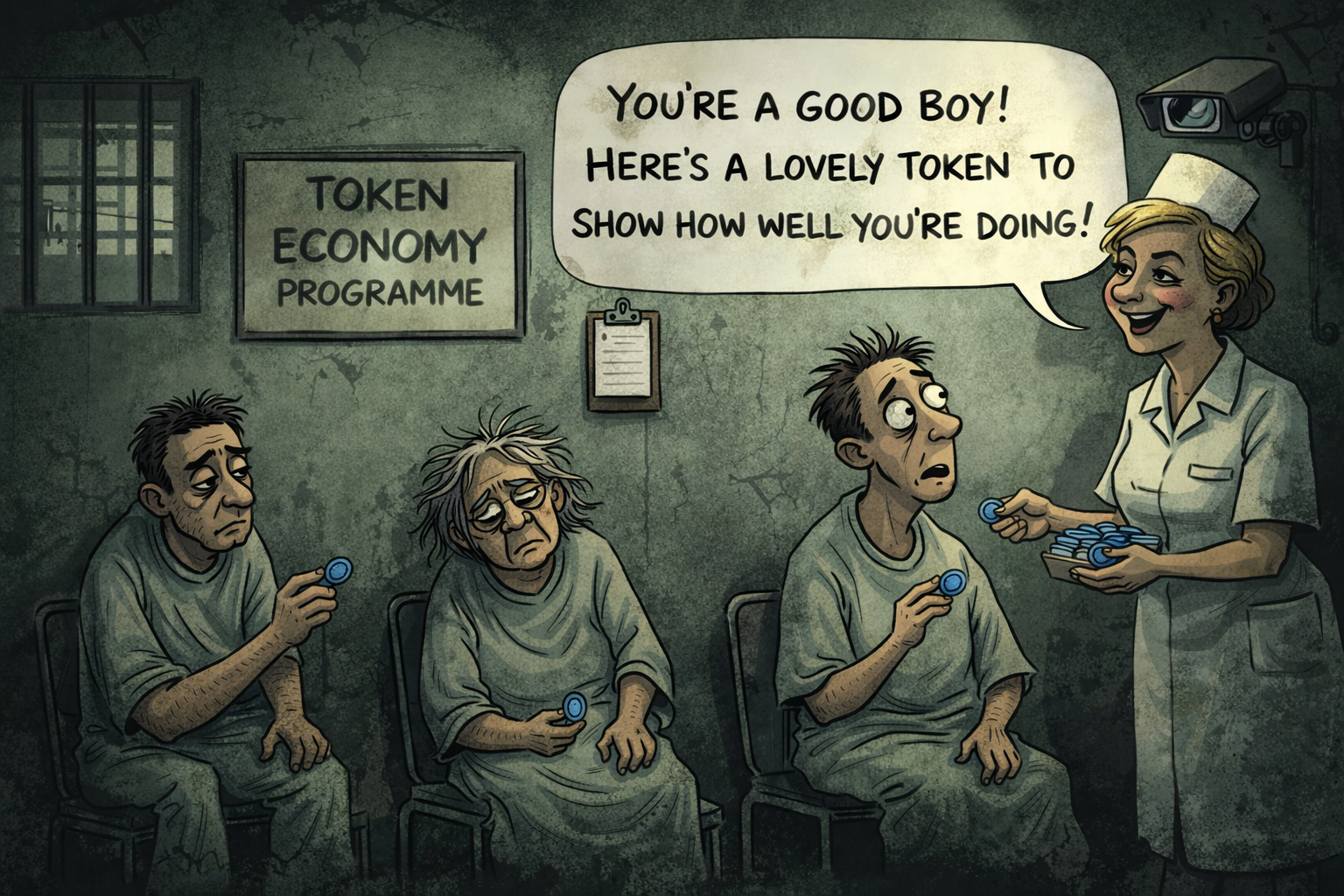
Token economies are a behaviour management system used primarily in psychiatric settings to manage schizophrenia, particularly among individuals who have experienced long periods of hospitalisation. They are based on principles of behaviour modification and operant conditioning and aim to encourage adaptive behaviours while reducing maladaptive ones.
DEVELOPING TOKEN ECONOMIES WITH SCHIZOPHRENIA
The token economy emerged in the mid-twentieth century within long-stay psychiatric hospitals and was explicitly grounded in operant conditioning, behaviour modification, and social learning theory. Token economies were first systematically applied to patients diagnosed with schizophrenia by Ayllon and Azrin in the 1960s, at a time when large institutional wards housed individuals for many years or decades.
The core assumption behind the token economy was behaviourist. From this perspective, schizophrenia was not understood in terms of internal mental states, neurobiology, or cognition, but in terms of observable behaviour. Behaviourists did not claim that schizophrenia itself was “learnt” in the cognitive sense, but they assumed that maladaptive behaviours shown by patients — such as social withdrawal, inactivity, poor self-care, or non-compliance — were shaped and maintained by reinforcement histories in the hospital environment. As with all behaviourist approaches, internal processes such as thoughts, emotions, hallucinations, or delusions were regarded as either unobservable or irrelevant to treatment.
In practice, token economies involved identifying specific, predefined “adaptive” behaviours that staff wished to increase. These typically included basic self-care behaviours (e.g., making the bed, washing, dressing appropriately), task engagement (e.g., attending work units, completing simple tasks), and ward participation (e.g., social interaction, cooperation with routines). When a patient performed one of these target behaviours, they received an immediate token. Tokens were usually neutral items such as plastic discs, counters, or points recorded on a chart.
These tokens had no inherent value. Their effectiveness came from the fact that they could later be exchanged for secondary reinforcers, sometimes called “back-up reinforcers”. These included privileges or rewards such as access to recreational activities, extra visiting time, preferred food items, cigarettes (historically), leisure materials, television time, or opportunities to leave the ward. Immediate token delivery was considered crucial, as behaviourist theory emphasised that reinforcement is most effective when it is delivered immediately after the behaviour.
Importantly, token economy programmes did not aim to treat the core symptoms of schizophrenia directly. They did not attempt to reduce hallucinations, challenge delusional beliefs, or address thought disorder. At the time these programmes were developed, negative symptoms had not yet been clearly conceptualised as a distinct symptom cluster, and cognitive impairments were poorly understood. As a result, behaviours that we would now interpret as negative symptoms, such as avolition or poverty of speech, were treated as behavioural deficits rather than manifestations of underlying neural dysfunction.
The introduction of token economies led to marked increases in targeted adaptive behaviours and reductions in disruptive or inactive behaviours in institutional settings. As a result, during the 1960s and 1970s, token economies became widely used in long-term psychiatric hospitals, particularly in the United States. They were regarded as among the first systematic attempts to introduce structure, predictability, and measurable outcomes into psychiatric care.
However, their use declined over time, particularly in the UK. This decline coincided with the closure of large psychiatric institutions, the shift towards community care, and growing ethical concerns about control, autonomy, and the artificial nature of behaviour change achieved through external reinforcement. Despite this, token economies continue to be used in some psychiatric and residential settings worldwide, primarily as behavioural management tools rather than as treatments for schizophrenia itself.
Although token economies do not treat the underlying cause of schizophrenia, they offer two main benefits. First, they can improve the quality of life within the hospital environment. Second, they can help individuals adapt more successfully to community life by fostering routine and independence.
HOW IT WORKS IN DETAIL
The system works by identifying specific target behaviours that staff want to increase. These are usually practical, everyday actions that improve self-care and ward functioning, for example:
Personal hygiene (washing, dressing appropriately)
Making the bed or tidying the living space
Attending ward activities or work units
Completing simple tasks
Social interaction or cooperation with routines
When a patient engages in one of these target behaviours, they receive an immediate token. Tokens are usually neutral items—plastic discs, counters, points on a chart, or similar items — with no value in themselves.
The tokens act as a bridge to real rewards. Later, patients can exchange them for “back-up reinforcers” — privileges or items they value, such as:
Extra television time
Preferred food or snacks
Access to leisure activities or recreational materials
Cigarettes (in older programmes)
Extra visiting time
Supervised trips outside the ward
The key rule is immediate reinforcement. Behaviourist theory holds that behaviour is shaped most effectively when the consequence follows the action immediately. Tokens address the problem of delay: meaningful rewards cannot always be provided immediately in a hospital, so tokens maintain a clear and consistent link until the exchange occurs.
Staff must be consistent — the same behaviours always earn tokens, and tokens always buy the same rewards. This predictability is essential for the system to work.
EVALUATION
EVIDENCE OF EFFECTIVENESS
There is evidence to support the effectiveness of token economies in managing schizophrenia, particularly within institutional settings. Reviews such as McMonagle and Sultana’s have identified several controlled studies demonstrating that token economy programmes reliably reduce undesirable behaviours in hospitalised patients. Across these studies, reductions were observed in behaviours such as inactivity, poor self-care, and non-compliance with ward routines. This consistency suggests that token economies can exert a measurable and predictable effect on observable behaviour, supporting the behaviourist claim that reinforcement can modify behaviour even in severe mental illness.
However, the strength of this evidence must be treated with caution. The overall evidence base is relatively small, and many studies were conducted several decades ago in long-stay psychiatric hospitals that no longer reflect modern care environments. Sample sizes were often small, and methodological quality varied, with weaknesses including lack of blinding, inconsistent outcome measures, and limited follow-up. These issues reduce confidence in the generalisability and durability of the findings.
Publication bias further limits the conclusions that can be drawn. Studies reporting positive outcomes are more likely to be published than those finding minimal or no effects, which may exaggerate the apparent effectiveness of token economies. This is particularly relevant given that large-scale, contemporary randomised controlled trials are rare. As a result, while token economies appear effective at modifying behaviour in controlled settings, the overall reliability of the evidence remains questionable.
A major limitation of token economies is their poor applicability beyond institutional environments. The approach depends on close monitoring, immediate reinforcement, and controlled access to rewards. In community care settings, behaviours cannot be observed continuously, reinforcement cannot be delivered consistently, and alternative sources of reward compete with tokens. This makes it difficult to sustain behavioural gains after discharge, limiting long-term effectiveness and real-world relevance.
Despite these limitations, token economies may still have a limited but specific role during hospitalisation. By improving basic self-care, increasing engagement with routines, and encouraging social interaction, they may help stabilise patients during acute or long-term admissions. In this sense, token economies function as behavioural management tools rather than treatments, potentially supporting readiness for discharge rather than addressing the underlying disorder.
Overall, token economies demonstrate that behaviour in schizophrenia can be influenced through reinforcement under highly controlled conditions. However, their effectiveness is context-dependent, their evidence base is methodologically constrained, and their relevance to modern, community-based care is limited. They are best understood as an adjunct for managing behaviour in institutional settings rather than a comprehensive or enduring intervention for schizophrenia
ETHICAL ISSUES
Token economies raise substantial ethical concerns, particularly in relation to power, autonomy, and the treatment of vulnerable individuals. By design, token economies place significant control over behaviour in the hands of professionals, allowing staff to decide which behaviours are rewarded and which are not. This creates an unequal power dynamic in which patients’ daily actions are shaped by external contingencies rather than personal choice, raising questions about respect for autonomy and dignity.
A central ethical issue is that target behaviours are often defined by institutional priorities rather than by the individual’s own needs or values. Behaviours such as compliance with routines, participation in work units, or adherence to ward norms may reflect what is convenient for staff or the institution rather than what is meaningful or therapeutic for the patient. As a result, token economies risk enforcing conformity rather than promoting genuine recovery or personal agency.
There are also serious concerns about the restriction of basic rights. In many historical token economy programmes, access to fundamental aspects of daily life—such as food choices, leisure activities, social interaction, or time outside the ward—was made contingent on earning tokens. Making basic human experiences conditional on behavioural compliance is ethically problematic, particularly for individuals with schizophrenia who may already be experiencing severe cognitive impairment, negative symptoms, or distressing psychotic symptoms. In such cases, failure to earn tokens may reflect illness-related limitations rather than unwillingness to cooperate, effectively punishing individuals for symptoms beyond their control.
Consent is another ethical challenge. Many patients involved in early token economy programmes were long-stay inpatients with limited capacity to refuse treatment or opt out. Participation was often not genuinely voluntary, and patients may not have fully understood the rationale behind the intervention. This raises concerns about coercion, particularly when refusal to participate could result in the loss of privileges or a reduced quality of life within the institution.
In addition, token economies risk oversimplifying complex mental illness by reducing behaviour to something that can be externally controlled without addressing internal experience. By ignoring subjective distress, hallucinations, delusions, and emotional suffering, the approach may prioritise outward behavioural order over psychological well-being. This can create an appearance of improvement without corresponding benefits to the individual’s mental state, further complicating ethical evaluation.
These ethical concerns have played a significant role in the decline of token economies, particularly in the UK, alongside deinstitutionalisation and the shift towards community-based care. Modern mental health services place greater emphasis on patient rights, informed consent, recovery-oriented practice, and collaboration rather than control. While contemporary versions of behavioural reinforcement may be used in limited, carefully regulated contexts, the traditional token economy is widely regarded as ethically incompatible with current standards of mental health care.
DO TOKE ECONOMIES SUGGEST SCHIZOPHRENIA IS NOT BIOLOGICALLY DETERMINED?
Token economies work on the premise that behaviour is responsive to consequences. If a behaviour increases when reinforced and decreases when reinforcement is removed, it implies that the individual can modify that behaviour in response to incentives. Applied to schizophrenia, this can introduce a non-biological deterministic assumption: if patients can behave differently across tokens, it may appear as if they could have behaved differently all along. Taken to its extreme, that logic risks implying the illness is self-maintained or even self-imposed.
This is particularly sensitive in schizophrenia because many of the most visible “behaviours” are not choices. Positive symptoms involve disturbances in perception and salience: hallucinations, delusions and thought disorder are not under voluntary control. Negative symptoms further strain the assumption of conditioning. Avolition, alogia, and reduced emotional expression are closely linked to impaired motivation, executive functioning, and cognitive capacity. Someone with severe avolition is not simply “refusing” to initiate activity; the drive and initiation systems are compromised. Treating this as a behaviour that can be switched on by incentives can collapse a neurodevelopmental disorder into a problem of effort.
That does not mean the method itself is inherently wrong. Token economies/operant conditioning or principles are embedded throughout society. Schools use certificates and prizes. Workplaces use pay, bonuses and promotion. Institutions use privileges and sanctions. Reinforcement is a normal way of shaping behaviour in settings where people are cognitively intact and can respond consistently to contingencies.
Token systems, therefore, make conceptual sense in structured environments where the aim is to increase specific adaptive behaviours, such as attendance, task completion or cooperation, and where individuals are sufficiently lucid to respond predictably to reinforcement. They are commonly used in schools, exclusion units, residential care and behavioural programmes.
The problem arises when this logic is extended to a severe psychiatric disorder whose core symptoms are not simply patterns of behaviour but disturbances in brain function. In that context, “behaviour change” can mean compliance within a controlled system rather than recovery, and the free-will implications become both conceptually and ethically loaded.

ALTERNATIVE APPROACHES TO TOKEN THERAPY
As token economies declined, other psychosocial approaches became more common in hospital and residential settings. These aim to improve functioning without relying on reward systems or behavioural control.
One alternative is art therapy. Art therapy allows patients to express thoughts and emotions through creative activity rather than through behavioural compliance. A review by Chiang et al found some evidence that art therapy can improve symptoms and quality of life, although the overall evidence base is modest. Unlike token economies, art therapy does not make privileges contingent on behaviour and is generally experienced as voluntary and therapeutic. NICE guidelines recommend arts therapies for people with schizophrenia, particularly for negative symptoms.
Social skills training is another alternative used in institutions. Instead of rewarding behaviour with tokens, this approach teaches practical communication and interaction skills through modelling and rehearsal. It aims to improve real-world functioning rather than simply increase ward compliance.
Occupational and activity-based programmes also provide structured daily routines without using artificial reinforcement systems. These focus on building independence and preparing individuals for community living through meaningful tasks rather than token exchange.
Compared with token economies, these alternatives are usually viewed as less ethically problematic because they emphasise collaboration and skill development rather than behavioural control. However, as with token economies, their effects are often modest, and they do not directly treat the underlying neurobiology of schizophrenia
QUESTIONS
Imagine that your cousin Kevin, who has schizophrenia, has been hospitalised for some time. His psychiatrist recommends implementing a token economy to improve Kevin’s social interaction prior to his return to the community. What reasons would you have for optimism, and what concerns might you have about this approach?
What might you suggest to increase the chances of Kevin’s successful reintegration into the community and reduce ethical concerns associated with token economies?
Identify one alternative approach the psychiatrist could use to improve Kevin’s interaction with others.
In psychology, review studies and meta-analyses combine findings from multiple studies to assess the overall effectiveness of treatments. Explain what is meant by a review study and by meta-analysis.
(2 marks + 2 marks)Explain one strength of using review methods rather than relying on individual small-scale studies.
(3 marks)Explain how a token economy could be used in the management of schizophrenia.
(4 marks)Explain the difference between treating schizophrenia and managing schizophrenia with a token economy.
(4 marks)Evaluate the use of token economies in the management of schizophrenia.
(6 marks)Discuss token economies as used in the management of schizophrenia.
(16 marks)
ESSAY EXEMPLAR
DISCUSS TOKEN ECONOMIES AS USED IN THE MANAGEMENT OF SCHIZOPHRENIA (16 MARKS)
AO1 KNOWLEDGE AND UNDERSTANDING
Token economies are a behaviour management technique based on principles of operant conditioning. They are used mainly in institutional settings to manage schizophrenia by reinforcing desirable behaviours and reducing maladaptive ones. Patients receive tokens immediately after performing a target behaviour, such as personal hygiene, making their bed, or engaging in social interaction. Tokens have no intrinsic value but can later be exchanged for rewards, such as primary reinforcers, including food, privileges, or leisure activities.
Token economies were first demonstrated by Ayllon and Azrin, who showed that reinforcing adaptive behaviours in hospitalised patients with schizophrenia led to improvements in self-care and social functioning. Tokens act as secondary reinforcers and, when exchangeable for a range of rewards, function as generalised reinforcers. The approach does not treat the underlying causes of schizophrenia but aims to manage behavioural symptoms, particularly those associated with institutionalisation.
AO3 EVALUATION (PEEL STRUCTURE)
POINT: A strength of token economies is that empirical evidence supports their effectiveness in reducing maladaptive behaviours in institutional settings.
EVIDENCE: Review evidence has shown consistent reductions in negative behaviours such as poor hygiene, inactivity and social withdrawal among hospitalised patients with schizophrenia when token economies are implemented.
EXPLAIN: This suggests that token economies can modify behaviour in structured environments, particularly when immediate reinforcement is delivered consistently. Because schizophrenia is often associated with negative symptoms such as avolition and apathy, reinforcing basic adaptive behaviours can improve daily functioning and quality of life within hospital settings.
LINK": Therefore, token economies have practical value as a management strategy for behavioural symptoms of schizophrenia in institutional contexts.
POINT: However, the evidence base supporting token economies is limited in both quantity and quality.
EVIDENCE: Many studies involve small sample sizes, short time frames, and lack appropriate control conditions. There is also concern about publication bias, as studies reporting positive outcomes are more likely to be published than those reporting null effects.
EXPLAIN: This weakens confidence in the overall effectiveness of token economies. If the evidence base is biased or methodologically weak, the apparent success of token economies may be overstated. This is particularly problematic when such interventions are used to justify behavioural control over vulnerable individuals.
LINK: As a result, although token economies appear effective in some settings, the strength of the supporting evidence is questionable.
POINT: A major criticism of token economies concerns ethical issues related to autonomy and consent.
EVIDENCE: Token economies place control of reinforcement in the hands of staff, meaning access to rewards or privileges may be contingent on compliance with institutional expectations. In some cases, rewards may involve access to basic activities or social opportunities.
EXPLAIN: This raises ethical concerns because patients with schizophrenia may already be experiencing distressing symptoms, impaired insight, or reduced capacity to give informed consent. Making aspects of daily life conditional on behaviour risks coercion and may prioritise institutional order over patient wellbeing.
LINK: Consequently, ethical concerns significantly undermine the acceptability of token economies, even if they are behaviourally effective.
POINT: Another limitation is that token economies have limited applicability outside institutional settings.
EVIDENCE: Token economies rely on close monitoring of behaviour and immediate reinforcement, conditions that are difficult to maintain once patients return to community care.
EXPLAIN: Since schizophrenia is now primarily managed in the community rather than long-term hospitalisation, token economies have reduced practical relevance. Improvements in behaviour achieved in hospital may not generalise to real-world settings where reinforcement is inconsistent or absent.
LINK: This limits token economies to short-term behavioural management rather than long-term treatment.
POINT Finally, token economies have limited explanatory and therapeutic scope.
EVIDENCE: They focus exclusively on observable behaviour and do not address cognitive distortions, emotional distress, or biological factors associated with schizophrenia.
EXPLAIN: As a result, token economies may suppress symptoms without addressing underlying causes. Alternative approaches, such as CBT or art therapy, may offer more holistic benefits by targeting cognition, emotion, or personal meaning without the same level of behavioural control.
Link: This suggests that token economies are best viewed as supplementary management tools rather than comprehensive interventions.