
THERE ARE DIFFERENT TYPES OF QUASI-EXPERIMENTS
NATURAL EXPERIMENTS (US: Natural Experiments) The researcher studies the effect of a real-world event that has already happened. The groups already exist, so random allocation is impossible.
INDEPENDENT GROUPS QUASI-EXPERIMENTS (BETWEEN-GROUPS DESIGNS) (US: Nonequivalent Control Group Design) The researcher deliberately uses pre-existing group differences as the independent variable. The focus is on investigating the effect of those group differences themselves. For example, comparing the outcomes of patients from two different clinics where one clinic has introduced a new therapy and the other has not. The group membership (clinic, school, region, etc.) is treated as the IV because the researcher wants to study the impact of belonging to that particular group.
NON-EQUIVALENT GROUPS DESIGN (US: Nonequivalent Groups Design) The researcher compares two or more pre-existing groups that were not randomly assigned. Random allocation is not used because it is either infeasible, unethical, or not possible in the circumstances. The groups are simply the most practical ones available for comparison, rather than the group difference being the main variable of interest
PLEASE NOTE
Importantly, AQA and other examination boards refer only to “natural and quasi-experiments” in the specification and in examination questions, and never to either an independent groups quasi-experiment or a non-equivalent quasi-experiment.
Moreover, natural and quasi-experiments are often treated as interchangeable, but they are not, as will become clear. This raises the question of why they are being distinguished here and why this level of detail is necessary. The reason is that although AQA does not require this level of precision in the examination, quasi-experiments and natural experiments confuse students when taught. The underlying logic becomes unclear, making it more difficult to identify the type of experiment and evaluate its associated strengths and limitations. For example, when students are taught about true experiments, the emphasis is often placed on randomisation (in contrast to quasi-experiments) and manipulation of the independent variable (in contrast to natural experiments). This creates problems when comparing studies such as Hodges and Tizard (natural) with the Brady monkey study or research into sexual selection.
Essentially, the independent groups' quasi-experiment is the only type of quasi-experiment examined by A-level exam boards. Although the specification simply refers to it as a “quasi-experiment.” This is the form in which participants are placed into pre-existing groups, and it aligns directly with an independent groups design in inferential statistics. As a result, both require the same statistical tests, depending on the level of measurement, because the comparison is between separate groups rather than repeated measures on the same participant
INDEPENDENT GROUPS QUASI EXPERIMENT (BETWEEN GROUPS QUASI): This is the only type of quasi-experiment examined by AQA
The prefix "quasi" implies "resembling" or "similar to." Therefore, quasi-experimental research shares similarities with experimental research but does not meet all the criteria of true experimental research.
TRUE EXPERIMENTS AND RANDOM ALLOCATION
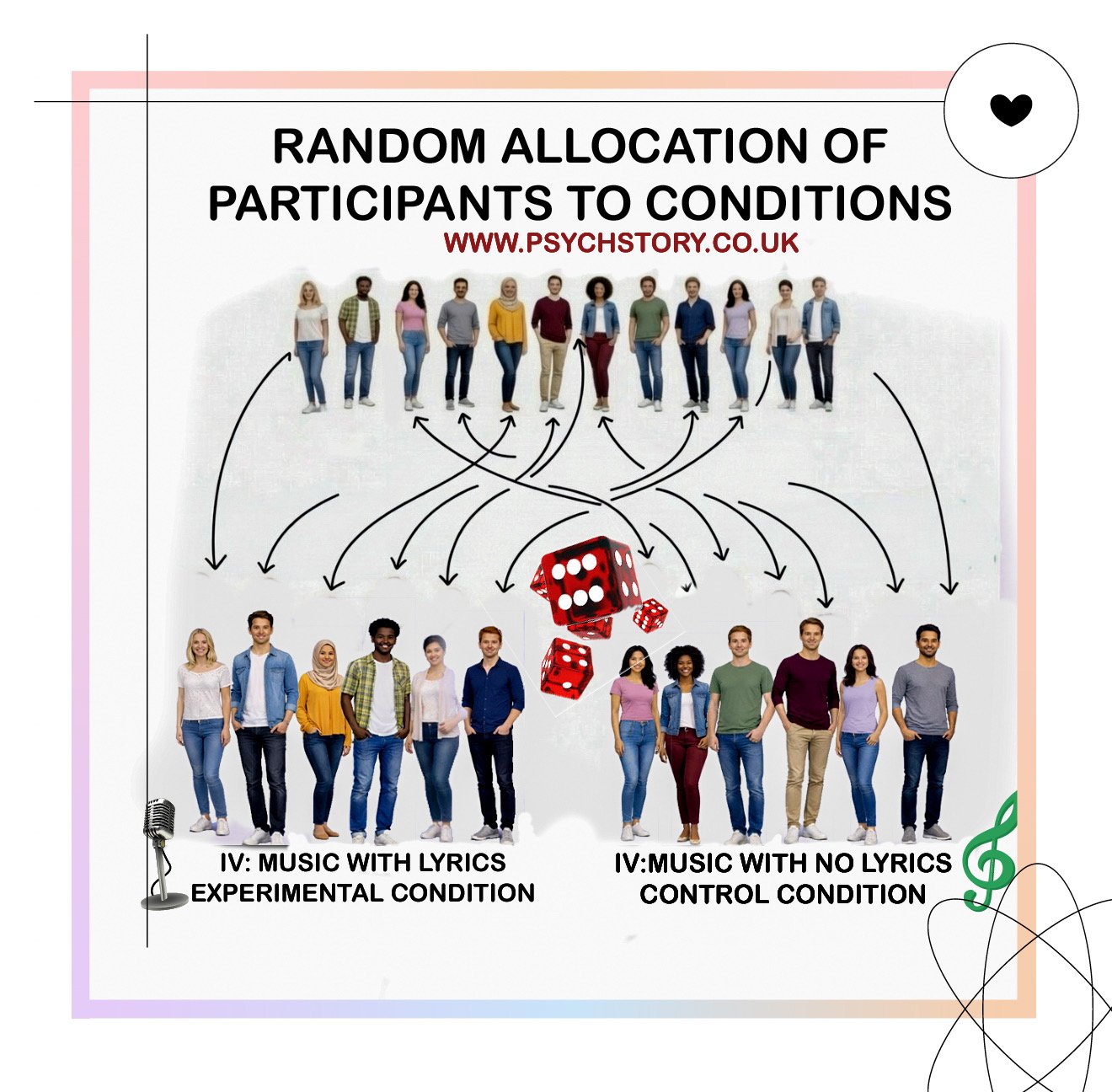
In a true experiment, participants are drawn from the same pool and randomly assigned to different conditions of the independent variable (IV). The resulting groups are then compared on the dependent variable (DV). Researchers regard these groups as similar or equivalent because random allocation gives each participant an equal chance of being placed in any condition. This safeguards against selection bias and ensures that any observed differences in the DV can be attributed with confidence to manipulation of the IV. The Stanford Prison Experiment conducted by Philip Zimbardo provides a clear illustration. Participants were randomly assigned to the role of prisoner or prison guard. This random allocation was essential because, without it, the researcher might unconsciously have selected tougher individuals for the guard role, introducing bias. Randomisation eliminated such selection effects and strengthened the claim that differences between the prisoner and guard groups were due to the experimental conditions rather than pre-existing participant differences.
INDEPENDENT GROUPS QUASI EXPERIMENT (BETWEEN GROUPS QUASI)
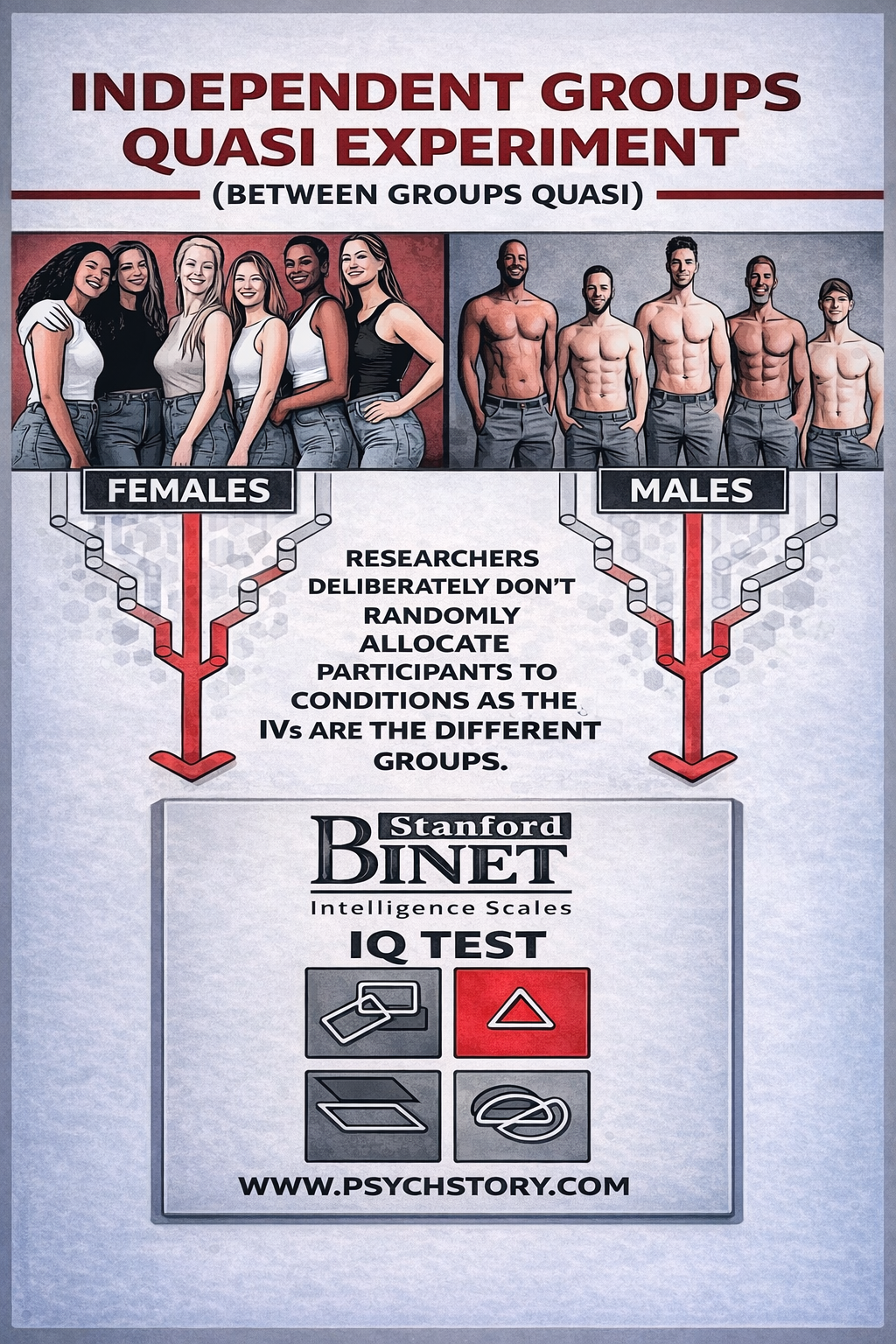
In an independent groups quasi-experiment, the IV is a pre-existing participant characteristic such as biological sex, handedness, age group, or family background. Random allocation is not used because the IV reflects existing differences among participants. The researcher deliberately compares naturally occurring groups, such as males versus females, to determine whether they differ on the DV, for example, IQ. The groups represent the levels of the IV.
EXAMPLES OF INDEPENDENT GROUPS QUASI EXPERIMENT
Comparing average IQ test scores between male and female undergraduates. Biological sex acts as the IV, and IQ test performance as the DV. The researcher cannot randomly allocate participants to be male or female, nor would this be desirable, because the aim is to examine whether pre-existing groups differ in measured intelligence.
Investigating body image perceptions between blind and sighted participants. Visual impairment (blind versus sighted) serves as the IV, while scores on a body shape questionnaire act as the DV. Random allocation is neither possible nor appropriate because the researcher is interested in whether the pre-existing characteristic of sight loss is associated with differences in body image perception.
Comparing levels of extraversion between university graduates and non-graduates. Educational attainment functions as the IV, while extraversion scores on a personality inventory form the DV. The researcher compares these naturally occurring groups to determine whether educational level is associated with differences in extraversion.
STATISTICAL TREATMENT IN INDEPENDENT GROUPS QUASI-EXPERIMENTS
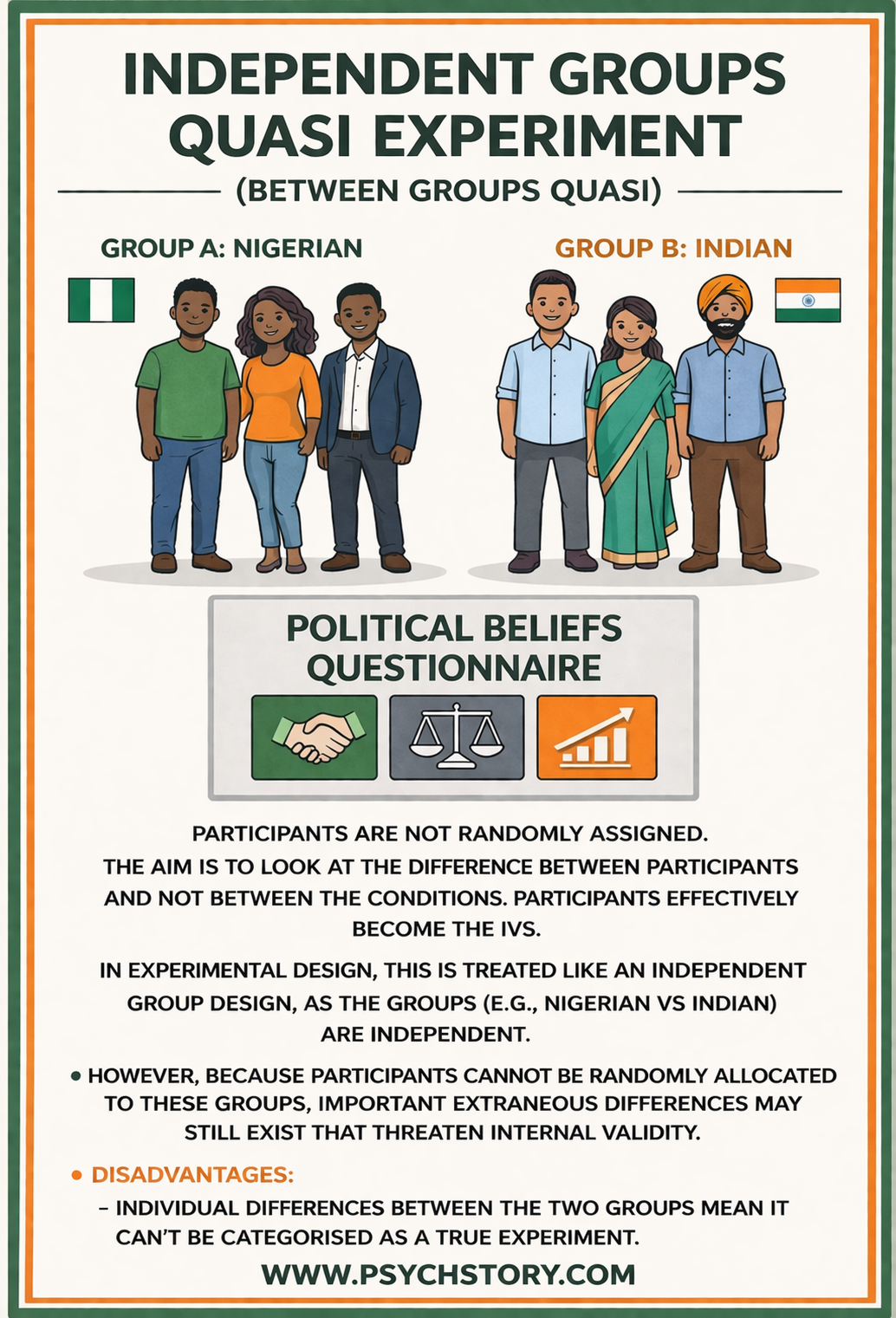
For statistical analysis, an independent groups quasi-experiment is treated in the same way as a true independent groups experiment. The appropriate statistical test is usually an independent samples t-test when comparing two groups, or a one-way ANOVA when comparing three or more groups, provided assumptions such as normality and homogeneity of variance are met. However, the absence of random allocation means that any significant difference between groups cannot be attributed to the IV with the same level of certainty as in a true experiment. Confounding variables remain a threat to internal validity, and findings must therefore be interpreted cautiously.
DISADVANTAGES OF QUASI-EXPERIMENTS
Although random allocation is not used, any observed difference in the DV may not be due to the variable being examined, such as male versus female or blind versus sighted. Differences may instead arise from other pre-existing group characteristics. For example, groups differing in blindness versus sight may also differ in social class, religion, or educational background. Consequently, results may not reflect the intended group difference. This threatens internal validity and weakens causal claims.
Generalisability may also be limited. The specific groups selected, such as male and female undergraduates from a single university, may not represent wider populations, reducing external validity. Interpretation, therefore, requires caution. Researchers must acknowledge that observed differences could reflect selection effects rather than a genuine effect of the IV. Statistical controls, such as matching procedures or ANCOVA, can reduce this problem but cannot remove it entirely.
The lack of random allocation means conclusions about causality must remain tentative. Most A-level specifications, including AQA, Edexcel, and OCR, focus primarily on this form of quasi-experiment when teaching quasi-experimental designs
EXAMPLES OF INDEPENDENT GROUPS QUASI EXPERIMENT
Effect of Classroom Environment on Student Learning:: This study aimed to investigate the influence of classroom environment on student learning outcomes by comparing students in traditional classroom settings with those in experimental classroom designs. Researchers selected schools with different classroom environments, such as traditional lecture-style classrooms versus active learning classrooms. They assessed student learning outcomes, including academic performance and engagement, and compared them between the two groups.
Reference: Freeman, S., Eddy, S. L., McDonough, M., Smith, M. K., Okoroafor, N., Jordt, H., & Wenderoth, M. P. (2014). Active learning increases student performance in science, engineering, and mathematics. Proceedings of the National Academy of Sciences, 111(23), 8410–8415.
Impact of Teaching Methods on Reading Comprehension:: This study investigated the effectiveness of different teaching methods on reading comprehension by comparing students taught using traditional methods with those taught using innovative instructional approaches. Researchers randomly assigned students to different instructional conditions within their classrooms. They administered pre-tests and post-tests to assess reading comprehension skills and compared the performance between the groups.
Reference: Chall, J. S., Jacobs, V. A., & Baldwin, L. E. (1990). The Reading Crisis: Why Poor Children Fall Behind. Harvard University Press.
Evaluation of Technology Integration in Education:: This study aimed to evaluate the impact of technology integration in education by comparing students exposed to technology-rich learning environments with those in traditional classroom settings. Researchers selected schools with varying levels of technology integration and assessed student outcomes, including academic achievement and technology proficiency. They compared students' performance and attitudes between the two groups.
Reference: Tondeur, J., van Braak, J., Ertmer, P. A., & Ottenbreit-Leftwich, A. (2017). Understanding the Relationship Between Teachers’ Pedagogical Beliefs and Technology Use in Education: A Systematic Review of Qualitative Evidence. Educational Technology Research and Development, 65(3), 555–575
NON-EQUIVALENT GROUP DESIGN QUASI-EXPERIMENTS
This type of quasi-experiment is not required at A-level.
In a non-equivalent quasi-experiment, the researcher manipulates the independent variable, but participants cannot be randomly assigned to conditions because it is either impossible, unethical, or both. The design is therefore not a true experiment in structure because it lacks randomisation. The groups are not equivalent at the start of the study. Randomisation means each participant has an equal chance of being allocated to either group, which reduces selection bias. Without it, equivalence cannot be assumed.
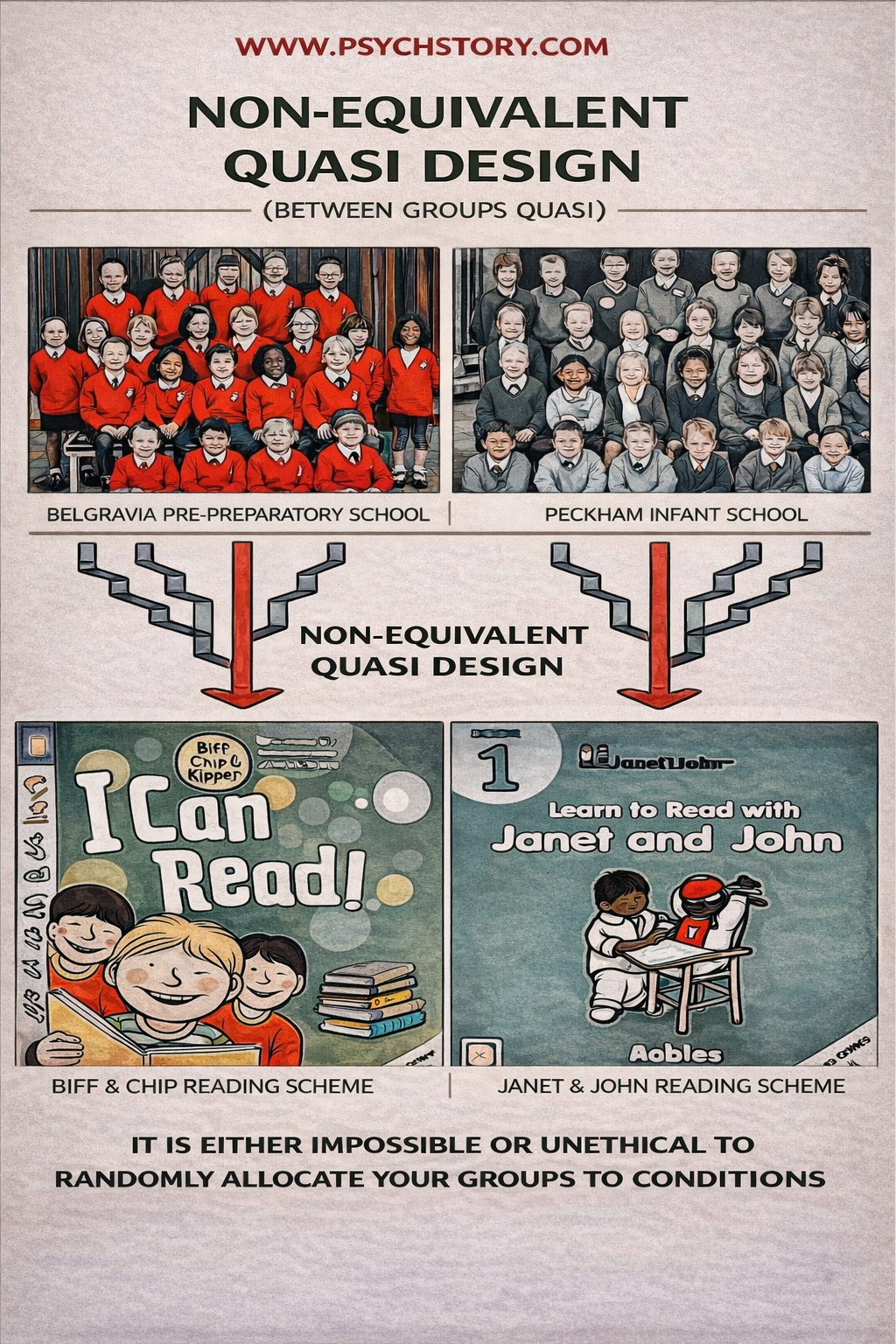
Let us look at the example in the picture above.
In the example shown, the independent variable is the reading scheme. The researcher wants to determine which reading scheme for reception or kindergarten is more effective at teaching children to read. She approaches two schools and asks whether one can use Biff and Chip and the other Janet and John. It is worth noting that if the schools had chosen these schemes independently, the study would be a natural experiment, which is why the two designs are often confused.
The two reading schemes are:
• The Biff and Chip reading scheme
• The Janet and John reading scheme
The dependent variable is reading performance.
The researcher is actively investigating which reading scheme leads to better reading outcomes. The IV has been deliberately selected to evaluate educational effectiveness.
WHY RANDOM ALLOCATION IS IMPOSSIBLE OR UNETHICAL
To conduct a true experiment, the researcher would usually randomly allocate children to the two reading schemes within the same population so that background differences were evenly distributed and the groups were equivalent.
However, this cannot realistically occur. Children cannot be randomly assigned to different schools purely for research purposes. Parents would not consent to their child being relocated to another school for research purposes, and schools cannot reorganise enrolments to satisfy experimental control. For ethical and practical reasons, random allocation is impossible.
As a result, the researcher must use participants who cannot be randomly assigned.
Now, suppose that participants using Biff and Chip achieve higher reading scores than those using Janet and John. Because participants were not randomly allocated, the difference cannot be confidently attributed to the reading scheme itself. Even if the researcher deliberately selects schools that appear demographically similar, the pupils will inevitably differ in socioeconomic and individual characteristics. These differences exist before the study begins and cannot be controlled through randomisation.
For example, Belgravia Pre-Preparatory School and Peckham Infant School may differ in:
• Socioeconomic background
• Parental education
• Access to books and enrichment
• Prior literacy exposure
• Cultural capital
These are confounding variables.
WHY QUASI-EXPERIMENTS ARE NOT TRUE EXPERIMENTS
The improved performance may reflect pre-existing advantages among Belgravia pupils rather than the effectiveness of the reading programme. The IV was selected and evaluated, but uncontrolled group differences undermine internal validity.
Therefore, the study is classified as a non-equivalent quasi-experiment rather than a true experiment. Causal conclusions remain tentative because alternative explanations cannot be ruled out.
MORE EXAMPLES
Comparing recovery from depression between patients in two clinics using different therapies introduced by the researcher. Therapy type is the IV, recovery rates the DV. Random allocation is impossible (patients can’t be reassigned to clinics for ethical/logistical reasons), so groups are non-equivalent (clinics differ in patient demographics).
Evaluating two workplace wellness programmes on employee stress in two companies. Programme type is the IV (introduced by the researcher), stress levels the DV. Random allocation to companies is impossible (employees can’t be moved), so groups are non-equivalent (companies differ in culture, workload).
Assessing two anti-smoking campaigns on quit rates in two cities. Campaign type is the IV (chosen by researcher), quit rates the DV. Random allocation to cities is impossible (people can’t be relocated), so groups are non-equivalent (cities differ in demographics, culture).
NOT RANDOMLY PARTICIPANTS TO CONDITIONS BY ERROR
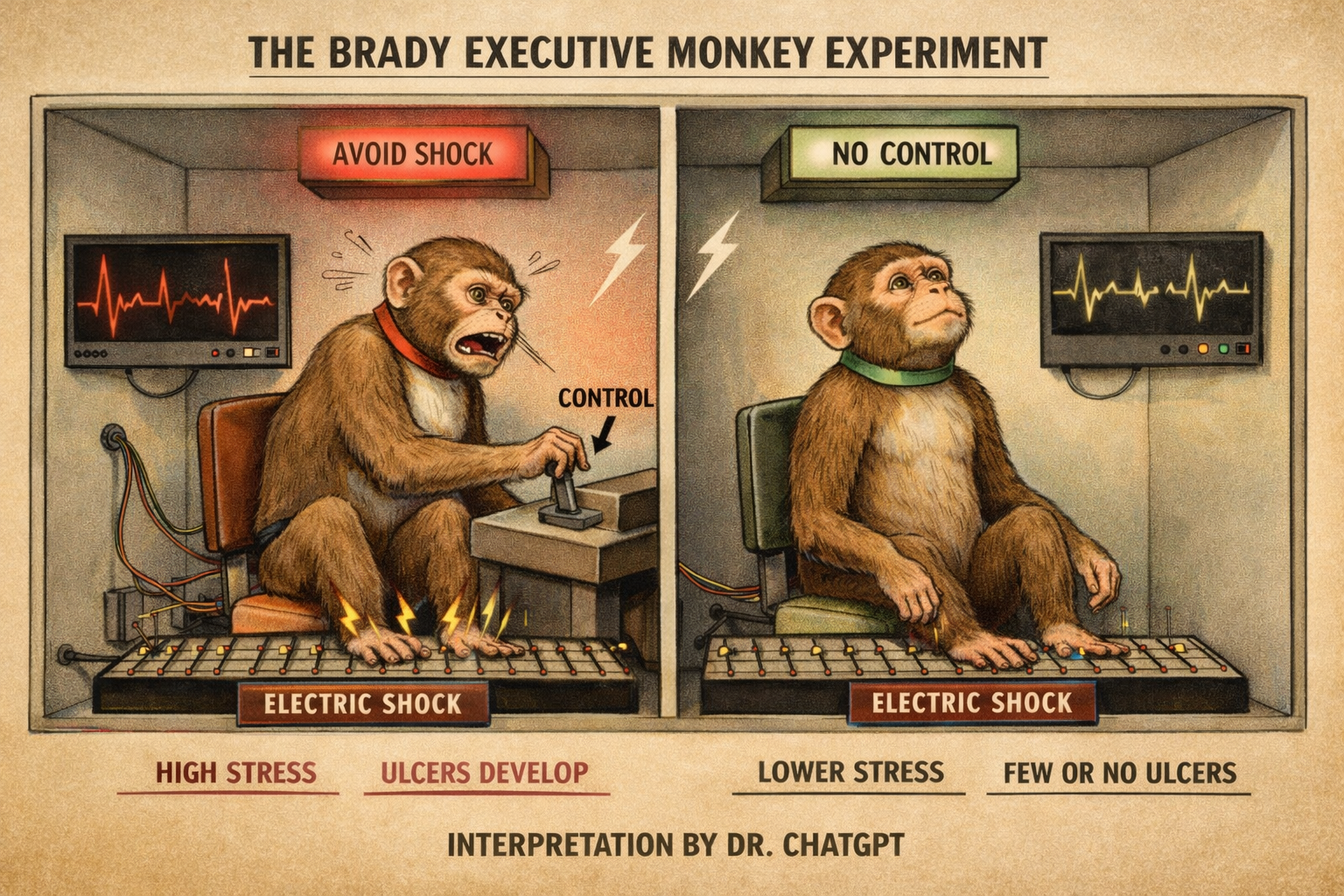
THE EXECUTIVE MONKEY EXPERIMENT BRADY 1958
The Executive Monkey experiment by Brady 1958 is a classic example of a non-equivalent groups quasi-experiment. However, it illustrates an important methodological point. Random allocation was neither impossible nor unethical in this case. It was simply not used, and this is now widely regarded as a design flaw.
Brady investigated the effects of stress on the development of ulcers in rhesus monkeys. Monkeys were placed in pairs in executive and yoked conditions. The executive monkey could press a lever to avoid electric shocks and therefore had control over the stressor. The yoked monkey received exactly the same shocks but had no control and could not press the lever. The executive monkeys developed severe gastric ulcers and died, whereas the yoked monkeys showed less severe or no ulcers. Brady concluded that psychological stress, specifically responsibility and control, was the causal factor in ulcer formation.
WHY THIS IS A NON-EQUIVALENT GROUPS QUASI-EXPERIMENT
The researcher manipulated the independent variable, which was control over shock avoidance versus no control.
The dependent variable was ulcer formation, measured post mortem. However, the monkeys were not randomly allocated to conditions. Assignment was based on pre-testing, such as higher lever pressing rates or responsiveness. This meant that monkeys selected for the executive role may already have differed in temperament, stress reactivity, or physiological vulnerability. The groups were therefore non-equivalent from the outset.
RANDOM ALLOCATION WAS POSSIBLE AND ETHICAL
Random allocation was entirely feasible. The monkeys came from the same pool, and simple random assignment would have ensured equivalence on pre-existing characteristics. It was not unethical to randomise. The electric shocks were part of the design regardless of the allocation method, and randomisation would not have increased harm or altered the ethical framework of the study under the standards of the time. The failure to randomise was therefore a methodological error. Without random allocation, pre-existing differences such as stress sensitivity or biological resilience could not be ruled out as explanations for ulcer development. The design weakened the claim that lack of control alone caused the ulcers.
NATURAL EXPERIMENTS VERSUS NON-EQUIVALENT QUASI-EXPERIMENTS
Many teachers and students confuse natural experiments with non-equivalent quasi-experiments because neither type of experiment can randomly allocate participants to conditions and, as a result, have non-equivalent groups (group differences). Superficially, they look similar. However, the independent variable has a fundamentally different cause, and this distinction is often insufficiently understood. The crucial difference concerns control over the independent variable. In a natural experiment, the independent variable occurs naturally. The researcher does not create, choose, or manipulate it. The researcher simply studies an event or condition that already exists in the real world. For example, looking at PTSD in New Yorkers before and after 9/11. Clearly, the researcher did not manipulate or cause 9/11 to happen (this would be insane), but is studying this devastating event nevertheless and cannot randomise participants to before 9/11 and after 9/11. The most common form of quasi-experiment is used when random assignment is not possible or ethical, for example, using different therapies in different hospitals, resulting in groups that may differ on key characteristics before any treatment is applied. In a non-equivalent quasi-experiment, however, the researcher manipulates or selects the independent variable but cannot randomly allocate participants to conditions. The researcher is deliberately testing something, even though randomisation is not possible.
THE DIFFERENCE BETWEEN NATURAL EXPERIMENTS AND QUASI-EXPERIMENTS
Natural experiments lack random allocation and are therefore often classified as quasi-experiments. However, there is an important distinction between them. In a natural experiment, the lack of random allocation is retrospective. The groups have already been formed by real-world events (such as a natural disaster, a new law, or a factory closure). The researcher cannot randomly assign people to groups because the conditions already exist — they simply study the groups as they are. In contrast, a quasi-experiment is prospective. The researcher deliberately manipulates or selects the independent variable from the outset when designing the study. The lack of random allocation is a conscious choice made by the researcher at the planning stage, not a result of real-world circumstances. This difference in timing and control is the key nuance: natural experiments are observational studies of events that have already happened, whereas quasi-experiments are planned studies where the researcher actively chooses the conditions.
HODGES AND TIZARD AS A NATURAL EXPERIMENT
Hodges and Tizard’s study of institutionalised children provides a clear example of a natural experiment. The independent variable was whether children who grew up in an institution were either adopted, sent back to their original homes, or stayed at the institution. These circumstances already arose in real-life social and caregiving situations. Hodges and Tizard simply studied the long-term effects of naturally occurring differences in early attachment experience. In addition, the researcher did not randomly assign children to these conditions, as this would have been extremely unethical. If an IV occurs naturally, participants are also assigned to conditions. Randomisation is not possible because the groups pre-existed. Natural experiments are retrospective.
WHY NON-EQUIVALENT QUASI-EXPERIMENTS ARE DIFFERENT
The key distinction is that natural experiments are typically retrospective, whereas non-equivalent quasi-experiments are typically prospective.
In a natural experiment, the independent variable has already occurred before the researcher begins the study. The researcher looks back at naturally formed groups and examines their outcomes. The groups pre-exist, and the researcher has no control over how they were formed. Hodges and Tizard is a retrospective study because the children had already been adopted, returned home, or remained institutionalised due to social and legal processes outside the researchers’ control. The researchers could not have randomly allocated participants to conditions because the groups already existed. The same is true of the 9/11 example: the groups that existed before and after the event were formed naturally, even though the independent variable itself was a real-world event. The researcher did not determine the IV, and the groups were naturally assigned. In contrast, a non-equivalent quasi-experiment is prospective. The researcher deliberately introduces or selects the independent variable and then measures its effects. However, participants still cannot be randomly allocated.
To make this explicit, using Hodges and Tizard, if the study had been a non-equivalent quasi-experiment, the researchers would have determined the independent variable themselves. For example, they might have decided that the IV would be adoption, return home, or continued institutional care in order to test the effects of these caregiving environments. However, they would have been unable to randomly assign children fully because of ethical constraints. You cannot decide who is adopted and who remains institutionalised. That would have been prospective and researcher-determined. But that is not what happened. In the actual study, the caregiving outcomes had already occurred. The researchers simply followed up with the children and assessed their attachment and social functioning later. The IV arose naturally, and the study examined its consequences retrospectively.
Therefore:
Natural experiments are retrospective because the IV is not determined by the researcher, but the groups are naturally assigned.
Non-equivalent quasi-experiments are prospective, so the IV is determined or selected by the researcher, but the groups are naturally assigned due to ethical or practical constraints.
Thus, natural experiments are often classified as quasi-experiments, but not all quasi-experiments are natural experiments.
SUMMARY OF THE DISTINCTION
Natural experiments are retrospective: the IV is not determined by the researcher, and groups are assigned by naturally occurring events.
Non-equivalent quasi-experiments are prospective: the IV is determined or selected by the researcher, but groups are naturally assigned due to ethical or practical limitations