IS THE SOUL 0.111958% OF OUR MASS?
WHAT ARE HUMANS MADE OF?
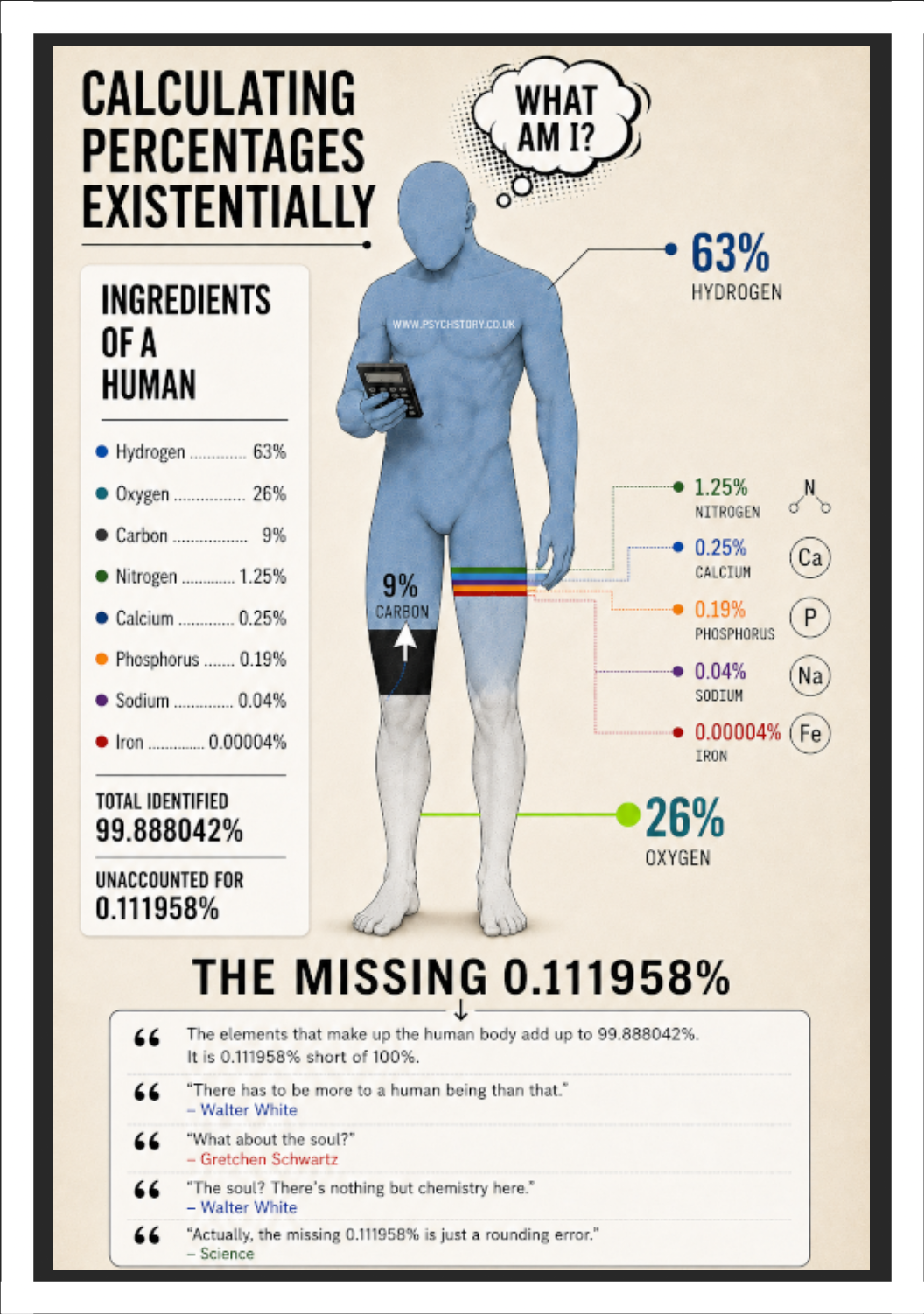
We are 63% hydrogen, 26% oxygen, 9% carbon, and a handful of trace elements.
That is the complete list. Everything you have ever thought, felt, remembered, or feared — reduced to eight ingredients.
Human beings have spent much of history describing themselves as unique, special, spiritual, chosen, enlightened, or somehow separate from the rest of nature.
Chemistry is less sentimental.
From a chemical perspective, a human being is just a bunch of bog-standard elements arranged in a particularly complicated pattern.
And yet, the numbers add up to only 99.888042%.
Some people think the missing 0.111958% is the soul.
Of course, this raises an interesting question. If every atom in the body can be identified, measured, weighed, and accounted for, where exactly do concepts such as consciousness, identity, free will, personality, meaning, and the soul fit into the equation?
Some would argue that they emerge from the arrangement of matter itself. Others would argue that something important is missing from purely physical explanations.
Science can tell us what we are made of.
Whether that is all we are remains a matter of debate. But isn't the soul supposed to be an abstract concept with no physical mass? If so, it would weigh nothing and register nothing in any chemical analysis.
Science thinks the missing 0.111958% is due to rounding.
What do you think?
#psychology #neuroscience #science #humanbody #existentialcrisis #psychstory #consciousness #alevelsupport