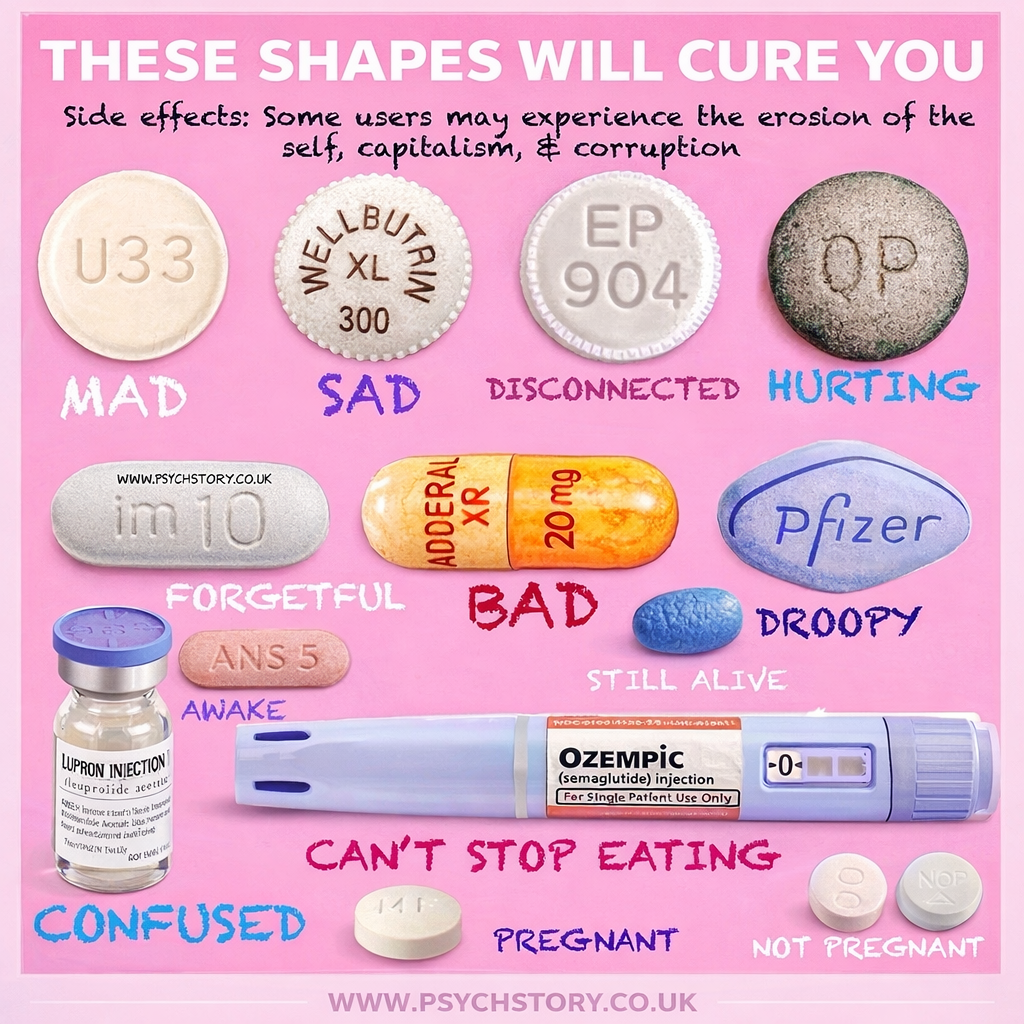
THESE DRUGS WILL SAVE YOU
We are living through a mass chemical experiment dressed up as care.
In the UK and US, SSRIs are handed out at scale—not just for depression, but for grief, irritability, PMS, boredom, breakups. They’re prescribed to teenagers, to the bereaved, to the burnt-out. The narrative? You’re chemically imbalanced. The solution? Lifelong correction.
But the data doesn’t lie: SSRIs perform no better than placebo in most clinical trials. What they do cause—reliably—is suicidal ideation, homicidal impulses, sexual dysfunction, and a complete blunting of emotion.
These aren’t side effects. They’re structural consequences of altering brain chemistry.
SSRIs interfere with serotonin reuptake, leading to downregulation of receptors over time. Stop taking them, and the brain responds with upregulation—a surge in instability and emotional chaos that gets conveniently misdiagnosed as “relapse.”
That’s not proof the drug worked. It’s proof the user’s neurochemistry has been compromised. And it doesn’t stop with antidepressants.
Adderall is prescribed to children as young as three. We call it managing “behavioural issues.” What it really manages is compliance—in overstimulating schools and underfunded classrooms.
Then there’s OxyContin—once sold as a breakthrough. Purdue Pharma knew it was addictive. They pushed it anyway. Half a million deaths later, they paid a settlement. No one went to prison.
The pill flattens women’s libidos, drops testosterone, and shifts attraction patterns. Women report feeling “like someone else.” Medicine calls it “well tolerated.”
Even placebo, which often matches or outperforms SSRIs, is dismissed—not because it fails, but because you can’t monetise belief.
Meanwhile, Big Pharma funds the APA, writes the diagnostic manuals, and ensures the solution is always chemical.
This isn’t mental health.
It’s mood management.
It’s system preservation.
It’s pharmaceutical people management at scale.
There’s a pill for everything now—But what if the real diagnosis is structural?
What if the real side effect… is the erosion of self and a society that does not need to repair itself because a pill will do.
#bigpharma #dsm #ssris