COLOUR
WHITE LIGHT
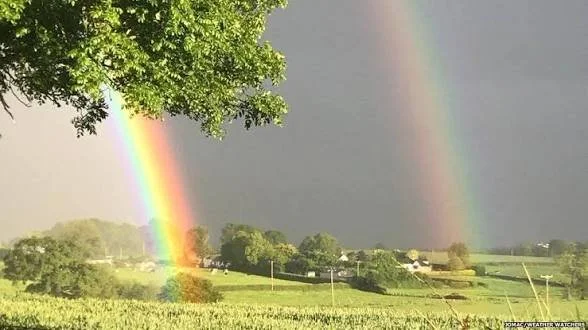
White light is not a single colour. It is made of all the colours of visible light mixed together. These colours can be separated and shown as a spectrum.
THE VISIBLE SPECTRUM
The visible spectrum is the range of colours that human eyes can see.
The colours of the rainbow, in order, are:
Red
Orange
Yellow
Green
Blue
Indigo
Violet
A useful way to remember them is ROYGBIV.
WHAT IS A WAVELENGTH
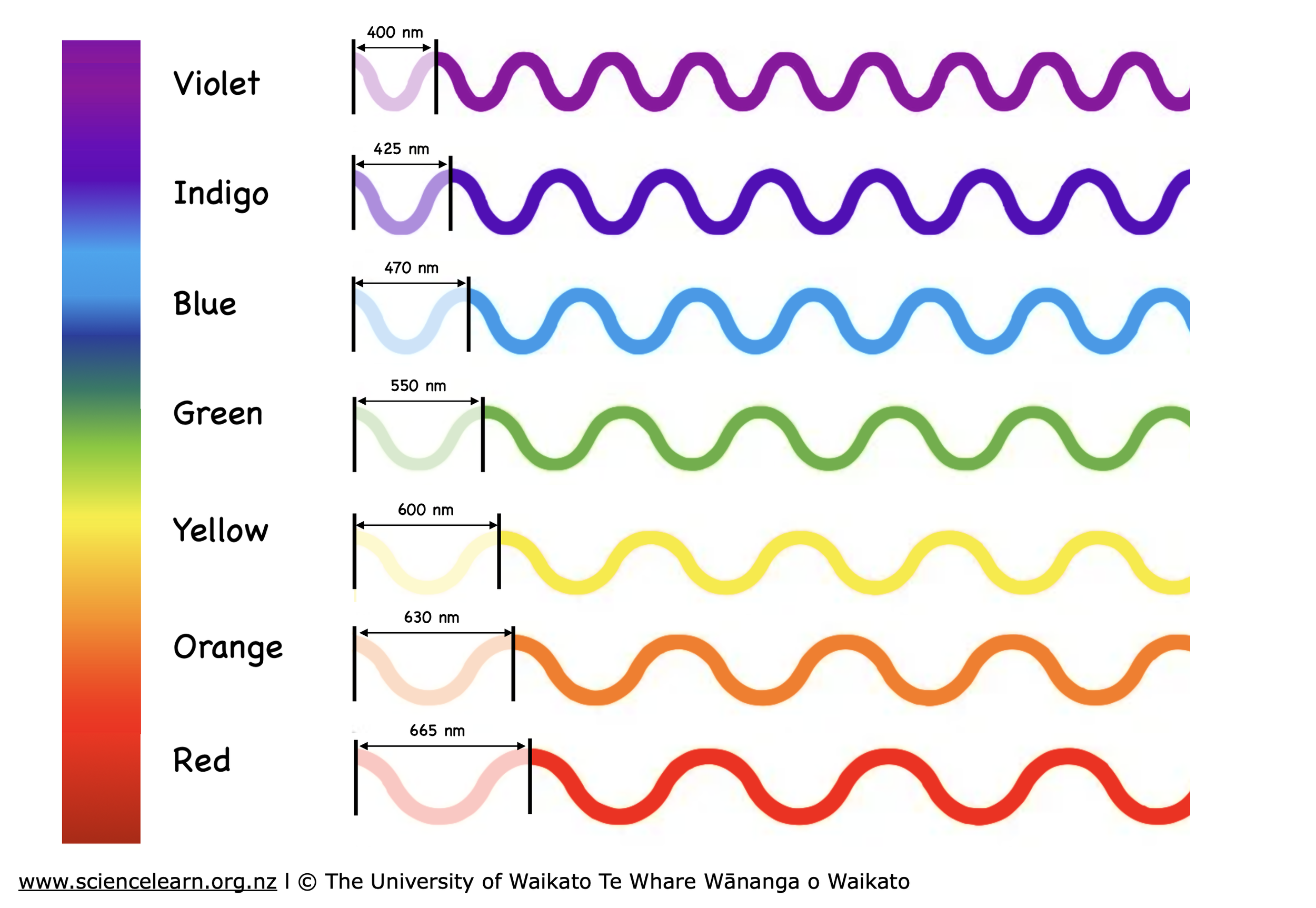
Light travels as a wave. A wavelength is the distance from one wave peak to the next wave peak. Some light waves are long and spread out. Some are short and close together.
Longer wavelengths carry less energy and are bent less by a prism.
Shorter wavelengths carry more energy and are bent more by a prism.
Red light has the longest wavelength in the visible spectrum.
Violet light has the shortest wavelength in the visible spectrum.
APPROXIMATE WAVELENGTHS OF VISIBLE LIGHT
Red: about 700 nanometres
Orange: about 620 nanometres
Yellow: about 580 nanometres
Green: about 530 nanometres
Blue: about 470 nanometres
Indigo: about 445 nanometres
Violet: about 400 nanometres
A nanometre is a very tiny unit of length. It is one billionth of a metre.
WHY ARE THE WAVELENGTHS DIFFERENT
Different colours are different forms of light energy. They are produced with different wavelengths and different frequencies. Frequency means how many waves pass a point each second. Short wavelength means high frequency. Long wavelength means low frequency. This is why red light and violet light behave slightly differently when they pass through substances such as glass.
WHY A PRISM SPLITS LIGHT
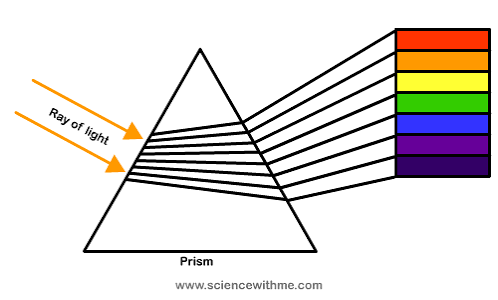
A prism splits white light because of refraction. Refraction means the bending of light when it moves from one material to another, such as from air into glass. Light changes speed when it enters the glass. Each colour changes speed by a slightly different amount because each colour has a different wavelength. This means each colour bends by a different amount. Red bends the least. Violet bends the most. The spreading out of white light into different colours is called dispersion.
HOW TO SPLIT WHITE LIGHT USING A PRISM
To split white light, shine a narrow beam of white light from a ray box or torch into a glass prism in a dim room. Place a white screen or a sheet of white paper on the other side. As the light enters the prism it slows down and bends. As it leaves the prism it bends again. Because each colour bends by a different amount, the white light spreads out into a spectrum.
DRAW A LABELLED DIAGRAM
Draw a prism and show white light entering one side and the visible spectrum leaving the other side.
ADDING COLOURS OF LIGHT
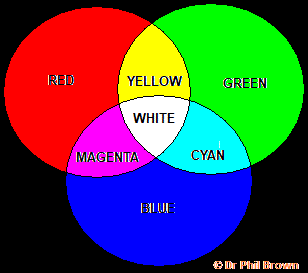
The primary colours of light are red, green and blue. These are called primary colours because all other light colours can be made from them.
When two primary colours of light are mixed, they make secondary colours:
Red + Green = Yellow
Red + Blue = Magenta
Blue + Green = Cyan
When red, green and blue light are all mixed together in equal amounts, they produce white light.
This is called additive mixing because colours are added together.
SUBTRACTING COLOURS
Subtracting colours happens when filters or coloured objects absorb some colours from white light and only allow some colours to pass through or reflect.
A red filter transmits red light and absorbs the other colours.
A green filter transmits green light and absorbs the other colours.
If you place a red filter and a green filter together, almost no light gets through because each filter removes the light the other one would need.
This is called subtractive colour because some colours are taken away.
WHY OBJECTS ARE DIFFERENT COLOURS
Objects appear different colours because they absorb some colours of white light and reflect others.
A red object looks red because it reflects red light into your eyes and absorbs most of the other colours.
A blue object looks blue because it reflects blue light and absorbs the rest.
A white object looks white because it reflects most colours of light.
A black object looks black because it absorbs most colours of light and reflects very little.
The colour you see depends on the light shining on the object. A red object only looks red if red light is available to reflect.
EXAMPLE
A green leaf in white light appears green because it reflects green light and absorbs the other colours.
A red apple appears red because it reflects red light and absorbs the other colours.
WHY THE SKY LOOKS BLUE
Sunlight is white light. When it enters Earth’s atmosphere it collides with tiny gas particles. Shorter wavelengths scatter more easily than longer wavelengths. Blue light has a shorter wavelength than red light, so blue light is scattered much more strongly across the sky. This is why the sky looks blue in the daytime.
FUN FACT
The Sun itself is not blue. It gives off white light. The sky looks blue because blue light is scattered in the atmosphere more than the other colours. In space, where there is no atmosphere, the sky would look black.
CHECK YOUR UNDERSTANDING
What is white light?
Write the colours of the visible spectrum in order.
What is a wavelength?
Which colour has the longest wavelength?
Which colour has the shortest wavelength?
What is refraction?
Why does a prism split white light into different colours?
What are the three primary colours of light?
What colour do red and green light make together?
What colour do red and blue light make together?
What colour do blue and green light make together?
Why does a red apple appear red?
Why does a black object appear black?
Why does the sky look blue?
CHALLENGE
Explain the difference between adding colours and subtracting colours.
KEY WORDS
White light: light made from all the colours of the visible spectrum.
Spectrum: the band of colours formed when white light is separated.
Visible light: the part of the electromagnetic spectrum that humans can see.
Wavelength: the distance between one wave peak and the next.
Frequency: the number of waves passing a point each second.
Refraction: the bending of light when it moves into a different material.
Dispersion: the splitting of white light into its component colours.
Primary colours of light: red, green and blue.
Secondary colours of light: cyan, magenta and yellow.
Reflect: to bounce light off a surface.
Absorb: to take in light energy.
Transmit: to allow light to pass through.
If needed, this can be turned into a cleaner one page worksheet and a matching answer shee