

MEMORY SPECIFICATION
TOPIC 2: COGNITIVE PSYCHOLOGY
TOPIC OVERVIEW
Students must understand that cognitive psychology focuses on the role of cognition and cognitive processes in human behaviour. These processes include perception, memory, selective attention, language, and problem-solving. The cognitive approach draws on the analogy of cognitive processing to computer processing.
Individual differences and developmental psychology must be considered when learning about memory differences, memory deficits, and how memory develops as the brain ages.
2.1 CONTENT
What students need to learn:
Memory
2.1.1 The Working Memory Model (Baddeley and Hitch, 1974).
2.1.2 The Multi-Store Model of Memory (Atkinson and Shiffrin, 1968), including Short-Term Memory (STM)and Long-Term Memory (LTM), and ideas about information processing, encoding, storage, retrieval, capacity, and duration.
2.1.3 Explanation of Long-Term Memory – Episodic and Semantic Memory (Tulving, 1972).
2.1.4 Reconstructive Memory (Bartlett, 1932) including Schema Theory.
2.1.5 INDIVIDUAL DIFFERENCES IN MEMORY
Memory can be affected by individual differences in processing speed or schemas that guide memory's reconstructive nature.
Autobiographical memory is inherently individual.
2.1.6 DEVELOPMENTAL PSYCHOLOGY IN MEMORY
Including at least one of these:
Sebastián and Hernández-Gil (2012) discuss developmental issues in memory span development, which is low at 5 years old and develops as memory capacity increases up to 17 years old.
Dyslexia affects children's memory span and working memory, impacting their learning.
The impact of Alzheimer’s disease on older adults and its effects on memory.
2.2 METHODS
What students need to learn:
Experiments
2.2.1 Designing and conducting experiments, including field and laboratory experiments.
2.2.2 Independent and dependent variables.
2.2.3 Experimental and Null Hypotheses.
2.2.4 Directional (one-tailed) and non-directional (two-tailed) tests and hypotheses.
2.2.5 Experimental designs: repeated measures, independent groups, and matched pairs.
2.2.6 Operationalisation of variables, extraneous variables, and confounding variables.
2.2.7 Counterbalancing, randomisation, and order effects.
2.2.8 Situational and Participant Variables.
2.2.9 Objectivity, reliability, and validity (internal, predictive, and ecological).
2.2.10 Experimenter effects, demand characteristics, and control issues.
2.2.11 QUANTITATIVE DATA ANALYSIS
Analysis of quantitative data: calculating measures of central tendency, frequency tables, measures of dispersion (range and standard deviation), and percentages.
Graphical presentation of data (bar graph, histogram).
2.2.12 DECISION-MAKING AND INFERENTIAL STATISTICS
Non-parametric tests of difference: Mann-Whitney U and Wilcoxon.
Probability and levels of significance (p≤.10, p≤.05, p≤.01).
Observed and critical values, use of critical value tables, and sense-checking of data.
One-tailed or two-tailed decisions in inferential testing.
Type I and Type II errors.
Normal and skewed distribution.
2.2.13 CASE STUDY OF BRAIN-DAMAGED PATIENTS
Including Henry Molaison (HM) and the use of qualitative data, exploring the strengths and weaknesses of the case study approach.
2.3 STUDIES
CLASSIC STUDY
2.3.1 Baddeley (1966b): Working Memory Model - the influence of acoustic and semantic similarity on Long-Term Memory for word sequences.
ONE CONTEMPORARY STUDY FROM THE FOLLOWING:
2.3.2 Schmolck et al. (2002): Semantic knowledge in patient HM and other patients with bilateral medial and lateral temporal lobe lesions.
2.3.3 Steyvers and Hemmer (2012): Reconstruction from memory in naturalistic environments.
2.3.4 Sebastián and Hernández-Gil (2012): Developmental pattern of digit span in the Spanish population.
2.4 KEY QUESTIONS
2.4.1 ONE KEY QUESTION RELEVANT TO TODAY’S SOCIETY
This is to be discussed as a contemporary rather than an academic argument.
2.4.2 CONCEPTS, THEORIES, AND/OR RESEARCH
Drawn from cognitive psychology as covered in this specification.
Suitable Examples
How can psychologists’ understanding of memory help patients with dementia?
How can knowledge of working memory be used to treat dyslexia?
INTRODUCTION TO PSYCHOLOGY AND ITS APPROACHES
Our first lesson taught us that psychology is not based on a single belief system but comprises different approaches that propose varied explanations for human behaviour. Each approach offers a unique perspective on what drives our thoughts, emotions, and actions.
The earliest approach was the Psychodynamic (or Psychoanalytic) theory, which suggested that unconscious processes, particularly those stemming from childhood experiences, significantly shape human behaviour. This theory laid the groundwork for understanding the depth of human emotions and motivations but faced criticism for its lack of scientific rigour.
Following this, the Behaviourist approach emerged as a rejection of psychoanalysis due to its unscientific nature. Behaviourism was a breakthrough as it introduced scientific concepts and experimental methods, making psychology more empirically respectable. However, behaviourism has two significant limitations:
It dismissed the relevance of the brain, focusing solely on observable behaviour without considering internal mental processes.
It argued that the brain could not be scientifically studied due to the lack of observable evidence, effectively overlooking mental processes like memory, attention, and perception.
While behaviourism remains relevant today, particularly in understanding how our environment shapes us through reinforcement, punishment, and associations (which you'll learn more about in detail with Ms Brice), it only explains part of the human experience. It focuses on environmental factors without accounting for the higher cognitive abilities crucial to understanding human behaviour.
Students must understand that cognitive psychology focuses on the role of cognition and cognitive processes in human behaviour. These processes include perception, memory, selective attention, language, and problem-solving. The cognitive approach draws on the analogy of cognitive processing to computer processing.
BIRTH OF THE COGNITIVE APPROACH
The limitations of behaviourism led to the rise of the Cognitive approach, which aimed to fill in the gaps left by its predecessor. This approach focuses on understanding how humans process information—examining memory, attention, language, perception, consciousness, and complex abilities like face recognition. The cognitive approach investigates the mental processes behind behaviour, exploring what we do, why we do it and how the brain works to produce these higher cognitive functions.s
COGNITIVE PSYCHOLOGISTS’ METHODS FOR INVESTIGATING THE BRAIN
Cognitive psychologists have four main methods for investigating how the brain processes mental functions such as memory and language. The choice of methods often depends on the technological advances of the time. For instance, in 1968, when scanning technologies like fMRI and PET scans did not exist, Atkinson and Shiffrin had to rely on less advanced techniques to explore how memory might be organised in the brain.
The four methods commonly used to investigate inner mental processes are:
Post-Mortem Studies of Brain-Damaged Individuals: Cognitive psychologists examine the brains of individuals who suffered from brain damage during their lifetime to understand how certain cognitive functions are affected. A classic example is the study of Tan by Paul Broca, where post-mortem analysis revealed damage to Broca’s area, associated with speech production. This early form of investigation laid the groundwork for understanding the relationship between brain areas and behaviour. Over time, as technology improved, brain scans provided more dynamic and real-time insights, leading to the development of cognitive neuropsychology.
Cognitive Neuroscience: This method involves scanning the brains of healthy individuals while they engage in specific cognitive tasks. Advanced techniques such as fMRI and PET scans allow researchers to see which areas of the brain are active during processes like memory recall, language comprehension, or problem-solving. For instance, scans show that Short-Term Memory (STM) and Long-Term Memory (LTM) are processed in different brain regions.
Laboratory Experiments: Cognitive psychologists conduct controlled lab experiments to study mental processes scientifically. These "fair tests" manipulate an Independent Variable (IV) to observe its effect on a Dependent Variable (DV). A famous example is Baddeley's encoding experiment, which investigated how STM and LTM encode information differently. Laboratory experiments are essential for testing hypotheses about how cognitive processes work under controlled conditions.
Cognitive Science and Artificial Intelligence (AI) Models: The aim is to simulate human cognitive processes by building AI models that mimic the brain's operation. Cognitive scientists can learn more about how the brain functions by replicating processes like memory storage, problem-solving, and language use. This approach helps bridge the gap between theoretical understanding and practical application by providing insights into how cognitive processes might be structured and work together.r
INTRODUCTION TO MEMORY RESEARCH
A key focus in cognitive psychology is the study of memory, with many introductory courses and specifications examining the Multi-Store Model (MSM) of memory proposed by Atkinson and Shiffrin. The MSM is often studied because it was the first comprehensive model to describe how memory operates, providing students with ample opportunity for positive and negative critiques.
Before Atkinson and Shiffrin's work, memory was primarily seen as a singular, unitary system. However, they hypothesised that memory is not one single entity but consists of three distinct stores: the Sensory Register, Short-Term Memory (STM), and Long-Term Memory (LTM). This idea revolutionised our understanding of how we encode, store, and retrieve information, laying the foundation for modern memory research.
With this background, we will begin our exploration of memory research by examining how theories like the Multi-Store Model challenged the traditional views of memory and paved the way for new approaches to understanding cognition and the brain.But first, we need to have some subject-specific terminology:
KEY WORDS
SENSORY REGISTER/MEMORY (ICONIC, ECHOIC, HAPTIC, OLFACTORY, GUSTATORY): The Sensory Register is the initial stage of memory that captures sensory information from the environment for a brief period. It includes:
Iconic Memory: Visual sensory memory (images and visual stimuli).
Echoic Memory: Auditory sensory memory (sounds).
Haptic Memory: Tactile sensory memory (touch).
Olfactory Memory: Memory for smells.
Gustatory Memory: Memory for tastes.
SHORT-TERM MEMORY (STM): Short-Term Memory refers to the temporary storage of information that is actively being processed. It typically holds a limited amount of information (around 7 items) for a short duration (approximately 18-30 seconds).
LONG-TERM MEMORY (LTM): Long-Term Memory is the continuous storage of information, which can last from a few minutes to an entire lifetime. It has a much larger capacity compared to STM and can store different types of information (e.g., declarative, procedural).
TRANSFER OF STM TO LTM: The process through which information moves from Short-Term Memory to Long-Term Memory. This typically requires rehearsal and encoding, where information is processed deeply enough to be stored for the long term.
FORGETTING THROUGH RETRIEVAL FAILURE: A type of forgetting that occurs when information is stored in Long-Term Memory but cannot be accessed. Retrieval failure often occurs due to a lack of retrieval cues or context.
LINEAR DIRECTION: In the context of memory models, a linear direction refers to the sequential process by which information moves through different memory stores—first to the sensory register, then to STM, and finally to LTM.
FORGETTING THROUGH DISPLACEMENT: Forgetting Through Displacement occurs when new information pushes out older information from Short-Term Memory due to its limited capacity.
UNITARY STORE: A Unitary Store is a memory model concept suggesting that memory is stored in a single, undifferentiated store rather than separate types (e.g., no division between STM and LTM).
MULTIPLE STORES: In contrast to a unitary store, Multiple Stores refer to models of memory that suggest distinct types of memory storage (e.g., Sensory Memory, Short-Term Memory, and Long-Term Memory), each with different characteristics.
REHEARSAL LOOP: The Rehearsal Loop is the process of repeatedly mentally repeating or verbalising information to keep it in Short-Term Memory or to transfer it to Long-Term Memory.
ENCODING: Encoding is the process of transforming sensory input into a form that can be stored in memory. It is how information is prepared to be stored in either Short-Term or Long-Term Memory.
CAPACITY: Capacity refers to the amount of information that can be held in a particular memory store. For instance, STM has a limited capacity (around 7 items), whereas LTM is thought to have a virtually unlimited capacity.
DURATION: Duration is the length of time information can be stored in a memory system. For example, STM has a short duration of around 18-30 seconds, whereas LTM can retain information for a much longer time, potentially a lifetime.
ACOUSTIC ENCODING: Acoustic Encoding is the process of converting information into sound patterns for storage in memory, often used in STM.
SEMANTIC ENCODING: Semantic Encoding is the encoding of information by its meaning, making it easier to recall. This type of encoding is more common in LTM.
VISUAL ENCODING: Visual Encoding is the process of converting visual information (e.g., images, colours) into a memory trace for storage. This type of encoding is often used in both sensory memory and STM.
AMNESIA: Amnesia is a condition characterised by a significant loss of memory, often affecting one’s ability to remember past events (Retrograde) or form new memories (Anterograde).
Causes:
Brain injury or trauma (e.g., concussion).
Neurological conditions (e.g., Alzheimer’s disease).
Psychological events (e.g., extreme stress or trauma).
ANTEROGRADE AMNESIA: Anterograde Amnesia is the inability to form new memories after the onset of an amnesia-causing event. While a person can still recall past events, they struggle to retain new information.
Causes:
Damage to the hippocampus or related brain areas (often due to traumatic brain injury, stroke, or certain drugs/alcohol abuse).
Diseases like Alzheimer’s that affect the brain's memory systems.
RETROGRADE AMNESIA: Retrograde Amnesia is the loss of access to memories that were formed before the onset of the amnesia-causing event. It can affect recent memories or even older ones, depending on severity.
Causes:
Traumatic brain injury (e.g., concussion, surgery).
Psychological trauma or events leading to memory repression.
Neurological damage (from conditions like encephalitis or Alzheimer’s disease).
MEMORY FAILURES AND CAUSES
DISPLACEMENT: The process where new information pushes out older information from Short-Term Memory (STM) because of its limited capacity.
Cause: Happens often when trying to memorise many items at once, leading to forgetting the earlier ones.
TRACE DECAY: The loss of memory if it is not accessed or rehearsed. Trace Decay is a theory of forgetting in which memory traces (the physical changes in the brain that represent memories) fade and weaken over time when they are not actively rehearsed or use
Cause: Natural degradation of memory traces in both Short-Term and Long-Term Memory.
RETRIEVAL FAILURE: The inability to access a memory that is stored in Long-Term Memory (LTM), often due to insufficient cues or lack of context.
Cause: Sometimes known as the "tip-of-the-tongue" phenomenon, it can occur due to insufficient rehearsal or improper encoding, making the memory hard to retrieve when needed
2.1.2 The Multi-Store Model of Memory (Atkinson and Shiffrin, 1968), including Short-Term Memory (STM)and Long-Term Memory (LTM), and ideas about information processing, encoding, storage, retrieval, capacity, and duration.
ATKINSON AND SHIFFRIN’S THREE TYPES OF MEMORY STORES
According to Atkinson and Shiffrin’s Multi-Store Model, memory comprises three distinct stores: the Sensory Register, Short-Term Memory (STM), and Long-Term Memory (LTM). Each store plays a unique role in processing and storing information.
SENSORY REGISTER
The Sensory Register is an unconscious memory store that briefly holds sensory information from the environment, creating an unconscious representation of our world. It constantly receives input from all our senses (e.g., sight, sound, touch).
You are typically unaware of this information unless you pay attention to it. For instance, you may not notice how your foot feels until you suddenly step on a pin. This sensation captures your attention, moving the information from the sensory register to STM, where it becomes conscious.
SHORT-TERM MEMORY (STM)
STM is where the information given attention is brought to conscious awareness and actively processed. At this stage, the stimuli become something we can think about or temporarily hold in our minds.
LONG-TERM MEMORY (LTM)
LTM stores information over extended periods, sometimes for a lifetime. It encodes information based on meaning—a process known as semantic encoding—which allows for deeper processing and long-term retention.
DIFFERENCES BETWEEN THE STORES: FEATURES OF EACH MEMORY STORE.
To prove their theory—that memory is not one store but three—Atkinson and Shiffrin had to demonstrate that STM, sensory memory (SM), and LTM differ fundamentally, such as being located in different parts of the brain. The most common way to prove these differences is to compare them based on duration, capacity, and encoding. Understanding these distinctions helps reinforce the idea that memory comprises three separate, interconnected stores.
CAPACITY IN MEMORY STORES
Capacity refers to the amount of information that each memory store can hold. STM has a limited capacity, whereas LTM is thought to have a far larger, potentially unlimited capacity.
STM Capacity - Miller’s Study (1956): George Miller investigated the capacity of STM and found that people can generally hold around 7±2 items at a time (often referred to as "the magic number seven"). This suggests that STM has a limited capacity, making it necessary to use techniques like chunking (grouping information) to maximise storage.
MEMORY SPAN/DIGIT SPAN: Memory span, often assessed through digit span tasks, is the capacity of working memory to hold a sequence of items, typically numbers, in the correct order for a short period. A classic digit span task involves a person listening to or reading a series of numbers and then trying to repeat them back in the same order. The number of items that can be correctly recalled without mistakes is considered their "digit span."
Typical Span:
Research, like that of George Miller, suggests that the average person’s memory span is about 7 ± 2 items (between 5 and 9), meaning this is the usual limit for the number of discrete units or chunks one can hold in short-term memory (STM).
CHUNKING AND STM CAPACITY: Chunking is a strategy used to overcome the limited capacity of STM by grouping individual bits of information into larger, meaningful units or "chunks." This allows for more efficient use of memory resources, enabling one to remember more items than by trying to store each piece separately.
Example: Instead of trying to remember the digits "1, 9, 4, 5," which could be four separate items, one might chunk them into the year "1945." This transformation reduces the number of items from four to one.
Significance: Chunking helps extend the capacity of STM by grouping information meaningfully. A well-known example is how people often remember phone numbers in chunks (e.g., 123-456-7890).
DURATION IN MEMORY STORES
Duration refers to when information can be retained within each memory store without being lost or forgotten.
STM Duration - Peterson and Peterson (1959): Peterson and Peterson studied the duration of STM by giving participants trigrams (nonsense sequences of three consonants, like "JRG") to remember while counting backwards to prevent rehearsal. They found that STM was unable to retain the information after just 18-30 seconds, showing that STM duration is very short without rehearsal.
LTM Duration - Bahrick et al. (1975): Bahrick and colleagues examined the duration of LTM by asking participants to recall names and faces from their high school yearbooks. They found that even years later—up to 50 years—people could recall about 70% of their classmates' names and faces, suggesting that LTM has a long duration, potentially lasting a lifetime.
UNDERSTANDING ENCODING IN STM AND LTM
Many students find the concept of encoding challenging. Put, encoding is how information is transformed and stored in our memory systems—Short-Term Memory (STM) and Long-Term Memory (LTM). However, the way we encode information in each system differs:
STM encodes acoustically and visually, meaning it primarily stores sounds and images. For instance, if you're trying to remember a phone number briefly, you might repeat it aloud (acoustic encoding) or visualise the digits (visual encoding).
LTM, however, encodes information semantically, which means it stores the meaning of information rather than the exact details.
SEMANTIC VS SYNTAX EXAMPLE
To understand semantic encoding, let's compare it with syntax.
Syntax refers to the exact structure of words and sentences—the specific word-for-word phrasing of something. For example, memorising every word of the story "Goldilocks and the Three Bears" would be remembering the syntax.
Semantic memory, however, is remembering the gist or meaning of the story—essentially, understanding that "Goldilocks enters the bears’ house, eats their food, sits in their chairs, and falls asleep in their bed." The exact words are not retained, but the main idea or meaning is.
Encoding information semantically in LTM means that our memory is not an exact replication of the actual event but rather an interpretation of it. Our intelligence, attention, biases, and personal understanding influence this interpretation. So, when we recall an event, we recall what it meant to us rather than every detail.
BADDELEY’S STUDY ON DIFFERENT TYPES OF ENCODING
Baddeley conducted a study examining the recall of acoustically and semantically similar and dissimilar words to test how STM and LTM encode differently.
Acoustically Similar and Dissimilar Words:
Acoustically Similar words sound similar (e.g., man, map, mat, mad).
Acoustically Dissimilar Words do not sound alike (e.g., pen, tree, sun, shoe).
In the experiment, when participants were asked to recall acoustically similar words immediately (using STM), they struggled more than dissimilar words, suggesting that STM relies heavily on acoustic encoding and that words sounding alike can cause confusion.
Semantically Similar and Dissimilar Words:
Semantically Similar Words have similar meanings (e.g., big, large, huge, enormous).
Semantically Dissimilar Words have different meanings (e.g., small, red, tree, walk).
When participants were asked to recall semantically similar words after a delay (using LTM), they found it more difficult than recalling semantically dissimilar words. This indicates that LTM relies on semantic encoding and that words with similar meanings can be easily confused in LTM.

2.3.1 Baddeley (1966b): Working Memory Model - the influence of acoustic and semantic similarity on Long-Term Memory for word sequences.
CLASSIC STUDY REQUIREMENT
In our last lesson, we discussed that we need to learn a classic study, and one of these is Baddeley's study on encoding. To help you remember the right parts of a study, psychologists often use the acronym APFC, which stands for:
Aims
Procedure
Findings
Conclusions
APPLYING APFC TO BADDELEY’S STUDY
Although the acronym APFC suggests a straightforward summary of a study, it’s a simplified way of understanding the research methodology. The survey methodology is not limited to aims, procedures, findings, and conclusions. It’s more complex, covering aspects like design, controls, participants, apparatus/materials, and the detailed procedure. However, teachers use APFC because it provides a more straightforward framework to describe the fundamentals of a method. Each part helps break down the research structure, making it easier to understand how the study was conducted and what conclusions were drawn.
AIMS
Baddeley aimed to investigate how Short-Term Memory (STM) and Long-Term Memory (LTM) encode information. Specifically, he wanted to see if STM encodes information acoustically (by sound) and if LTM encodes information semantically (by meaning).
PROCEDURE
Participants were presented with four lists of words:
Acoustically Similar: words that sound alike.
Acoustically Dissimilar: words that sound different.
Semantically Similar: words with similar meanings.
Semantically Dissimilar: words with different meanings.
For testing STM, participants had to recall the words immediately after hearing them. For LTM, there was a 20-minute delay before the recall to assess the retention of the words.
FINDINGS
STM Encoding: Participants had difficulty recalling acoustically similar words immediately, suggesting that STM relies heavily on acoustic encoding.
LTM Encoding: When recalling words after a delay, participants struggled more with semantically similar words, indicating that LTM relies on semantic encoding.
Conclusions
Baddeley concluded that STM and LTM use different encoding processes. STM encodes information primarily through sounds (acoustically), while LTM focuses on the meaning of information (semantically). This supports the idea that STM and LTM are separate memory stores with unique encoding methods.
By applying APFC to Baddeley’s study, students can more easily grasp the aims, methods, and outcomes of the research, helping to build a foundation for understanding classic studies in cognitive psychology.
Here is how APFC applies to Baddeley's study on encoding:
Aims:
Baddeley aimed to investigate how STM and LTM encode information differently. Specifically, he wanted to determine if STM primarily uses acoustic encoding (by sound) and LTM uses semantic encoding (by meaning).
Procedure:
Participants were presented with four lists of words:
Acoustically Similar (words that sound alike).
Acoustically Dissimilar (words that sound different).
Semantically Similar (words with similar meanings).
Semantically Dissimilar (words with different meanings).
For STM encoding, participants were asked to recall the words immediately after hearing them. For LTM encoding, there was a 20-minute delay before recall to test the retention of the words.
Findings:
Participants struggled more with acoustically similar words when recalling words from STM, indicating that STM encodes information acoustically.
When recalling words from LTM, participants found it challenging to recall semantically similar words, suggesting that LTM encodes information based on meaning (semantically).
Conclusions:
Baddeley concluded that STM and LTM use different encoding processes: STM relies primarily on acoustic encoding, while LTM uses semantic encoding. This distinction supports the idea that the STM and LTM are separate stores with unique ways of processing information.
Understanding APFC helps you break down classic studies like Baddeley’s, making remembering their aims, methods, and conclusions easier.
CONCLUSION FEATURES OF MEMORY
Baddeley's study demonstrated that STM and LTM use different encoding processes. STM tends to encode information acoustically, so you can repeat something to keep it in mind, while LTM encodes semantically, storing the meaning of information rather than the precise details. This distinction is crucial for understanding how we learn and remember different types of information over short and long periods
QUESTIONS
What led to the rise of the Cognitive approach in psychology, and how did it differ from Behaviourism? (2 marks)
What are the four main methods cognitive psychologists use to investigate mental processes and brain functioning? (4 marks)
How did Atkinson and Shiffrin’s Multi-Store Model challenge earlier views of memory? (2 marks)
Explain how information is transferred from the Sensory Register to Short-Term Memory (STM). Provide an example. (2 marks)
What are the key differences between STM and LTM in terms of encoding, based on Baddeley’s study? (2 marks)
What did George Miller (1956) discover about the capacity of Short-Term Memory? (1 mark)
What did Peterson and Peterson (1959) demonstrate about the duration of STM? (2 marks)
How did Bahrick et al. (1975) study the duration of Long-Term Memory (LTM), and what did they find? (2 marks)
What is semantic encoding, and how does it differ from remembering syntax? Give an example from a well-known story. (2 marks)
According to Baddeley’s study, how do acoustically similar and semantically similar words affect recall in STM and LTM? (2 marks)
What are the three distinct stores in Atkinson and Shiffrin’s Multi-Store Model of memory, and what role does each play? (3 marks)
Why is the capacity of LTM considered difficult to measure empirically? (1 mark)
How do laboratory experiments contribute to understanding cognitive processes, and what is an example of such an experiment? (2 marks)
What limitations of Behaviourism led to the development of the Cognitive approach? (2 marks)
How does Cognitive Science and the development of AI models help us understand human memory processes? (2 marks)
What were the main aims of Baddeley’s study, and what aspect of memory was he trying to investigate? (2 marks)
How did the procedure of Baddeley’s study differ when testing Short-Term Memory (STM) versus Long-Term Memory (LTM)? (2 marks)
According to Baddeley’s findings, what were the key differences in how STM and LTM encode information, and what conclusion did he draw from this? (2 marks)
THE MULTISTORE MODEL OF MEMORY
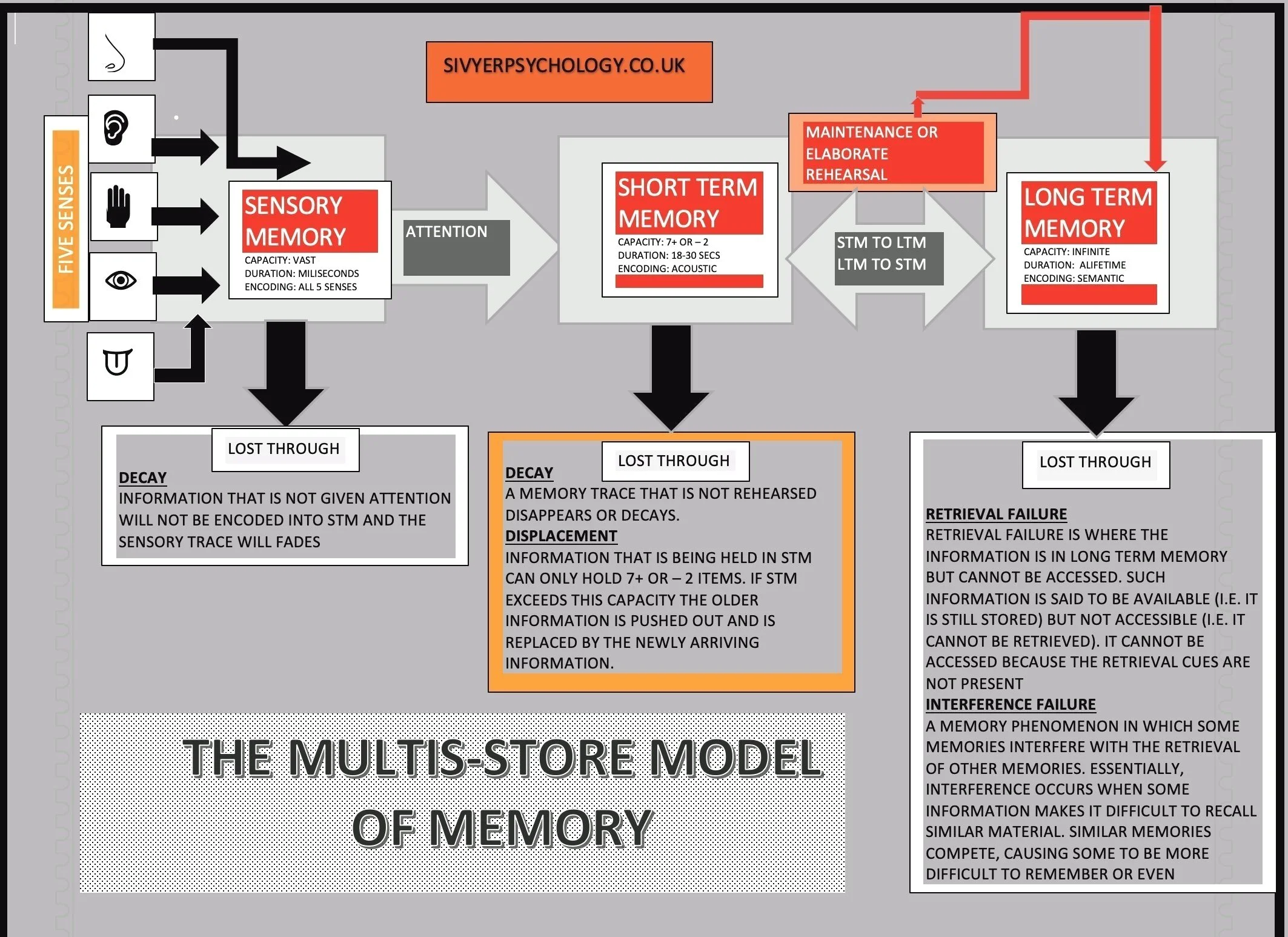
IN SHORT IF YOU CAN DESCRIBE THE MODEL ABOVE THEN YOU KNOW THE MULTISTIRE MODEL OF MEMORY
MSM DESCRIPTION
Before the 1960s, understanding of cognitive processes like memory was limited. The focus at that time was on behaviourism, which ignored mental processes, thinking the brain’s internal workings (or the ‘black box’) were irrelevant.
It was believed that memory was a single system in the brain.
In 1968, Atkinson & Shiffrin (A&S) suggested a different idea: memory consists of three separate stores, so their theory is called the Multi-Store Model (MSM). These three stores are sensory memory (SM), short-term memory (STM), and long-term memory (LTM). A&S argued that memory works as a structure, not just a process, and that information moves between these three stores in a fixed order: from SM to STM and then to LTM.
Sensory Memory (SM) is the first stop for all new information from the environment. It has different registers for the senses: sight (iconic), sound (echoic), touch (haptic), taste (gustatory), and smell (olfactory). Information here is raw and unprocessed, with a large capacity but only lasts for milliseconds. If attention isn’t paid, the information fades away and is forgotten.
Sensory memory captures everything happening around us, but we aren’t aware of most of it (e.g., every step we take or every sound we hear). It helps us make sense of our environment, giving us a feeling of time and space. Focusing on something specific (like a sound or a person) moves into STM, making us consciously aware of it. The sensory register operates without cognitive control, and attention is the key to moving information to the next store.
Short-term memory (STM) is where we become aware of information. It holds only a tiny amount of information for a short time (18-30 seconds) and has a capacity of around seven items. If we don’t rehearse the information, it can easily be forgotten.
To transfer information to LTM, we rehearse it in STM by repeating it (maintenance rehearsal) or processing it more deeply (elaborative rehearsal). If not rehearsed, information is lost through displacement (pushed out by new info) or trace decay (fades away).
Long-term memory (LTM) is like an archive for all memories, unlimited capacity and potential to last a lifetime. Retrieval happens when information from LTM passes back into STM.
While STM mainly uses sound-based encoding (acoustic), LTM stores information based on its meaning (semantic).
EXPLAINING A01 AND A03 IN EDEXCEL PSYCHOLOGY
Edexcel Psychology's essays are divided into three main components: A01, A02 and A03. Think of it as having two distinct roles: being a reporter for A01 and a critic for A03 (we will discuss A2 later).
A01 = Description and Reporting
A01 is about describing the theory or research—clearly explaining the ideas, processes, and findings without adding your opinion. It’s like being a reporter, where you stick to the facts and provide a detailed overview of the subject matter. For example, you might describe Atkinson and Shiffrin’s Multi-Store Model by outlining the three memory stores: Sensory Register, Short-Term Memory (STM), and Long-Term Memory (LTM). Alternatively, discussing Baddeley's study, you would focus on the aims, procedure, findings, and conclusions (using APFC). You do not critique or evaluate—your role is to inform.
A03 = Evaluation and Critique - both positive and negative
A03 is where you evaluate the theory or research, becoming more of a critic. This means that, rather than just describing, you assess the strengths and limitations of the study and its implications. You’re demonstrating your understanding of how robust the research is, considering factors like validity, reliability, and generalizability. In the context of Baddeley’s study, for instance, you might discuss whether the study effectively supports the distinction between STM and LTM encoding or whether there were limitations in how the research was conducted.
PUTTING IT ALTOGETHER IN AN ESSAY
In an Edexcel essay, you first present the A01 content, describing the theory or research in a structured way. After thoroughly covering this, you then move on to A03, where you critique and evaluate what you have described. This helps balance the essay by showcasing your knowledge of the subject and your critical thinking skills.
In future lessons, we will delve deeper into A03 evaluation, where you'll learn to assess how credible and robust the research is, giving your essays a more analytical edge. In the meantime, look at the example below and see if you can recognise the difference between A01 and A03.
A01 ACCOUNT OF THE MULTI-STORE MODEL OF MEMORY (MSM)
The Multi-Store Model of Memory (MSM), proposed by Atkinson and Shiffrin (1968), is a theoretical framework suggesting that memory is composed of three distinct stores: the Sensory Register, Short-Term Memory (STM), and Long-Term Memory (LTM). Each of these stores has its features in terms of capacity (how much it can hold), duration (how long it can retain information), and encoding (how it processes information).
Sensory Register: Briefly holds sensory information from the environment in an unconscious state. It lasts for less than a second unless attention is given, at which point it transfers to STM.
STM: Holds information that has been attended to, lasting around 18-30 seconds without rehearsal. STM has a limited capacity of 7±2 items (Miller, 1956) and primarily encodes information acoustically.
LTM: Stores information for a long duration, potentially a lifetime. It has an unlimited capacity and primarily encodes semantically, meaning information is stored based on its meaning.
The MSM proposes that information moves linearly from the Sensory Register to STM and then to LTM through processes like attention and rehearsal.
SUPPORTING RESEARCH
2.2.13 CASE STUDY OF BRAIN-DAMAGED PATIENTS:
Including Henry Molaison (HM) and the use of qualitative data, exploring the strengths and weaknesses of the case study approach.
IN-DEPTH CASE STUDY OF HENRY MOLAISON (HM): QUALITATIVE DATA AND THE CASE STUDY APPROACH
Henry Molaison's (HM) case is one of the most significant contributions to our understanding of memory. HM underwent brain surgery in 1953 to treat severe epilepsy, during which his medial temporal lobes, including the hippocampus, were removed bilaterally. While the surgery successfully controlled his epilepsy, it left HM with profound anterograde amnesia, unable to form new long-term memories. However, his short-term memory and some procedural memories remained intact. His case has been studied extensively through the case study method, mainly using qualitative data.
SCOVILLE & MILNER (1957): THE CASE STUDY OF H.M.
The case of Henry Gustav Molaison (H.M.) remains one of the most influential studies in cognitive psychology. This research, conducted by William Beecher Scoville and Brenda Milner, revolutionised our understanding of memory by demonstrating the role of the hippocampus in different memory functions.
SIGNIFICANCE OF THE STUDY
Before this research, psychologists believed memory was a single, uniform process occurring throughout the brain. Scoville and Milner’s findings challenged this view, showing that memory comprises distinct functions linked to specific brain regions.
The study exemplifies:
Instrumental case studies: Investigating phenomena that cannot be manipulated in a lab.
Generalisability issues: Highlighting limitations due to the uniqueness of single-case studies.

WHO WAS H.M.?
Henry Molaison developed epilepsy after a head injury at age 7. His seizures worsened throughout his life, leaving brain surgery as his only option. In 1953, at age 27, Scoville performed a bilateral medial temporal lobe resection, removing parts of H.M.'s hippocampus and amygdala to control the seizures.
While the surgery reduced his epilepsy, it caused severe memory impairments:
Retrograde amnesia: Gaps in his memory of the 11 years preceding the surgery.
Anterograde amnesia: An inability to form new long-term memories, leaving him unable to remember events beyond 30 seconds.
Despite these deficits, H.M. retained procedural memory (e.g., learning to play tennis) and could recall childhood memories. H.M. described his experience as:
"Like waking from a dream… every day is alone."
THE EVOLUTION OF H.M.'S CASE STUDIES
Brenda Milner began studying H.M. in the 1950s, publishing her findings in 1957. Milner tested H.M.'s cognitive abilities, distinguishing between short-term and long-term memory deficits. Her tests included tasks like maze navigation and mirror-drawing.
In the 1960s, Milner demonstrated that H.M. could learn new procedural skills despite his amnesia. Later, Suzanne Corkin expanded on this research, using advanced technologies like MRI scans to map H.M.'s brain. H.M. remained a research subject until his death in 2008, after which his brain was meticulously preserved and studied.
THE H.M. CASE STUDIES
AIM
To investigate the nature and extent of H.M.'s memory deficits and their relation to brain structures, particularly the hippocampus.
SAMPLE
H.M. was the primary participant in this case study. Scoville & Milner initially described nine other patients, but H.M. was the only one with "clean" amnesia (memory loss without other mental disorders).
PROCEDURE
Milner’s tests included:
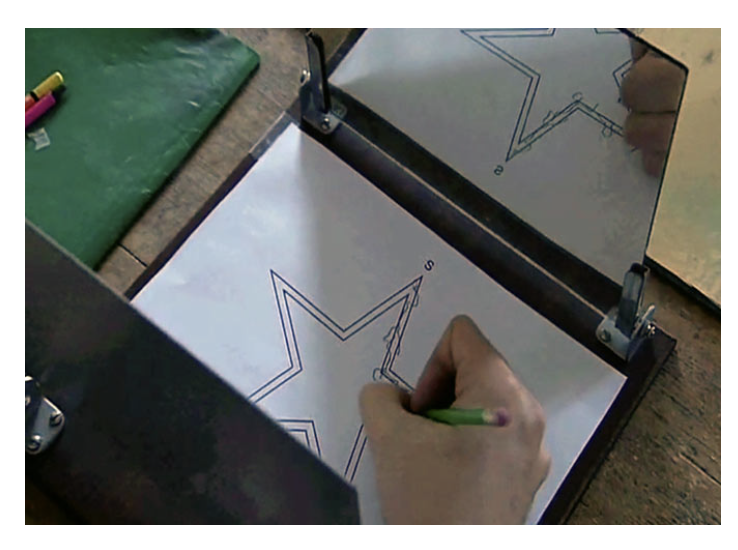
In the 1962 case study, Milner asked H.M. to replicate a five-pointed star by drawing between the lines of a template, but with a twist—he could only see the reflection of the star and his hand in a mirror. This added complexity made the task particularly challenging. Like the maze task, Milner had H.M. repeat the star-drawing task multiple times to observe whether his procedural skills improved, even though he could not remember performing the task before.
Additional experiments were conducted on H.M. to explore the effects of reinforcement and punishment. For instance, researchers investigated whether mild electric shocks could help H.M. retain correct answers. Later, under Suzanne Corkin's supervision, advancements in brain scanning technology were employed to gain deeper insights into H.M.'s condition and the neural mechanisms underlying his memory deficits.
Memory recall tasks: Testing H.M.’s ability to recall events from childhood, adulthood, and after the surgery.
Maze navigation: Tracing routes repeatedly to see if H.M. could learn without remembering the task.
Mirror-drawing: Copying a star shape while only seeing its reflection, testing procedural memory.

Milner conducted maze tests with H.M., where he was asked to trace the correct route through a maze using his finger. She repeated the test multiple times with the same maze to determine whether H.M. could retain the route despite being unable to recall having performed the task previously.
Later studies investigated reinforcement and punishment (e.g., mild electric shocks) and used MRI scans to analyse H.M.’s brain.
RESULTS
H.M. retained clear childhood memories but forgot experiences after ~30 seconds.
He had everyday language skills, an above-average IQ, and consistent personality traits.
Procedural memory remained intact: in the mirror-drawing task, H.M. improved despite forgetting each attempt, starting with 30 errors and dropping to fewer than five by Day 3.
H.M. remembered some general knowledge after the surgery (e.g., the moon landing) but forgot the events.
CONCLUSIONS
The study provided critical insights into the structure of memory:
The hippocampus is vital for transferring short-term to long-term memory.
Procedural and semantic memory rely on different brain regions, remaining intact in H.M. despite his hippocampal damage.
H.M.'s calm demeanour and impaired pain perception may be linked to his damaged amygdala.
EVALUATING H.M.'S CASE STUDIES (AO3)
GENERALISABILITY
H.M.’s case is both unique and representative. His "clean" amnesia provides rare insight into hippocampal function, but his specific surgery and epilepsy history make generalising to other populations difficult.
RELIABILITY
Milner’s use of standardised memory tasks ensures test-retest reliability. However, H.M.'s condition makes replication impossible, as no similar cases have occurred since.
APPLICATIONS
H.M.'s case transformed memory research:
It contributed to models like the Multi Store Model and Tulving’s memory distinctions.
It advanced surgical techniques, ensuring a better understanding of the hippocampus's role in memory.
It influenced neuropsychological approaches to treating memory disorders.
Critics argue that the case has overshadowed the importance of other brain regions, such as the base of the brain (e.g., B.J.’s case of amnesia caused by a snooker cue accident).
VALIDITY
H.M.'s condition provided a "pure" study of amnesia, unaffected by other mental health issues. However, the artificial nature of some tasks (e.g., mirror drawing) raises concerns about ecological validity.
ETHICS
H.M. consented to the surgery without a full understanding of the consequences, as the hippocampus’s role was unknown at the time. Researchers explained the studies to H.M. throughout his life, and he willingly participated.
However, H.M. depended on researchers, and critics argue he could not withhold consent. Given its profound scientific contributions, researchers maintained anonymity during his life and justified their work as a cost-benefit trade-off.
EXEMPLAR 8-MARK ESSAY
Assess how H.M.’s case studies have contributed to our understanding of memory. (8 marks)
Description (AO1):
H.M. underwent surgery in 1953 to control epilepsy, which involved removing his hippocampus. This caused severe anterograde amnesia, preventing him from forming new long-term memories. Brenda Milner’s case studies showed that H.M. retained procedural memory (e.g., improving at mirror drawing) and semantic knowledge despite his episodic memory deficits.
Evaluation (AO3):
H.M.’s case transformed our understanding of memory, revealing its division into different types and brain regions. Milner’s work led to influential models like the Multi Store Model. However, H.M.’s uniqueness limits generalisability and some tasks' artificial nature reduces ecological validity. Despite ethical concerns, the research has had invaluable applications, from surgical techniques to memory models.
Conclusion:
H.M.’s case provides unparalleled insights into memory’s structure, but its uniqueness limits broader applicability. Nevertheless, its contributions to psychology and neuroscience remain foundational.
STRENGTHS OF THE CASE STUDY APPROACH IN HM'S CASE
Rich, Detailed Data The case study of HM provided in-depth insights into the nature of memory, particularly its division into distinct components such as short-term memory, long-term memory, and procedural memory. Researchers like Brenda Milner and Suzanne Corkin conducted detailed assessments, including interviews, memory tests, and observations, which allowed for a comprehensive understanding of his cognitive impairments.
Example: HM could recall procedural tasks, such as learning to trace a star in a mirror, but had no recollection of performing the task, demonstrating that procedural memory relies on different brain structures than declarative memory.
Qualitative Data for Unique Cases HM's unique condition provided an opportunity to collect qualitative data that could not be obtained through experimental methods. His rare brain surgery and the resulting amnesia offered insights into memory functions that are not ethically or practically replicable in controlled studies.
Foundation for Theories HM's case led to groundbreaking discoveries in memory research, such as the understanding that the hippocampus is critical for forming declarative memories but not procedural or implicit ones. These findings have had profound implications for memory models, including the Multi-Store Model and the distinction between explicit and implicit memory.
Real-World Application The qualitative data collected from HM has informed clinical practices, particularly in treating memory-related conditions such as Alzheimer’s disease, traumatic brain injury, and epilepsy. For instance, his case highlighted the importance of careful surgical planning to minimise cognitive side effects.
WEAKNESSES OF THE CASE STUDY APPROACH IN HM'S CASE
Lack of Generalisability Case studies focus on a single individual, making it difficult to generalise findings to the broader population. HM's specific condition, including the extent and location of his brain damage, is unique and may not fully represent other cases of amnesia or brain injury.
Example: While HM demonstrated severe anterograde amnesia, other amnesic patients with less extensive hippocampal damage have shown different memory profiles, indicating variability in-memory processing.
Subjectivity in Data Collection Qualitative data, such as interviews and observations, can be influenced by researcher bias or interpretation. Although researchers like Milner and Corkin employed rigorous methods, subjective interpretations of HM’s behaviour and responses could have influenced conclusions.
Reliance on Retrospective Reports Much of the data collected from HM depended on his ability to report his experiences, which was inherently limited by his memory impairments. For example, HM could not recall events immediately after they occurred, potentially leading to incomplete or inaccurate data.
Ethical Concerns HM participated in decades of research, sometimes without fully understanding or recalling his consent. Although researchers acted within the ethical norms of the time, modern ethical standards emphasise informed consent, raising questions about the prolonged use of HM in studies.
Limited Scope of Quantitative Analysis While qualitative data provided rich insights, the lack of controlled experimental data limits the ability to quantify HM’s impairments and compare them systematically with other cases. The reliance on qualitative methods may miss opportunities for statistical validation.
CONTRIBUTION OF QUALITATIVE DATA IN HM'S CASE
Using qualitative data, such as interviews, direct observation, and narrative descriptions, was crucial in understanding HM's condition. These methods allowed researchers to:
Identify specific deficits (e.g., anterograde amnesia).
Explore his preserved abilities (e.g., procedural memory).
Formulate hypotheses about the role of the hippocampus in memory.
CONTRIBUTION OF QUALITATIVE DATA
Qualitative data played a central role in understanding HM’s condition. It enabled researchers to identify the specific nature of his memory deficits and preserved abilities. For instance, using interviews and observations allowed a detailed exploration of his inability to form new episodic memories while maintaining procedural learning. This nuanced data contributed to key hypotheses about the hippocampus and its function in declarative memory.
However, qualitative data also posed challenges. The subjective nature of interpretation and the inability to quantify some aspects of his condition made it difficult to compare HM’s case systematically with others. This reliance on qualitative data meant some findings lacked the statistical validation of controlled experimental designs.
CONCLUDING REMARKS
The study of Henry Molaison demonstrates the unique value of the case study approach and qualitative data in uncovering complex cognitive phenomena. While the findings from his case were rich and transformative, they were also limited by generalisability, subjectivity, and ethical considerations. Despite these challenges, HM’s case remains a cornerstone of memory research, offering unparalleled insights into the workings of the human brain and laying the foundation for future explorations into memory and cognition.
OTHER RESEARCH THAT SUPPORTS MSM
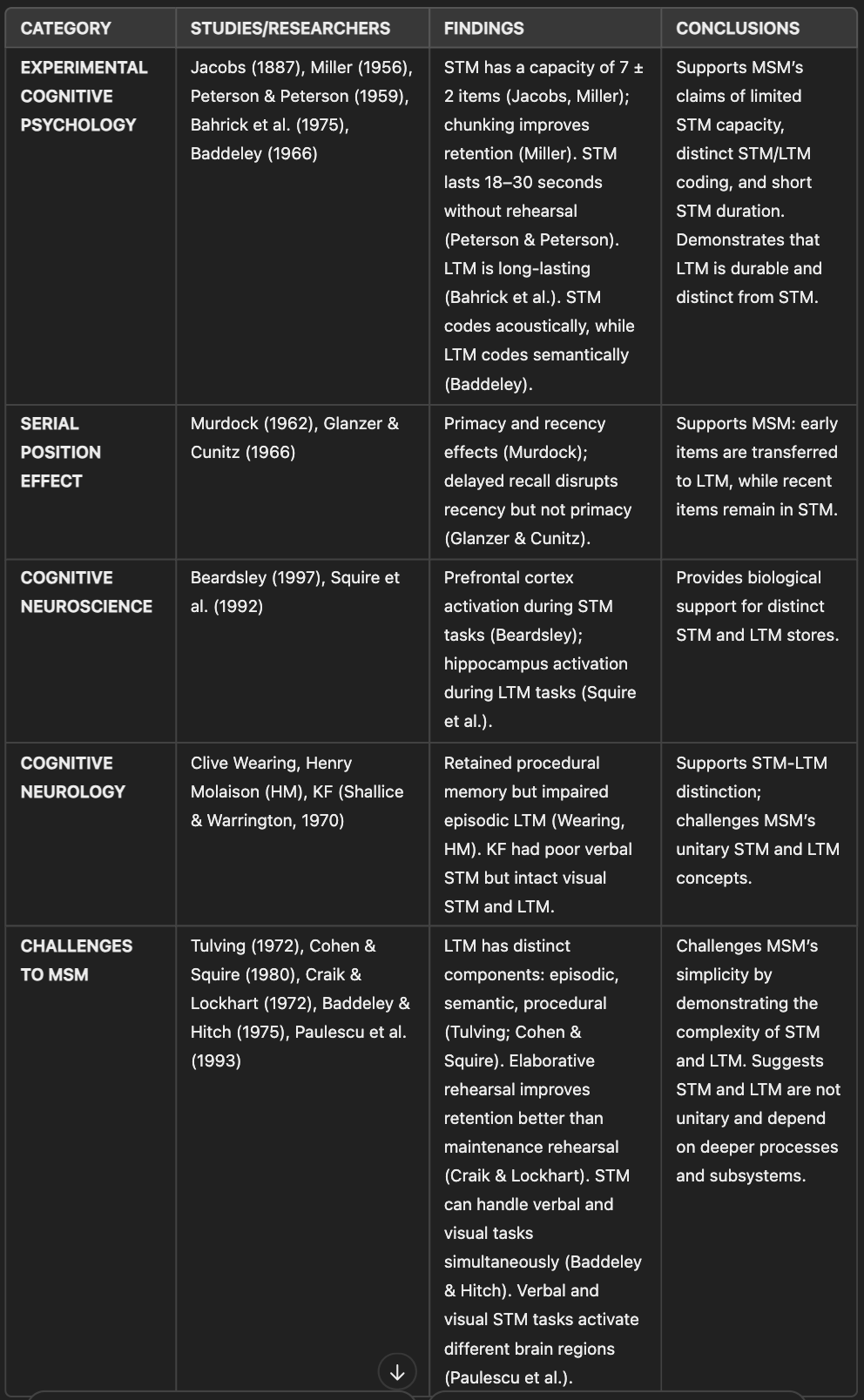
A03 PEEL PARAGRAPHS EVALUATING MSM USING MEMORY FEATURES
PEEL Paragraph: Supporting Capacity Differences
Point: The MSM is supported by evidence that STM and LTM have different capacities.
Evidence: Miller (1956) found that STM has a capacity of 7±2 items, suggesting it is limited in the amount of information it can hold. In contrast, LTM is considered to have an unlimited capacity, as demonstrated by studies like Bahrick et al. (1975), which found that participants could recall names and faces from their high school yearbooks up to 50 years later.
Explain: These capacity differences between STM and LTM support the MSM's idea that memory comprises separate stores with distinct features.
Link: Therefore, evidence clearly distinguishing between the capacities of STM and LTM strengthens the MSM.PEEL Paragraph: Supporting Duration Differences
Point: The MSM’s claim that STM and LTM have different durations is supported by research.
Evidence: Peterson and Peterson (1959) found that STM lasts only 18-30 seconds without rehearsal, indicating a short duration. In contrast, Bahrick et al. (1975) demonstrated that LTM can last for decades, highlighting its long-lasting nature.
Explain: The difference in durations between STM and LTM aligns with the MSM’s proposal that the two memory stores operate separately and serve different functions.
Link: Consequently, the research on memory duration validates the MSM's distinction between short-term and long-term stores.PEEL Paragraph: Supporting Encoding Differences
Point: The MSM is supported by evidence that STM and LTM encode information differently.Evidence: Research by Baddeley (1966) demonstrates that STM and LTM use different encoding types. He found that STM primarily encodes information acoustically, as participants struggled to recall words that sounded similar. In contrast, LTM encodes semantically, where participants found it difficult to recall words with similar meanings after a delay.
Explanation: This suggests that STM and LTM are distinct memory stores with different functions and encoding processes. The distinction supports the MSM's claim that STM and LTM are separate stores rather than just a single memory system.
Link: This supports the MSM's assertion that information is processed differently across STM and LTM, strengthening the model's validity in explaining how memory is structured and how information is transferred between stores
the varying accessibility of different memories.
2.1.1 The Working Memory Model (Baddeley and Hitch, 1974).
THE DEVELOPMENT OF THE WORKING MEMORY MODEL
As discussed in the summary of Atkinson and Shiffrin’s Multi-Store Model (MSM), the contribution of this foundational theory to memory research cannot be underestimated. Initially, memory was thought to function as a solitary unit in the brain. However, the idea that memory is solely comprised of three stores proved too simplistic to explain the vast complexity of human cognition. One of MSM’s greatest contributions was its ability to inspire the development of more sophisticated models, paving the way for a deeper understanding of memory processes.
One such development was the Working Memory Model (WMM) proposed by Baddeley and Hitch (1974), which redefined the concept of Short-Term Memory (STM). Their research, including the case of KF, challenged the traditional view of STM as a single, unified system. KF, an amnesiac, could transfer visual information from STM to Long-Term Memory (LTM) but struggled to transfer linguistic details. This discrepancy raised a fundamental question: could STM consist of separate systems for visual and linguistic information?
To address this, Baddeley and Hitch proposed that STM was not a single store but comprised multiple specialised components. The original model included three components:
The Central Executive: The "boss" of the system, responsible for allocating attention and coordinating the activities of the slave systems. It does not store information but acts as a controller, deciding which tasks require more focus. For example, it might shift attention between processing linguistic information via the Phonological Loop and visual-spatial tasks via the Visuospatial Sketchpad.
The Phonological Loop: This subsystem handles verbal and auditory information. It has two parts:
The Phonological Store, which temporarily holds sound-based information. For instance, it keeps a phone number you’ve just heard active in your memory for a few seconds.
The Articulatory Process rehearses verbal information to prevent it from fading. For example, silently repeating a shopping list to yourself helps you retain it temporarily.
The Visuospatial Sketchpad: Often referred to as the “inner eye,” this component processes visual and spatial information. It allows you to visualise and manipulate images in your mind, such as mentally navigating a familiar route or picturing the layout of your living room. The sketchpad has two subdivisions:
The Visual Cache stores details like shape and colour.
The Inner Scribe rehearses spatial information and tracks movement, such as following the position of a moving car.
By 2001, the model was expanded to include the Episodic Buffer, introduced to address criticisms of the original WMM. This integrative component links information from the Phonological Loop, the Visuospatial Sketchpad, and LTM, creating unified episodes. For example, when reading a story, it combines the visual text (from the Sketchpad), the inner voice narrating the story (from the Loop), and personal knowledge (from LTM) to provide a coherent understanding of the plot.

A critical feature of the WMM is its ability to explain how STM processes linguistic/verbal and visual-spatial information simultaneously. This separation aligns with everyday experiences. For instance, navigating on the phone demonstrates the capacity to handle both modalities concurrently. Similarly, meeting someone for the first time and later recalling their conversation and appearance suggests that STM can manage multiple types of information simultaneously, challenging the MSM’s simpler view of a singular STM.
By distinguishing between these components and illustrating their interactions, Baddeley and Hitch’s WMM provided a dynamic and functional approach to understanding STM, revolutionising memory research. It highlights how the brain processes and integrates different types of information, paving the way for further advancements in understanding human cognition.
RESEARCH THAT SUPPORTS WMM

EVALUATION OF THE WORKING MEMORY MODEL
ADVANTAGES
RESEARCH
Substantial evidence supports the idea of two slave systems within the Working Memory Model, as proposed by Baddeley and Hitch. This evidence comes from various sources, including case studies, experimental studies, and neuroimaging research:
Case Studies: Individuals with brain damage, such as Clive Wearing, have provided insights into the dissociation between different memory systems. Despite severe impairments in episodic memory, individuals like Clive Wearing demonstrate relatively preserved working memory abilities, suggesting the presence of distinct memory systems.
Experimental Studies: Studies utilising dual-task paradigms have consistently shown that individuals struggle to perform two tasks simultaneously if both functions rely on the same cognitive resources. For example, participants may have difficulty simultaneously completing a verbal reasoning task and a verbal memory task, indicating the limited capacity of the phonological loop.
Neuroimaging Research: Neuroimaging techniques such as functional magnetic resonance imaging (fMRI) have revealed distinct neural networks underlying different components of working memory. For instance, studies have shown that verbal working memory tasks activate regions associated with language processing, while spatial working memory tasks activate regions involved in visuospatial processing. This supports the idea of separate neural substrates for the phonological loop and visuospatial sketchpad.
The Working Memory Model (WMM) is supported by a wealth of research from diverse methodologies, making it one of the most robust and well-validated models in cognitive psychology. Cognitive neuroscience, cognitive neuropsychology, and experimental cognitive psychology contribute to a rich body of evidence that triangulates the model's key claims, enhancing its validity and reliability.
One of the WMM’s greatest strengths is the support from cognitive neuroscience, particularly neuroimaging studies. Techniques like fMRI and PET scans consistently show distinct brain regions activated during verbal and visual-spatial tasks, such as the left prefrontal cortex for linguistic tasks and the right prefrontal cortex for spatial processing. These findings align with the WMM’s distinction between the Phonological Loop and the Visuospatial Sketchpad, providing strong neural evidence for the model. Neuroimaging methods are highly objective and robust, reducing subjectivity or experimental bias concerns.
Additionally, cognitive neuropsychology, including case studies like KF (Shallice & Warrington), offers valuable insights by illustrating how damage to specific brain areas can impair certain aspects of working memory while leaving others intact. KF’s difficulties with verbal STM but intact visual-spatial STM strongly support the WMM’s assertion that STM is not a unitary store. However, neuropsychological evidence can suffer from validity issues due to the reliance on single cases that may not be generalised to the broader population.
Experimental cognitive psychology, such as Baddeley and Hitch’s dual-task experiments, further bolsters the WMM. These studies demonstrate that individuals can perform verbal and visual tasks simultaneously without interference, consistent with separate slave systems. Yet, the artificial nature of laboratory tasks raises concerns about ecological validity, as the controlled environments may not accurately reflect real-life memory use.
Despite these limitations, the convergence of findings across all three methodologies—neuroscience, neuropsychology, and experimental psychology—creates a robust case for the WMM. This triangulation of evidence enhances confidence in the model, as the strengths of another often mitigate the weaknesses of one method. For instance, while cognitive neuropsychology may lack generalisability, its findings are supported by robust and objective neuroimaging results, lending greater overall validity to the model.
SYNOPSIS OF OF WMM RESEARCH:
The Working Memory Model (WMM) has been evaluated through various methods, including case studies, experimental studies, and brain scans. Each method has inherent flaws: case studies cannot be readily generalized to the broader population, experimental studies may lack mundane realism and ecological validity, and brain scans may not capture the full complexity of cognitive processes. However, when considered collectively, along with brain scan data, the evidence overwhelmingly supports the notion that working memory is not a singular unit.
SUPPORT FROM NEUROSCIENCE
The WMM is supported by neuroimaging research that demonstrates distinct brain regions linked to its components:
The phonological loop is associated with Broca’s area and Wernicke’s area in the left hemisphere, activated during verbal tasks.
The visuospatial sketchpad involves the occipital and parietal lobes responsible for processing spatial and visual information.
The central executive is linked to the prefrontal cortex, particularly the dorsolateral prefrontal cortex, active during tasks requiring attentional control.
While newer to the model, the episodic buffer likely involves the hippocampus and other areas involved in multimodal integration.
This evidence, derived from robust methodologies like fMRI and PET scans, strengthens the WMM’s validity and demonstrates how its components operate in the brain.
STM NO MORE
The Working Memory Model (WMM) provides a more dynamic explanation of short-term memory than earlier models like the Multi-Store Model (MSM). It emphasises active manipulation of information, highlighting how memory processes involve reorganising, prioritising, and integrating data. Unlike the passive depiction of STM in the MSM, the WMM portrays memory as the seat of consciousness, where real-time tasks like problem-solving, multitasking, and learning occur.
For example, dual-task experiments show individuals can manage two simultaneous tasks using distinct working memory systems (e.g., verbal and visual). This demonstrates the model’s versatility and ability to explain real-world cognitive function diversity.
APPLICATIONS TO THE REAL WORLD
The WMM has significant real-world applications, particularly in understanding and addressing cognitive challenges and educational needs.
Managing Mental Health Conditions: The WMM aids in understanding conditions like ADHD, OCD, Tourette’s syndrome, and schizophrenia, where central executive dysfunction is evident. For example, interventions targeting attentional control and impulse regulation (core functions of the central executive) can improve symptoms.
Diagnosing Educational Difficulties: The model explains learning disorders such as dyslexia and dyspraxia, where phonological loop deficits affect reading and verbal processing. Tailored interventions, such as breaking tasks into smaller chunks, can reduce cognitive load and improve outcomes.
Detecting Neurodegenerative Diseases: Declines in working memory, especially in the episodic buffer and central executive, are early indicators of dementia. Assessing working memory capacity allows for early diagnosis and intervention.
Improving Educational Practices: Teachers can use strategies like chunking, mnemonics, and multimodal teaching to enhance students’ working memory and learning efficiency.
CRITICISMS WORKING MEMORY
LACK OF NEUROBIOLOGICAL SPECIFICITY
The Working Memory Model (WMM) is supported by neuroimaging studies, identifying brain regions linked to its components. However, the model fails to explain how these brain areas interact to perform complex memory tasks. Memory processes involve interconnected networks, not isolated brain regions. For example:
Prefrontal Cortex: Governs attention and decision-making, functions attributed to the central executive.
Anterior Cingulate Cortex: Resolves conflicts, such as prioritising competing tasks when the phonological loop and visuospatial sketchpad are overloaded.
Parietal Lobes: Coordinate spatial awareness and visual-spatial information.
These regions work as part of a distributed system. For instance, navigating to a new location while on the phone requires cooperation between the visuospatial sketchpad, phonological loop, and central executive. The WMM, however, simplifies these interactions, failing to explain how components communicate to perform real-world tasks.
Additionally, advances in neuroscience reveal that brain regions share responsibilities across tasks. For example, the anterior cingulate and parietal lobes are active in verbal and spatial tasks, suggesting that the boundaries between WMM components are less clear-cut than the model implies.
Summary: While the WMM identifies key brain regions involved in working memory, it oversimplifies their interactions. Incorporating these dynamic relationships would align the model more closely with modern neuroscience.
ROLE OF THE CENTRAL EXECUTIVE
The central executive (CE), described as the "boss" of working memory, is one of the least understood aspects of the WMM. It is said to allocate attention and manage the phonological loop and visuospatial sketchpad. However, the WMM lacks clarity on how these functions are performed, earning the CE the nickname “black box” due to its vague conceptualisation.
Neuroimaging Evidence:
Dorsolateral Prefrontal Cortex: Engages in holding and manipulating information.
Ventromedial Prefrontal Cortex: Involved in decision-making and integrating emotions.
Anterior Cingulate Cortex: Monitors conflicts and errors when tasks compete for resources.
This evidence suggests that executive functions rely on a distributed network of brain regions, challenging the WMM’s depiction of the CE as a singular component. For example, solving a math problem while listening to instructions requires the CE to coordinate multiple brain areas, prioritise tasks, and resolve conflicts.
Case Study Evidence:
Patient EVR (Eslinger et al.): After surgery to remove a tumour, EVR could reason well but struggled with decision-making, demonstrating that executive functions are modular and distributed rather than unified.
Criticism: The WMM’s portrayal of the CE oversimplifies its role, ignoring the complexity of overlapping brain systems involved in attention, multitasking, and decision-making. Alternative theories, such as the Global Workspace Theory, provide a more detailed account of attentional control, highlighting this limitation.
INCOMPLETE EXPLANATION OF LONG-TERM MEMORY INTERACTIONS
The episodic buffer, introduced to explain how working memory interacts with long-term memory (LTM), offers only a vague account of these processes. For example:
Retrieval from LTM: The WMM does not explain how working memory retrieves schemas, facts, or meanings from LTM to complete tasks like interpreting a story or solving a problem.
Storage into LTM: Similarly, the transition from working memory to LTM—through processes like rehearsal or organisation—is not explicitly tied to the episodic buffer or other components.
Examples:
Navigating using the visuospatial sketchpad relies on maps stored in LTM.
Conversations involve the phonological loop drawing on LTM for word meanings and prior context.
Problem-solving requires the central executive to retrieve and apply schemas from LTM.
The WMM does not sufficiently explain how these bidirectional relationships between working memory and LTM are managed.
Alternative Models:
Logie’s Hierarchical Model: This suggests that working memory relies on activated LTM representations rather than modular systems.
Cowen’s Embedded Process Model argues that working memory is simply an active subset of LTM, further blurring distinctions.
Summary: The WMM needs refinement to explain how working memory and LTM interact during encoding, retrieval, and manipulation processes.
LIEBERMAN’S CRITIQUE OF THE VISUOSPATIAL SKETCHPAD
Lieberman argues that the WMM conflates visual and spatial processing in conceptualising the visuospatial sketchpad (VSS), overlooking how these processes can operate independently.
Evidence:
Blind individuals demonstrate strong spatial reasoning through auditory or tactile cues, forming mental maps without visual input.
Tasks such as estimating distance or navigating environments rely on spatial reasoning that does not require visual imagery.
This suggests that spatial processing is a distinct cognitive function separate from visual processing. The WMM fails to account for these distinctions, oversimplifying the VSS.
Implications:
The WMM could be refined by separating visual and spatial components, reflecting their independent roles in cognition.
EMOTIONAL AND CULTURAL INFLUENCES
The WMM largely ignores how emotions and cultural contexts influence working memory processes:
Stress and Anxiety:
High stress reduces prefrontal cortex activity, impairing the CE’s ability to allocate attention or switch tasks.
Anxiety-related rumination consumes attentional resources, limiting the capacity of the phonological loop and visuospatial sketchpad.
Cultural Variations:
Individuals from logographic cultures (e.g., Chinese) exhibit stronger visuospatial processing due to reliance on visual memory for reading.
Alphabetic cultures (e.g., English) depend more on the phonological loop for decoding letters and sounds.
The WMM risks oversimplification and reduced applicability across diverse populations by neglecting these factors.
SUMMARY OF LIMITATIONS
Oversimplification of Neural Mechanisms: Fails to account for the distributed networks supporting working memory tasks.
Vague Central Executive: Lacks specificity regarding allocating attention and resolving conflicts.
Limited Integration with LTM: Provides insufficient detail on how working memory and LTM interact.
Cultural and Sensory Oversights: Ignores variations in memory processes across populations.
CONCLUSION
The WMM remains an influential framework for understanding short-term memory processes, but its limitations underscore the need for refinement. Incorporating findings from neuroscience and addressing cultural and emotional influences could enhance its explanatory power, making it a more comprehensive model of working memory
TEST YOURSELF
https://player.quizalize.com/quiz/bd62fc82-375c-4eaf-86ea-eeb8d9ab3370
https://quizlet.com/gb/566072923/the-multi-store-model-of-memory-aqa-a-level-psychology-flash-cards/
EPISODIC AND SEMANTIC LONG-TERM MEMORY (TULVING, 1972)
2.1.3 Explanation of Long-Term Memory – Episodic and Semantic Memory (Tulving, 1972).
INTRODUCTION
Endel Tulving’s (1972) theory of episodic and semantic long-term memory (LTM) revolutionised the understanding of memory by challenging earlier models, such as the multi-store model, which treated LTM as a single, unified system. Tulving proposed that LTM is divided into distinct subsystems: episodic memory, which stores personal experiences, and semantic memory, which stores general knowledge. Both declarative (explicit) memory systems operate independently yet interact to support cognition.
Tulving’s work has provided critical insights into how memory functions, influencing fields ranging from cognitive neuroscience to education and clinical psychology. By distinguishing between episodic and semantic memory, Tulving paved the way for more nuanced theories of memory supported by neuroimaging and case study evidence.
TYPES OF DECLARATIVE LONG-TERM MEMORY
EPISODIC MEMORY
What It Is: Episodic memory involves recalling personal experiences and specific events. These memories are time-stamped, tied to a particular moment, and often include contextual details such as emotions, settings, and sensory experiences.
Examples:
Remembering your first day at school.
Recalling a family holiday.
Characteristics:
Time-Stamped: Episodic memories are associated with specific moments in time.
Contextual: Include sensory details and emotions.
Autobiographical: Personal to the individual.
Brain Areas Involved:
Hippocampus: Essential for forming and consolidating episodic memories.
Prefrontal Cortex: Plays a role in retrieving and organising episodic details.
SEMANTIC MEMORY
What It Is: Semantic memory stores general knowledge and facts about the world. Unlike episodic memory, semantic memory is not tied to specific personal experiences or points in time.
Examples:
Knowing that Paris is the capital of France.
Understanding the meaning of the word "gravity."
Characteristics:
Abstract: Not tied to personal experiences.
Shared Knowledge: Universally accessible facts.
Timeless: Unrelated to specific events.
Brain Areas Involved:
Temporal Lobes: Particularly the anterior temporal cortex.
Frontal Lobes: Contribute to semantic processing and retrieval.
SUPPORT FOR EPISODIC AND SEMANTIC MEMORY
NEUROIMAGING EVIDENCE
Functional imaging techniques, such as PET and fMRI scans, have revealed distinct activation patterns for episodic and semantic memory tasks:
Episodic Memory: Activates the hippocampus and prefrontal cortex.
Semantic Memory: Engages the anterior temporal lobe.
These findings provide biological evidence that episodic and semantic memories involve different brain regions, supporting Tulving’s distinction between the two systems.
CASE STUDY EVIDENCE
Clive Wearing: Suffered severe episodic memory impairment due to brain damage but retained semantic memory. For example, he could remember factual information, such as the meaning of words, but could not recall personal events, such as his wedding day.
Kent Cochrane (KC): Experienced damage to his episodic memory, leaving him unable to recall specific personal events, yet his semantic memory remained intact, allowing him to recall general facts about the world.
These case studies illustrate that episodic and semantic memories are distinct systems within declarative memory.
EVALUATION OF TULVING’S MODEL
STRENGTHS
Scientific Rigor: Neuroimaging evidence provides strong biological support for the distinction between episodic and semantic memory. These findings validate Tulving’s theory using objective, measurable data.
Real-World Application: The theory helps explain patterns of memory loss in clinical conditions such as Alzheimer’s disease (which initially affects episodic memory) and semantic dementia (which primarily impacts semantic memory). This has improved diagnostic tools and treatment approaches.
Support from Case Studies: Evidence from individuals like Clive Wearing and Kent Cochrane highlights the independence of episodic and semantic memory systems.
Educational Implications: Understanding the differences between episodic and semantic memory has informed teaching strategies, such as using storytelling to enhance episodic memory or repetition for semantic learning.
WEAKNESSES
Lack of Focus on Procedural Memory: Tulving’s original model overlooks non-declarative memory systems, such as procedural memory, which governs skills like riding a bike or playing an instrument. This omission limits the comprehensiveness of the model.
Overlap Between Episodic and Semantic Memory: Critics argue that episodic and semantic memory are not entirely separate systems. Episodic memories often underpin semantic knowledge. For example, repeated personal experiences (episodic) contribute to forming general knowledge (semantic). This interdependence blurs the boundaries between the two systems.
Reliance on Case Studies: While cases like Clive Wearing provide valuable insights, they are based on unique individuals and may not generalise to the broader population.
Evolution of the Model: Tulving’s later work incorporated non-declarative memory systems, reflecting the model’s limitations in addressing the complexity of memory.
APPLICATIONS OF TULVING’S MODEL
CLINICAL DIAGNOSIS
Tulving’s theory has been instrumental in diagnosing and understanding memory disorders:
Alzheimer’s Disease: Episodic memory is often the first to deteriorate, with semantic memory remaining intact in the early stages.
Semantic Dementia: Patients lose general knowledge (semantic memory) while retaining autobiographical information (episodic memory).
EDUCATIONAL STRATEGIES
The distinction between episodic and semantic memory has informed teaching methods:
Episodic Learning: Creating personal, memorable experiences helps embed knowledge.
Semantic Learning: Repetition and organisation of information strengthen general knowledge.
CONCLUSION
Tulving’s distinction between episodic and semantic long-term memory was groundbreaking, reshaping the understanding of how memories are stored and retrieved. Supported by neuroimaging and case study evidence, his theory highlights the complexity of memory systems and their unique roles in human cognition. While the model has limitations, such as its initial neglect of procedural memory and the overlap between episodic and semantic systems, it remains a cornerstone of cognitive psychology. Its clinical diagnosis and education applications underline its enduring relevance, demonstrating how theoretical insights can have a real-world impact.
2.1.4 Reconstructive Memory (Bartlett, 1932), including Schema Theory
RECONSTRUCTIVE MEMORY AND SCHEMA THEORY (BARTLETT, 1932)
INTRODUCTION TO RECONSTRUCTIVE MEMORY
Reconstructive memory is not retrieving memories as perfect, unaltered recordings. Instead, we actively rebuild or "reconstruct" them during recall, influenced by prior knowledge, expectations, and cultural experiences. This dynamic process is shaped by schemas—mental frameworks that help us organise and interpret information.
Sir Frederic Bartlett’s research on reconstructive memory, particularly his 1932 study using The War of the Ghosts, revealed how memories are pieced together and often distorted to fit our existing schemas. His findings challenge the notion of memory as an accurate playback of past events and highlight the role of prior knowledge in shaping what we remember.
SCHEMA THEORY
Schemas are mental frameworks built from past experiences that help us interpret new information. They enable us to process vast amounts of information efficiently by filling in gaps and creating meaning. For example, if someone mentions a "birthday party," you might automatically think of cake, candles, and balloons—even if these details weren’t explicitly stated.
While schemas are helpful, they can also lead to memory distortions. If the details of an event don’t align with an existing schema, the brain may unconsciously alter or omit information to make it fit.
BARTLETT’S STUDY: THE WAR OF THE GHOSTS
AIMS
Bartlett aimed to investigate how cultural schemas influence memory. He hypothesised that people reconstruct memories to align with their cultural background and prior knowledge.
METHOD
All English participants were asked to read a Native American folk tale, The War of the Ghosts. The story included cultural references unfamiliar to the participants, such as canoes, ghostly warriors, and spiritual themes. After reading, participants were asked to recall the story multiple times over varying intervals, a method called serial reproduction.
FINDINGS
Bartlett found that participants’ recollections were not accurate reproductions of the story but were systematically altered to fit their cultural schemas:
Omissions: Unfamiliar details, like "canoes," were omitted entirely.
Substitutions: Culturally unfamiliar elements were replaced with familiar ones, such as changing "canoe" to "boat."
Rationalisations: Participants added details or altered events to make the story more logical and coherent within their cultural framework.
Shortening: The story became progressively shorter with each retelling as irrelevant details were removed.
These distortions revealed how schemas influence recall, reshaping unfamiliar or ambiguous information into something more recognisable.
IMPLICATIONS
Bartlett’s findings demonstrated that memory is not a passive retrieval process but an active process of reconstruction guided by schemas. This has significant implications for understanding the reliability of memory, particularly in contexts like eyewitness testimony.
EVALUATION OF BARTLETT’S WORK
STRENGTHS
Pioneering Research: Bartlett’s groundbreaking study introduced the idea that memory is reconstructive rather than a passive and static process. His emphasis on the role of schemas laid the foundation for modern cognitive psychology and inspired further research into memory, such as work on eyewitness testimony.
Real-World Relevance: Bartlett highlighted how personal and cultural frameworks influence memory reconstruction by using a culturally specific story (The War of the Ghosts). This is particularly relevant in understanding how biases affect real-world situations, such as eyewitness testimony and cross-cultural communication.
Ecological Validity: Unlike studies that use artificial materials like word lists or random numbers, Bartlett used a narrative structure that is closer to how people encounter information in everyday life. This made his findings more applicable to real-world memory processes.
Insights into Cultural Biases: Bartlett’s research demonstrated how cultural differences influence memory. His findings are beneficial in explaining why people from different cultural backgrounds may interpret the same event differently, highlighting the subjective nature of memory.
WEAKNESSES
Lack of Experimental Control: Bartlett’s methodology lacked precision, as participants were not given consistent instructions, and recall was tested at varying intervals. This makes replicating the study and drawing firm conclusions about his findings difficult.
Qualitative Data and Subjectivity: Bartlett relied on qualitative analysis of participants’ recollections, which involved interpreting their distortions. This introduces potential researcher bias, as there was no standardised way to measure memory accuracy or distortions.
Cultural Bias: Bartlett’s participants were all English, and the Native American story used in the study was unfamiliar to them. This raises questions about the generalisability of the findings to other cultures or more familiar materials. If participants had been tested on a culturally familiar story, their schemas might have facilitated more accurate recall.
Reductionist Approach: Bartlett’s focus on schemas overlooks other potential influences on memory, such as emotional state or individual differences in cognitive ability. While his research was foundational, it does not account for the complexity of memory processes highlighted in later studies.
Lack of Statistical Rigor: Bartlett’s study predates the widespread use of statistical analysis in psychological research. Without numerical data to support his conclusions, the results rely heavily on subjective interpretation, limiting their scientific robustness.
APPLICATIONS AND LIMITATIONS
Application in Eyewitness Testimony: Bartlett’s findings are instrumental in understanding how memory distortions occur, particularly in legal contexts. Eyewitnesses often unintentionally reconstruct events to fit their schemas, leading to inaccuracies. However, his research doesn’t account for other factors, such as the effects of stress or leading questions, which are now understood to play significant roles in eyewitness recall.
Legacy in Cognitive Psychology: While Bartlett’s work provided a theoretical foundation, his methods have since been criticised as unscientific by modern standards. Replications of his findings often show variability, which reduces their reliability. However, the core principles of reconstructive memory and schema theory remain highly influential.
CONCLUSION OF EVALUATION
Bartlett’s revolutionary study provided valuable insights into how schemas reconstruct and influence memory. However, the methodological flaws, cultural bias, and lack of statistical rigour limit its reliability and generalisability. Despite these criticisms, the study remains a cornerstone of cognitive psychology, shaping how we understand memory and its application in real-world contexts. Future research has built on Bartlett’s work, addressing its limitations and broadening our understanding of the reconstructive nature of memory.
2.3 STUDIES : CLASSIC STUDY
2.3.1 Baddeley (1966b): Working Memory Model - the influence of acoustic and semantic similarity on Long-Term Memory for word sequences.
BADDELEY (1966B): SEMANTIC ENCODING IN LONG-TERM MEMORY
This is the classic cognitive study, central to understanding memory processes. Students are expected to know it in detail for exams. Questions may focus on the aims, procedures, results, and conclusions (APRC), or delve into specifics like how Baddeley tested memory or the performance of different groups. Although the study reports three experiments, students are typically assessed on the third, but familiarity with all is helpful for context.
CONTENTS
Baddeley's Experiments
AO1: Study Details
AO3: Evaluation
Exemplar Essay
BACKGROUND
This study, conducted by Alan Baddeley in the 1960s, contributes to the foundation of cognitive psychology. Baddeley and Hitch later developed the Working Memory Model, which built on insights from this research. This study challenged the simpler Multi-Store memory model, proposing that memory is more complex than initially believed.
The research exemplifies the scientific process: Baddeley refined his methods across three experiments, identifying and controlling confounding variables better to understand semantic encoding in long-term memory (LTM). It demonstrates cognitive psychology’s reliance on experimental design and controls to isolate intricate memory processes.
THE FIRST TWO EXPERIMENTS
The initial experiments aimed to explore whether LTM encodes semantically or acoustically. Participants attempted to recall word lists after a delay, with Baddeley predicting more incredible difficulty recalling semantically similar words due to interference in semantic encoding. However, results showed STM aiding LTM, skewing outcomes.
To address this, a second experiment introduced an interference task, disrupting STM and isolating LTM. This adjustment clarified the memory process but revealed additional variables. The experiments evolved to eliminate issues, such as replacing taped word lists with a slideshow to control for hearing impairments. These refinements culminated in the third experiment, described below.
BADDELEY’S STUDY: APRC
Aim
The study sought to determine whether LTM encodes acoustically or semantically. Participants learned word lists with either acoustic or semantic similarities, testing whether confusion arose from the type of similarity.
Independent Variables (IVs)
Word list type: Acoustically similar/dissimilar, semantically similar/dissimilar.
Recall performance before and after a 15-minute delay.
Dependent Variable (DV)
The accuracy of word sequence recall, measuring whether LTM was confused by similarities in sound or meaning.
Sample
Seventy-two volunteers from the Cambridge University subject panel participated. Divided into four groups, each condition had 15–20 participants. The sample included both men and women, representing an educated population.
Procedure
Participants viewed slides of word lists, each word appearing for three seconds. Four conditions were tested:
Acoustically Similar (e.g., man, cab, can).
Acoustically Dissimilar (e.g., pit, few, cow).
Semantically Similar (e.g., great, large, big).
Semantically Dissimilar (e.g., good, huge, hot).
After viewing, participants completed an interference task (writing numerical sequences) to prevent rehearsal. They then recalled the word order across four trials, with words displayed as cues. Following a 15-minute break, a surprise recall tested forgetting.
Results
Participants in the Semantically Similar condition struggled to recall word order compared to controls, supporting the hypothesis that LTM encodes semantically. The Acoustically Similar group initially performed poorly, reflecting STM’s interference, but improved across trials, suggesting LTM does not encode acoustically. Control groups consistently outperformed experimental groups.
Conclusions
Baddeley concluded that LTM primarily encodes semantically. STM, by contrast, encodes acoustically. Semantic similarity confused LTM, but acoustic similarity only affected STM. This supports a distinction between STM and LTM processing.
EVALUATING BADDELEY (AO3): GRAVE
Generalisability
The large sample size reduces the impact of anomalies, ensuring that the findings are robust. However, splitting participants across conditions results in small groups (e.g., 15 in the Acoustically Similar condition), risking the influence of outliers. As volunteers, participants might also represent individuals with above-average memory, limiting generalisability.
Reliability
Standardised procedures enhance reliability, allowing replication. Replacing audio word lists with visual slides ensured consistent exposure. Interference tasks effectively blocked STM rehearsal, further supporting reliability. However, replicating such controlled conditions might be challenging outside laboratory settings.
Application
Findings have influenced memory research and real-world applications. Insights on semantic encoding informed Tulving’s research and the development of the Working Memory Model. The study highlights effective learning strategies, such as semantic mind maps, and underscores the limited utility of rote rehearsal for LTM.
Validity
Internal validity was improved through controls, isolating LTM by focusing on word order recall. However, ecological validity remains low; word sequence recall lacks real-world relevance. Unexpected recall trials mimic real-life demands, partially addressing this limitation.
Ethics
The study adhered to ethical standards, with no distressing tasks or deceptive practices involved.
EXEMPLAR ESSAY
Evaluate Baddeley’s study on LTM encoding (8 marks).
Baddeley’s research demonstrates reliable methodology, employing standardised procedures to ensure consistency. His use of interference tasks isolated LTM and visual word lists controlled auditory issues. These refinements highlight robust experimental design.
Despite its strengths, the study’s low ecological validity limits real-world application. Recalling word order from semantically or acoustically similar lists is an artificial task unrepresentative of everyday memory use.
The sample size supports generalisability, but small condition groups risk distortion by outliers. Volunteer bias further reduces representativeness, as participants might exhibit stronger-than-average memory.
In conclusion, Baddeley’s study has significantly advanced our understanding of LTM encoding, distinguishing semantic from acoustic processes. While its artificial nature limits real-world applicability, its methodological rigour ensures findings remain foundational to cognitive psychology.
This version restores the original word count while maintaining clarity and incorporating all details. Let me know if further refinements are needed!
2.1.6 DEVELOPMENTAL PSYCHOLOGY IN MEMORY: The impact of Alzheimer’s disease on older adults and its effects on memory.
2.4 KEY QUESTIONS
2.4.1 ONE KEY QUESTION RELEVANT TO TODAY’S SOCIETY: This is to be discussed as a contemporary rather than an academic argument.
2.4.2 CONCEPTS, THEORIES, AND/OR RESEARCH: Drawn from cognitive psychology as covered in this specification.
SUITABLE EXAMPLES: How can psychologists’ understanding of memory help patients with dementia?
WHAT IS ALZHEIMER’S DISEASE AND ITS CAUSES?
Alzheimer’s disease is the most common form of dementia, affecting memory, cognition, and daily functioning. It is characterised by progressive brain damage caused by the build-up of amyloid plaques and neurofibrillary tangles. These protein abnormalities disrupt communication between brain cells and eventually lead to their death, causing brain atrophy. The hippocampus and prefrontal cortex—crucial for memory and decision-making—are among the first areas affected. As the disease progresses, other brain regions are impacted, leading to widespread cognitive and physical decline.
CAUSES OF ALZHEIMER’S DISEASE
The precise causes of Alzheimer’s disease are still under investigation, but research has identified several contributing factors:
Amyloid Plaques and Neurofibrillary Tangles: Amyloid-beta proteins form plaques that disrupt cell-to-cell communication, while tau proteins tangle, destabilising neurons. Though these features are hallmark indicators, emerging research questions whether they are primary causes or consequences of other processes.
Genetics: Certain genetic mutations, such as the presence of the APOE-e4 gene, significantly increase the risk of developing Alzheimer’s. However, not everyone with these genes will develop the disease, highlighting the interplay between genetics and other factors.
Ageing: Age is the most significant risk factor. Natural processes like oxidative stress and the accumulation of cellular damage increase vulnerability as people age.
Vascular Health: Conditions such as high blood pressure, diabetes, and high cholesterol impair blood flow to the brain, exacerbating neuronal damage.
Chronic Inflammation: Long-term inflammation in the brain, possibly triggered by infections or immune system dysfunction, has been linked to Alzheimer’s.
Lifestyle Factors: Environmental and behavioural factors, such as poor diet, lack of physical activity, and low cognitive engagement, also play a role. These modifiable risks underscore the importance of a healthy lifestyle in potentially reducing the likelihood of developing Alzheimer’s
DIAGNOSING DEMENTIA
Dementia often progresses unnoticed in its early stages because many people attribute memory problems to normal ageing. As a result, symptoms may not be recognised until the disease is significantly advanced.
Professor Bruno at Liverpool Hope University has developed a test to diagnose dementia before noticeable symptoms appear. His test involves a word recall exercise, where patients are asked to remember words from a list of 15.
In healthy individuals, the primacy effect means that words from the start of the list are well-recalled because they are rehearsed into long-term memory (LTM). However, some patients recalled words from the middle of the list instead, which indicates pathological memory loss rather than the typical effects of ageing.
Professor Bruno distinguishes between “healthy” memory loss, which comes naturally with age, and “pathological” memory loss, which is more likely to signal dementia. His test aims to detect warning signs of dementia early, allowing interventions before sufferers notice memory problems themselves.
The cognitive psychology behind this test includes the Multi-Store Model and concepts such as displacement theory, which explains why middle-list words are usually forgotten due to the limited capacity of short-term memory (STM). Failure to recall primacy words suggests an inability to transfer information to LTM, a hallmark of pathological memory loss.
ALZHEIMER’S DISEASE: STAGES AND IMPACT ON MEMORY, COGNITION, AND PHYSICAL FUNCTION
EARLY STAGE (MILD)
In the early stage, the symptoms are subtle but noticeable to close family and friends. The primary changes include memory difficulties, but other cognitive and behavioural shifts may also emerge.
MEMORY IMPAIRMENTS
Short-term memory is most affected, with individuals frequently forgetting recent conversations, events, or appointments.
Repetition of questions or misplacing items is common.
COGNITIVE DECLINE
Difficulty planning, organising, and solving problems, such as managing finances or following recipes.
Decreased ability to concentrate or find the right words during conversations (mild language difficulties).
PHYSICAL AND BEHAVIOURAL CHANGES
Individuals typically remain physically functional but may show mild apathy or withdrawal from activities.
Subtle changes in mood, such as increased irritability or anxiety, may occur.
MIDDLE STAGE (MODERATE)
During this stage, memory loss and cognitive decline become more pronounced, and the disease begins to interfere with daily life significantly. Behavioural and emotional symptoms often emerge, and physical function may begin to deteriorate.
MEMORY IMPAIRMENTS
Episodic memory declines, making recalling significant life events, such as weddings or holidays challenging.
Semantic memory is affected, with individuals forgetting the names of familiar people or objects.
Working memory struggles lead to losing track of tasks or conversations.
COGNITIVE DECLINE
Disorientation and confusion become more frequent, including difficulty recognising locations or navigating familiar places.
Language impairments worsen, with difficulty finding words, forming coherent sentences, or understanding instructions.
Poor judgment and increased impulsivity may lead to unsafe behaviours.
PHYSICAL AND BEHAVIOURAL CHANGES
Behavioural symptoms, such as agitation, wandering, or compulsive behaviours, become more apparent.
Sleep disturbances are common.
Some individuals begin to experience motor difficulties, such as problems with coordination or balance.
LATE STAGE (SEVERE)
In the final stage of Alzheimer’s disease, cognitive and physical decline are profound. Individuals become entirely dependent on caregivers for all aspects of daily life.
MEMORY IMPAIRMENTS
Global memory failure occurs, with individuals losing recognition of close family members and their sense of identity.
Even procedural memory, such as walking or eating, is severely affected.
COGNITIVE DECLINE
Communication abilities are nearly non-existent, with only a few words or phrases retained.
Awareness of surroundings is minimal.
PHYSICAL DETERIORATION
Severe motor difficulties develop, including an inability to walk, sit, or control movements.
Loss of bladder and bowel control is standard.
Swallowing difficulties increases the risk of choking or aspiration pneumonia.
Weight loss and frailty often accompany physical decline.
THE PROGRESSIVE NATURE OF ALZHEIMER'S
Alzheimer’s disease is not limited to memory loss; it involves a broader spectrum of cognitive and physical challenges. The progression through these stages highlights the increasing care needs and the emotional and practical burdens on patients and caregivers.
HOW ALZHEIMER’S AFFECTS DIFFERENT TYPES OF MEMORY
SHORT-TERM MEMORY
Short-term memory is among the first areas affected by Alzheimer’s. Patients struggle to retain recent information, leading to frequent repetition or confusion.
Patients often forget conversations, events, or appointments within minutes.
Asking the same question repeatedly or forgetting where an object was just placed.
EPISODIC MEMORY
Episodic memory, which stores personal experiences tied to specific times and places, gradually deteriorates as the disease progresses.
Loss of the ability to recall autobiographical events and their contextual details.
Forgetting the details of a family holiday or the events of a birthday party.
SEMANTIC MEMORY
Semantic memory, which involves general knowledge and facts, becomes increasingly impaired, especially in the middle stages of Alzheimer’s.
Difficulty recalling factual information or recognising familiar concepts.
Struggling to name everyday objects, such as calling a "pen" a "stick" or forgetting the name of a country’s capital.
PROCEDURAL MEMORY
Procedural memory, which stores motor skills and learned routines, remains intact longer but eventually declines in the later stages.
Skills that were once automatic become difficult or impossible to perform.
Forgetting how to use a fork, tie a shoelace, or ride a bike as the disease progresses.
WORKING MEMORY
Working memory, which holds and manipulates information for brief periods, is affected early in Alzheimer’s.
Patients struggle to maintain focus and complete tasks requiring short-term mental effort.
Forgetting what they were doing mid-task, such as losing track of the steps while cooking or reading.
THE COMPREHENSIVE IMPACT OF ALZHEIMER'S ON MEMORY
Alzheimer’s progressively disrupts all forms of memory, starting with short-term recall and episodic experiences, eventually affecting semantic, procedural, and working memory. This widespread memory deterioration underscores the disease's complexity and highlights the need for tailored interventions to support cognitive and functional abilities.
TREATING DEMENTIA
COGNITIVE STIMULATION
Cognitive stimulation therapy focuses on keeping the mind active through structured activities often involving memories. Patients participate in group discussions, games, and puzzles, which can be tailored to their interests or past experiences. For example, sessions might include:
Looking at old photographs or memorabilia
Listening to familiar songs from their youth
Participating in activities that use familiar skills, such as knitting or bowling
This therapy is most effective in the mild to moderate stages of dementia. Research indicates that it can:
Slow disease progression, particularly memory decline
Reduce stress and loneliness, providing patients with a sense of community and purpose
VARIATIONS IN COGNITIVE STIMULATION
Other forms of cognitive stimulation include music therapy or interaction with animals. A notable example comes from Providence Mount St Vincent Residential Home ("The Mount") in Seattle. This care home brings together its 400 residents with 150 kindergarten children five days a week. The children and residents play games, tell stories, and interact socially.
Staff report that these activities often lead to “moments of grace,” where residents temporarily regain lucidity and engage meaningfully. Such activities stimulate episodic and semantic memory and improve emotional well-being.
THE DEMENTIA VILLAGE
Hogewey, a care home in the Netherlands, provides an innovative environment for dementia patients. Unlike traditional care homes, Hogewey is designed as a self-contained village where residents can live normally.
Features of Hogewey include:
Freedom to move: No locked doors, allowing residents to wander safely.
Themed environments: Different parts of the village resemble various lifestyles, such as upper-class homes with lace and chandeliers or urban areas with cafes and pop music.
Integrated care: Staff, including nurses and caregivers, act as shopkeepers, waiters, or community organisers to create a naturalistic setting.
Hogewey employs Validation Therapy, which involves affirming residents' perceptions rather than challenging their delusions. For example, staff “go along with” patients’ beliefs about living in the past rather than contradicting them.
Benefits of this approach include:
Reduced stress: Patients are less agitated because they are not continually told they are wrong.
Improved fitness: Residents stay active and require less medication than dementia patients in traditional care homes.
While innovative, this method has sparked ethical debates about deception in dementia care. Proponents argue that the improved quality of life outweighs the moral concerns, as residents are happier and healthier.
OTHER TREATMENTS AND STRATEGIES
In addition to cognitive therapies and environments like Hogewey, several other treatments and lifestyle interventions can support dementia patients:
PHARMACOLOGICAL TREATMENTS
MEMANTINE
A medication that regulates glutamate levels in the brain to slow cognitive decline in moderate to severe dementia.CHOLINESTERASE INHIBITORS
Drugs like donepezil enhance communication between brain cells by preventing the breakdown of acetylcholine, a neurotransmitter involved in memory and learning.
DIET AND EXERCISE
NUTRITIONAL INTERVENTIONS
Diets rich in antioxidants, omega-3 fatty acids, and vitamins (e.g., the Mediterranean diet) may protect brain health.PHYSICAL ACTIVITY
Regular exercise improves blood flow to the brain, supports cardiovascular health, and can delay cognitive decline.
ENVIRONMENTAL ADJUSTMENTS
MEMORY AIDS
Labelled objects, calendars, and digital reminders help patients navigate their environment.CONSISTENT ROUTINES
Familiar schedules and surroundings reduce confusion and promote stability.
CONCLUSION
While there is no cure for dementia, a combination of early diagnosis, cognitive therapies, innovative care environments, and lifestyle interventions can significantly improve the quality of life for sufferers. Psychological theories, such as memory models and reconstructive memory, provide valuable insights into these treatments, bridging research and practical care. By tailoring interventions to individual needs, psychology continues to offer hope and dignity to those living with dementia.
APPLYING PSYCHOLOGY TO THE KEY QUESTION
AO2 REQUIREMENTS
Questions about your Key Question will test AO2 (Application of Concepts and Ideas). This means that alongside describing dementia and possible interventions, you must link your answers to psychological theories and studies.
Questions might follow one of two formats:
A two-part question, with one part asking for a summary of your Key Question and another part requiring the application of psychology.
A single question that combines explanation and application. In this case, it’s helpful to structure your answer in two sections: explain the key concepts and then apply them.
FEATURES OF DEMENTIA AND ALZHEIMER’S
Dementia involves cognitive decline, but sufferers don’t lose all memories equally. Different types of memory are affected at different stages, explained through psychological theories:
Episodic Memory: Tulving’s model shows that episodic memory, which stores personal events, is typically the first to decline. Recent episodic memories are lost first, while older ones are retained longer.
Semantic Memory: Semantic memory, which holds general knowledge, deteriorates separately. For example, sufferers may recognise a face but forget the name. This aligns with Schmolck et al.’s findings that semantic and episodic memories rely on different brain areas.
Procedural Memory: Procedural memories, such as the ability to read or use a phone, are initially preserved but deteriorate later. The loss of these abilities contributes to confusion and dependency.
Schemas, a key concept from Reconstructive Memory, explain why familiar stimuli—like old songs or familiar surroundings—can temporarily restore memories, as they activate related schemas in long-term memory.
DIAGNOSING DEMENTIA
Early diagnosis is crucial for managing dementia. Professor Bruno’s word recall test highlights how cognitive psychology supports diagnostic tools:
Primacy Effect: According to the Multi-Store Model, early items in a list are rehearsed into long-term memory (LTM) and recalled more easily.
Displacement Theory: Middle items are displaced in short-term memory (STM) due to its limited capacity.
If a patient struggles to recall primacy items, it suggests a problem with LTM, which Bruno terms “pathological.” This allows clinicians to identify early signs of dementia before more severe symptoms develop.
COGNITIVE STIMULATION
Cognitive stimulation therapies aim to engage multiple types of memory, slowing cognitive decline:
Episodic Memory: These therapies often focus on recalling childhood and early adult memories, which are retained the longest.
Semantic Memory: Using general knowledge to connect and retrieve episodic memories can aid recall.
Procedural Memory: Activities such as singing or games reinforce procedural memories, delaying their decline.
Reconstructive Memory supports this approach, showing that schemas help reconstruct memories. By immersing patients in familiar settings or activities, cognitive stimulation reactivates schemas, aiding memory recall and improving quality of life.
DEMENTIA VILLAGES
Dementia villages, such as Hogewey in the Netherlands, are designed based on psychological principles:
Schema Activation: Different areas of the village are tailored to specific schemas, such as rural or urban settings. These familiar environments allow residents to function more independently and with less distress.
Validation Therapy: Staff at Hogewey adopt a validation approach, where they avoid challenging the residents' beliefs and behaviours. This reduces confusion and anxiety by allowing residents to “live in the past.”
While practical, such approaches raise ethical questions. Critics argue that creating artificial environments deceives patients, conflicting with ethical standards in healthcare. However, evidence suggests these interventions improve physical health, cognitive engagement, and overall well-being.
EXEMPLAR ANSWER
Key Question: How can cognitive psychology help people suffering from dementia?
Dementia, affecting 850,000 people in the UK, leads to memory loss, confusion, and cognitive decline, with Alzheimer’s being the most common type. While there is no cure, early diagnosis and targeted interventions can slow its progression.
Summary: Professor Bruno’s word recall test uses displacement theory and the primacy effect to identify early symptoms. Cognitive stimulation therapies reconnect patients with their past using episodic and semantic memory. Dementia villages like Hogewey create familiar environments tailored to residents’ schemas, reducing confusion and improving quality of life.
Application: Tulving’s model of long-term memory explains the loss of episodic and semantic memories in dementia. Reconstructive memory highlights the role of schemas in therapy, showing how familiar stimuli can aid recall. Displacement theory underpins diagnostic tests, identifying dysfunction in long-term memory storage.
Conclusion: Cognitive psychology provides valuable tools to diagnose and manage dementia, improving patients’ and caregivers’ lives. Ethical concerns, such as deception in dementia villages, must be weighed against these interventions' clear benefits.
This detailed response balances theory and application, covering the core aspects of memory affected by dementia and the interventions that psychology offers.
TYPICAL EXAM QUESTIONS ON DEVELOPMENTAL PSYCHOLOGY IN MEMORY
The following questions align with the Edexcel specification for developmental psychology topics, focusing on Alzheimer’s disease and its impact on memory. These are structured to reflect past paper formats and the specification content.
DEFINE ALZHEIMER’S DISEASE AND EXPLAIN HOW IT AFFECTS MEMORY (4 MARKS)
Students should provide a concise definition of Alzheimer’s disease as a progressive neurodegenerative condition. Answers should outline its impact on memory, such as short-term memory loss in the early stages and global memory decline in the advanced stages.DESCRIBE HOW ALZHEIMER’S DISEASE AFFECTS EPISODIC, SEMANTIC, AND PROCEDURAL MEMORY. USE EXAMPLES TO SUPPORT YOUR ANSWER (6 MARKS)
Explain the specific effects on each memory type, using clear examples such as forgetting recent family events (episodic), difficulty recalling general knowledge (semantic), and the eventual loss of learned skills (procedural).EXPLAIN THE RELATIONSHIP BETWEEN EPISODIC MEMORY DECLINE AND THE EARLY STAGES OF ALZHEIMER’S DISEASE (4 MARKS)
Focus on how episodic memory loss, such as forgetting recent events or conversations, is one of the earliest symptoms families and caregivers notice.DISCUSS HOW ALZHEIMER’S DISEASE ILLUSTRATES DEVELOPMENTAL CHANGES IN MEMORY DURING AGEING (8 MARKS)
Discuss how Alzheimer’s reflects the natural decline of cognitive processes in older adults but with more pronounced and pathological changes compared to normal ageing.EVALUATE THE PSYCHOLOGICAL AND SOCIAL IMPACTS OF ALZHEIMER’S DISEASE ON PATIENTS AND THEIR CAREGIVERS (8 MARKS)
Explore the emotional distress and identity loss in patients and the emotional and practical strain on caregivers. Provide a balanced evaluation of these impacts, including any mitigating strategies.EXPLAIN HOW ALZHEIMER’S DISEASE HIGHLIGHTS THE RECONSTRUCTIVE NATURE OF MEMORY (6 MARKS)
Discuss how the disease disrupts the ability to reconstruct past events, blending fragmented memories with confusion, and relate this to reconstructive memory theory.
TASKS AND ACTIVITIES TO REINFORCE LEARNING
ODD ONE OUT (1 MARK EACH)
Which type of memory is least affected in the early stages of Alzheimer’s disease?
A) Semantic memory
B) Procedural memory
C) Episodic memoryWhich type of memory involves recalling personal life events?
A) Semantic memory
B) Procedural memory
C) Episodic memoryWhich type of memory allows a patient to describe the meaning of words?
A) Episodic memory
B) Procedural memory
C) Semantic memoryWhich type of memory would help a patient tie their shoelaces?
A) Working memory
B) Procedural memory
C) Episodic memoryWhich type of memory loss would cause a patient to repeatedly forget where they left their keys?
A) Episodic memory
B) Semantic memory
C) Procedural memory
LOGICAL DEDUCTION QUESTIONS (2-4 MARKS EACH)
(2 MARKS) If a patient struggles to remember family holidays but can still describe the meaning of words, which type of memory is affected?
(2 MARKS) A patient confuses a “chair” with a “table.” What type of memory impairment does this indicate?
(3 MARKS) A caregiver observes that a patient has difficulty following multi-step instructions but still recognises familiar faces. Which memory system is likely impaired?
(4 MARKS) A patient can no longer recall their wedding day but still remembers how to play the piano. Which types of memory are affected and unaffected?
(3 MARKS) If a patient frequently forgets what they were doing mid-task, which type of memory is likely impaired?
DEVELOPMENTAL AND THEORETICAL QUESTIONS (4-6 MARKS EACH)
(6 MARKS) Discuss how the progression of Alzheimer’s disease highlights the reconstructive nature of memory.
(4 MARKS) Explain how the loss of episodic memory in the early stages of Alzheimer’s disease demonstrates the role of the hippocampus.
(6 MARKS) How might early interventions delay the progression of memory loss in Alzheimer’s disease?
(6 MARKS) Compare the impacts of Alzheimer’s disease on episodic and semantic memory, including examples of how these differences manifest.
APPLICATION TO REAL LIFE (4-6 MARKS EACH)
(6 MARKS) Write a short explanation of how understanding the impact of Alzheimer’s disease on memory could improve:
Communication strategies for caregivers.
Designing living environments for patients.
Emotional support for families.
(6 MARKS) Propose three ways a care home could adapt its environment to better support residents with Alzheimer’s disease.
(4 MARKS) Explain why memory aids, such as calendars and photo albums, are particularly helpful for patients in the early stages of Alzheimer’s disease.
(6 MARKS) Discuss how a caregiver could use knowledge about procedural memory to support a patient in the middle stage of Alzheimer’s disease
2.1.5 INDIVIDUAL DIFFERENCES IN MEMORY
Memory can be affected by individual differences in processing speed or schemas that guide memory's reconstructive nature.
Autobiographical memory is inherently individual.
WHAT ARE INDIVIDUAL DIFFERENCES IN MEMORY?
Individual differences refer to variables that distinguish one person’s memory from another’s. These differences may arise from age, sex, culture, personality, or unique abilities.
HOW COGNITIVE THEORIES ADDRESS INDIVIDUAL DIFFERENCES
Cognitive theories of memory typically focus on universal processes, such as attention, rehearsal, and encoding, that apply to everyone. However, they also acknowledge individual differences in how people engage with these processes:
Attention: Individuals may pay varying levels of attention to the same events, affecting memory encoding.
Rehearsal: Some people rehearse more effectively, using strategies like chunking or elaborative rehearsal.
Schemas: Personal experiences shape unique schemas, influencing how people interpret, store, and recall information.
MEMORY AND PROCESSING SPEED
Individual differences in processing speed significantly influence memory performance. Faster processing speeds allow for more efficient encoding, storage, and retrieval of information, while slower speeds can impair these processes and contribute to memory difficulties.
PROCESSING SPEED AND MEMORY PERFORMANCE
Processing speed refers to how quickly an individual can process and respond to information. This cognitive ability affects various aspects of memory, including short-term and working memory.
FASTER PROCESSING SPEEDS: Individuals with faster processing speeds can rehearse and consolidate information more effectively, leading to more substantial and more reliable long-term memories.
SLOWER PROCESSING SPEEDS: Slower speeds can result in difficulties keeping up with information flow, which affects rehearsal and encoding. For example, a student with slower processing may struggle to take effective notes during a fast-paced lecture, reducing the likelihood of retaining the information.
AGE-RELATED DECLINES
Processing speed often decreases with age, leading to memory impairments in older adults.
IMPACT ON SHORT-TERM MEMORY: Slower processing can affect the ability to hold and manipulate information, leading to difficulties with tasks requiring working memory, such as following multi-step instructions.
IMPACT ON LONG-TERM MEMORY: Reduced processing speed may hinder the encoding of new information into long-term memory, contributing to age-related memory decline.
NEUROLOGICAL BASIS OF PROCESSING SPEED
Brain regions associated with processing speed, such as the prefrontal cortex and white matter tracts, show age-related changes that can impact cognitive functioning. The degradation of these neural pathways reduces the efficiency of information transmission, leading to slower cognitive responses and memory difficulties.
ROLE IN INDIVIDUAL DIFFERENCES
Due to genetic factors, education, and health, processing speed can vary significantly among individuals. Faster processing speeds are often associated with higher intelligence and better memory performance, while slower speeds may contribute to learning difficulties or cognitive impairments.
MEMORY AND SCHEMAS
Schemas, the mental frameworks that organise and interpret information, play a crucial role in memory. They guide attention, influence encoding, and shape retrieval, contributing to individual differences in how people remember events and experiences.
SCHEMAS AND ENCODING
Schemas affect what individuals focus on and how they interpret incoming information.
CULTURAL INFLUENCES: People from different cultures develop distinct schemas that shape what they perceive as important or memorable. For instance, Western cultures may emphasise individual achievements, while collectivist cultures may focus on family or community events.
INDIVIDUAL EXPERIENCES: Personal experiences and education further refine schemas, influencing how individuals organise and store memories.
SCHEMAS AND RECONSTRUCTION
Schemas guide the reconstructive nature of memory, allowing individuals to fill in gaps during recall.
MEMORY BIASES: This process can lead to distortions, as individuals unconsciously alter memories to fit their existing schemas. For example, a witness to an event may misremember details based on preconceived notions or stereotypes.
APPLICATION IN EYEWITNESS TESTIMONY: Understanding the influence of schemas helps explain why eyewitness accounts can be unreliable, as they are often shaped by prior knowledge and expectations.
SCHEMAS AND MEMORY EFFICIENCY
While schemas can introduce biases, they also enhance memory efficiency by reducing cognitive load. By organising information into meaningful categories, schemas allow individuals to quickly retrieve related details without processing every piece of information anew.
CONCLUSION
Processing speed and schemas are critical factors in understanding individual differences in memory. Faster processing speeds facilitate efficient memory operations, while schemas shape how individuals encode, retrieve, and interpret information. Together, these factors highlight the complex interplay between cognitive mechanisms and personal experiences in shaping memory.
EXCEPTIONAL MEMORY ABILITIES
Some individuals exhibit extraordinary memory abilities that significantly surpass typical human capabilities. These abilities are rare and often confined to specific types of memory, such as autobiographical or visual recall, and they highlight the diversity of memory functions in humans.
HYPERTHYMESIA (HSAM)
Hyperthymesia, or Highly Superior Autobiographical Memory, is a rare condition in which individuals can recall nearly every day of their lives in vivid detail. Notable individuals with HSAM include Jill Price and Aurelien Hayman.
NATURE OF HSAM: This ability is limited to autobiographical memory, allowing individuals to remember personal experiences with exceptional clarity. For instance, they can accurately describe events, dates, and even the weather from decades ago.
SCOPE OF MEMORY: Unlike other memory abilities, HSAM does not extend to learned material, such as academic subjects or memorising lists, and does not necessarily correlate with high intelligence.
MECHANISMS: Research suggests that individuals with HSAM frequently rehearse their memories, often triggered by emotional or personal significance. Brain imaging studies indicate that specific brain regions, such as the temporal lobe and caudate nucleus, may be unusually active in these individuals.
CHALLENGES OF HSAM: While HSAM can be seen as a gift, it is not without difficulties. Jill Price, for example, described her ability as a burden, leading to stress and depression from the inability to forget negative or painful experiences.
EIDETIC MEMORY
Eidetic memory, often called photographic memory, is primarily observed in children, with 2–10% of children reportedly possessing this ability.
NATURE OF EIDETIC MEMORY: This ability allows children to recall detailed visual information with high precision after only brief exposure, such as recalling every element of a complex image or a page of text.
DEVELOPMENTAL LIMITATIONS: Eidetic memory typically fades by age six as the brain's cognitive processes evolve, and it is almost never observed in adults.
MISCONCEPTIONS: Despite popular belief, eidetic memory is different from photographic memory. While eidetic memory involves vivid recall of visual stimuli, it does not equate to perfect, lifelong retention of visual data.
SAVANT SYNDROME
Savant syndrome is often observed in individuals with autism or other developmental disorders, characterised by exceptional abilities in specific domains such as art, music, or mathematics.
NATURE OF SAVANT ABILITIES: Savants like Stephen Wiltshire often display remarkable memory skills. Wiltshire, for example, is known for his ability to draw intricate cityscapes in astonishing detail after seeing them just once. Other savants might memorise large amounts of numerical data or play complex pieces of music after hearing them only once.
ORIGINS OF SAVANT ABILITIES: Savant skills are believed to arise from intense focus on specific tasks and excessive rehearsal. These abilities may be compensatory, emerging to counterbalance deficits in other cognitive or social areas.
NEURAL BASIS: Research suggests that savant abilities may be linked to atypical brain development, particularly involving the left hemisphere. In some cases, damage to this region may result in enhanced abilities in the right hemisphere, such as spatial or artistic skills.
CHALLENGES OF SAVANT SYNDROME: While their abilities are extraordinary, savants often face significant cognitive or social difficulties, such as communication or difficulty with abstract thinking.
CONCLUSION
Exceptional memory abilities, such as hyperthymesia, eidetic memory, and savant syndrome, demonstrate the remarkable variability of human memory. These phenomena offer valuable insights into the mechanisms of memory and the interplay between memory and other cognitive functions. However, they also underscore the challenges and limitations that often accompany such extraordinary capabilities, reminding us of memory's complex and multifaceted nature.
AUTOBIOGRAPHICAL MEMORY IS INHERENTLY INDIVIDUAL
Autobiographical memory, the recollection of personal life experiences, is shaped by individual differences such as age, personality, and cultural background. No two individuals encode or recall autobiographical memories similarly, as these memories are deeply tied to personal experiences and interpretations.
Studies like those by Mary Mullen (1994) and Harlene Hayne (2000) demonstrate how autobiographical memory varies across cultures, with differences in the age of first memories and the richness of recall. Autobiographical memory is also influenced by emotional salience, as significant or emotionally charged events are often remembered more vividly.
This uniqueness makes autobiographical memory a core aspect of individuality, reflecting not only what a person remembers but also how they perceive and construct their identity over time.
OTHER INDIVIDUAL DIFFERENCES: CULTURAL DIFFERENCES IN MEMORY
While universal memory processes like working memory, short-term memory, and long-term memory exist across all humans, culture plays a significant role in shaping how memories are formed, retained, and recalled. Cultural influences affect schemas, which guide attention, interpretation, and memory priorities.
CROSS-CULTURAL RESEARCH ON AUTOBIOGRAPHICAL MEMORY
Mary Mullen (1994) conducted pioneering research into autobiographical memory, examining the earliest personal memories of over 700 Caucasian and Asian students. She found that Asian students’ earliest memories occurred around age 4, about six months later than Caucasian students, whose memories dated to approximately 3 years and 6 months.
Katherine Nelson (2004) explained these differences through developmental interactions, particularly how parents in Western cultures encourage children to create "elaborate narrative tales" when discussing events. This style of interaction helps children encode vivid, detailed memories. In contrast, cultures that are less focused on storytelling may lead to later or less detailed early memories.
Harlene Hayne (2000) extended this research by studying Maori populations in New Zealand. She found Maoris recalled autobiographical events as early as their second year of life, nearly a year earlier than Caucasians. Hayne attributed this to the Maori emphasis on personal and familial history, where revisiting past events is a cultural norm. She stated:
“In Maori culture, there's a strong emphasis on the past—both the personal and family's past. They look backwards with an eye to the future. And hence they remember more of their past as well.”
TECHNOLOGY AND “DIGITAL AMNESIA”
In Western societies, reliance on technology has led to what Maria Wimber (2015) termed “digital amnesia.” By outsourcing memory to devices like smartphones, individuals rely less on their memory systems. Wimber argued that this weakens the brain’s ability to form lasting long-term memories:
“Our brain appears to strengthen a memory each time we recall it, and at the same time forget irrelevant memories that distract us. In contrast, passively repeating information, such as repeatedly looking it up online, does not create a solid, lasting memory trace similarly.”
CULTURAL CONTEXT AND MEMORY
Research highlights how culture influences memory formation, retention, and recall. Early autobiographical memories and technological impacts demonstrate the profound effects of cultural practices on memory, emphasising the importance of context in understanding variability in memory processes.
DEVELOPMENTAL DIFFERENCES IN MEMORY
Memory abilities evolve across the lifespan:
Childhood: Memory improves with age, but younger children (ages 5–10) are more suggestible to leading questions, as shown in Loftus et al.'s (1992) study.
Adulthood: Memory peaks in middle adulthood, with individuals aged 26–35 achieving the highest accuracy (77%) in Loftus’ research.
Older Adults: Memory declines after age 65, with recall accuracy dropping to 56%. This group is highly suggestible and vulnerable to false memories.
GENDER DIFFERENCES IN MEMORY
Although gender differences in memory are minimal, schemas and specific abilities may vary:
Facial Recognition: Wang (2013) found that women were better at recognising female faces but performed similarly to men in recognising male faces.
Elderly Differences: In Loftus’ study, elderly women outperformed elderly men in recall accuracy (69% vs. 43%), suggesting gender differences may emerge in later life.
PERSONALITY DIFFERENCES IN MEMORY
Personality traits also influence memory performance:
Introverts Tend to have better long-term memory (LTM) due to heightened cortical arousal under stress, which enhances rehearsal.
Extroverts Exhibit stronger short-term memory (STM) as they focus on immediate sensory experiences rather than long-term rehearsal.
Freud’s psychodynamic theory links personality and memory, suggesting that repressed childhood memories influence adult behaviour. For example, Freud attributed "childhood amnesia"—the inability to recall early life events—to the repression of painful or unresolved memories during personality development.
APPLYING PSYCHOLOGY TO INDIVIDUAL DIFFERENCES IN MEMORY
Understanding individual differences enhances practical applications:
Eyewitness Testimony: Research by Loftus et al. highlights that children and the elderly are less accurate and more suggestible, making them unreliable witnesses.
Education: Insights into gender and personality differences can tailor teaching strategies, such as encouraging rehearsal techniques for introverts or sensory learning for extroverts.
Healthcare: Savants and individuals with HSAM may offer unique skills for roles requiring exceptional memory. However, leading questions and schemas can still influence their memories, limiting reliability in high-stakes scenarios.
EVALUATING INDIVIDUAL DIFFERENCES IN MEMORY
STRENGTHS
Extensive Research: Studies like Loftus et al. and case studies on HSAM provide robust evidence for individual differences.
Practical Applications: Insights into age, gender, and personality differences inform practices in education, law enforcement, and healthcare.
WEAKNESSES
Generalisability: Case studies, such as those on savants, are often based on unique individuals and may not represent the broader population.
Causal Ambiguity: While cognitive theories explain differences through rehearsal and schemas, they do not fully address the underlying causes of exceptional abilities like HSAM.
APPLICATIONS
Individual differences inform practices in diverse fields:
Police Work: Eyewitness reliability varies across age and education levels, suggesting best practices for gathering testimony.
Employment: Savants may excel in roles requiring precision and memory, like accounting or art.
COMPARISONS
Cognitive theories like the Multi-Store Model explain individual differences by emphasising rehearsal and attention. However, Reconstructive Memory provides a broader framework, highlighting how schemas and cultural factors shape memory recall.
EXEMPLAR ESSAY: EVALUATING INDIVIDUAL DIFFERENCES IN MEMORY
Question: Evaluate the importance of individual differences in research into memory.
Answer:
Individual differences are factors like age, gender, and personality influencing how people remember information. For example, Loftus et al. found that memory accuracy peaks in adults aged 26–35, with lower accuracy in children and the elderly. Savants and individuals with HSAM, like Jill Price, demonstrate unique memory abilities, but these are rare and often linked to social or emotional challenges.
Research into individual differences has practical applications. For example, it helps police determine which eyewitnesses are reliable and suggests that leading questions should be avoided for children and older adults. It also informs educational strategies and highlights the potential of savants in memory-focused roles.
Despite this, case studies on exceptional individuals like Stephen Wiltshire lack generalisability. Theories like the Multi-Store Model explain individual differences through rehearsal and attention but do not account for cultural impacts or extreme abilities like HSAM.
In conclusion, individual differences in memory are well-supported by research and have significant real-world applications, though the causes and generalisability of these differences remain areas for further investigation.
ONE CONTEMPORARY STUDY FROM THE FOLLOWING: 2.3.2 Schmolck et al. (2002): Semantic knowledge in patient HM and other patients with bilateral medial and lateral temporal lobe lesions
SCHMOLCK ET AL. (2002): INDIVIDUAL DIFFERENCES IN SEMANTIC MEMORY
As a Contemporary Study, Schmolck et al. (2002) is one of three that students may cover, alongside Steyvers & Hemmer and Sebastián & Hernández-Gil. This means the examiner does not know in advance which study you’ve studied, so you will never encounter a question specifically about Schmolck et al. (e.g., "What does MTL+ mean?" or "How did the controls score in the category sorting task?"). Instead, you may be asked general questions about the Aim, Procedure, Results, and Conclusions (APRC) of the study. Additionally, we expect to evaluate it using GRAVE criteria: Generalisability, reliability, applications, validity, and ethics.
BACKGROUND: SCHMOLCK ET AL. AND H.M.
Schmolck et al. studied patients with brain damage and memory impairments, including the renowned case of Henry Molaison (H.M.), whose brain surgery for epilepsy in 1953 removed his hippocampus, causing severe episodic memory loss but sparing procedural memory. H.M. could learn new skills like tennis but would forget the lessons immediately. Schmolck aimed to compare H.M. to others with similar damage, exploring links between brain structure and semantic memory.
This study demonstrates several key aspects of psychology:
The use of brain-imaging techniques in contemporary neuroscience.
Links to Tulving’s theory of Long-Term Memory and its distinctions between episodic and semantic memory.
The experimental approach highlights the Cognitive Method.
The strengths and limitations of natural experiments, where researchers do not control the independent variable (IV)—brain damage—.
PARTICIPANTS: H.M. AND THE STUDY GROUP
Schmolck’s study involved 14 participants divided into three groups:
Hippocampus/MTL damage group: Three patients, including H.M., have damage from surgery or other causes.
MTL+ group: Three patients with broader temporal cortex damage, often caused by viral encephalitis.
Control group: Eight healthy individuals, matched for age (70s) and education.
The study used a matched pairs design to compare controls with patients. Importantly, H.M. was analysed separately due to the more extensive lesions in his brain than the other hippocampus patients, though less widespread than those in the MTL+ group.
SCHMOLCK ET AL.’S STUDY
AIM
To investigate whether semantic long-term memory (LTM) is linked to specific brain regions, particularly the medial temporal lobe (MTL) and temporal cortex. Schmolck sought to determine if patients with damage to these areas would perform worse on semantic memory tasks and whether H.M.’s performance was unique.
DESIGN
IV: The extent of brain damage:
Patients with damage to the hippocampus/MTL only.
Patients with additional damage to the temporal cortex (MTL+).
Healthy controls with no brain damage.
DV: Scores on nine tests of semantic memory, including:
Identifying similar pictures.
Category fluency tasks.
Sorting items by category (e.g., "living" vs "man-made").
Defining pictures.
PROCEDURE
Participants completed tasks based on 48 drawings, split into categories like animals and objects. For instance:
Similar pictures task: Participants identified the correct item from similar images (e.g., birds).
Category fluency: Naming as many items as possible within a category in one minute.
Category sorting: Dividing items into living vs. non-living groups.
Responses were recorded and transcribed, with 14 independent raters assessing accuracy and analysing grammar for signs of semantic impairment.
RESULTS
Controls scored nearly perfectly (99%) on all tasks.
Hippocampus/MTL group also performed well, with 100% for category sorting and slight lapses compared to controls.
MTL+ group showed significant impairments, scoring an average of 78%.
H.M. performed slightly better than the MTL+ group but worse than the hippocampus-only group.
A positive correlation emerged between the extent of brain damage and the number of errors.
CONCLUSIONS
Schmolck concluded that:
Damage to the hippocampus/MTL affects episodic memory but spares semantic memory.
Damage extending to the temporal cortex results in semantic memory impairments, confirming the link between these brain areas and semantic LTM.
H.M.’s unique performance suggests that his unusual background (e.g., lifelong epilepsy and low socioeconomic status) and wider lesions may have contributed to his results, raising questions about his representativeness.
EVALUATING SCHMOLCK ET AL.
GENERALISABILITY
The small sample (3 hippocampus/MTL patients, 3 MTL+ patients) limits generalisability. However, Schmolck acknowledged H.M.’s anomalous status and analysed him separately.
The rarity of these conditions (e.g., epilepsy, encephalitis) further reduces representativeness.
RELIABILITY
Standardised procedures (e.g., consistent tasks and matched pairs design) ensure replicability.
The use of 14 independent raters enhances inter-rater reliability.
However, unique cases like H.M. cannot be replicated, reducing reliability over time.
APPLICATIONS
Schmolck’s findings inform neurocognitive psychology, combining Cognitive and Biological perspectives.
Insights into the risks of brain surgery guide decisions about invasive treatments.
The study provides tools for diagnosing dementia, as Schmolck adapted dementia tests for her research.
VALIDITY
The matched pairs design minimises confounding variables like age or education, improving internal validity.
However, ecological validity is low. Tasks like naming pictures or sorting items are artificial and do not reflect real-life memory use.
ETHICS
Patients with brain damage could not provide fully informed consent, raising ethical concerns.
H.M. was studied intensively throughout his life without meaningful consent. However, the benefits of his contributions to science may outweigh these issues, making this a cost-benefit ethical decision.
EXEMPLAR 8-MARK ESSAY
Evaluate the contemporary study by Schmolck et al. (2002). (8 marks)
Description (AO1):
Schmolck et al. investigated the role of the medial temporal lobe (MTL) and temporal cortex in semantic LTM using natural and matched pair designs. Patients with brain damage (e.g., H.M.) were compared to controls on nine semantic tasks. Results showed that MTL+ patients performed significantly worse than controls and MTL-only patients.
Evaluation (AO3):
The study is reliable due to standardised procedures and independent raters. However, generalisability is limited by the small, unrepresentative sample, and ecological validity is low because the tasks were artificial. Despite ethical concerns about consent, the research provides significant insights into memory and brain functioning.
Conclusion:
Schmolck et al.’s study highlights the importance of the temporal cortex in semantic memory and contributes to neurocognitive psychology, though its generalisability and ecological validity are limited.
FURTHER READING
Here are some interesting articles and websites for further reading on the topics mentioned:
Memory Models and Cognitive Psychology
https://www.psychologywizard.net/multi-store-model-ao1-ao2-ao3.html
A great resource for Alevel memory
Simply Psychology: Multi-Store Model of Memory
A detailed breakdown of Atkinson and Shiffrin’s Multi-Store Model, discussing the three memory stores, their features, and evidence supporting the model.Psychology Today: Understanding Memory
An overview of memory processes in everyday life offers insights into how STM and LTM function in different contexts.
Classic Studies in Memory
Research Digest: Baddeley's Classic Study
This article summarises Baddeley's classic study on encoding and discusses its significance in cognitive psychology. (Search the site for Baddeley's encoding study for direct access.)British Psychological Society (BPS): Revisiting Key Memory Studies
The BPS website contains articles discussing key studies and theories in memory research. Check out their resources to understand the historical context of the Multi-Store Model and Baddeley's work.
Understanding A01 and A03 in Essays
Tutor2u: A01 and A03 Explained
A resource that clearly explains the differences between A01 description and A03 evaluation, offering tips on how to structure essays effectively for Edexcel Psychology.The Student Room: Psychology Essay Tips
A forum where psychology students share advice on essay-writing techniques and discuss how to balance A01 and A03 in Edexcel essays.
Further Reading on Cognitive Psychology and Methods
Mind Tools: Cognitive Psychology in Practice
Mind Tools offers resources on how cognitive psychology applies to everyday thinking and decision-making, which helps provide practical examples for understanding mental processes.Verywell Mind: Cognitive Neuroscience Methods
For a deeper look at how cognitive neuroscientists study brain functioning, this site explains scanning techniques like fMRI and PET scans and their role in studying memory.
By exploring these resources, you can deepen your understanding of memory research, study methodologies, and effective ways to write psychology essays that incorporate both A01 and A03 effectively.