
EXAMINATION QUESTIONS
SECTION C: PSYCHOLOGICAL RESEARCH AND THE SCIENTIFIC METHOD
June 2011 (This topic carries 35 marks)
“It is thought that colours might affect our performance when carrying out certain tasks. Research in this area has been inconclusive. Some studies have shown that red improves performance but others have found the opposite. It could be that these contradictory results have arisen because red is beneficial only for certain kinds of mental processing. Some psychologists tested this hypothesis in a series of independent-groups design experiments using students at a Canadian university. The experiments involved computer tasks, with either a red, blue or neutral background appearing on the monitor. The researchers found that participants were better at a word-recall task and a spell-checking task when the screen background was red rather than blue or neutral. However, participants thought of more creative ideas when the screen was blue rather than red or neutral. The researchers concluded that red is beneficial for tasks that require attention to detail whereas blue aids creativity.”
What were the researchers’ aims in this study? (2 marks)
“Imagine that you are writing up the report for this series of experiments.”
What is the purpose of the introduction section of a report? (4 marks)
What are the conventions for a psychological report? (4 marks)
What is meant by validity? (1 mark)
Explain how one factor in this study might affect its internal validity and how one factor might affect its external validity. (2 marks + 2 marks)
“In a further experiment, participants were given 20 blue shapes or 20 red shapes. They were then asked to pick 5 shapes and use them to make a toy suitable for a child aged between five and eleven years. They were given a limited time to carry out this task. Participants given red shapes made toys that independent judges rated to be more practical but less original, whereas participants given blue shapes made more creative toys.”
Explain why the researchers asked independent judges to rate the toys. (2 marks)
Explain what is meant by the phrase “is statistically significant at the 5% level.” (2 marks)
How does the set significance level affect the chance of researchers getting a type 1 or type 2 error? (4 marks)
Explain what is meant by “p = ≤ 0.01”. (2 marks)
Write a set of standardised instructions that would be suitable to read out to participants in this experiment. (5 marks) AO2/AO3 = 5 marks
Psychological research suggests an association between birth order and certain abilities. For example, first-born children are often logical in their thinking whereas later-born children tend to be more creative. A psychologist wonders whether this might mean that birth order is associated with different career choices. She decides to investigate and asks 50 artists and 65 lawyers whether they were the first-born child in the family or not.
Write a non-directional hypothesis for this study. (2 marks) AO2/AO3 = 2 marks
Identify an appropriate sampling method for this study and explain how the psychologist might have obtained such a sample. (3 marks) AO2/AO3 = 3 marks
The psychologist found the following results:
· 20 of the 50 artists were first-born children
· 35 of the 65 lawyers were first-born children.
She analysed her data using a statistical test and calculated a value of X2 = 2.27. She then looked at the relevant table to see whether this value was statistically significant.
An extract from the table is provided below.
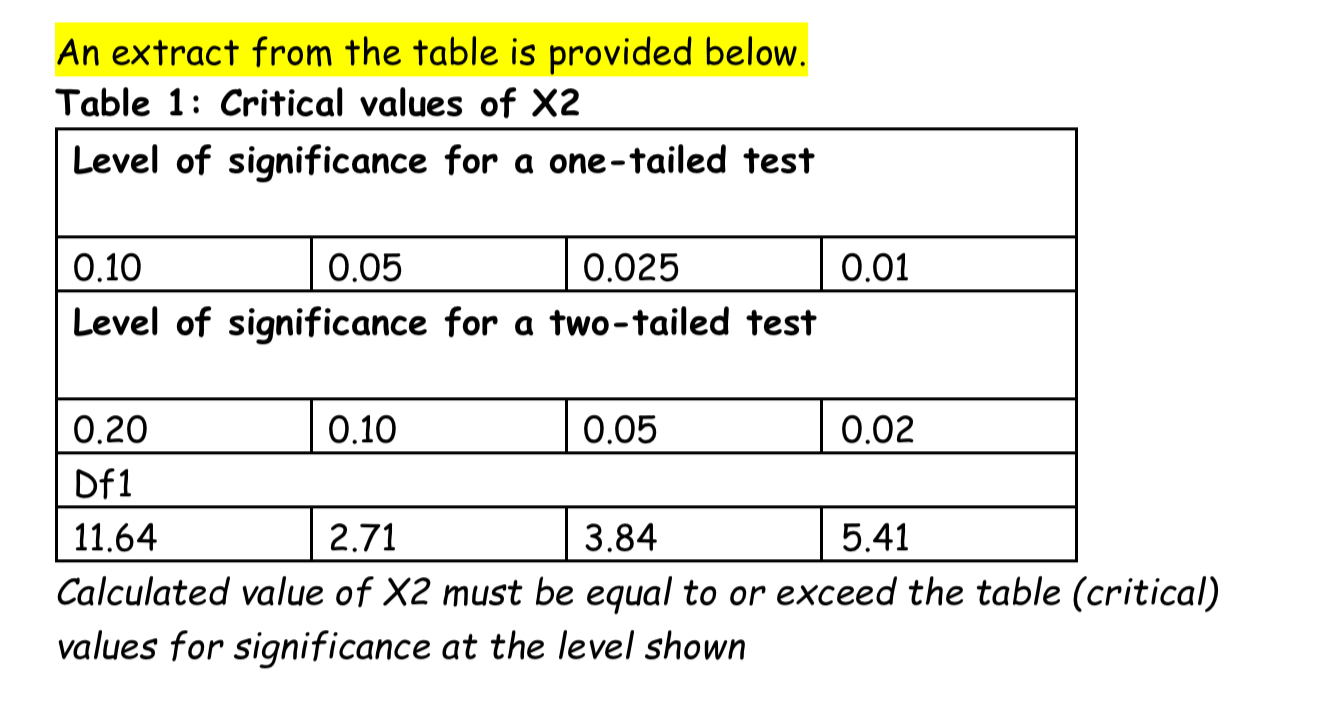
14.Imagine that you are writing the results section of the report on this investigation. Using information from the description of the study above and the relevant information from the statistical table, provide contents suitable for the results section. (12 marks) AO2/AO3 = 12 marks
You must provide all of the following:
An appropriately labelled 2 x 2 contingency table
A sketch of an appropriately labelled graph
Identification of the appropriate statistical test with justification for its use and identification of an appropriate significance level
A statement of the results of the statistical test in relation to the hypothesis.
QUESTION D ANSWERS
SECTION C: PSYCHOLOGICAL RESEARCH AND SCIENTIFIC METHOD
JUNE 2011 (THIS TOPIC CARRIES 35 MARKS)
“It is thought that colours might affect our performance when carrying out certain tasks. Research in this area has been inconclusive. Some studies have shown that red improves performance but others have found the opposite. It could be that these contradictory results have arisen because red is beneficial only for certain kinds of mental processing. Some psychologists tested this hypothesis in a series of independent-groups design experiments using students at a Canadian university.
The experiments involved computer tasks, with either a red, blue or neutral background appearing on the monitor. The researchers found that participants were better at a word-recall task and a spell-checking task when the screen background was red rather than blue or neutral. However, participants thought of more creative ideas when the screen was blue rather than red or neutral.
The researchers concluded that red is beneficial for tasks that require attention to detail whereas blue aids creativity.”
1. WHAT WERE THE RESEARCHERS’ AIMS IN THIS STUDY? (2 MARKS)
ANSWER:
They wanted to clarify some of the issues raised by previous research where some studies had shown that red facilitated tasks and other studies had shown the opposite. They believed that one way to reconcile these different findings was to look at particular cognitive tasks e.g. ones which required attention to detail and to compare them with tasks which tap into very different skills e.g. creativity and thus to narrow down the benefits of providing red backgrounds.
One mark for a brief answer e.g. 'they wanted to investigate the effects of colour on performance.'
One further mark for elaboration, in relation to colour and / or performance.
“IMAGINE THAT YOU ARE WRITING UP THE REPORT FOR THIS SERIES OF EXPERIMENTS.”
2. WHAT IS THE PURPOSE OF THE INTRODUCTION SECTION OF A REPORT? (2 MARKS)
ANSWER:
A short summary of the available research so far in the area of colour/performance research, criticisms of previous research in the area, e.g., previous research didn’t focus on specific types of performance. Justification for why you are doing research, e.g., to concentrate on word recall tasks and colour; leading logically to the aims and hypotheses.
Candidates need to show understanding of reporting conventions. The introduction is an important part of the report that provides background information on theories and studies relevant to the investigation.
One mark for a brief explanation of the purpose e.g. 'It provides background information', and one further mark for elaboration or for other detail such as reviewing methodological issues or how the current aims/ hypothesis were derived.
3. WHAT ARE THE CONVENTIONS FOR A PSYCHOLOGICAL REPORT (4 MARKS)?
ANSWER:
Abstract, Introduction (+aims & hypotheses), Method (design, controls, participants, materials/apparatus, procedure), Results (descriptive and inferential), discussion (explanations of findings, criticisms of design, implications for future research and who research impacts on real world), references, appendices.
4. WHAT IS MEANT BY VALIDITY? (1 MARK)
ANSWER:
Validity refers to how well a test or a piece of research measures what it says it measures = 1
In this question, candidates are not required to relate validity to this particular study so a general definition of validity is acceptable. Definitions of specific types of validity (e.g. population validity) can also gain credit.
Mark answers such as 'truth' or 'whether it is true', ‘legitimacy’ or ‘accuracy’ = 0 marks.
5. EXPLAIN HOW ONE FACTOR IN THIS STUDY MIGHT AFFECT ITS INTERNAL VALIDITY AND HOW ONE FACTOR MIGHT AFFECT ITS EXTERNAL VALIDITY. (2 MARKS + 2 MARKS)
ANSWER:
In this question, candidates have to make their answers relevant to this particular study.
Candidates need to make it clear which factor refers to internal and which to external validity. Where candidates do not make this clear, examiners should accept the first factor as referring to internal validity and the second to external validity.
For each factor, one mark for a brief explanation and one further mark for elaboration.
FACTORS THAT MIGHT AFFECT INTERNAL VALIDITY INCLUDE:
Individual differences e.g. colour blindness could have affect the outcome as the studies were all independent groups design (although if big enough sample only a random error).
The possibility of experimenter bias in judging the creativity of the ideas.
EXAMPLE ANSWERS:
'Individual differences' = 1 mark
Because the researchers used an independent groups design, there could be a problem with individual differences' = 2 marks
FACTORS THAT MIGHT AFFECT EXTERNAL VALIDITY INCLUDE:
Sampling bias – all participants were university students
Cultural bias – study took place in Canadian university – response to colours might well be affected by cultural factors
EXAMPLE ANSWERS:
Sample biases – 1 mark
'There was a sampling bias. Although all the participants were university students the investigators drew more general conclusions' = 2 marks
“IN A FURTHER EXPERIMENT, PARTICIPANTS WERE GIVEN 20 BLUE SHAPES OR 20 RED SHAPES. THEY WERE THEN ASKED TO PICK 5 SHAPES AND USE THEM TO MAKE A TOY SUITABLE FOR A CHILD AGED BETWEEN FIVE AND ELEVEN YEARS. THEY WERE GIVEN A LIMITED TIME TO CARRY OUT THIS TASK. PARTICIPANTS GIVEN RED SHAPES MADE TOYS THAT INDEPENDENT JUDGES RATED TO BE MORE PRACTICAL BUT LESS ORIGINAL, WHEREAS PARTICIPANTS GIVEN BLUE SHAPES MADE MORE CREATIVE TOYS.”
6. EXPLAIN WHY THE RESEARCHERS ASKED INDEPENDENT JUDGES TO RATE THE TOYS. (2 MARKS)
ANSWER:
If the researchers had judged the toys themselves, they might have been biased in favour of their hypothesis. There are no objective criteria for what makes a toy either practical or original. Independent judges would be able to decide between themselves on a set of criteria and then apply them to the toys made by the participants.
Some candidates might interpret 'independent judges' in this question to mean judges who do not confer with one another. In this case, an acceptable answer would be that they could not conform to one another when making their judgement.
One mark for a brief explanation, e.g. to avoid experimenter bias, and one further mark for elaboration, e.g. if the researchers judged the toys themselves.
An answer explaining the value of rating the toys should be credited.
7. EXPLAIN WHAT IS MEANT BY THE PHRASE “IS STATISTICALLY SIGNIFICANT AT THE 5% LEVEL.” (2 MARKS)
ANSWER:
If something is statistically significant it means it did not occur by chance and that your study worked so you can accept your experimental/alternative hypothesis and reject your Null hypothesis. It means that your inferential results are ten percent or less due to chance.
8. HOW DOES THE SET SIGNIFICANCE LEVEL AFFECT THE CHANCE OF RESEARCHERS GETTING A TYPE 1 OR TYPE 2 ERROR? (4 MARKS)
ANSWER:
If psychologists choose a ten percent level of significance than they have a greater chance of making type one error. This is because there is a ten percent probability that results could be due to chance. Therefore psychologists may accept their experimental hypothesis when they should reject it (they won’t know this until they replicate).
If psychologists go to the other extreme and choose a one percent level of significance they will have a greater chance of making type two errors. This is when the significance level is set too high and psychologists reject their experimental hypothesis instead of accepting it (again not known until replication).
Therefore psychologists usually choose five percent as it is midway between making type 1 and type 2 errors.
9. EXPLAIN WHAT IS MEANT BY “P = ≤ 0.01”. (2 MARKS)
ANSWER:
It means that a researcher has chosen a one percent or less significance level and they want their results to have only a one percent or less probability of being due to chance.
10. WRITE A SET OF STANDARDISED INSTRUCTIONS THAT WOULD BE SUITABLE TO READ OUT TO PARTICIPANTS IN THIS EXPERIMENT. (5 MARKS) AO2/AO3 = 5 MARKS
ANSWER:
Candidates need to use the details in the description of the study to write an appropriate set of instructions for potential participants.
The instructions should be clear and succinct. They must: explain the procedures of this study relevant to participants and include a check of understanding of instructions. They should also use language appropriate for a formal document and be as straightforward and courteous as possible.
This is not a consent form so explicit references to ethical considerations are not necessary for full marks. However, it is perfectly acceptable to include comments such as 'you are free to withdraw from the study at any time.'
Psychological research suggests an association between birth order and certain abilities. For example, first-born children are often logical in their thinking whereas later-born children tend to be more creative. A psychologist wonders whether this might mean that birth order is associated with different career choices. She decides to investigate and asks 50 artists and 65 lawyers whether they were the first-born child in the family or not.
11. WRITE A NON-DIRECTIONAL HYPOTHESIS FOR THIS STUDY. (2 MARKS) AO2/AO3 = 2 MARKS
ANSWER:
'There is an association between birth order and choice of career' = 2 marks
A directional hypothesis is not creditworthy. Reference to a relationship/correlation cannot gain credit. Although technically, the psychologist is looking for an association, candidates can gain credit for expressing the hypothesis in terms of a difference e.g. 'There is a difference in career choice depending on birth order.'
2 marks for a clear hypothesis, 1 mark for a hypothesis which lacks clarity.
IDENTIFY AN APPROPRIATE SAMPLING METHOD FOR THIS STUDY AND EXPLAIN HOW THE PSYCHOLOGIST MIGHT HAVE OBTAINED SUCH A SAMPLE. (3 MARKS) AO2/AO3 = 3 MARKS
ANSWER:
One mark for identifying a sampling method.
One mark for a brief explanation of how to obtain the sample e.g. 'by advertising for lawyers or artists to come forward’.
One further mark for elaboration e.g. ‘by explaining that adverts would have to be placed in appropriate journals etc. to attract these particular categories of participants’.
Candidates who identify a sampling method but describe it incorrectly can be awarded 1 mark.
The psychologist found the following results:
20 of the 50 artists were first-born children
35 of the 65 lawyers were first-born children
She analysed her data using a statistical test and calculated a value of X² = 2.27. She then looked at the relevant table to see whether this value was statistically significant