
NEURAL AND HORMONAL MECHANISMS IN THE CONTROL OF EATING BEHAVIOUR
Neural and hormonal mechanisms involved in the control of eating behaviour, including the role of the hypothalamus, ghrelin and leptin
This unit examines the biological factors that regulate appetite, focusing on what initiates hunger, how eating is controlled, and what produces satiety. Together, these processes are referred to as feeding behaviour, meaning the biological regulation of when eating begins, how much food is consumed, and when eating stops.
The explanations in this topic are biological and neural, focusing specifically on mechanisms within the brain rather than psychological, social, or cultural influences.
KEYWORDS
GHRELIN: A peptide hormone released by the stomach that stimulates hunger by acting on the hypothalamus, particularly increasing activity in feeding centres.
HOMEOSTASIS: The physiological process by which the body maintains internal equilibrium, including regulation of energy balance and blood glucose levels.
HYPOTHALAMUS: A subcortical brain structure that plays a central role in the regulation of feeding behaviour, body temperature, and endocrine activity.
LATERAL HYPOTHALAMUS (LH): A region of the hypothalamus associated with the initiation of feeding behaviour; lesions result in aphagia and weight loss.
VENTROMEDIAL HYPOTHALAMUS (VMH): A region of the hypothalamus associated with the inhibition of feeding behaviour; lesions result in hyperphagia and weight gain.
PARAVENTRICULAR NUCLEUS (PVN): A nucleus within the hypothalamus involved in appetite regulation and energy balance, integrating hormonal signals such as leptin and ghrelin.
INSULIN: A hormone secreted by the pancreas that reduces blood glucose levels and contributes to satiety by acting on the hypothalamus.
GLUCOSE: A primary energy source in the blood, monitored by the hypothalamus to regulate hunger and feeding behaviour.
SET POINT: The biologically preferred level of body weight or energy stores that homeostatic mechanisms act to maintain.
LEPTIN: A hormone released by adipose tissue that suppresses appetite by signalling long-term energy stores to the hypothalamus.
DUAL CENTRE MODEL OF FEEDING: A model proposing that feeding behaviour is regulated by two hypothalamic centres: the lateral hypothalamus (feeding on) and the ventromedial hypothalamus (feeding off).
APHAGIA: A severe reduction or absence of eating behaviour, typically resulting from damage to the lateral hypothalamus.
HYPERPHAGIA: Excessive eating behaviour, typically resulting from damage to the ventromedial hypothalamus.
SATIATION: The physiological process that leads to the termination of eating during a meal as feelings of fullness increase.
Homeostasis: if this did not occur, we would starve or die of starvation. Knowing whether we are at our set point (full) is individual, however. Each individual has a set point, and their weight is regulated around it.
THE STOMACH’S ROLE IN APPETITE
Early biological explanations of appetite regulation focused on the stomach rather than the brain. In 1927, Walter Cannon proposed that hunger was caused by contractions of an empty stomach, while satiety occurred when the stomach stretched after eating. In this account, feelings of hunger and fullness were assumed to arise directly from these mechanical changes in the stomach itself.
Cannon’s theory did not involve detailed neural mechanisms within the brain, reflecting the limited understanding of neural control of appetite at the time.
RESEARCH
Cannon’s theory treated hunger and satiety as sensations arising from the physical state of the stomach. To test this, he and his colleague Allan L. Washburn used an inflatable balloon that could be expanded inside the stomach. The balloon allowed the stomach to be stretched without the ingestion of food.
This method made it possible to examine whether stomach fullness alone was sufficient to reduce hunger, independent of eating itself. When the balloon was inflated, Washburn reported a reduction in hunger. At the time, this was taken as evidence that the mechanical state of the stomach, rather than food intake, was responsible for satiety.
Subsequent research demonstrated that this explanation was incomplete. Clinical observations show that individuals who have had part or all of their stomach surgically removed continue to experience hunger and satiety. Although eating patterns change, appetite regulation does not disappear. Research by Wangensteen and Carlson found that removal of the stomach has little effect on the ability to maintain body weight. Comparable findings have been reported in animal studies. The consistent change observed is behavioural rather than motivational: individuals consume smaller meals more frequently, indicating compensation rather than loss of appetite.
Methodological weaknesses further undermine the original stomach contraction theory. Later analyses suggested that the contractions measured by Cannon were likely induced by the balloon itself rather than representing genuine hunger signals. In addition, Davis et al. showed that Washburn failed to reliably detect stomach contractions even when they occurred, raising concerns about the objectivity and reliability of the findings.
Despite these limitations, the stomach does contribute to appetite regulation, though not as a simple mechanical controller. When the stomach is empty, it releases the hormone ghrelin, which acts on the hypothalamus to increase hunger. This demonstrates that the stomach communicates with the brain via hormonal pathways, linking peripheral bodily signals to central neural mechanisms involved in feeding.
Contemporary research indicates that the stomach plays a more specific role in regulating the timing of meals rather than determining overall appetite or long term body weight. Studies by Jacques Le Magnen showed that the interval between meals depends on the size and energy content of the previous meal. Larger meals are followed by longer delays before eating again, reflecting ongoing digestion and nutrient absorption. Rising blood glucose levels following digestion are associated with reduced hunger, highlighting the importance of metabolic feedback rather than stomach stretch alone.
Research also demonstrates that stomach volume is not sufficient to produce sustained satiety. Studies by Levinson et al. found that filling the stomach with non nutritive substances such as fibre, cellulose, or saline suppresses eating only briefly. When food is diluted with non caloric bulk, animals compensate by increasing intake. This indicates that caloric and metabolic signals are essential for long term regulation of eating behaviour.
Washburn tested the stomach fullness idea by swallowing an inflatable balloon that could be expanded inside the stomach. When the balloon was inflated, he reported reduced hunger. The point of the balloon was to produce stomach stretch without eating food, so any change in hunger could be attributed to stomach fullness rather than the act of eating.
However, later evidence shows that stomach stretch cannot be the sole basis of hunger and satiety. People who have had part or all of their stomach surgically removed still experience hunger and satiety, indicating that appetite regulation persists despite major loss of stomach capacity. Wangensteen and Carlson reported that removing the stomach has little effect on longer term regulation, with the main change being eating pattern: smaller meals taken more frequently, rather than loss of the drive to eat. Similar patterns have been observed in animal studies.
Methodological problems also weaken the original stomach contraction evidence. Later work suggested that the contractions recorded by Cannon were likely triggered by the balloon used to measure them rather than representing naturally occurring hunger contractions. Davis et al. also found that Washburn did not reliably detect stomach contractions even when they occurred, raising doubts about the reliability of the early findings.
The stomach still contributes to appetite regulation, but not as a simple mechanical controller. When the stomach is empty it releases ghrelin, which increases hunger via the hypothalamus. Current evidence also indicates that stomach signals are more important for meal patterning, particularly the timing between meals, than for determining overall appetite. Le Magnen found that larger meals are followed by longer intervals before the next meal, consistent with ongoing digestion and nutrient related feedback.
Stomach volume alone produces only brief suppression of eating. Filling the stomach with non nutritive bulk such as saline or cellulose reduces eating only temporarily. When food is diluted with non nutritive bulk, rats compensate by eating more (Levinson et al.). This indicates that caloric and metabolic consequences of food, not bulk alone, are necessary for sustained satiety.
GASTRIC BANDS AND GASTRIC SURGERY
Restrictive gastric procedures operate within this framework rather than contradicting it. Reducing stomach capacity alters eating behaviour by slowing consumption, increasing early sensations of fullness, and modifying hormonal signalling, including ghrelin release. These changes influence meal size and spacing, but do not remove hunger altogether. Appetite regulation remains primarily under central control, with stomach based signals shaping short term satiety and feeding patterns rather than acting as the sole determinant of hunger.
Overall, the stomach contributes to appetite regulation through mechanical, hormonal, and metabolic signalling that influences meal timing and short term satiety. However, it does not function as an independent controller of hunger. Feeding behaviour emerges from interaction between peripheral signals from the stomach, circulating nutrients, hormones, and hypothalamic control systems.
THE HYPOTHALAMUS
The hypothalamus is a small but essential brain structure that regulates core survival functions, including body temperature, hunger and eating behaviour, thirst, sexual behaviour, autonomic and endocrine responses to stress, and the sleep–wake cycle. Together, these functions maintain homeostasis by keeping internal conditions within optimal limits.
The hypothalamus is located beneath the thalamus and above the brain stem. Although relatively small, roughly the size of an almond in humans, it contains functionally distinct regions responsible for different regulatory roles.
Rather than acting as a single unit, all brain structures have different regions that carry out different functions. These regions are named according to their position within the brain, using standard anatomical terms such as anterior (front), posterior (back), dorsal (upper), ventral (lower), medial (middle), and lateral (side). These labels describe location of the brain structure.
The hypothalamus follows this same organisational principle. It contains multiple regions with different roles in homeostatic regulation.
In relation to feeding, regions such as the lateral hypothalamus, ventromedial hypothalamus, and dorsal areas are involved in different aspects of appetite regulation.
THE HYPOTHALAMUS’S ROLE IN EATING BEHAVIOUR
There has been considerable research evidence to support neural mechanisms' role in hunger and satiety.
Studies examining this structure's lesioning regions have supported the hypothalamus's role. In 1920, W. R. Hess showed that the hypothalamus regulates body processes, including eating and drinking. (Hess won the Nobel Prize in 1949 for his pioneering work. The current view states that the hypothalamus is the major site for detecting signals of nutritional state and organising hunger-related behaviour. It gets information about the body's need for food through neural connections and hormones from the gut, and it controls food-related responses, partly through the autonomic nervous system and the pituitary gland. A long winding route led to this view.
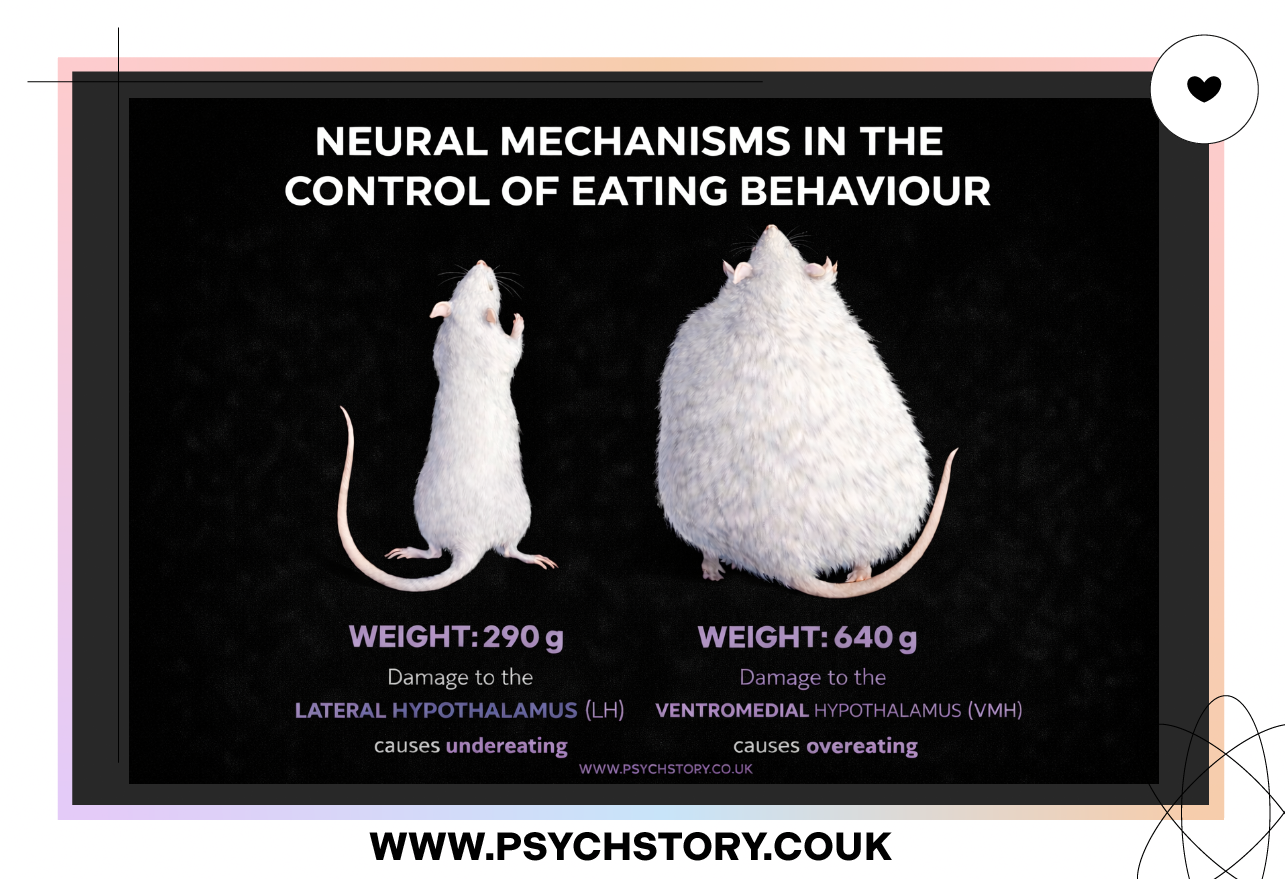
Early research showed that damage in the hypothalamus severely disrupts normal eating and regulation of body weight. Damage to the lateral (~side) hypothalamus greatly depresses eating. (Teitelbaum & Epstein, 1962). In contrast, damage to the ventromedial hypothalamus (ventro- = ~bottom or belly side; medial = [toward the] middle) greatly increases eating. A rat with such a lesion can overeat enough to double its normal body weight.
Research on the Hypothalamus
The first study on the role of the hypothalamus was done by Hetherington and Ranson in 1942. Their study involved lesioning rat Hypothalamus. The lesion is cutting away areas of the brain. In this case, it was either the lateral hypothalamus (LH) or the Ventromedial Hypothalamus (VMH). If you forget the part of the hypothalamus, you can say when parts of the Hypothalamus are removed. The results from this study show that the Hypothalamus has an ‘on’ and ‘off’ command for eating. The LH functions as the hunger centre. If this area is lesioned in rats, they starve themselves. If, however, the VMH is lesioned, then they overeat until death. It is suggested that if these areas are dysfunctional, they can lead to eating disorders such as Obesity and Anorexia.
Area of hypothalamus
Effect of lesioning
Effect of stimulating
Ventromedial hypothalamus (satiety centre)
Increases eating
Decreases eating
Lateral hypothalamus (hunger centre)
Decreases eating
Increases eating
Tumours in the VMH have led to excessive binge eating in humans. Hypothalamic obesity is an unfortunate complication in some survivors of brain tumours, especially those diagnosed in childhood. Robert H. Lustig, 2003 ‘The Journal of Clinical Endocrinology & Metabolism’. Damage to the VMH from surgery has long been known to promote excessive eating (hyperphagia) and weight gain, termed "hypothalamic obesity." Victims of this form of obesity continue to gain weight despite their best efforts. De Araujo et al, 2006.
Implanting electrodes into rats' brains (hypothalamus) so they can record the electrical activity of the feeding cycle. So when a rat is hungry, do certain brain regions activate and vice versa for when the rat is full up? Yes, they do.
Electrical stimulation of the hypothalamus. Activity is recorded when electrodes are implanted into the brain and used to stimulate neurons artificially. The findings are the same as above, e.g., VMH inhibits feeding, and LH stimulation encourages it.
Prader-Willi syndrome is frequently associated with an extreme and insatiable appetite, often resulting in morbid obesity. There is currently no consensus on the cause for this particular symptom, although genetic abnormalities in chromosome 15 disrupt the normal functioning of the hypothalamus. Given that the hypothalamus regulates many basic processes, including appetite, there may be a link.
However, no organic defect of the hypothalamus has been discovered in post-mortem investigation.
Hypothalamus only
The hypothalamus model has been discarded because early studies gave an incomplete picture of the effects of hypothalamic functioning. There is no other evidence that hormones such as Leptin and Glucose are also critically involved in eating behaviour (see below).
In addition, the model, as described, also fails to indicate how we know when to start and stop eating. What are the signals we use? Again it I thought Glucose plays a vital role here. For example, what triggers the hypothalamus to stop and start?
The hypothalamus has other important arrears in appetite, such as the parvo-ventricular nucleus.
Conflicting Evidence Studies such as those involving lesions to the LH and VMH in rats have supported the role of the hypothalamus in regulating eating behaviour. However, Gold (1973) found that lesions restricted to the VMH alone did NOT result in hyperphagia and only produced overeating when they included other areas such as the parvo-ventricular nucleus! However, subsequent research has failed to replicate Gold’s findings, so it is a type 1 error.
Linking site of damage to behaviour: Lesions are when brain areas are cut away. In the past, little was known about the brain, so researchers tended to chop away lots, not realising the effect they were having (think Lobotomy/psycho surgery). But as Logue (2004) points out, destroying brain tissue (even a small lesion) however carefully, could affect far more neurons and cell bodies whose axons or dendrites run through the lesioned area e.g., not just neurons at that site but possibly pathways travelling through. Even the destroyed neurons have connections to many other neurons, which will be affected by the damage. Likely, some of the neurons with cell bodies in the VMH and LH could have connections to the frontal cortex that relay sensory information about food, e.g., smells, sights, motivation to obtain food, etc. For example, it is thought that lesions to the VMH cause damage to the Dopamine system" (Berridge & Robinson, 1995). The Dopaminergic system passes through the lateral and ventromedial hypothalamus. See point 4
Therefore, when researchers lesion the hypothalamus, they damage other areas, affecting behaviour. Unfortunately, researchers concluded that the resulting behaviour was due only to the hypothalamus and not the other areas they had lobbed off. For example, more complete information shows that damage to the hypothalamus systems VMH and LH produces under- and overeating indirectly. Damage to the lateral hypothalamus depresses responsiveness to all external stimuli, not just food-related ones. These rats sit and do nothing as if completely unmotivated. This finding has led researchers to hypothesise that LH Lesions Cause Sensory Neglect. Marshall et al. (1971) found that LH lesions produce a range of sensory and motor impairments termed sensory neglect.
Rats with LH lesions
Do not respond to touch, auditory, or visual stimuli
Remain immobile unless disturbed
Do not right themselves when placed on their side
Marshall et al.'s findings imply that LH lesions may reduce arousal. Eating is triggered by external stimuli such as the time of day, or the sight and smell of food. If LH lesions interfere with an animal's ability to process such stimuli, this could account for reduced food intake. This explanation casts doubt that the LH is specifically involved in food intake; all behaviour would be affected if sensation was disrupted. The sensory neglect produced by LH lesions is now thought to be caused by the lesion-destroying axons in the Dopamine system or, more specifically, the nigrostriatal pathway. The nigrostriatal tract utilizes dopamine (DA) as its transmitter. Incidentally, Parkinson's disease is associated with a massive reduction in Dopamine.
The result of this disruption to our Dopamine system is that even if tasty food is put into the mouth, these rats chew and eat it actively. They appear to like the food but don't do anything to get it. They don't because the dopaminergic (dopamine-using) "wanting/reward system" (Berridge & Robinson, 1995) that passes through the lateral hypothalamus is damaged.
These animal experiments appear to correspond to the observation that obese humans eat fewer peanuts if they have to shell them than people of normal weight.
The same is true of rats with VMH lesions. They are initially able to eat loads more, but the motivation of rats to obtain food is less clear-cut (i.e., they will eat ravenously if food is in front of them, but will they be motivated to look for it?). VMH lesioned rats were put through various reinforcement feeding schedules, varying from pressing a lever once to obtain a pellet of food right through to pressing a lever 256 times to obtain one pellet of food. One would imagine that rats with legions to the VMH would be so hungry they would be motivated to press a lever any number of times to get food.
Findings: rats with VMH lesions are more likely to press the lever in the one-tap condition than non-VMH rats, but once the schedule got tougher, they were less motivated than non-VMH lesioned rats to press the lever for food pellets.
Chemical Lesions of the LH We have seen that electrical lesions of the LH have failed to provide clear-cut answers to the role of the LH in feeding. Chemical lesions, on the other hand, did resolve the issue of sensory neglect. Recently, research has employed chemical lesions to destroy cells in the LH whilst sparing axons of the nearby nigrostriatal/dopamine tract. Kainic acid and ibotenic acid lesions of cells in the LH produce a long-lasting decrease in food intake and body weight but do not produce sensory neglect. However, it is widely acknowledged that it is a gross oversimplification to call the LH a 'feeding centre' because:
Animals recover from LH lesions.
LH lesions disrupt aggression, sexual behaviour, and reinforcement.
Nigrostriatal/Dopamine lesions produce aphagia and adipsia
9) a body of evidence indicates that VMH-lesioned rats are pernickety eaters. Compared to normal rats, they eat less when:
· Quinine is added to make food taste bitter
· Food is stale
These are not the behaviours you might expect if the VMH is a hunger centre whose destruction increases an animal's motivation for food! The hypothalamus is an insufficient explanation alone. Other biological mechanisms are involved.
Another hypothesis is that damage to the ventromedial hypothalamus produces over-eating and obesity by making gut reflexes work faster. This speeds digestion and removes food faster (Keesey & Powley, 1975). Therefore, the next meal comes much sooner than normal, which produces overeating and obesity.
In any case, the effects of the lesions in the VMH are not permanent. After an initial increase in weight, body weight stabilizes in Rats. VMH lesioned rats could reach satiety (not overeat) despite the absence of their satiety centre. For example, after lesions in the lateral hypothalamus, rats ignore food completely. They will starve to death amid food. They must be force-fed for up to several weeks before they start eating again. Eventually, they recover enough to maintain their body weight with tasty, easily eaten-food, but they keep it below normal. After regaining normal body weight by force-feeding, they eat less until they return to the low weight they had stabilized after the brain lesion. Therefore, there must be other mechanisms involved in appetite.
Pinel has provided a complementary explanation for the role of the VMH in feeding. He suggests that animals with VMH lesions “overeat because they become obese ". He argues that VMH lesions increase blood insulin levels. This triggers lipogenesis (the conversion of glucose into fat). Because any food the animal eats is rapidly converted into fat, they suffer an energy deficiency. Consequently, they eat in vain to overcome the lack of glucose circulating in their bloodstream.
Role of the LH & VMH - What do contemporary textbooks say? The search for a role for the LH in hunger continues. It may play a role in controlling insulin release. According to this idea, excitation in the LH stimulates insulin release from the pancreas. Lesioning the LH is followed by a reduction in insulin release. Insulin allows glucose to be broken down to provide a source of energy. The body compensates for the lack of glucose-derived energy by breaking down stored body fat to provide fuel. Due to fat breakdown, body weight declines. But the blood is full of excess energy-rich free fatty acids, and the animal fails to eat because its body is telling the brain areas controlling feeding that there is no need to take in more energy (Schneider & Tarshis, Elements of Physiological Psychology, McGraw Hill, 1995, p 386-7, 1995).
For those having trouble with the complexity of this topic. Please see the general A02 at the end. Ensure you mention the methodologies used. Most of it is experimental and very good; say why. Please talk about the fact that a variety of methods are good, however are not replicable, the tumor studies done on humans is not as generalisable as tumour grow differently and impact the LH and VMH in different ways, yet at least we have humans, this backs up animal research which lacked comparability to humans.
Rounding it all up/Conclusions
Dual Centre Model of feeding
Now that you understand the role of LH, VMH, Glucose, and Insulin, I can tell you about the dual-centre feeding model. This is a SET POINT theory; it suggests we have set points for hunger and satiety. I could, by the way, tell you so much more about this topic; there are many things we have not even discussed, but if you know the Dual Centre model, that should be enough.
Dual Centre Model of Feeding (DCMF)
Explanation of DCMF
When blood glucose levels fall, the hypothalamus senses this, and the LH is activated. We feel hungry and eat. As food intake is likely to increase blood glucose, the VMH senses this, activating us into feeling full and not eating any more.
Dual Centre Model of Feeding
Set-point theories are rigid and insufficient to explain all aspects of eating behaviour. For instance:
Early ancestors needed to eat a lot to store energy as fat.
Eating behaviour is not always motivated by an energy deficit. Other factors, such as taste, learning, and society, influence eating behaviour.
Does not account for the influence of hormones such as ghrelin, Leptin, etc.
The latest theory and the best theory on appetite ….
.Neural and hormonal signals of the body's energy balance come from the gut and fat storage cells in many body parts. Two kinds of signals from the gut reach the hypothalamus: hormones and neural signals. The main hormones are insulin, which controls the level of blood glucose ("blood sugar"), and leptin, which fat cells release when they are filled. The neural signals come from receptors in the gut that detect stomach content and hormones the gut releases in response to food level. One of these is CCK, a hormone the gut releases when it is filled with food. The neural signals get to the central nervous system mainly over the vague nerve in the parasympathetic division of the autonomic nervous system. This large nerve connects the insides of the body to the brain stem.
Leptin, insulin, and blood glucose levels regulate food intake in the short term (hours). Leptin is also important in long-term body weight regulation because it reflects calories stored in fat cells.
Low insulin levels and leptin signal the body is in a negative energy balance (using more energy than it is getting). These signals depress unnecessary body activity to conserve energy and activate eating to counteract this condition. High insulin levels and leptin signal that the body is in a positive energy balance (getting more energy than it uses). These signals increase body activity to burn energy and inhibit eating in this condition. In summary, insulin and leptin levels generate negative feedback to counteract both low and high levels of food to keep the body within homeostatic limits. The basic physiological core that regulates eating does not operate in isolation. Many psychological, social, and cultural processes modify eating. These processes include associative learning, food variety, food palatability (tastiness), visual appearance, social setting for eating, and cultural effects.
Research and theory applicable to all the above theories
Reductionism
We can see that biological theories see appetite as caused by only one factor. They exclude other approaches, yet there are individual differences in appetites. Appetites are probably influenced by various factors: genetics, family, culture and society. Therefore, biological reductionism is not a good way to understand appetites, i.e., appetite cannot just be boiled down to biological concepts; it probably can be better understood with a few approaches. Moreover, there is substantial and convincing evidence that social, cultural and psychological factors affect our eating behaviours, as is evident from psychological explanations of eating disorders.
Ecological Validity
Highly controlled lab experiments with humans may lack mundane realism and ecological validity, as in Cannon’s study.
Cannot extrapolate/generalise animal findings to humans:
Against: Firstly, many animals, such as rats, have eating behaviours and eating patterns that are different from humans. Also, it is unclear whether the influences are completely the same for humans, though, as our eating is not just geared (like many mammals) as an automatic stimulus–response drive. In humans, Cognition/mood/culture may also play a part in our eating habits. Food and over/under eating also have a social significance to us, in how we look, are perceived as greedy, etc.
Also, research on animals may not be directly comparable as we are physiologically different despite our many similarities. Thus, research on animals has resulted in huge medical blunders for humans: thalidomide, Opren, etc. Moreover, animals have different reactions to different foods. For example, dogs cannot tolerate chocolate, and Guinea pigs are allergic to penicillin.
Many researchers would counter-argue that rodents have more similarities than dissimilarities. For example, our lower-down brain structures (hypothalamus, hindbrain and forebrain) are the same. Plus, we all produce the same (hormones: insulin, Ghrelin, Leptin).
Against Animal Ethics.
Lesioning is an invasive brain technique. Is it unnecessarily cruel to lesion animals, they probably die or starve overeat to death. Plus, there are caging and anaesthesia issues.
For animal ethics
Are there any psychological/medical advances, especially in understanding the causes of obesity (Heart attacks, diabetes, strokes, and shorter life spans by nine years) is a very current problem (There are currently 1.6 billion overweight adults in the world, according to the World Health Organization- WHO). That number is projected to grow by 40% over the next ten years). Anorexia and Bulimia Nervosa are also areas where the end may justify the means.
This theory (biological) is deterministic because it says you have no free will over your appetite set point. Appetite is determined by biology. This cannot be true as people do have some success at dieting. Surely dieting indicates free will (though it has to be said that most people fail at dieting)? Can physiological drives be overridden (e.g. desire to lose weight, dislike of certain foods, fear of losing control, social cues to continue eating, food availability)?
Physiological drives can be overridden (e.g. desire to lose weight, dislike of certain foods, fear of losing control, social cues to continue eating, food availability.
Such studies provide sound scientific evidence. The experiments on rats were well-controlled and scientific. Rats do not suffer from individual differences the way humans do.
One weakness of the model is that it ignores the behavioural approach. This means that focusing solely on biology (the hypothalamus) ignores the role that learning plays in feeding behaviour. For example, research has shown that we may learn to associate certain times of the day with eating, so we feel hungry at these times through classical conditioning. This problem suggests that learning also plays a role in eating behaviour, so a solely biological approach may be too narrow.
Biological rhythms impact eating behaviour. We tend to feel hungry at certain times of the day, regardless of what we’ve eaten earlier. Rats tend to feel hungry just after darkness. This suggests a link between the body clock and eating mechanisms, but again, the precise link isn’t known, though the main clock is located in adjacent areas of the hypothalamus.