
DISINHIBITION AND THE BOUNDARY MODEL OF OBESITY
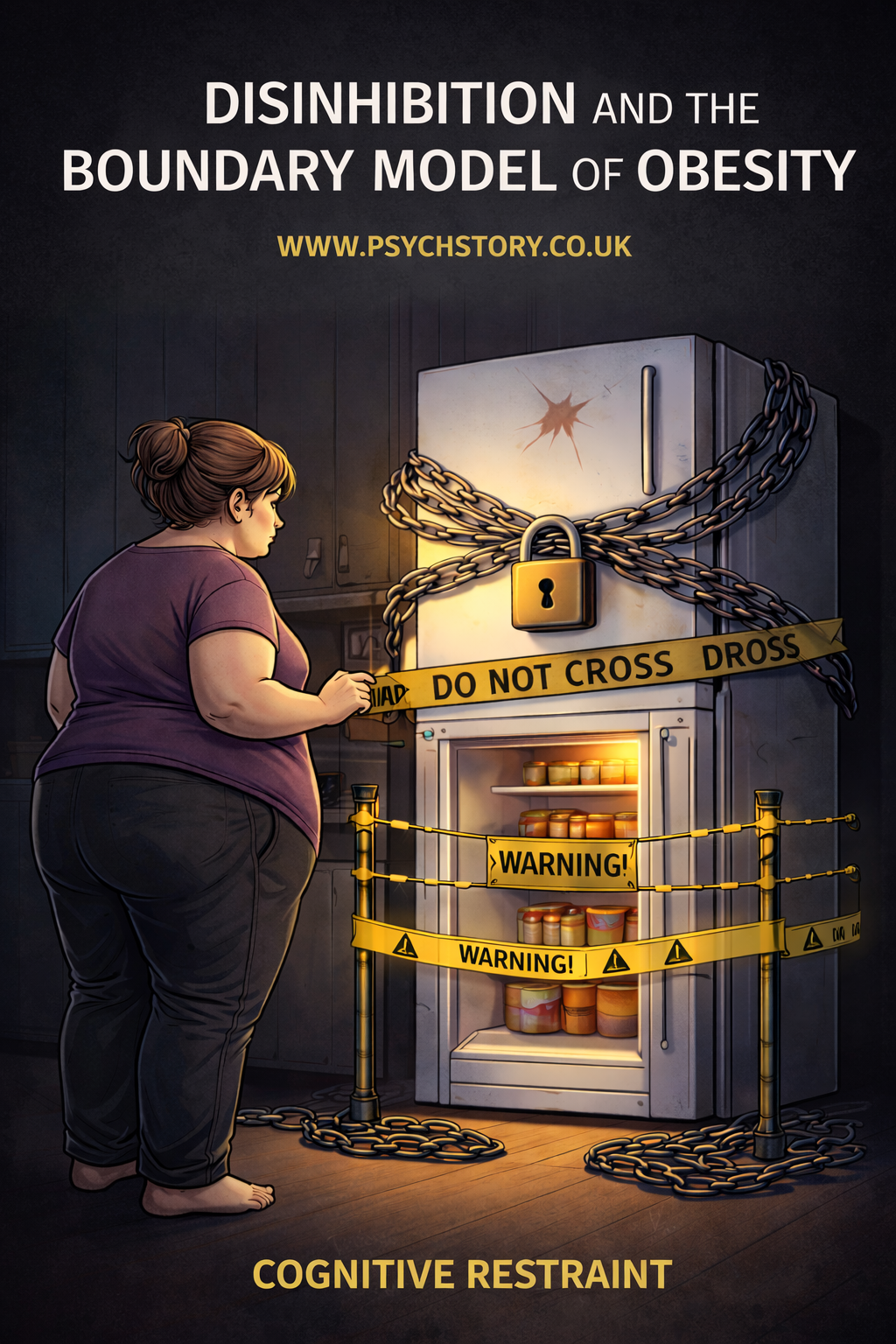
Psychological explanations for obesity, including restraint theory, disinhibition and the boundary model.
THE DISINHIBITION MODEL OF OBESITY
UNDERSTANDING DISINHIBITION IN EATING BEHAVIOUR
Disinhibition is characterised by the loss of restraint over eating behaviours, making an individual prone to overeating in the presence of palatable foods or during emotional distress. This state results in a diminished response to satiation cues, increasing vulnerability to overeating. Studies, including those by Bellisle et al. (2004), have demonstrated a strong correlation between disinhibition, adult weight gain, and BMI, highlighting its significance in obesity.
TYPES OF DISINHIBITION IN OBESITY RESEARCH
Bond et al. (2001) categorise disinhibition into three distinct types, each contributing differently to overeating behaviours:
Habitual Disinhibition: This form is related to routine overeating triggered by everyday circumstances. It is considered a significant predictor of weight gain due to constant exposure to overeating triggers in a typical Western food environment.
Emotional Disinhibition: This involves overeating in response to emotional states such as anxiety or depression. Emotional eating represents a coping mechanism for managing negative emotions, albeit one that can contribute to unhealthy weight gain.
Situational Disinhibition: This occurs in response to specific external cues, often during social events. While influential, its less frequent occurrence than habitual disinhibition means it contributes less to the overall risk of obesity.
Hays and Roberts (2008) emphasise the importance of habitual disinhibition, referring to it as "opportunistic eating" due to the abundance of daily opportunities for overeating in modern societies. Bryant et al. (2008) support this view but note that situational and emotional disinhibition, while less frequent, still play roles in the development of obesity.
EVALUATING DISINHIBITION AS A PSYCHOLOGICAL EXPLANATION FOR OBESITY
The psychological explanation of disinhibition provides valuable insights into the behavioural aspects of obesity. It acknowledges the complex interplay between internal psychological states and external environmental factors in shaping eating behaviours. However, this explanation also invites consideration of individual differences in susceptibility to disinhibition and the effectiveness of interventions aimed at enhancing self-regulation and coping mechanisms.
CONCLUSION: DISINHIBITION AND OBESITY EXPLANATIONS
Disinhibition, as a psychological explanation for obesity, underscores the need for a multifaceted approach that considers not only dietary and physical activity interventions but also strategies for managing emotional well-being and addressing environmental triggers. Recognising the roles of habitual, emotional, and situational disinhibition in overeating can guide the development of more comprehensive and effective obesity prevention and treatment programmes.
EVALUATION OF HERMAN AND MACK: ETHICAL AND METHODOLOGICAL ISSUES
ETHICAL CONSIDERATIONS IN HERMAN AND MACK’S STUDY
The study's ethical considerations revolve around deception and the potential lack of fully informed consent. The deception was employed to prevent demand characteristics from influencing participants' behaviour, a common practice in psychological research to ensure the validity of findings. However, this raises ethical questions about participants' autonomy and their right to make fully informed decisions about participation. While debriefing is critical to mitigate these issues, providing a full explanation afterwards does not entirely remove the ethical concern of initially withholding information.
The ethical justification depends on weighing potential harm against the study’s scientific value. If participants were not psychologically or physically harmed and were debriefed adequately, the ethical breach may be considered justifiable. However, this requires careful evaluation of whether similar findings could have been obtained using less ethically problematic methods.
METHODOLOGICAL LIMITATIONS OF HERMAN AND MACK
Timing of Questionnaires: Administering questionnaires on dieting behaviour after the experiment introduces potential bias. Participants’ responses may be influenced by awareness of the study, reducing the accuracy of self-report data. Ideally, classification into dieters and non-dieters should occur before the experiment.
Study Sample and Distribution of Dieters: With only 15 participants per condition and an unknown distribution of dieters prior to testing, the study lacks representativeness and statistical power. This limits the reliability and generalisability of findings.
Lack of Controls: The absence of controls for variables such as prior eating disorders, physical activity levels, and weight complicates interpretation. These factors may independently influence eating behaviour.
Generalisability: Findings may not generalise beyond the specific sample used, particularly across different cultures or genders.
Participant Preferences: Assuming uniform responses to ice cream ignores individual differences in food preference, introducing uncontrolled variability.
THE ALL-OR-NOTHING THEORY AND DIETING BEHAVIOUR
The All-or-Nothing Theory provides a framework for understanding dieting by drawing parallels with addictive behaviours such as smoking or alcohol use. It suggests that for some individuals, complete cessation is more effective than gradual reduction. Evidence from addiction research supports the effectiveness of abrupt stopping in certain contexts.
APPLICABILITY OF THE ALL-OR-NOTHING APPROACH TO DIETING
However, dieting differs fundamentally from other addictive behaviours because eating is necessary for survival. Individuals cannot eliminate food intake entirely; they can only regulate it. This creates a unique challenge: maintaining control rather than achieving total abstinence. This requirement for ongoing moderation may explain why dieting is often more difficult than quitting non-essential behaviours