
QUANTITATIVE AND QUALITATIVE DATA
CONTENTS
WHAT IS DATA?
QUALITATIVE AND QUANTITATIVE DATA
THE DISTINCTION BETWEEN QUALITATIVE
QUANTITATIVE DATA COLLECTION TECHNIQUES
THE STORY OF DATA
To begin, let's clarify some definitions:
Singular: Datum
Plural: Data
In modern usage, "data" commonly refers to both the singular and plural forms.
Data is a term so ingrained in everyday language that its profound significance often goes unnoticed. Data allows us to systematically capture reality in a form that can be examined and utilised. The mechanism encompasses all facts and information, representing everything that can be quantified and measured. It is the foundation for structuring information into units that can be manipulated, described, and analysed. This conversion process is crucial for making sense of the information, enabling us to make predictions and inform decisions.
BUT NOT ALL DATA IS CREATED EQUALLY
The notion of data is diverse, covering a broad spectrum of types and depths of information. In scientific research, a significant portion of data is empirical and complex, constituting the bedrock of credible scientific investigation. However, it is essential to acknowledge that not all data possess the same level of objectivity. Data stemming from personal opinions, devoid of inherent numerical or objective properties, require statisticians to transform them into a measurable format for further analysis. This form of data, known as qualitative data, is frequently utilised in psychology and other social sciences. Such research is often accorded less regard within the scientific community than disciplines that rely primarily on quantitative data. Quantitative data are directly measurable and numerical, enabling parametric testing. For undergraduate students, grasping this differentiation is pivotal, as it underscores the varied nature of data and its significance across distinct scientific fields.
Lastly, understanding the nature of one's data is essential for selecting appropriate descriptive and inferential statistics. This understanding enables researchers to apply the most suitable statistical techniques for data analysis, ensuring their findings are valid, reliable, and accurately reflect the phenomena under investigation.
WHAT IS RAW DATA?
AKA: source data, atomic data, or unprocessed data
Raw data are the unprocessed, crude results of a study.
Raw data represent the initial, untouched outcomes of a study or observation.
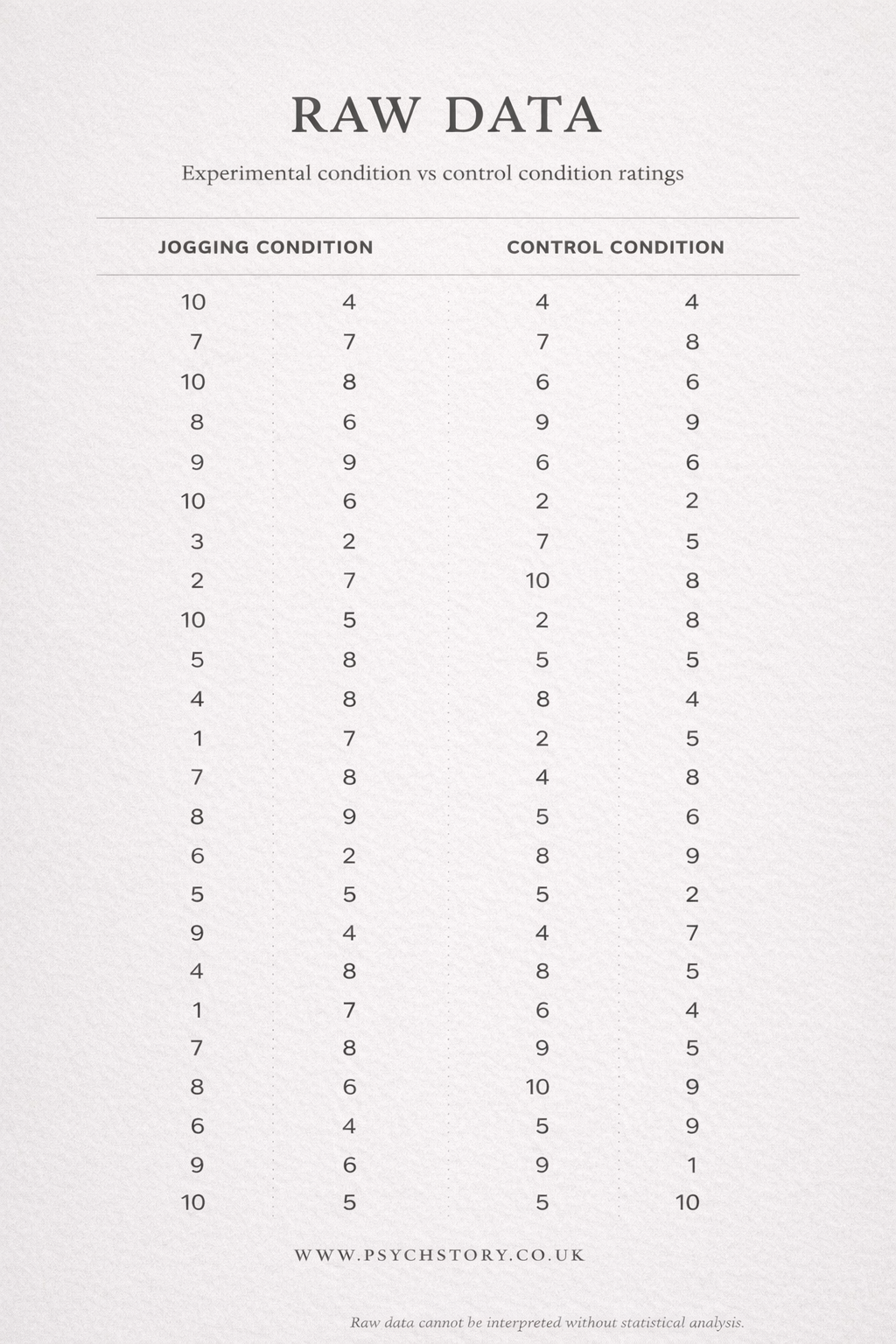
In the following example, Participants rated photographs of the opposite sex on a scale of attractiveness from 1 to 10. Participants were randomly assigned to two groups (an independent groups design). One group jogged on the spot for ten minutes while the other half performed the ratings without exercise. It was hypothesised that physical activity would increase ratings of attractiveness.
Below are the unprocessed responses from participants in both groups.
Q: Can you determine whether the hypothesis worked from reading the raw data below?
DATA VERSUS INFORMATION
Raw data in its original form is challenging to interpret and assess, making it difficult to determine the effectiveness of the hypothesis. The sheer volume of numbers presents complex, cumbersome information to analyse and understand.
A pivotal distinction is frequently underscored between the concepts of data and information:
Data is initially presented as raw, unprocessed numbers and facts, devoid of context or interpretative framework.
Conversely, information emerges through the methodical processing of data, thereby endowing it with context, relevance, and meaning.
COOKED DATA:
Raw data must undergo cleaning before any analysis. During this phase, anomalies, such as outliers, are carefully identified and removed, while errors in instrument readings or data entry are diligently corrected. This pivotal step is fundamental to preserving the integrity and accuracy of the data, paving the way for comprehensive analysis.
Applying descriptive statistics, such as means, medians, modes, ranges, and standard deviations, transforms processed data into descriptive data by summarising and methodically organising a dataset's characteristics, significantly enhancing comprehension.
WHAT IS QUALITATIVE DATA?
A straightforward approach to classifying data is to divide it into two main types: qualitative and quantitative.
Understanding Qualitative Research:
Qualitative research focuses on exploring the subjective aspects of human life, such as individuals' opinions, attitudes, motivations, and behaviours. It's primarily utilised for exploratory purposes, aiming to provide deep insights into complex issues or topics of interest. By investigating these areas, qualitative research helps reveal underlying trends, patterns, and hypotheses, which can later be examined more rigorously through quantitative methods.
Unlike quantitative data, which is numerical, qualitative data is non-numerical and cannot be measured by standard metrics.
Qualitative data captures the complex nuances of human experiences and attitudes through descriptive narratives. This type of research focuses on understanding the "why" behind human actions, thoughts, and feelings, relying on open-ended questions that allow participants to express themselves in their own words, whether verbally or in writing.
The core of qualitative research lies in its ability to explore the meanings people attribute to their experiences, emphasising the context and depth of those experiences over numerical analysis. It's particularly effective in uncovering trends, motivations, and deeper insights into social and cultural phenomena. For example, in studying the impact of chronic illness, qualitative research can reveal not just the physical effects but the emotional and social ramifications on a person's life.
A key aspect of qualitative research is its setting in the participants' natural environments, such as homes, schools, or workplaces. This approach helps researchers understand how individuals and groups interact with and make sense of their world in real-time, offering a rich, contextual understanding of their behaviours and decisions.
Qualitative research doesn't aim to predict outcomes but to describe and explain human experiences. An example of this could be a study on how families navigate the challenges of remote learning, providing insights into the strategies they develop, the obstacles they face, and the overall impact on family dynamics.
This method values the depth and quality of data over quantification, making it indispensable for studies requiring a deep dive into subjective experiences and social context.
QUALITATIVE QUESTIONS ARE OPEN-ENDED
Open-ended questions invite detailed, personalised responses, allowing individuals to express their thoughts and experiences without the limitations of predefined options.
For example:
Why did you start smoking?…………………………………………………………………………………………………………………………………………………………………………………
How do you describe your experience with social anxiety in social settings? …………………………………………..
What strategies do you employ to cope with stress during challenging times? …………………………………………...
Can you share your journey of recovering from a traumatic event? …………………………………………..
How has your perception of self-worth changed over time, and what influenced these changes? …………………………………………..
What role has family support played in your mental health journey? ……………………………………………………………
How do you manage work-life balance, and what challenges have you faced in achieving it? …………………………………………..
These questions are designed to elicit detailed responses, providing deep insights into individuals' experiences, coping mechanisms, and perceptions related to psychological well-being. The participant can share a comprehensive story or list of reasons in their own words, highlighting personal experiences, influences, or circumstances that led to their decision to start smoking.
In contrast, closed questions restrict answers to specific, pre-determined choices, limiting the depth of response but facilitating easier quantification and data analysis.
Below are some examples of closed questions using quantitative data:
"How much do you weigh?" (Measured in pounds or kilograms)
"How tall are you?" (Measured in feet and inches or centimetres)
"What is your IQ score according to a standardised IQ test?"
"How many minutes do you meditate each day?"
"How many hours per week do you spend on cognitive training exercises?"
"At what age did you start walking as a child?" (Measured in months)
"How many minutes does it take to fall asleep after going to bed?"
"How many new words do you learn on average per week?"
"How many pages can you read in an hour?"
"How often a week do you experience a dream you remember?"
IQS of students in a psychology class:: 145 150 100 105 120 89 99 135 146 120 116 1
TYPES OF QUALITATIVE DATA
Qualitative data can be in descriptions, narratives, words, meanings, clichés, colloquialisms, euphemisms, and conversations.


HOW CAN CLOSED QUESTIONS BE QUALITATIVE DATA?
TURNING OPINIONS INTO MATHS
The classification of data into qualitative or quantitative categories often hinges on the nature of the data—whether it's numeric and quantifiable or descriptive and categorical. Here's a clarification on how nominal and ordinal data fit within these definitions and why they are considered qualitative despite sometimes being presented in a structured or "closed" format:
Qualitative Data: This type of data describes attributes or characteristics that are not inherently numeric. Qualitative data is often textual or categorical, capturing observed rather than measured qualities. The key aspect of qualitative data is that it focuses on the elements' nature or quality rather than quantity.
Quantitative Data: This type involves numbers and values that can be measured and counted. It deals with quantities and includes anything that can be quantified, including amounts, volumes, sizes, and frequencies. Quantitative data allows for mathematical calculations and statistical analysis.
HOW NOMINAL AND ORDINAL DATA FIT IN
NOMINAL DATA: Although nominal data might be coded with numbers (e.g., 1 for male, 2 for female), these numbers do not hold mathematical value but are simply labels for categories. Using numbers is for convenience in data analysis rather than an indication of quantity or order. Hence, nominal data are qualitative because they describe categories or characteristics without implying quantitative measurement or inherent ranking.
Q: WHY DID YOU START SMOKING?
A: PEER-PRESSURE STRESS COPIED-SOMEONE-YOU-ADMIRED BOREDOM TO-LOSE-WEIGHT TO-LOOK-COOL OTHER
ORDINAL DATA: Ordinal data represent categories with a natural order or sequence (e.g., satisfaction levels, class ranks), but the intervals between these ranks are not necessarily equal or quantifiable. Although ordinal data appears closer to quantitative data because of its order, it remains qualitative at its core because the focus is on the order of categories rather than on precise measurement or distance between them. The numbers used in ordinal data rank order rather than measure exact quantities.
How much do you like Italian food? Please circle a response below
NOT AT ALL, NOT MUCH, IT’S OK, QUITE NICE. I LOVE IT
How much do you like Thai food? Please circle a response below
LEAST -1 2 3 4 5 6 7 8 9 10 - MOST
CLARIFICATION:
The distinction between qualitative and quantitative data doesn't solely depend on whether the data can be counted, but on what the data represents. Qualitative data, including nominal and ordinal data, can be structured or come in "closed" questions (e.g., multiple-choice questions and Likert scales for ordinal data). The categorisation as qualitative stems from the nature of the information these data types convey—qualities, characteristics, or categories—rather than numerical values or quantities that can be mathematically manipulated.
Thus, even though nominal and ordinal data might be organised to allow for counting (e.g., how many respondents chose each category), they are considered qualitative because they fundamentally describe characteristics or categories, not quantities.
THE STORY ABOUT DATA SO FAR
Qualitative data is non-numeric information. However, qualitative data must be turned into quantitative data for analysis. Qualitative data, which is non-numeric, can be coded quantitatively for analysis. However, this transformation doesn't alter its inherent qualitative nature but enables statistical evaluation. This ultimately means that all data is quantitative.
However, data with roots in the qualitative process are not considered real numbers, e.g., data derived from content analysis and thematic analysis.
Quantitative data are countable variables that contain numerical values.
Quantitative data can be split into two main types: discrete (or categorical) and continuous. Discrete data refers to countable, distinct categories, while continuous data involves measurements on a scale with no breaks, allowing any value within a range.