
ORIGINS OF PSYCHOLOGY
SPECIFICATION: Origins of Psychology: Wundt, introspection and the emergence of Psychology as a science.
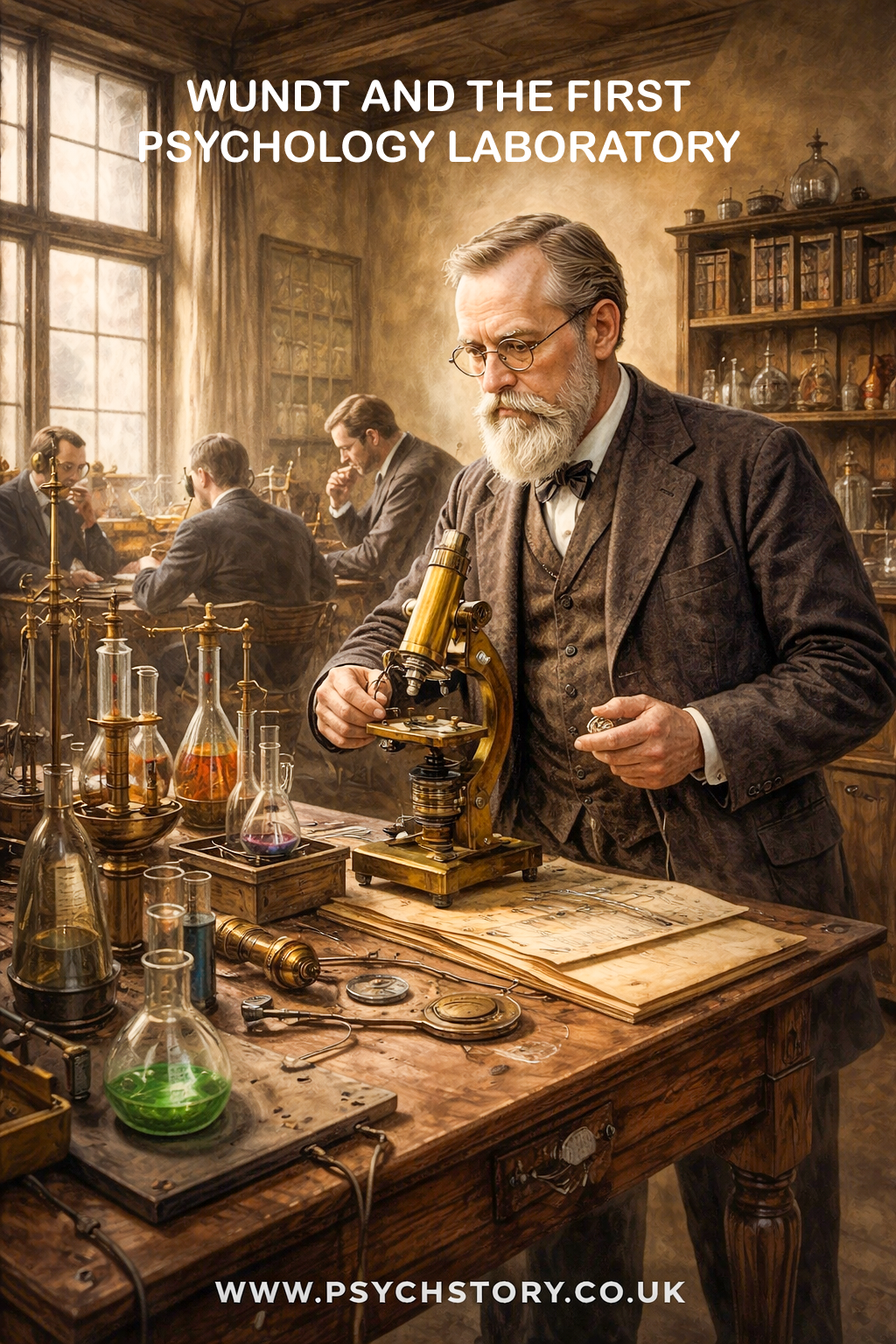
ORIGINS OF PSYCHOLOGY AQA A LEVEL: WILHELM WUNDT AND THE FIRST PSYCHOLOGY LABORATORY
Wilhelm Wundt is widely regarded as the founder of modern psychology because he established the first psychology laboratory in Leipzig, Germany, in 1879. This event marks psychology’s transition from philosophical speculation to scientific investigation.
Before Wundt, the study of the mind was dominated by philosophers who relied on logic and introspective reflection without experimental control. Wundt proposed that mental processes could be studied scientifically through observation under controlled laboratory conditions. His aim was to investigate conscious experience using systematic measurement.
WUNDT’S METHOD OF INTROSPECTION IN AQA PSYCHOLOGY
Wundt’s primary research method was controlled introspection. Participants were trained to report their immediate conscious experiences when presented with carefully standardised stimuli.
Key features of Wundt’s introspection:
• Participants Were Trained To Produce Consistent Reports
• Stimuli Were Standardised And Repeated
• Participants Reported Immediate Sensations Rather Than Interpretations
• Experimental Conditions Were Controlled
• Responses Were Timed And Quantified
For example, participants might listen to a metronome and describe the sensations experienced at the exact moment of hearing the sound, avoiding personal meaning or memory. Wundt believed consciousness could be broken down into basic elements, such as sensations and feelings, much as chemical compounds can be analysed into their elements.

HOW PSYCHOLOGY EMERGED AS A SCIENCE: WUNDT’S CONTRIBUTION
Wundt’s work established psychology as a science because it introduced core scientific principles:
• Use Of Laboratory Experiments
• Systematic Observation
• Measurement Of Behaviour And Mental Processes
• Controlled Variables
• Replication Of Procedures
His laboratory model spread rapidly across Europe and America and influenced later psychologists such as Edward Titchener.
EVALUATION AO3: STRENGTHS OF WUNDT AND INTROSPECTION
Wundt’s greatest contribution was methodological. He demonstrated that psychological processes could be studied empirically rather than philosophically. This gave psychology scientific credibility and allowed it to emerge as an independent academic discipline.
Importantly, Wundt introduced standardised procedures and experimental control. These principles underpin modern psychological research, including cognitive neuroscience and experimental cognitive psychology. Reaction time studies used today to investigate attention, perception, and decision-making are direct descendants of Wundt’s methods.
Another strength is that introspection represented an early attempt to operationalise internal mental processes. Rather than abandoning subjective experience entirely, Wundt attempted to make it measurable, bridging physiology and psychology.
EVALUATION AO3: LIMITATIONS OF INTROSPECTION
Despite attempts at control, introspection suffered from fundamental methodological problems.
• Subjective Reports Could Not Be Independently Verified
• Findings Often Lacked Reliability Across Participants
• Training Introduced Researcher Expectancy Effects
• The Method Was Limited To Conscious Experience Only
Because introspection relied on self-report, results depended heavily on interpretation. This reduced objectivity compared with later behavioural methods.
Additionally, introspection could not be used to study infants, animals or individuals with mental disorders. This restricted psychology’s scope and contributed to the later rise of behaviourism, which rejected introspection in favour of observable behaviour.
THE ROLE OF WUNDT IN THE EMERGENCE OF SCIENTIFIC PSYCHOLOGY
Although introspection itself was later abandoned, Wundt’s importance lies in establishing psychology’s scientific framework. Behaviourists rejected his method but retained experimental control, demonstrating that his methodological influence persisted.
Wundt therefore represents psychology’s starting point as a science. His laboratory model enabled later developments, including behaviourism, cognitive psychology and neuroscience.